
Quico Toro at Persuasion:
 The climate debate is in a strange place. We’re told we face an epochal, civilization-ending calamity within our lifetimes. But when scientists bring up unconventional new ways of managing that risk, we’re told we mustn’t even talk about them.
Why? Because, alas, some of their most promising ideas got slapped with the label “geoengineering”: a term so scary it seems to shut down people’s prefrontal cortex altogether.
The result is a weirdly misshapen public debate, where a strong taboo weighs over a whole branch of atmospheric science. Our climate debate refuses to acknowledge something top researchers now strongly suspect: that we could reverse global warming quickly and affordably using nothing scarier than sea salt.
The idea is called Marine Cloud Brightening (MCB). It would work by making clouds reflect more of the sun’s energy back out into space. As we speak, researchers are working on the basic science needed to figure out if it can really work at scale.
I’ve been talking to some of them.
More here.
Enjoying the content on 3QD? Help keep us going by donating now.
 Vice-Presidential debates are normally for the archives: the transcript gets recorded and then filed away. Strain your memory and try to recall: Who won the debate between John Edwards and Dick Cheney? Biden-Ryan? Even Harris-Pence, just four years ago? In the rush of the Presidential race, these events were simply speed bumps. The best way to approach Tuesday night’s version was with a certain measure of historically earned skepticism. Was there any reason to think that this Vice-Presidential debate would actually matter—would even be remembered—by Election Day, now a little more than a month away, when so few have in the past?
 Scientific breakthroughs rely on decades of diligent work and expertise, sprinkled with flashes of ingenuity and, sometimes, serendipity. What if we could speed up this process?
 The first time I tried to write this essay, I failed. It was the middle of the pandemic—a time in which uncountable numbers of introspective personal essays were written to no apparent end—and I watched Sans Soleil, director Chris Marker’s dreamlike 1983 travelogue. I was working at a marketing agency at the time, suffusing strategic briefs with literary ambition, and something about the way Marker’s film faded from documentary to sci-fi to philosophical reverie ignited long-dormant neurons in my brain. Sleeper cells dissatisfied with a life in service of internet content and client work assembled. They blew up access tunnels and sabotaged meeting preparation protocols. I wrote something big and haunted about my experience as a writer and intended to publish it, in an act of vainglorious career suicide, on LinkedIn.
 P
P I first met
 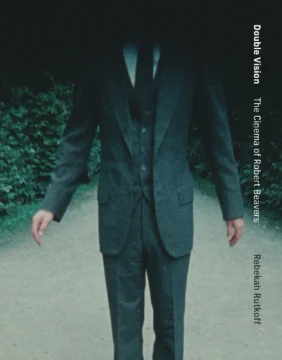 Though the history of experimental film is rife with iconoclastic visionaries, Robert Beavers somehow remains one of its under-sung heroes. Together with his partner, Gregory Markopoulos (1928–92), Beavers developed an approach to cinema defined by its singular and uncompromising rigor, yielding a body of work celebrated as much for its poetic beauty as its complex formal investigation of the filmmaking apparatus. While continuing to make films to this day, Beavers also helms the Temenos, an open-air theatre in Lyssaraia Greece, dedicated to screenings of Markopoulos’s sprawling magnum opus, Eniaios (1947–91).
 I
I W
W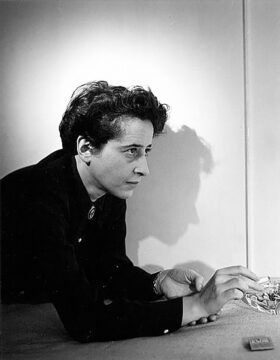 For a while there in the late nineties, it seemed to me like every other book of poetry that I flipped open in the bookstore was prefaced by an austere epigraph from the writings of Ludwig Wittgenstein. Plato, Rousseau, Nietzsche, Sartre, and Wittgenstein—for all their many differences—enjoy a special status as “poets’ philosophers” in the annals of literary history. Other lofty thinkers fly under poets’ collective radar; I have yet to come across a volume of verse prefaced by a quotation from David Hume. What makes some philosophers, and not others, into poets’ philosophers remains a mystery to me. But I’ve never really thought of Hannah Arendt as one of them.
 If a change of style is a change of subject, as Wallace Stevens averred, then a change of syntax is a change of meaning. Word order is, if not all, then nine tenths. I exaggerate, but I do so advisedly, as a corrective to the overemphasis on word choice, the unjust rule of the mot juste (recall here the old saying about the difference between lightning and a lightning bug) that dominates, to the detriment of other concerns, contemporary literature and creative writing. At times, this passion for the right—or the unusual—word reaps dividends; at others, it merely produces an uncalled-for flood of verbed nouns, portmanteaus, adjectives wrenched out of joint.
 I
I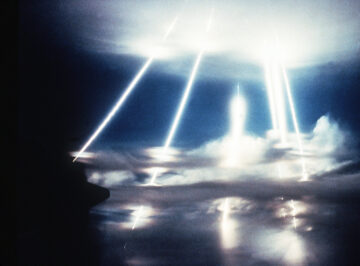 The key structure of the doctrine of nuclear deterrence is audible in the September 4, 2024, speech by U.S. Deputy Under Secretary of Defense Cara Abercrombie: “Any nuclear attack by the DPRK against the United States or its allies and partners is unacceptable and will result in the end of that regime.” The doctrine, which the United States has embraced since the Cold War, aims to prevent an adversary from launching a nuclear weapon by assuring that any first strike will be followed by a retaliatory second strike, whose effects will equal or exceed the original damage and may eliminate the adversary altogether. This annihilating reflex of deterrence is equally audible in the quiet words of the Department of Defense in its web page on “America’s Nuclear Triad,” its sea-based, land-based, and air-based delivery platforms: “The triad, along with assigned forces, provide 24/7 deterrence to prevent catastrophic actions from our adversaries and they stand ready, if necessary, to deliver a decisive response, anywhere, anytime.”