Reclaiming the Politics of Freedom

RobinCorey Robin in The Nation (via Zujaja Tauqeer):

Conservatives often complain that they’ve been exiled from power, whether in the corridors of the Capitol or the pages of the New York Times. Yet conservative ideas have dominated American politics for thirty years. The centerpiece of that dominance is the notion that the market equals freedom and government is the threat to freedom. Despite the Great Recession and election of Barack Obama, the most progressive candidate to win the presidency since 1964, that idea retains its hold. The ideological realignment we have been waiting for, in which that idea is repudiated, has yet to come.

One reason for the dominance of this idea is that since the ’70s, liberals and leftists have misidentified the source of conservatism’s appeal. Confident that no one short of a millionaire could endorse the right’s economic ideology, everyone from Clintonite centrists to radical populists has treated conservatism as essentially a politics of distraction and delusion. Conservatives, it’s said, are just good salespeople, wrapping their ugly wares in the pretty paper of the culture wars. The way to combat them is not to challenge their ideas or defend ours but to use prettier wrapping paper.

Instead of confronting the allure of the free market, as conservatives understand it, liberals have tried to co-opt the discourse of traditional values. Painting themselves as the new Victorians, they’ve claimed, We stand for thrift and family, God and country. We put people to work rather than on welfare. We don’t spend recklessly; we reduce the deficit. We provide security: not just the physical security of cops on the street, crooks behind bars and troops in Afghanistan but the economic security of shared risk and protection from risk. We stand for responsibilities over rights, safety over freedom, constraint rather than counterculture.

This strategy might have something to recommend it if it worked. But it hasn’t. When right-wing ideas dominate, we get right-wing policies. After the midterm elections in November, it seemed the most natural thing in the world—to the right, the media, Obama and parts of the Democratic Party—to freeze the pay of federal workers and extend the Bush tax cuts for two years. Incoherent as policy—the first presumes that the deficit is the greatest threat to the economy; the second, the lack of consumer spending—it makes sense as ideology. The best (and only) thing the government can do for you and the economy is to get out of your way.
HOW CULTURE DROVE HUMAN EVOLUTION

A conversation with Joseph Henrich in Edge:

Edge[JOSEPH HENRICH:] The main questions I've been asking myself over the last couple years are broadly about how culture drove human evolution. Think back to when humans first got the capacity for cumulative cultural evolution—and by this I mean the ability for ideas to accumulate over generations, to get an increasingly complex tool starting from something simple. One generation adds a few things to it, the next generation adds a few more things, and the next generation, until it's so complex that no one in the first generation could have invented it. This was a really important line in human evolution, and we've begun to pursue this idea called the cultural brain hypothesis—this is the idea that the real driver in the expansion of human brains was this growing cumulative body of cultural information, so that what our brains increasingly got good at was the ability to acquire information, store, process and retransmit this non genetic body of information. The two systems begin interacting over time, and the most important selection pressures over the course of human evolution are the things that culture creates—like tools. Compared to chimpanzees, we have high levels of manual dexterity. We're good at throwing objects. We can thread a needle. There are aspects of our brain that seem to be consistent with that as being an innate ability, but tools and artifacts (the kinds of things that one finds useful to throw or finds useful to manipulate) are themselves products of cultural evolution.

Another example here is fire and cooking. Richard Wrangham, for example, has argued that fire and cooking have been important selection pressures, but what often gets overlooked in understanding fire and cooking is that they're culturally transmitted—we're terrible at making fires actually. We have no innate fire-making ability. But once you got this idea for cooking and making fires to be culturally transmitted, then it created a whole new selection pressure that made our stomachs smaller, our teeth smaller, our gapes or holdings of our mouth smaller, it altered the length of our intestines. It had a whole bunch of downstream effects.

More here.

Murder in the Cathedral

From The New York Times:

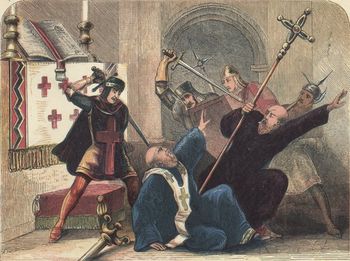
Beckett“The biographer’s trap,” John Guy remarks in “Thomas Becket,” his portrait of that foremost friend turned foremost foe of Henry II, “is to look for a decisive moment of change.” But, he adds, “to do that is to write the history of the saint without his shadow.” With ­Becket, this temptation often seems to have been irresistible, from the very night of his murder, Dec. 29, 1170, near the high altar of Canterbury Cathedral. As a crowd swooped down on the battered corpse of the archbishop, tearing off pieces of clothing to dip in the gruesome puddle of his blood and brains, the outlines of the story of Becket’s sudden conversion from ­luxury-loving chancellor to ascetic defender of the church were already being rehearsed, soon to be followed by tales of his miraculous powers. Although Guy is known as a historian of the Tudor period, he admits to a long-held fascination with the 12th century’s “extraordinary galaxy of larger-than-life characters.” And his previous book, “A Daughter’s Love: Thomas More and His Dearest Meg,” must have provided ample psychological grounding for this new one, tracing another struggle between an imperious, unscrupulous monarch, Henry VIII, and another stubborn commoner who found it impossible to bend to the royal will. In the case of Becket, Guy was also aided by an array of firsthand source materials, many of them biographies written by men who knew Becket themselves. Shrewdly contrasting them and assessing their biases, Guy has constructed his own modern successor, assisted by electronic search engines and high-resolution digital photography, which revealed previously invisible annotations in volumes from Becket’s personal library.

After almost 900 years, are there any shocking discoveries to be made? Was Becket, as an “impressionable teenager,” rather more than the fast friend and protégé of Richer de l’Aigle, a Norman aristocrat and dashing older man who introduced him to hawking and hunting and courtly manners? Guy assembles enough evidence to suggest that Becket’s mother (to whom he was very close) might have tried to separate the pair by sending her son to Paris for schooling. But he hedges his bet, arguing that the adult Becket “could not have been homosexual” because Henry would have used this as evidence in the course of their deeply acrimonious public feud.

More here.

Saturday Poem

Become Becoming
.
Wait for evening.
Then you’ll be alone.
.
Wait for the playground to empty.
Then call out those companions from childhood:
.
The one who closed his eyesand pretended to be invisible.
The one to whom you told every secret.
The one who made a world of any hiding place.
.
And don’t forget the one who listened in silence
while you wondered out loud:
.
Is the universe an empty mirror? A flowering tree?
Is the universe the sleep of a woman?
.
Wait for the sky’s last blue (the color of your homesickness).
Then you’ll know the answer.
.
Wait for the air’s first gold (that color of Amen).
Then you’ll spy the wind’ barefoot steps.
.
Then you’ll recall that story beginning with a child who strays in the woods.
The search for him goes on in the growing shadow of the clock.
.
And the face behind the clock’s face
is not his father’s face.
.
And the hands behind the clock’s hands
are not his mother’s hands.
.
All of Time began when you first answered
to the names your mother and father gave you.
.
Soon, those names will travel with the leaves.
Then, you can trade places with the wind.
.
Then you’ll remember your life as a book of candles,
each page read by the light of its own burning.
.
.
by Li-Young Lee
from Behind My Eyes

Emrys Westacott on Philosophy and Everyday Living

Interview by Sophie Roell in The Browser:

25rude_CA1.450Your own book, The Virtues of our Vices makes, I think, a brilliant case for applying philosophy to everyday living, because, as you point out in the introduction, apparently trivial things – like a colleague being rude to us – have a much bigger impact on us on a day-to-day basis than ruminations on the meaning of life.

A lot of philosophy concerns fairly theoretical issues – the correct definition of concepts like justice, the relation between mind and body, or the nature of the soul. These are problems that have been inherited down the years from Plato and Aristotle, Descartes and Kant. There is another tradition which sees philosophy as a reflection on life. This includes discussion of ethical problems that we face, but also focuses on the way we conduct ourselves, the way we live, the way we relate to each other. I see my book as a contribution to that tradition. Not so much an attempt to solve complex metaphysical problems, or problems in the theory of knowledge or the philosophy of mind, but a reflection on the way we live.

Do you feel this side of philosophy has been neglected?

I do. In one of the books I’ve chosen, The Guide to the Good Life: The Ancient Art of Stoic Joy, William Irvine makes this very explicit. In ancient times, Plato and Aristotle and other philosophers did deal with theoretical problems, but the Greeks and the Romans understood philosophy as something that people had and used in everyday life, and there were competing schools of philosophy.

More here.

How Bill Clinton ad-libs his way to a winning speech

David Kusnet at CNN:

By one account, the former president spoke for 48 minutes and 5,895 words, while his prepared text, which had been distributed beforehand to the media, was only 3,136 words. No wonder, when asked about her husband's speech, Secretary of State Hillary Clinton said she was looking forward to comparing the “as prepared” and “as delivered” texts.

Reviewing each version, it's clear that the same person wrote both — the same president who improvised 20% of his first State of the Union address and explained his health-care plan from memory to a joint session of Congress after the teleprompter displayed the text of an earlier speech.

Clinton's improvisations are instructive because they show how the nation's most popular political figure (69% approval rating, according to a USA Today/Gallup poll) still serves as extemporizer-in-chief. While most speakers ad-lib anecdotes, Clinton also explains complex issues off-the-cuff.

More here. And here's the full speech from the DNC:

Dispatches From ‘Tumorland’

Chris Lehmann in the Los Angeles Review of Books:

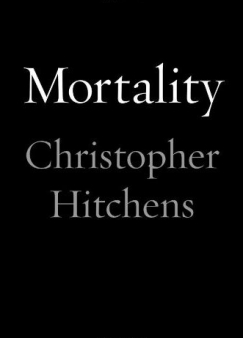
1346436019Mortality is not the sustained Socratic mediation on the human condition that the title might suggest. It is, rather, made up largely of just this sort of carefully reported, drily ironic dispatches from the sick country (or “Tumorland,” as Hitchens comes to call it) — meticulously recording both the physical symptoms of rapidly encroaching decay, and the feeble human effort to assimilate them into whatever semblance of a recognizably normal life may still remain. At its heart, this slender volume is a prolonged and painful study in cognitive dissonance, as the robust, high-living and (yes) terminally witty Hitchens records the galloping dissolution of his health and consciousness — the two things that humans almost have to take for granted in order to function in any reliable fashion. If, as Montaigne famously said (by way of Cicero) “to study philosophy is to learn to die,” Mortality is a crash course in lived philosophy, without benefit of abstraction or metaphysical speculation.

More here.

Friday, September 7, 2012

The Weatherman Is Not a Moron

09weather-articleLargeAn article adapted from Nate Silver's The Signal and the Noise: Why So Many Predictions Fail — but Some Don’t, in the NYT Magazine [h/t: Jennifer Ouellette]:

From the inside, the National Centers for Environmental Prediction looked like a cross between a submarine command center and a Goldman Sachs trading floor. Twenty minutes outside Washington, it consisted mainly of sleek workstations manned by meteorologists working an armada of flat-screen monitors with maps of every conceivable type of weather data for every corner of the country. The center is part of the National Weather Service, which Ulysses S. Grant created under the War Department. Even now, it remains true to those roots. Many of its meteorologists have a background in the armed services, and virtually all speak with the precision of former officers.

They also seem to possess a high-frequency-trader’s skill for managing risk. Expert meteorologists are forced to arbitrage a torrent of information to make their predictions as accurate as possible. After receiving weather forecasts generated by supercomputers, they interpret and parse them by, among other things, comparing them with various conflicting models or what their colleagues are seeing in the field or what they already know about certain weather patterns — or, often, all of the above. From station to station, I watched as meteorologists sifted through numbers and called other forecasters to compare notes, while trading instant messages about matters like whether the chance of rain in Tucson should be 10 or 20 percent. As the information continued to flow in, I watched them draw on their maps with light pens, painstakingly adjusting the contours of temperature gradients produced by the computers — 15 miles westward over the Mississippi Delta or 30 miles northward into Lake Erie — in order to bring them one step closer to accuracy.

What Happens in Patna, Stays in Patna?

17-Bihar-IndiaInk-blog480Amitava Kumar in the NYT's India Ink:

When the travel writer Trevor Fishlock went to my hometown of Patna, a journalist greeted him by saying, “Welcome to hell.” A few days later, that particular journalist, who had been zealous in his defense of the freedom of the press, was beaten unconscious.

I read the above story in a piece by Norman Lewis titled “Through the Badlands of Bihar.” But it is not only Western visitors like Mr. Fishlock and Mr. Lewis who portray Patna thus. If you have been keeping track of recent Bollywood movies, the badlands of Bihar have become fertile ground for reaping cinematic violence.

I am writing a book about Patna where I want to present what the people who live there think about it. A part of me believes that Patna might be the victim of bad press. Did you know, for instance, that somewhere in the dark recesses of history, Patna produced the best opium?

I remember making this discovery when I stood on a treadmill in a steamy gym in Florida. Bending down, I looked at what had drawn my attention. The picture in the glossy magazine left open on the treadmill showed swarthy, dhoti-clad men at work in an immense hall, arranging in neat lines circular mounds of — what?

The text above the picture offered a clue: “Connoisseurs, he says, argue as to the source of the finest opium. Some say the best opium comes from Patna, India, along the southern bank of the Ganges.”

Anything good is so rarely said about Patna that my seldom-exercised heart burst with joy. I stole the magazine from the gym. And on returning home, I cut out the picture and the text and stuck it in my notebook.

That was 12 years ago. I have unearthed my notebook now because I have been seized by a simple idea. I am currently in Patna to see my parents. I would like to post flyers on the city’s busy roads that ask, “Does the best opium still come from Patna?”

The Undercities of Karachi

Jan Breman in New Left Review [h/t: Tunku Varadarajan]:

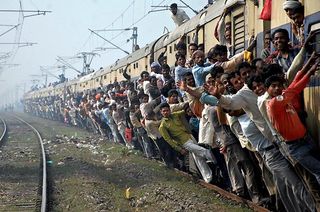
The largest port on the Arabian Sea, Karachi today has a population over 20 million, on a par with Mumbai, and ranks as the world’s eighth biggest city. Commanding the north-east quadrant of the ocean, with a hinterland stretching up the Indus Valley to Afghanistan, it has been the principal entry-point for US arms and supplies in the ‘war on terror’, while refugees—and heroin—have flowed in the opposite direction. From the bloodstained birth of Pakistan with the Partition of British India, the city’s explosive growth has more often been fuelled by the ‘push’ of geopolitical, agrarian and ecological crises than by the ‘pull’ of economic development. Life in its sprawling katchi abadis, or ‘unpaved settlements’, has much in common with that of other giant undercities, such as Mumbai’s, with the exception that violence plays a significantly greater role here. The vast majority of Karachiites are not only entangled in competition with each other, in a desperate struggle for survival, but must also contend with a brutal climate of aggression fuelled by gangsterized political groupings, the most influential of which also control the armed force of the state. In what conditions do its inhabitants live and what could drive increasing numbers of newcomers to try to survive here?

On the eve of Independence in 1947, the seaport of Karachi had fewer than half a million inhabitants, mostly Hindus, living within the old city walls or in fishing villages along the coast. The British had built up the docks and warehouse districts, constructed a military cantonment and laid out tree-lined streets for themselves to the south of the ‘native’ city, areas still known as Clifton and Defence. Partition led to an exodus of some of the city’s Hindus to India, and the arrival from that country of a much larger number of Muslims: around half a million Urdu-speaking Mohajirs (refugees), who abandoned property and possessions south of the new border to flee to what was now the capital of Pakistan.

The conquest of space

1346244500251

The phrase comes up again and again as I sift through dozens of Soviet documents of the period. By 1986 the ardent years of the Space Age were of course over, its most notable vestiges a few space stations orbiting Earth, but the embers still retain a beguiling, and decidedly nostalgic, glow. In East Berlin especially there has always been a great habitation of the sky: the television tower in Alexanderplatz, often beheaded by fog, the stately socialist buildings lining Karl Marx Allee, In East Berlin especially there has always been a great habitation of the sky . . . the less elegant prefabricated tower blocks farther east . . . That same summer of ’86 I crossed Checkpoint Charlie and in a bookstore on Friedrichstrasse, one of East Berlin’s most important arteries, I met my friend Stefan. Born in Moscow, where he lived until the age of eight, he spoke, among other things, about his Russian grandfather Ivan Ivanovich Bryanov, who in the late fifties and early sixties had been doctor to the Soviet cosmonauts, endeavouring to cure them of their more terrestrial ailments.

more from Chloe Aridjis at Granta here.

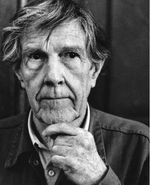
“I have nothing to say, and I am saying it.”

John-Cage

The line, probably John Cage’s most famous statement, appears three times over in his book Silence, which Wesleyan University Press has reissued in a smart fiftieth anniversary edition that also coincides with the centenary of the author’s birth. A self-devouring paradox, Cage’s modest avowal neatly draws attention to the impossibility of saying nothing, for once a frame of communication has been set up, be that frame a book or a musical score, a sheet of paper mounted in a gallery space or a performance scheduled in a concert hall (and Cage worked in all these media), emptiness will speak. It does so in 4’ 33”, probably Cage’s most famous musical statement, which, being entirely silent, offers clear proof that nothing is never simply nothing. The piece is the vanishing point towards which Cage’s forebears Webern and Satie were tending in their reduction of means; it is a space within which members of the audience can react, and others hear that reaction; it is an invitation to pay attention to what is normally unvalued (perhaps the sound of air conditioning or traffic outside); it is a provocation; it is a joke; and, perhaps ideally, it is an opportunity to listen to silence as keenly as we listen to (other) music.

more from Paul Griffiths at the TLS here.

brighton beach and the J-1s

Movie-sotre

Walk down Brighton Beach Avenue and you’ll see that between the glossy stores selling Russian speciality foods there are now cheap but buzzing Turkish hairdressers, Indian groceries, Chinese nail parlours. These are the newest immigrants, the ones just off the boat. Russians have stopped coming in big numbers – there’s just a steady stream known as the ‘J-1s’. J-1s are non-immigrant visas issued to students. Many try to extend their visas into more permanent ones, and the term ‘J-1’ has become a synonym for pretty Russian girls allegedly desperate to stay in America. ‘You must come to such-and-such a party,’ Little Russia Romeos tell me, ‘it’ll be full of J-1s.’ The J-1s live in crowded apartments, sleep on mattresses and are regularly ripped off by landlords. A few lucky ones get to help Bella sell flowers: she gives them free board at her house and they babysit the kids in return. One of them, Oksana, a psychology student in Lvov, was at Cosmos carrying bouquets in a basket like Eliza Doolittle. She was born in 1992, and is bemused by Little Russia. ‘It’s so Soviet. Or what I imagine the Soviet Union was like. Lvov is so much more European and modern.’

more from Peter Pomerantsev at the LRB here.

We need books to stoke the fires of imagination

From The Independent:

A gloriously uplifting tale has crossed my desk, and there's so much guff and depressing nonsense in the news just now that I thought it only decent and proper to report it. At St Cuthbert and St Matthias Church of England Primary School in Earls Court, West London, yesterday afternoon, Lady Borwick, deputy mayor of the Royal Borough of Kensington and Chelsea, opened a new library. It was the culmination of an inspirational campaign by school governors.

Despite its location and denomination, the school's intake is more than 70 per cent Muslim, with a large chunk of Buddhists, Hindus and Catholics thrown in. About 80 per cent of pupils have English as their second language; at least 26 languages are spoken across the school (Arabic mainly); and more than half the 220 or so pupils are on free school meals. They have had 20 volunteer readers for five years, but because so many parents do not speak English well, the governors decided they needed a library. So they started fundraising – selling cakes and running stalls at a fair, lobbying the council for a double-size portable cabin, squeezing contacts for funds – some Eton old boys gave £1,000; two private trust funds gave £2,000 each – and running up and down mountains for sponsorship. Best of all, the librarian at St Paul's prep school, Colet Court, arranged for some of her pupils to deliver new books. The significance of efforts such as these can hardly be overstated. A perfect sentence or memorised poem is a friend for life; and just think what fires will blaze in the imaginations of these inner-city kids now they have a library. What an unspeakably delicious prospect.

More here.

Distance record set for quantum teleportation

From MSNBC:

Physicists say they have “teleported” quantum information farther than ever before. This kind of teleportation isn't quite what Scotty was “beaming up” on television's Star Trek, but it does represent a kind of magic of its own. While Star Trek's teleporters transport people from place to place instantaneously, quantum teleportation sends information. A team of scientists from Austria, Canada and Germany say they beamed the quantum state of a particle of light from one island to another 89 miles (143 kilometers) away. “One can actually transfer the quantum states of a particle — in our case a photon — from one location to another location without physically transferring this photon itself,” explained physicist Xiaosong Ma of the Institute for Quantum Optics and Quantum Information at the Austrian Academy of Sciences in Vienna. To do this, the researchers started out with three particles: one particle to be teleported, and two “entangled” particles. Entanglement is one of the most bizarre implications of the theory of quantum mechanics, which governs the physics of tiny particles. When two particles are entangled, they become connected in such a way that, even if separated over vast distances, an action performed on one affects the other.

In the recent experiment, all three photons started out on the island of La Palma, one of the Canary Islands off the coast of Spain. One of the entangled photons was then sent through the air 89 miles to the Canary Island of Tenerife. Since the particles were entangled, when a measurement was made of the quantum states of the two particles on La Palma, it affected the particle on Tenerife, too, allowing the first particle to be essentially re-created in a new location without traversing the distance. [Stunning Photos of the Very Small] This achievement beat the previous quantum teleportation distance record of 60 miles (97 kilometers), reported by a Chinese research group months ago. It represents a significant step toward establishing a “quantum Internet” that could allow messages to be sent more securely, and calculations to be completed more quickly, scientists say.

More here.

Thursday, September 6, 2012

3 Quarks Daily 2012 Philosophy Prize: Vote Here

Dear Reader,

Thanks very much for participating in our contest. For details of the prize you can look at the announcement here, and to read the nominated posts you can go here for a complete list with links.

If you are new to 3 Quarks Daily, we welcome you and invite you to look around the site after you vote. Learn more about who we are and what we do here, and do check out the full site here. Bookmark us and come back regularly, or sign up for the RSS feed. If you have a blog or website, and like what you see here, we would very much appreciate being added to your blogroll. Please don’t forget!

Voting ends on September 14 at 11:59 pm NYC time.

Results of the voting round (the top twenty most voted for posts) will be posted on the main page on September 17, 2012. Winners of the contest will be announced on or around September 24, 2012.

Now go ahead and submit your vote below!

PLEASE BE AWARE: We have multiple ways of detecting fraud such as multiple votes being cast by the same person. We will disqualify anyone attempting to cheat.

Cheers,

Abbas