Europe on the verge of a nervous breakdown

Richard Evans in New Statesman:

FasA spectre is haunting Europe: the spectre of unemployment. At the latest count, there were almost 25 million people in the member states of the European Union without a job, an increase of two million on the same point in the previous year. This is well over 10 per cent of the workforce, and in some countries the situation is much worse. At the top of the list is Spain, with 25 per cent unemployed, followed by Greece, with nearly 23 per cent. Particularly hard-hit are the young. In Greece and Spain more than half the workforce below the age of 25 is without a job. The youth unemployment rate across the EU is running at 22 per cent. And there are no signs of the upward trend being reversed.

At the same time, openly neo-Nazi parties are on the rise. In Greece, the Golden Dawn movement shot from nowhere to win 21 seats in the legislature at the May election and 18 in the rerun election a few weeks later, attracting nearly 7 per cent of the popular vote. The party’s flag is black, white and red, like that of the original Nazi Party in Germany, with a swastika-like emblem at the centre (Golden Dawn denies any resemblance and claims that the symbol is a “Greek meander”). Not only has it issued threats of violence against parliamentary deputies who oppose its policies but it has also been involved in numerous violent incidents across Greece. During the campaign, television viewers were treated to the spectacle of a party spokesman assaulting two female politicians during a live debate. In 2012, it campaigned on the election slogan “So we can rid this land of filth”.

More here.

Why Do We Say That Someone is “Hot”?

From Scientific American:

HotWhat do a chilly reception, a cold-blooded murder, and an icy stare have in common? Each plumbs the bulb of what could be called your social thermometer, exposing our reflexive tendency to conflate social judgments—estimations of another’s trust and intent — with the perception of temperature. Decades of fascinating cross-disciplinary studies have illuminated the surprising speed, pervasiveness and neurobiology of this unconscious mingling of the personal and the thermal.

The blurring of ‘heat’ and ‘greet’ is highlighted in a recent experiment by Ohio University’s Matthew Vess, who asked whether this tendency is influenced by an individual’s sensitivity to relational distress. They found that people high in the psychological attribute called attachment anxiety (a tendency to worry about the proximity and availability of a romantic partner) responded to memories of a relationship breakup with an increased preference for warm-temperature foods over cooler ones: soup over crackers. Subjects low in attachment anxiety — those more temperamentally secure — did not show this “comfort food” effect. In a related part of the same experiment, subjects were asked to reconstruct jumbled words into sentences that had either cold or warm evocations. (Sentence reconstruction tasks involving specific themes are known to unconsciously influence subsequent behavior.) After being temperature-primed, Vess’s subjects rated their perceptions of their current romantic relationship. As in the first condition, subjects higher in attachment anxiety rated their relationship satisfaction higher when prompted with balmier phrases than with frosty ones.

More here.

Wednesday Poem

Grammar

Maxine, back from a weekend with her boyfriend,
smiles like a big cat and says
that she's a conjugated verb.
She's been doing the direct object
with a second person pronoun named Phil,
and when she walks into the room,
everybody turns:

some kind of light is coming from her head.
Even the geraniums look curious,
and the bees, if they were here, would buzz
suspiciously around her hair, looking
for the door in her corona.
We're all attracted to the perfume
of fermenting joy,

we've all tried to start a fire,
and one day maybe it will blaze up on its own.
In the meantime, she is the one today among us
most able to bear the idea of her own beauty,
and when we see it, what we do is natural:
we take our burned hands
out of our pockets,
and clap.

by Tony Hoagland
from Donkey Gospel, 1998
Graywolf Press, St. Paul, Minn.

The 11 Ways That Consumers Are Hopeless at Math

Derek Thompson in The Atlantic:

ScreenHunter_03 Jul. 11 10.59You walk into a Starbucks and see two deals for a cup of coffee. The first deal offers 33% extra coffee. The second takes 33% off the regular price. What's the better deal?

“They're about equal!” you'd say, if you're like the students who participated in a new study published in the Journal of Marketing. And you'd be wrong. The deals appear to be equivalent, but in fact, a 33% discount is the same as a 50 percent increase in quantity. Math time: Let's say the standard coffee is $1 for 3 quarts ($0.33 per quart). The first deal gets you 4 quarts for $1 ($0.25 per quart) and the second gets you 3 quarts for 66 cents ($.22 per quart).

The upshot: Getting something extra “for free” feels better than getting the same for less. The applications of this simple fact are huge. Selling cereal? Don't talk up the discount. Talk how much bigger the box is! Selling a car? Skip the MPG conversion. Talk about all the extra miles.

There are two broad reasons why these kind of tricks work. First: Consumers don't know what the heck anything should cost, so we rely on parts of our brains that aren't strictly quantitative. Second: Although humans spend in numbered dollars, we make decisions based on clues and half-thinking that amount to innumeracy.

More here.

Think Again: India’s Rise

Sumit Ganguly in Foreign Policy:

ScreenHunter_02 Jul. 11 10.54On foreign policy, India has shown growing global aspirations — and capabilities. It is the fifth-largest player in the reconstruction of war-ravaged Afghanistan, and its reach extends well beyond its neighborhood. At the recent G-20 summit in Los Cabos, Mexico, Prime Minister Manmohan Singh pledged $20 billion to an endowment designed to shore up the IMF's lending capacity.

Unfortunately, the fascination with India's growing economic clout and foreign-policy overtures has glossed over its institutional limits, the many quirks of its political culture, and the significant economic and social challenges it faces. To cite but one example, at least 30 percent of Indian agricultural produce spoils because the country has failed to develop a viable supply chain. Foreign investors could alleviate, if not solve, that problem. But thanks to the intransigence of a small number of political parties and organized interest groups, India has refused to open its markets to outsiders. Until India can meet basic challenges like this, its greatness will remain a matter of rhetoric, not fact.

More here.

We mustn’t allow Muslims in public life to be silenced

Mehdi Hasan in The Guardian:

ScreenHunter_01 Jul. 11 10.26Have you ever been called an Islamist? How about a jihadist or a terrorist? Extremist, maybe? Welcome to my world. It's pretty depressing. Every morning, I take a deep breath and then go online to discover what new insult or smear has been thrown in my direction. Whether it's tweets, blogposts or comment threads, the abuse is as relentless as it is vicious.

You might think I'd have become used to it by now. Well, I haven't. When I started writing for a living, I never imagined I'd be the victim of such personal, such Islamophobic, attacks, on a near-daily basis. On joining the New Statesman in 2009, I was promptly subjected to an online smear campaign, involving a series of selectively edited videos of speeches I'd delivered in front of groups of Muslim university students several years ago. I was accused of being a “secret” member of the extremist group Hizb ut-Tahrir, and a “dangerous Muslim shithead” in the “same genre” as the Nazis. The post that sticks in my mind is from the blogger who referred to me as a “moderate cockroach” whose Islamic faith was “no different from the Islam of Abu Hamza, Abu Qatada, Ayman al-Zawahiri, Anjem Choudary or any of the 'tiny minority' of Islamic terrorists who believe that Islam must dominate, no matter what the cost”.

Three years later, as I leave the New Statesman to join the Huffington Post UK, little seems to have changed. “Huffington Post's new UK political director brings pro-Iran baggage,” screamed the headline on the Fox News website back in late May. My “baggage”? I once publicly praised a fatwa from Iran's supreme leader, Ayatollah Ali Khamenei, forbidding the production of nuclear weapons. Shame on me! Another ultra-conservative US news website, the Washington Free Beacon, referred to me as the “HuffPo's house jihadi”.

More here.

Tuesday, July 10, 2012

FATA is not a country in Africa

Slightly old, but a very insightful piece from Myra MacDonald at Reuters:

FATAU.S. Defense Secretary Leon Panetta is using increasingly forthright terms to describe the spillover of the war in Afghanistan into Pakistan’s Federally Administered Tribal Areas (FATA) in its campaign of drone strikes. “We are fighting a war in the FATA, we are fighting a war against terrorism,” he said during a visit to India. The idea that the United States is at war inside Pakistan, albeit in its tribal areas bordering Afghanistan, is not new. But the use of language is significant, requiring as Spencer Ackerman noted at Danger Room, “a war-weary (US) public to get used to fighting what’s effectively a third war in a decade, even if this one relies far more on remote controlled robots than ground troops”.

Panetta’s choice of words (and venue for delivering them) may not go down too well with Pakistani authorities in Islamabad/Rawalpindi. It is not particularly promising for the people of FATA either, who find themselves caught in the middle of a shadow war between the United States and Pakistan. But in one respect, it is not necessarily a bad thing. Rarely has the United States fought a war in a place about which it knows so little. If Panetta’s comments force people to learn about FATA, it might even lift us out of what until now has been a polemical debate between supporters and opponents of drone strikes, with little attention paid to the voices of people who actually live there.

For a start, we have to understand that not only are those voices not heard, but they are actively marginalised. For the U.S. administration, arguing that drone attacks are legal, ethical and wise, and a complicit U.S. public, the people on the ground are best dismissed as turbaned, bearded dangerous folks living in “the tribal badlands” (a phrase that really ought to be banned along with “Graveyard of Empires” and “the Great Game”.) For opponents of drones in Pakistan, their voices are marginalised by a virulent strain of anti-Americanism through which political popularity or greater bargaining power in negotiations with the United States can best be attained by whipping up rage about the drone strikes.

Read the rest here.

love hurts

ID_BS_CRISP_LOVEH_AP_001

We are working under the delusion that we somehow fixed society with feminism or whatever. We’ve removed the traditional barriers to marriage based on anything other than true love. Because women can earn their own living, they no longer have to consider the economic status of their mate. We are a more racially tolerant society, and so we no longer have to restrict our choices by race. Class stratifications have disappeared from the dating scene; the words dowry and salary do not come up in negotiations. We only have to listen to our hearts to know what we want. And then we just have to find it. If that were true, if we truly had removed all societal pressures from our relationships, then why are so many miserable singles looking for love? So many women harassed by the ticking of their biological clocks, unable to find men to father their children? So many submissions every week to the Modern Love column?

more from Jessa Crispin at The Smart Set here.

the floating world

00033348_007

Every element in a Japanese painting has symbolic value, chosen for its auspicious nature. Catalogue entries that describe a work merely as ‘birds and flowers’ entirely miss the point. Specific creatures have specific meanings and are associated with particular plants and seasons. Cranes go with pines, tortoises with bamboo, and all four signify long life. Screech quotes a humorous poem to the effect that the inept artist adds bamboo to an image so that the viewer will know that the animal in his picture is a tiger, not a cat. Tigers went with bamboos, cats with peonies. While the Kanō were the official painters of the shogunate, the Tosa worked for the emperor’s court in Kyoto. The court’s power had been wrested away by the shogunate centuries earlier. Its entire claim to reverence was that it perpetuated classical Japanese tradition. The Tosa painted scenes of the exquisite world of the ancient court. The snag was that the most revered classics, The Tale of Genji and The Tales of Ise, depict lives of utter decadence. Genji the Shining Prince spends his time seducing court ladies, while Narihira, the hero of The Tales of Ise, defiles the virgin priestess of Ise Shrine.

more from Lesley Downer at Literary Review here.

Tragic is too big a word for me

Borges_eyes_shut

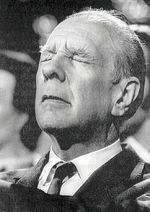
By his last years Jorge Luis Borges (1899–1986) was often seen as a skeptic. Michel Foucault began Les mots et les choses (1966, published in English as The Order of Things) by acclaiming him for having defied certainty and demolished every familiar landmark of knowledge, since everything “bears the stamp of our age and our geography.” Foucault cited something Borges claimed to have found once in an old Chinese encyclopedia, a hilarious taxonomy of animals using the following categories: those belonging to the emperor, those that are embalmed, those that are tame, sucking pigs, sirens, stray dogs, et cetera. That was impressively credulous of Foucault, since Borges (as I once heard him say) often made up his quotations: “One is allowed to change the past.” Among the literal minded, however, his reward was to be thought to have sounded the death knell of all human hopes to know the world or to understand our place in it.

more from at The American Scholar here.

A bitter struggle over the origins of kindness

Eric Michael Johnson in Scientific American:

ScreenHunter_40 Jul. 10 14.55What would it take for you to give your life to save another? The answer of course is two siblings or eight cousins, that is, if you’re thinking like a geneticist. This famous quip, attributed to the British biologist J.B.S. Haldane, is based on the premise that you share on average 50% of your genes with a brother or sister and 12.5% with a cousin. For altruism to be worth the cost it should ensure that you break even, genetically speaking.

This basic idea was later formalized by the evolutionary theorist William Hamilton as“inclusive fitness theory” that extended Darwin’s definition of fitness–the total number of offspring produced–to also include the offspring of close relatives. Hamilton’s model has been highly influential, particularly for Oxford evolutionary biologist Richard Dawkins who spent considerable time discussing its implications in his 1976 book The Selfish Gene. But in the last few years an academic turf war has developed pitting the supporters of inclusive fitness theory (better known as kin selection) against a handful of upstarts advocating what is known as group selection, the idea that evolutionary pressures act not only on individual organisms but also at the level of the social group.

The latest row was sparked by the publication of Edward O. Wilson’s new book, The Social Conquest of Earth, which followed up on his 2010 paper in the journal Naturewritten with theoretical biologists Martin Nowak and Corina Tarniţă.

More here.

A gorgeously wackadoodle book

Carolyn See in the Washington Post:

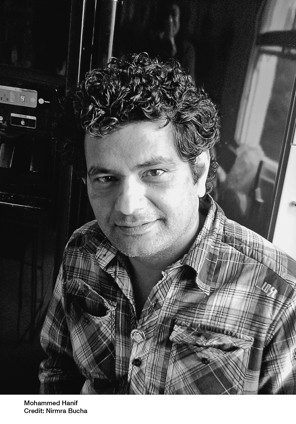
Books0713see2After reading “Our Lady of Alice Bhatti,” I Googled Mohammed Hanif to see what kind of person would write such a gorgeously wackadoodle book. I found an essay Hanif wrote to explain why he had decided to return to Pakistan with his wife and young son from London, where he had been staying for more than a decade. The essay shows us a rather aristocratic gentleman with a bit of a let-them-eat-cake attitude about the circumstances of everyday life. Pakistan has better schools and better domestic help, and as for the electricity being turned off for 10 hours at a time, you can always buy your own generator; if the food in the fridge goes bad, go out to a restaurant. Hanif is an accomplished young man, a former air force pilot and a working journalist, and “Alice Bhatti” is his second novel, on the heels of “A Case of Exploding Mangoes,” which was longlisted for the Booker Prize .

It’s as though a different person entirely wrote “Our Lady of Alice Bhatti.” The author of this novel is plainly a wild man, and since the radical edge of the Islamic world isn’t shy about threatening people who make fun of its religion, he must be a man of enormous courage. Even though he extolled Pakistan in that personal essay, here he doesn’t just bite the hand that feeds him — he chews it up.

More here.

The Ghosts of Edward Saïd

Vladislav Davidzon in Tablet:

ScreenHunter_38 Jul. 10 13.37Walking through the astounding new show “Les Juifs dans l’orientalisme”—“The Jews in Orientalism”—in Paris, it is impossible to avoid the ghostly accompanying presence of the late Edward Saïd, who turned the term “Orientalism” into a curse against the West and a political weapon in the service of his people. Hung in the elegant halls of the three-and-a-half-century-old Hôtel de Saint-Aignan, home of the Musée d’Art et d’Histoire du Judaïsme (which by common acclaim has the most interesting programming of any Jewish museum in Europe), the show charts the European encounter with the Sephardic Jewish communities of Northern Africa and the Mediterranean rim at the beginning of the 19th century. Would Saïd, the great scourge of Western cultural condensation and appropriation, have taken the art that resulted from that encounter to be prime evidence in his case against the Occident? Or would he have dismissed it as a high-class form of Zionist-colonialist propaganda?

More here.

Water torture

Gideon Levy in Haaretz:

ImagesThe Civil Administration is supposed to take care of the people's needs. But it does not stop at the most despicable measure – depriving people and livestock of water in the scathing summer heat – to implement Israel's strategic goal: to drive them from their lands and purge the valley of its non-Jewish residents.

The stealing of water, whether it did or didn't take place, is of course only the excuse. Even if there was such a thing – what choice do these people have? The authorities won't allow them to connect to the water pipe running through their fields; pipes whose water is flowing to saturate the settlers' green vineyards and fields.

More here.

Thinking Outside the Pack

From Harvard Magazine:

CigCigarettes, observes Robert N. Proctor, Ph.D. ’84, “remain the world’s single largest preventable cause of death,” and following roughly 100 million tobacco-related deaths in the twentieth century, far more mortality “lies in the future”—an estimated billion deaths in the twenty-first. The author, now professor of the history of science at Stanford, has written a large, and hotly passionate, book on the subject, Golden Holocaust: Origins of the Cigarette Catastrophe and the Case for Abolition (University of California, $49.95). From the prologue:

This is a book about the history of cigarette design, cigarette rhetoric, and cigarette science. My goal is to treat the cigarette as part of the ordinary history of technology—and a deeply political (and fraudulent) artifact.…It is also, though, a story of how smoking became not just sexy and “adult” (meaning “for kids”) but also routine and banal. The banalization of smoking is one of the oddest aspects of modern history. How did we come into this world, where millions perish from smoking and most of those in power turn a blind eye? How did tobacco manage to capture the love of governments and the high rhetorical ground of liberty, leaving the lesser virtues of longevity to its critics? And what can we do to strengthen movements now afoot to prevent tobacco death? Think again about the numbers: in the United States alone, 400,000 babies are born every year to mothers who smoke during pregnancy. Smoking is estimated to cause more than 20,000 spontaneous abortions—and perhaps as many as seven times that. Seven hundred Americans are killed every year by cigarette fires, and 150 million Chinese alive today will die from cigarette smoking. Tens of thousands of acres of tropical forest are destroyed every year to grow the leaves required to forge the nicotine bond.

More here.

Tuesday Poem

How To Be a Poet
(to remind myself)
.
Make a place to sit down.
Sit down. Be quiet.
You must depend upon
affection, reading, knowledge,
skill — more of each
than you have — inspiration,
work, growing older, patience,
for patience joins time
to eternity. Any readers
who like your work,
doubt their judgment.
Breathe with unconditional breath
the unconditioned air.
Shun electric wire.
Communicate slowly. Live
a three-dimensioned life;
stay away from screens.
Stay away from anything
that obscures the place it is in.
There are no unsacred places;
There are only sacred places
And desecrated places.
by Wendell Berry
from Given

Confirmed: Fracking Can Pollute

Sarah Laskow reports on a new study that finally challenges the gas industy’s claims that fracking won’t contaminate local water, in Salon:

FrackingOne of the key arguments in the case for fracking rests on an appeal to common sense. The hydraulic fracturing process — pushing gallons upon gallons of chemical-laden water into shale rock in order to bubble up natural gas — takes place deep in the ground, thousands of feet below the earth’s surface and thousands of feet below the shallow aquifers that provide drinking water. Given the distance between the water and the fracking fluid, there’s just no way fracking could contaminate aquifers, the gas industry and its allies argue. So many layers of rock lie between noxious fracking fluid and water that the risks of chemical-laced drinking water don’t compute.

“Any way you look at it,” one natural gas executive told Fox News, “it is hard to imagine that anything we can do at 6,500 feet would ever approach the surface.”

But a new study, published in the formidable Proceedings of the National Academy of Sciences, upends that common-sense argument. It shows that fluids may have traveled from deep within Pennsylvania’s Marcellus Shale, one of the formations at the center of the gas boom, into shallow aquifers hundreds of feet above. These fluids aren’t products of fracking, but if they can travel up through layers of rocks, close to the surface, it means that fracking fluids could, too.

“The fact that it’s a mile or two miles apart doesn’t mean that there’s separation,” says Prof. Avner Vengosh, the Duke University geochemist whose research group conducted the study.

More here.

A blip that speaks of our place in the universe

Lawrence Krauss in The New York Times:

HiggsLast week, physicists around the world were glued to computers at very odd hours (I was at a 1 a.m. physics “party” here with a large projection screen and dozens of colleagues) to watch live as scientists at the Large Hadron Collider, outside Geneva, announced that they had apparently found one of the most important missing pieces of the jigsaw puzzle that is nature. The “Higgs particle,” proposed almost 50 years ago to allow for consistency between theoretical predictions and experimental observations in elementary particle physics, appears to have been discovered — even as the detailed nature of the discovery allows room for even more exotic revelations that may be just around the corner. It is natural for those not deeply involved in the half-century quest for the Higgs to ask why they should care about this seemingly esoteric discovery. There are three reasons.

First, it caps one of the most remarkable intellectual adventures in human history — one that anyone interested in the progress of knowledge should at least be aware of. Second, it makes even more remarkable the precarious accident that allowed our existence to form from nothing — further proof that the universe of our senses is just the tip of a vast, largely hidden cosmic iceberg. And finally, the effort to uncover this tiny particle represents the very best of what the process of science can offer to modern civilization. If one is a theoretical physicist working on some idea late at night or at a blackboard with colleagues over coffee one afternoon, it is almost terrifying to imagine that something that you cook up in your mind might actually be real. It’s like staring at a large jar and being asked to guess the number of jelly beans inside; if you guess right, it seems too good to be true. The prediction of the Higgs particle accompanied a remarkable revolution that completely changed our understanding of particle physics in the latter part of the 20th century.

More here.