the most spectacular illusion is reality itself

Images

Debates in mid-century French psychiatry reflected these assumptions. Were hallucinations a malfunction of the sense organs or, as Esquirol maintained, a ‘central’ phenomenon of the brain itself? Was it possible for them to co-exist with reason? Should all mystic states be regarded as hallucinations? Such questions were put to the test by Esquirol’s protégé Jacques-Joseph Moreau de Tours, who experimented with large doses of hashish in the company of a literary demi-monde that included Théophile Gautier, Gérard de Nerval and Baudelaire. He concluded that, even at the mindbending peak of its effects, hashish produced only illusions based on sensory distortion rather than ‘true hallucinations’, manufactured by the mind from whole cloth. ‘A hallucination,’ he wrote in 1845, ‘is the most frequent symptom and the fundamental fact of delirium, mental illness and madness.’ The physician and theorist of dreams Alfred Maury assumed a direct equivalence between hallucinators and the insane: ‘For what are the latter, if not minds who believe in their hallucinations as if they were serious facts?’

more from Mike Jay at the LRB here.

Barack X

From The New Yorker:

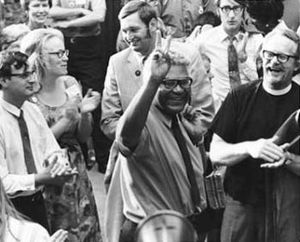
The more onerous aspects of Jim Crow conspired to obscure a reality key to understanding Barack Obama’s complicated relationship to black America: simply put, the colored section was far more democratic than the ostensibly free segments of America because virtually any tincture of black ancestry was sufficient to gain admission. The boundaries of whiteness required vigilant policing and scrutiny, but black people were far more catholic in our self-perception. In response, America conjured a usable mythology, one in which the product of interracial unions were uniformly doomed to suffer disproportionate woe. Fiction, folklore, and films like “Imitation of Life” cinched the concept of the tragic mulatto in American popular imagination. But the concept didn’t square with our own lived experience. There was nothing tragic about the trajectories of Frederick Douglass, Booker T. Washington, Mordecai Johnson, or any other biracial black person—aside from the burden of racial inequality they shouldered along with anyone else of African descent. The activist Walter White used his nearly white skin as a kind of camouflage that allowed him to investigate lynchings for the N.A.A.C.P. in the nineteen-twenties. Obama understood this history well enough to stand nearly outside of it. In 2008, Barack Obama authored a new archetype—a biracial man who was not so much tragic as ironic. Unlike the maligned mulattoes of old, Obama wasn’t passing for white—he was passing for mixed. For those with an eye to this history it was a masterful performance, a riff as adroit as anything conjured by Dizzy Gillespie or Sonny Rollins.

Early on, observers noted Obama’s Ebonic lapses when speaking to black audiences and saw in them a sly attempt to pander to African-American voters. But they had it precisely backward: to black audiences, his ability to speak in pulpit inflections one moment and concave Midwestern tones the next made him seem more black, not less. We saw him as no different than any African-American lawyer who speaks black English at home and another, entirely more formal language, in his professional environment. Not surprisingly this has translated into confusion over who the President of the United States is. A 2010 Pew poll showed that fifty-three per cent of whites see the President as biracial while only a quarter see him as black. At the same time, fifty-five per cent of African-Americans see Obama as black while a third see him as mixed race. What the poll failed to ask, however, was whether African-Americans see those two categories as mutually exclusive. Slavery, coercion, and the randomness of social exchange conspired to ensure that virtually all of black America is biracial in some regard. Walter White had blonde hair, fair skin, and blue eyes—yet was black enough to serve as the N.A.A.C.P.’s chief executive for twenty-four years. What was known but left unsaid is that Obama was at least as black as any of the other forty million of us and biracial in the same sense that Douglass, Washington, and White were.

More here. (Note: At least one daily post throughout February will be devoted to African American History Month)

Thursday Poem

Place

On the last day of the world
I would want to plant a tree

what for
not for the fruit

the tree that bears the fruit
is not the one that was planted

I want the tree that stands
in the earth for the first time

with the sun already
going down

and the water
touching its roots

in the earth full of the dead
and the clouds passing

one by one
over its leaves

by W.S. Merwin
from The Rain in the Trees
Alfred A. Knopf, 1988

Say Goodbye To Video Stores, Mailmen, Pennies…

From Smithsonian:

FutureThe February 1989 issue of Life magazine predicted that, by the year 2000, many staples of modern American life might find themselves on the scrapheap of history. Life predicted that by the year 2000 people would need to say goodbye to everything from film (pretty much) to all-male clergy in the Catholic church (not so much). Bid ta-ta to LPs, fur coats and sugar. Toodle-oo to checkbooks, oil and swimming in the ocean. Happy trails to privacy, porno theaters and who knows, maybe even Democrats. It’s not just animals and vegetation that are departing the planet (currently one species every 15 minutes). With them goes, for better or worse, any number of the tangibles and intangibles now taken for granted. Gathered here are the contents of an as-yet-unburied time capsule dedicated to impending obsolescence. So should auld acquaintance be forgot…

The predictions are especially interesting in that they were made shortly before the birth of the modern web and the mid-1990s flood of non-tech types getting online. What then will bring about the decline of the mailman? The magazine insists that it’s not email, but the fax machine. A few of the things that Life said you’d “Say goodbye to…”

The Red Cent

“The extinction of penny candy along with the high cost of copper have made the life expectancy of this coin not worth a plugged nickel.” On February 4, Canada stopped putting their penny into circulation. They joined the likes of Australia, Norway and Sweden among others, but there’s no indication that Americans will be rid of Lincoln’s copper face anytime soon.

More here.

Wednesday, February 27, 2013

Peering into our blind spots

Katie Koch in the Harvard Gazette:

ScreenHunter_125 Feb. 27 18.41Mahzarin Banaji shouldn’t have been biased against women. A leading social psychologist — who rose from unlikely circumstances in her native India, where she once dreamed of becoming a secretary — she knew better than most that women were just as cut out for the working world as men.

Then Banaji sat down to take a test. Names of men and women and words associated with “career” and “family” flashed across the computer screen, one after the other. As she tried to sort the words into groups as instructed, she found that she was much faster and more accurate when asked to lump the male names with job-oriented words. It wasn’t what a pathbreaking female scientist would have expected, or hoped, to see.

“I thought to myself: Something is wrong with this damned test,” said Banaji, Harvard’s Richard Clarke Cabot Professor of Social Ethics, as she reflected during an interview in her William James Hall office on her first run-in with an Implicit Association Test (I.A.T.).

That Banaji specializes in creating just these kinds of assessments did nothing to change the results. But at least she can take comfort in knowing she’s not alone. In the past 15 years, more than 14 million such tests have been taken at Project Implicit, the website of Banaji and her longtime collaborator Anthony Greenwald.

What these curious test-takers, as well as Banaji and Greenwald, found was that many of us hold onto quite a bit of unconscious bias against all sorts of groups, no matter how unprejudiced we strive to be in our actions and conscious thoughts. It’s a counterintuitive, even unnerving proposition, and one that Banaji and Greenwald, a professor of psychology at the University of Washington, set out to explain for a lay audience in “Blindspot: Hidden Biases of Good People.”

More here.

An exhibit encapsulating 1993 also captures the freedom, and the anxiety, of post-historical art

Our own Morgan Meis in The Smart Set:

ID_IC_MEIS_1993_AP_001 (1)“NYC 1993: Experimental Jet Set, Trash and No Star” proposes that an art exhibit can function as a time capsule. The current exhibit at the New Museum in New York City takes a cross section of the art and culture produced in 1993 and displays it in the museum in no particular order and with no particular agenda. There are works from artists already famous in 1993 — like Kiki Smith — and artists who would soon become famous, like Mathew Barney. But there are also plenty of works from artists you've never heard of. Some of the work in the exhibit was originally shown in big galleries and museums. But some of it was never officially shown at all, or was only available in little-known galleries and private artist studios. The point of “NYC 1993” is to give a sense of what might have been encountered across the cultural landscape of New York City 20 years ago.

Promotional material for the exhibit argues that, “The social and economic landscape of the early ’90s was a cultural turning point both nationally and globally,” and that 1993 was a “pivotal moment in the New York art world.” But this is mere nervousness on the part of the curators, who don't want to be accused of creating a show that is utterly arbitrary. The perfect thing about 1993 is that it has no special significance. In the grand scope of history, 1993 means nothing.

The non-essential nature of the year 1993 is what makes it the proper subject for a time capsule. Time capsules are meant to give an overall picture of one period of time so that another period of time in the future can know what life was like back then. And if you want to give an overall picture, you want to stay away from extraordinary events or unusually significant points in history. You want to focus on the mundane.

More here.

The Taliban’s New, More Terrifying Cousin

Jeffrey Stern in The Atlantic:

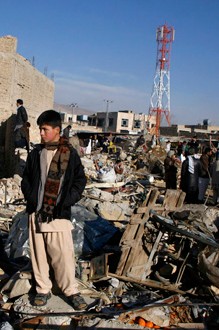
ScreenHunter_124 Feb. 27 18.29For the Hazaras, a group of Shia Muslims from Afghanistan with a large population in Pakistan, leaving the house has become a fraught enterprise. Schools have emptied, students stay home and parents try to explain to their children why people want them dead. They believe their government is at best uninterested in protecting them, and many are so traumatized they believe it's complicit. The Feb. 16 bombing killed 85 people, almost all of them Hazaras, and the number is still rising as people succumb to their wounds. About a month prior, another attack had killed 96 people who were also almost all Hazaras. The victims are not bystanders; they are a people who are being exterminated.

The group doing the killing is called Lashkar e Jhangvi, “The Army of Jhangvi” or LEJ. They are Sunnis whose agenda is not much more nuanced than killing Shias. Though South Asia is a region rife with internecine conflict, with factions who have fought each other for all of recent history over land and religion, these attacks are unique. Even in a region violence visits far too often, what's happening now is singular, and it's getting worse.

First it was snipers picking off civilians, then LEJ members began stopping busses, shooting Shia passengers and leaving their bodies on the roadsides. Now, LEJ is using massive bombs in places frequented by Shia civilians: social clubs, computer cafes, markets and schools. About 1,300 people have been killed in these attacks since 1999, according to a website dedicated to raising awareness about them. More than 200 have been killed so far this year.

More here.

Piero

130304_r23213_p233

The great Renaissance expert Bernard Berenson explained the sudden, virtual cult appeal of the artist in terms of an emerging modern taste for “the ineloquent in art,” by which he meant a turn away from dramatic illustration toward the aesthetics of conceptual design and candid technique. Berenson cited Impressionism and, especially, the phlegmatic, intellectually bracing method of Cézanne as spurs to the new appreciation of Piero. That’s apposite. His style also resonates in the marmoreal figures of Picasso’s neoclassical period; and his way of seeming to capture something fundamental, once and for all, reminds me of abstract paintings by Piet Mondrian. Looking at Piero’s work may impart a sense of being steadied and elevated. You might even forget momentarily that you were ever less noble, or that any other art has held more than a passing interest for you.

more from Peter Schjeldahl at The New Yorker here.

the homo bomb

Image

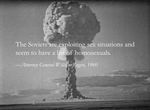
Homosexuality Is Stalin’s Atom Bomb to Destroy America explores how players on both sides of the cold war did their own appropriating, using the idea of homosexuality as a political weapon. The exhibition includes photos of atomic explosions printed with quotations from US politicians, for instance: “You can’t hardly separate homosexuals from subversives. Mind you, I don’t say every homosexual is a subversive, and I don’t say every subversive is a homosexual. But a man of low morality is a menace in the government, whatever he is, and they are all tied up together.” Such absurd equations show how homosexuality became a floating signifier, associated with whatever political tendency one most disliked. Rather than representing a certain group of people, it represented everything that was wrong—whatever that meant. America’s Red Scare bled into its Lavender Scare; the Soviets associated homosexuality with capitalism and fascism. But empty as it was, the political use of the trope of homosexuality had a devastating effect on real people from both countries.

more from Sophie Pinkham at n+1 here.

deep time

Article00

In 1971, Conceptual artist Douglas Huebler announced his intention to “photographically document . . . the existence of everyone alive, in order to produce the most authentic and inclusive representation of the human species that may be assembled.” His Variable Piece #70 was, unsurprisingly, never completed, but Huebler’s comprehensive cataloguing impulse is telling: It speaks of a desire to map the contours of civilization, to capture and behold the mass of humanity. What do we, collectively, look like? And how do we depict ourselves to ourselves? Artist and geographer Trevor Paglen’s The Last Pictures takes up these questions from a perspective very different from Huebler’s, seeing in them a way to explore the difficulty of representation and the illegibility of images across “deep time.” Propelling these inquiries to their most extreme registers, Paglen assembled a collection of one hundred pictures and had them launched into space on a satellite that will remain in orbit for perhaps billions of years.

more from Julia Bryan-Wilson at Bookforum here.

Telling Carl Maxey’s Story

From BlackPast:

Carl_MaxeyWhen I interviewed Maxey in April 1997, the grey-haired 72-year-old was predictably sharp and acerbic about those days, recalling getting repeatedly tossed out of the city's amusement park, even on nights when the bandstand entertainer was Fats Waller or Duke Ellington. He was also full of stories about taking restaurants to court, going after social clubs where it hurt them most (their liquor licenses) and heatedly debating the practice of redlining with the local real estate leaders. He was still full of disdain for certain hotels and restaurants, not because they still discriminated, but because they had dragged their heels so stubbornly 40 years earlier. And then, in the middle of the interview, he said this, “But you know, to really understand this story, you have to know where I come from.” And with that, Maxey started telling me his life story. Now, as a reporter with a deadline, my knee-jerk reaction was probably, “That's great, but I can't use it. I'm not writing your life story.” Fortunately, I did not say this out loud, because another thought soon crowded it out: “If Carl Maxey wants to tell me his life story, then I need to shut up and listen. And keep that tape recorder running.”

The story he told that day was absolutely stunning. He was a 12-year-old orphan in Spokane in 1936, when the orphanage kicked him out, along with the only other “colored” orphan. Maxey was able to quote the minutes of the orphanage board meeting verbatim: “The board (goes) on record as voting to have no more colored children in the Home, from this time forward. Motion carried – unanimous.” No other orphanage in Spokane would subsequently take these young two boys. Then Maxey said to me, “If you wonder where some of my fire comes from, it comes from a memory that includes this event.” At that moment, I realized that Maxey's life story had an uncommonly compelling dramatic arc. How does a child survive the worst possible start in life? And then, how does that child grow up to become the man whose bronze bust in the Gonzaga Law School library reads, “He made a difference”? At the time, I still had no idea how Maxey made that journey, but I knew it would be a great story.

Then, after Maxey committed suicide a little more than two months after our interview, I knew that the story had just become even more dramatic and complex.

More here. (Note: At least one daily post throughout February will be devoted to African American History Month)

Wednesday Poem

Requests for a Toy Piano
.
Play the one about the family of the ducks
where the ducks go down to the river
and one of them thinks the water will be cold
but then they jump in anyway
and like it and splash around.
.
No, I must play the one
about the nervous man from Palestine in row 14
with a brown bag in his lap
in which a gun is hidden in a sandwich.
.
Play the one about the handsome man and woman
standing on the steps of her apartment
and how the darkness and her perfume and the beating of their hearts
conjoin to make them feel
like leaping from the edge of chance—
.
No, I should play the one about
the hard rectangle of the credit card
hidden in the man’s back pocket
and how the woman spent an hour
plucking out her brows, and how her perfume
was made from the destruction of a hundred flowers.
.
Then play the one about the flower industry
in which the migrant workers curse their own infected hands
from tossing sheaves of roses and carnations
into the back of the refrigerated trucks.
.
No, I must play the one about the single yellow daffodil
standing on my kitchen table
whose cut stem draws the water upwards
so the plant is flushed with the conviction
.
that the water has been sent
to find and raise it up
from somewhere so deep inside the earth
not even flowers can remember.
.

by Tony Hoagland
from Poetry Magazine

Doubts Emerge on the Value of Very Low Cholesterol Levels

From Scientific American:

Doubts-emerge-cholesterol-level-target_1Since 2002, when ATP III called on doctors to push LDL levels below set targets, the concept of low cholesterol has become synonymous with heart health. Patients brag about their cholesterol scores, physicians joke about adding statins to drinking water, and some hospitals reward doctors when patients hit cholesterol targets. In 2011, US doctors wrote nearly 250 million prescriptions for cholesterol-lowering drugs, creating a US$18.5-billion market, according to IMS Health, a health-care technology and information company based in Danbury, Connecticut. “The drug industry in particular is very much in favour of target-based measures,” says Joseph Drozda, a cardiologist and director of outcomes research at Mercy Health in Chesterfield, Missouri. “It drives the use of products.”

ATP III reflected a growing consensus among physicians that sharply lowering cholesterol would lessen the likelihood of heart attacks and strokes, says Richard Cooper, an epidemiologist at the Loyola University of Chicago Stritch School of Medicine in Illinois, who served on the committee that compiled the guidelines. The committee drew heavily on clinical data, but also took extrapolations from basic research and post hoc analyses of clinical trials. LDL targets were set to be “less than” specific values to send a message, Cooper says. “We didn’t want to explicitly say ‘the lower the better’ because there wasn’t evidence for that,” he says. “But everybody had the strong feeling that was the correct answer.” By contrast, the ATP IV committee has pledged to hew strictly to the science and to focus on data from randomized clinical trials, says committee chairman Neil Stone, a cardiologist at Northwestern University School of Medicine in Chicago. If so, Krumholz argues, LDL targets will be cast aside because they have never been explicitly tested. Clinical trials have shown repeatedly that statins reduce the risk of heart attack and stroke, but lowering LDL with other medications does not work as well. The benefits of statins may reflect their other effects on the body, including fighting inflammation, another risk factor for heart disease.

More here.

Tuesday, February 26, 2013

Squash star takes on the Taliban

James Montague at CNN:

Art.pakay.cnnChingaiz Khan was an unknown quantity when he arrived for a junior weightlifting tournament in South Waziristan nine years ago.

Chaotic and intensely religious, the Pakistani region is known by locals as “the most dangerous place in the world.”

The 12-year-old Chingaiz, with his short, jet-black hair and smooth, unblemished skin, looked younger than the other boys. But, despite it being his first ever tournament, he was still stronger than everyone else.

For his father Shams-Ul Wazir, a local college lecturer, the decision to register his son for the tournament paid off handsomely.

Chingaiz was crowned the junior boys' weightlifting champion, the first step on a journey that would take him into the world of professional sport.

Except Chingaiz wasn't really his name.

Chingaiz was actually called Maria Toor Pakay.

Chingaiz was a girl.

“I suggested the name of Chingaiz Khan for her since she had always been like a boy,” explained Al Wazir in an interview with HBO. “She liked the name very much.”

This isn't a story of deception, but rather a tale of necessity.

Maria Toor Pakay is Pakistan's number one squash player, ranked 49th in the world. She also comes from an ultra conservative region in Pakistan that is home to the Taliban.

More here.

Transcending Matter

Our own Morgan Meis in The Smart Set:

ID_IC_MEIS_ASHCA_AP_001Human history is written from the perspective of the winners. But it is also the case that the winners are, more often than not, assholes. Looking back over the wreckage of past ages, losers can come off looking pretty good in comparison. The story of what-could-have-been sometimes beats the story of what-actually-was.

One scenario for meditations upon history's winners and losers took place in New York City, 1913 when a group of painters decided to put on a show at the Armory building. The idea behind the show was simple. One of the organizers, John Quinn, expressed it in his opening address, “The members of this association have shown you that American artists — young American artists, that is — do not dread, and have no need to dread, the ideas or the culture of Europe.”

America was ready to confront the big boys (and a couple of girls) of European art. American art would no longer be perceived as the mostly provincial, second-order stuff of a colonial backwater. The Armory exhibit would display American artists like Oscar Bluemner, Patrick H. Bruce, James Earle Fraser, and Henry Twachtman alongside Cezanne, Redon, Gauguin, Van Gogh, Matisse, Picasso, Kandinsky, and Duchamp. Likewise, art enthusiasts in the U.S. would get their first glimpse of Continental art movements: Neo-Impressionism, Futurism, Fauvism, Abstraction, and Cubism.

Viewers of the exhibit were also going to see the newest creations of those American artists who had come to be known as The Ashcan School. Painters like William Glackens, Robert Henri, George Luks, Everett Shinn, and a young Edward Hopper.

More here.

GETTING ANIMALS IN VIEW

Christine M. Korsgaard in The Point:

ScreenHunter_122 Feb. 26 16.54What sorts of philosophical problems do we face because of the existence of non-human animals? Most humane people would agree that their existence presents us with some moral and legal quandaries. And recently, but only recently, philosophers have taken a serious interest in the character of animal minds. But I have come to think that animals present us with a philosophical problem deeper than either of those—that the existence of non-human animals is the source of a profound disturbance in the way that human beings conceptualize the world. It is almost as if we—I’m using “we” to mean “us human beings” here—are unable to get them firmly into view, to see them for what they really are.

Many people, to take one small example, find nothing odd about the sentence, “I live alone with a cat.” Okay, granted, someone might also say, “I live alone with a child,” at least so long as the child was a very small one.[1] But “I live alone with four children” would be starting to put the language under stress, even if they were all toddlers, while “I live alone with four cats” would not. Here’s another example: People wondering about whether there might be life on other planets sometimes ask, “Are we alone in the universe?” Just look around! Well, you may reply, they mean to ask whether there is any other intelligent life in the universe. Right. Just look around!

Animals also seem to pop in and out of our moral view. Most people would agree that it is wrong to hurt or kill a non-human animal without a good reason, but then it turns out that any reason, short of malicious pleasure, is reason enough.

More here.

SPLIT BRAIN, SPLIT VIEWS – DEBATING IAIN MCGILCHRIST

Kenan Malik in Pandaemonium:

Divided-brain-reportIain McGilchrist has written a response to my post about his book The Master and his Emissary and about the RSA workshop that discussed it. Since it is a long reply, Iain asked me whether I could publish it as a post, rather than as a comment, which I am happy to do. I have appended my own response at the end. (And just to avoid any confusion, while I have set up the discussion in the form of two open letters, Iain’s piece was written as a straightforward essay, not in letter form.) I am slightly puzzled, as I observe in my reply, by the tone of Iain’s piece. He seems to suggest in places that my original was written in bad faith and that I seem not to have not read his book or the RSA document. Whether I have adequately understood either is, of course, a matter for debate. But my post was written in good faith, and while critical of Iain’s thesis was also, in my eyes at least, respectful of his work. I wrote it to engage in the kind of debate for which I had hoped that Iain himself had written his book, and the RSA had held its workshop. I am publishing Iain’s essay in the spirit of such debate, I have written my response to it in that spirit, and I hope that people will engage in that spirit with both sets of arguments.

More here.

The Gatekeepers

1361571220gatekeepers

Will the film become a watershed in Israeli life? Will Israeli audiences walk out of the theaters re-thinking what they thought they knew about Israel’s albatross? The inauspicious answer begins with the fact that for Israelis, there is little that is new or revelatory about the chiefs’ confessions, nor the basic dilemmas in general. Most know that some Shin Bet chiefs criticize the state’s security policies after leaving office, that Ami Ayalon has a conflict resolution initiative with Al-Quds University president Sari Nusseibeh, and that Yaacov Peri is active in center-left political circles (he has now entered Knesset with Yesh Atid, Yair Lapid’s centrist party). The film must also be considered in a context where the occupation is a paradigm that rules Israeli life. Historic empires drew legitimacy from heaven; by contrast, paradigms are supposed to rest on empirical truths that are nearly unquestionable and can withstand disagreements over their finer points. For example, most Israelis believe that “there’s no Palestinian partner,” and that this is why the occupation continues. Israelis are convinced that they themselves want peace (nearly 60 percent in the December 2012 Peace Index survey support a two-state solution), but that Palestinians continue to hate and refuse to recognize Israel.

more from Dahlia Scheindlin at Dissent here.