Zhu Jinshi. Rice Paper Boat. 2013.
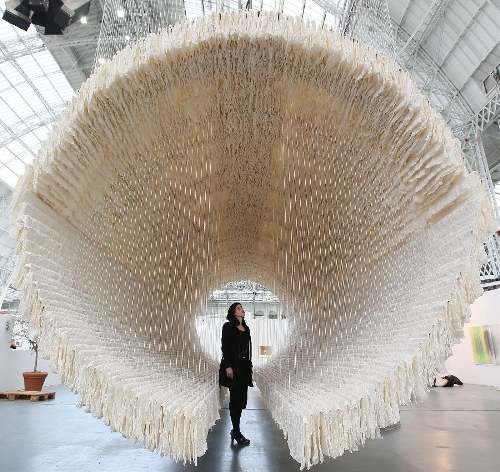
12-metre-long installation made of 8,000 sheets of rice paper.

Justin E. H. Smith in Paper Monument:
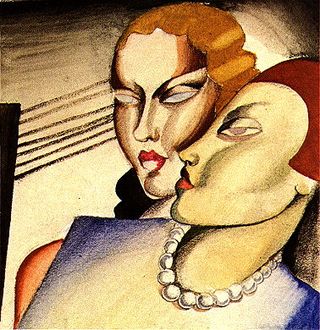
If you made an effort, circa 2009, to master the news about Lady Gaga, you will by now have come to regret this unwise disposal of your time. Gaga had been an American performer of some repute, a singer and dancer, and she was held for a brief time to be shaking things up, to be causing us to see things in new ways. This perception had mostly to do with her manipulation of gender signifiers, but in this what little claim she had to iconic status was derived, mostly unconsciously, from her status as an iteration of a type that had far more blazing tokens nearly a century ago. The type passes through Madonna, on whom one was probably right to expend some mental energy, and back through the great film stars Madonna so diligently imitated, and so lovingly praised in the shout-out portion of “Vogue.” And it passes on, too, to someone who was not credited in Madonna’s 1990 hit, yet whose paintings seem to have done more to concretize the figure of the modern woman to which these later pop stars would work so hard to fit themselves, the figure that always seems so modern and insolite, while remaining eternally rooted in a mythical 1925 Paris, in the moment when Tamara de Lempicka (who had fled St. Petersburg in 1917) painted it in cool neo-cubist blues: la garçonne, the female boy, artificial and contrived even grammatically, always a surprise, always as if new, even when its long chain of iterations is revealed.
We are also iterations of ourselves through time: receding series, as Vladimir Nabokov (who also fled St. Petersburg in 1917) wrote of his Lucette at the moment of her drowning. And sometimes new series spin off from moments, and are taken up by others, while we come to look less like ourselves than our imitators do.
More here.
Your DNA is not a blueprint. Day by day, week by week, your genes are in a conversation with your surroundings. Your neighbors, your family, your feelings of loneliness: They don’t just get under your skin, they get into the control rooms of your cells. Inside the new social science of genetics.
David Dobbs in Pacific Standard:

Working carefully, Robinson’s conspirators—researchers at Mexico’s National Center for Research in Animal Physiology, in the high resort town of Ixtapan de la Sal—jiggled loose the lids from two African hives and two European hives, pulled free a few honeycomb racks, plucked off about 250 of the youngest bees from each hive, and painted marks on the bees’ tiny backs. Then they switched each set of newborns into the hive of the other subspecies.
Robinson, back in his office at the University of Illinois at Urbana-Champaign’s Department of Entomology, did not fret about the bees’ safety. He knew that if you move bees to a new colony in their first day, the colony accepts them as its own. Nevertheless, Robinson did expect the bees would be changed by their adoptive homes: He expected the killer bees to take on the European bees’ moderate ways and the European bees to assume the killer bees’ more violent temperament. Robinson had discovered this in prior experiments. But he hadn’t yet figured out how it happened.
More here.
Santiago Zabala in Al Jazeera:
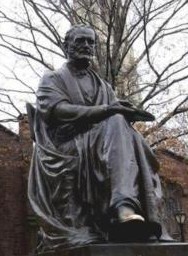
For those of us who had the good fortune to be educated by teachers who guided our intellectual interest and social wellbeing regardless of where we were enrolled, we know it's always the faculty that makes the difference, not the institution. If, as Noam Chomsky once pointed out, “our kids are being prepared for passive obedience, not creative, independent lives”, it's because we live in a corporate world where most institutions are ranked according to criteria that too often ignore the essence of the discipline in favour of the job market.
It is also interesting to notice how the failure of MOOCs (massive open online courses, which represent corporate universities' latest development), lies in the impersonal nature of the courses – because students are unable to meaningfully interact with their professors, one of the fundamental aspects of any serious education. This is why, asSarah Kendzior brilliantly explained, colleges must be “reformed, not replaced”. How can we reform our higher education system? And why is it necessary?
More here.
From ArtAsiaPacific:
In June, the Pakistan-born, New York-based artist Shahzia Sikander and Vishakha N. Desai, president emerita of Asia Society and Asian art scholar, met at Sikander’s studio in Midtown, New York, to mark her participation in Sharjah Biennial 11, the 5th Auckland Triennial and the 13th Istanbul Biennial. Their discussion focused on the transnational nature of Sikander’s work, complexities around the questions of her identity, and her role in the rise of contemporary miniature painting in Pakistan and its reception around the world.
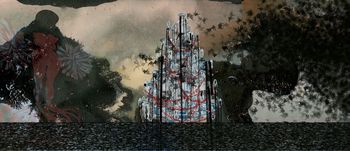
Shahzia Sikander: Miniature painting for me has always been heroic in scope and not limited by its scale—it is a space to unleash one’s imagination. Parallax is in fact a compact, varied, multilayered, expandable projection created from hundreds of small drawings. It came about as a result of my visits to Sharjah, and in particular from driving in and around the emirate, across its deserts and up and down its coasts. There is no better activity than driving to get a sense of a space in a car culture, and I picked up a great sense of the topography of the land. Parallax examines Sharjah’s position beside the Strait of Hormuz, and its role as a stopover for the old Imperial Airways. This proximity to water, sand and oil, and of course the historical power tensions surrounding maritime trade, all became fodder for visual play between solid and liquid representations in the work. All of the liquid states in the animation are made up of millions of silhouettes of hair that have been culled from images of gopis—female worshippers of Krishna often portrayed in Indian miniatures. These transform into large swaths of static noise that hover between multiple representations, ranging from oceans, water and oil, to flocks of birds and patterns of human migration.
By isolating the gopi hair from its source, I emphasized its potential to cultivate new associations. Similarly, there is no fixed viewing point in the film. It is simultaneously aerial and internal. For me, even the Arabic recitation in the score doesn’t need a translation, as the emotional range in the delivery is vast and inclusive. This is also a reference to the non-Arabic-speaking Muslim cultures such as Pakistan, where Arabic is primarily aural. I see Parallax as immersive and limitless in scale. Scaled up using certain projectors it could defy all sorts of architectural boundaries, and scaled down it could even be a sort of “Sharjahnama” illuminated manuscript.
More here.
Neetzan Zimmerman in Gawker:
Sure, summer is almost over. And we've already had plenty of worthy pretenders to the “Song of the Summer” throne. But that just makes this unknown duo's accomplishment that much more impressive.
Perhaps calling Bård Ylvisåker and Vegard Ylvisåker “unknown” is somewhat unfair. They're plenty known in their home country of Norway where they go by “Ylvis” and have their very own talk show on TVNorge.
And as part of the promotion campaign for that show's upcoming season premiere, Ylvis released a music video for a song unassumingly called “The Fox” which went on to set the world of sound on fire.
Don't read another word. Just, uh, just listen to it. Seriously, stop reading. Go listen. Stop. Go.
Usha Alexander in Shunya's Notes:

The adjustment might have been more difficult, though. Happily, we have no children, which means, among other things, we aren’t agonizing about their health with each sip of water and every mosquito bite, nor are we selecting schools and private tutors to ensure the right college admissions, as we see other middle-class parents doing. This alone collapses our risks and costs immeasurably and increases our freedom. Just as much, we are fortunate to not have to seek conventional employment—provided we live modestly—which means we avoid the grind of daily commutes, workaday insults, and the weariness of mounting the career ladder. The upwardly mobile, family-oriented lifestyle emerging in India seems even more of a rat-race than it is in the US, and a good part of our secret to gladness in being here is that we are not pursuing it.
More here.
Over at Eurozine, an interview with Jerzy Jarzebski, editor of Gombrowicz's Kronos:
Adam Puchejda: How would you describe Gombrowicz's Kronos? Is it private, intimate, sublime, banal?
Jerzy Jarzebski: Ambivalent. It is private, personal and intimate, but at the same time it is none of these. Primarily, it is a record of facts that are not private as such. It contains the humdrumness of life. I met with this and that person, I drank another cup of coffee, I signed a contract with the publishing house, etc. Of course, in Kronos you can also find very personal fragments, the ones dealing with Gombrowicz's sexual and emotional relationships, but throughout the text he tries to be strictly objective. This is a record that Gombrowicz writes for himself in order to read it again and again, trying to grasp a sense of his own life. If you think about it this way, you understand why this text strives to be at least an attempt to record an objective, factual truth. It becomes personal only when you start to interpret it – something that Gombrowicz does himself, even within the text.
AP: But how can you make any sense of this tangle of names, dates and events, a sort of raw record of almost all life's events?
JJ: Gombrowicz was a metaphysician and, at various moments of his life, looked for a pattern in his own existence. When he sailed back from Argentina to Europe – we read in his Diary – he expected to see the “Chrobry” sailing in the opposite direction. The Chrobry was the name of the ship he took to Argentina in the first place, 24 years earlier. Seeing it again, in accordance with the vision that Gombrowicz entertains, would be a sign that the period of his life spent in Argentina has come to an end. Sometimes Gombrowicz – already in Kronos – is playing with numbers and it is very funny, because he is not able to add two and two. Wherever there are calculations, we find in them some horrendous mistakes, but it was on these erroneous calculations that Gombrowicz based his conclusions.
Joselle DiNunzio Kehoe in Plus magazine:
By the nineteenth century mathematicians struggled with the meaning and implications of their ideas and tried to shore up the foundation of mathematics, fearing perhaps that the weightlessness of the purely abstract could threaten the integrity of their discipline. They reflected on, and argued about, the meaning of their work — what it could address, and how. What was a function? Was “infinity” simply shorthand for an unending process, or was it something? In 1829 the legendary mathematician Carl Friedrich Gauss wrote, “mathematics has for its object all extensive quantities.” Other kinds of quantities could be considered “only to the extent that they depend on the extensive.” By extensive quantities Gauss meant lines that are described by length, surfaces, solid bodies and angles, as well as time and number. The non-extensive quantities he allowed included speed, density, hardness, height, the depth and strength of tones, the depth and strength of light, and probability. But he also provided an important qualification, “One quantity in itself cannot be the object of a mathematical investigation: mathematics considers quantities only in their relation to one another.” Here, quantities and their measures are considered together, and they can each be thought of as magnitudes.
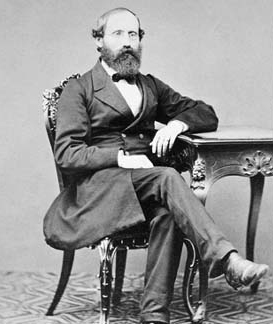
Gauss's student Bernhard Riemann brought a definitive clarification to the meaning of measure. He acknowledged in the introduction to his famous lecture On the hypotheses which lie at the bases of geometry that this was influenced, not only by Gauss, but also by ideas of the philosopher John Friedrich Herbart, who pioneered early studies of perception and learning. Herbart's work played a significant role in debates centered on how the mind brings structure to sensation.
Like cognitive scientists today, Herbart broke down the world of appearances into the subjective impressions that build it. He rejected the idea that space was the thing that contained the physical world. For him spatial forms were mental images derived from relationships among any number of things we experience. They arise in our conception of time (the future being ahead of us and the past behind us), as well as number, and are applied to all aspects of the physical world. Herbart accepted that any perceived object could be thought of as a collection of properties bound together.
In death, as in life, Leigh Fermor was a master of bringing together different worlds that one would normally have imagined to be opposed, if not incompatible. A one-man compendium of contradictions, Paddy (as he was known to everyone) was a genuine war hero. He abducted the German commandant of Crete, and in the movie of the exploit, Ill Met By Moonlight, Paddy was played by Dirk Bogarde. Yet this man of action, with the speech patterns, polished brogues and perfect manners of a prewar British major, was also one of the great masters of English prose. Paddy was equally at home with both high and low living. His masterpiece, A Time of Gifts, the first volume of a trilogy, tells of his walk from the Hook of Holland to Constantinople in the last days of prewar Europe, “like a tramp, a pilgrim, or a wandering scholar”, as he moved from dosshouses to Danubian ducal fortresses: “There is much to recommend moving straight from straw to a four-poster,” he wrote, “and then back again.” On the wet afternoon of 9 December 1933, the year Hitler came to power, as “a thousand glistening umbrellas were tilted over a thousand bowler hats”, Paddy left London, boarding a Dutch steamer at Irongate wharf.
more from William Dalrymple at The Guardian here.
In The Story of the Jews: Finding the Words 1000BCE – 1492CE, Simon Schama has done a splendid job in challenging the stereotypes. His spirited, immensely enjoyable and wide-ranging account – the first of two projected volumes – takes us from the time when we can begin to talk about the Jews as a people and a religious community up to the traumatic moment of their expulsion from Spain, the land where they had seemed most secure and had risen to the greatest heights in scholarship and even government. Towards the end Schama does pile up the woes, and his graphic portrayal of the deterioration in Spain needs to be balanced by the story of Jewish settlement in Italy, Poland and parts of Germany. Sometimes he lets the stereotypes prevail: interfering Jewish mothers; people who kvetch (a Yiddish word for constantly complaining). But as he says, the Jews of early medieval Cairo, about whom we know an enormous amount because a massive rubbish heap of their letters and sacred documents has survived, “were not a people who went around with their heads bowed, austerely dressed”. Still less was that the case for Joseph ibn Naghrela, a vizier of 11-century Granada, who possibly created the first luxurious palace on the Alhambra hill, or Samuel Abulafia, whose 14th-century Tránsito synagogue is covered with inscriptions glorifying him and the king of Castile whom he served as treasurer (and who before long had him executed).
more from David Abulafia at the FT here.
I don’t read J.M. Coetzee for pleasure. To be fair, I’m not sure anyone does. The 2003 Nobel laureate writes from his head more than his heart, framing novels that are philosophical and austere, books that break down the world in highly rational ways. Over the course of his career, he’s been compared to Beckett and Kafka, although despite the occasional nod in their direction — the title character of his 1983 novel “The Life and Times of Michael K.” functions to some extent as an homage to “The Trial’s” Josef K. — he lacks their appreciation of humor, of life as essentially absurd. “We must cultivate, all of us,” Coetzee writes in “Foe” (a 1986 recasting, of sorts, of “Robinson Crusoe”), “a certain ignorance, a certain blindness, or society will not be tolerable.” Here we see the fundamental tension of his writing: to make sense of ourselves in a universe where the private and the public narrative often are in conflict, where history betrays us in all sorts of ways. Coetzee’s new novel “The Childhood of Jesus” operates very much out of this territory: an allegory that is oddly concrete.
more from David L. Ulin at the LA Times here.
[Thanks to Farrukh Azfar.]
From The Telegraph:

“I truly believe the only way we can create global peace is through not only educating our minds, but our hearts and our souls. “This is the way forward to our destiny of peace and prosperity. “Books are very precious – some books can travel you back centuries and some take you into the future. “In some books you will visit the core of your heart and in others you will go out into the universe. “Books keep ones feeling alive. “Aristotle's words are steal breathing, Rumi's poetry will always inspire and Shakespeare's soul will never die. “There is no better way to explain the importance of books than say that even God chose the medium of a book to send his message to his people.”
Abraham Varghese in The New York Times:
In 1968, a letter to The British Medical Journal titled “Not Allowed to Die” described the ordeal of a retired 68-year-old doctor admitted to “an overseas hospital” (almost certainly in America) with metastatic stomach cancer. After much of his stomach was surgically removed and a blood clot cleared from his lung, he asked that “no further steps be taken to prolong his life, for the pain of his cancer was now more than he would needlessly continue to endure.” Two weeks later the unfortunate doctor had a heart attack in the hospital. His heart was shocked and restarted five times in a single night; morning found him in a persistent vegetative state. His body remained alive for another three weeks. That hellish situation, rare in the rest of the world, is all too common in this country. Although most of us claim no desire to die with a tube down our throat and on a ventilator, the fact is, as Katy Butler reminds us in “Knocking on Heaven’s Door,” a fifth of American deaths now take place in intensive care, where 10 days of futile flailing can cost as much as $323,000, as it did for one California man.
Butler’s introduction to the surreal world of health “care” at the end of life was precipitated by the sudden illness of her father, a native of South Africa. Jeffrey Butler lost his arm while serving in World War II. He married, earned a Ph.D. from Oxford and settled into academic life in the United States. He was a charismatic father, the sort who would “stand in our bedroom doorways and say good night to my two brothers and me quoting Horatio’s farewell to the dying Hamlet: ‘May flights of angels sing thee to thy rest!’ ” At 79 he was active and enjoying retirement when he suffered a stroke. Soon after hospitalization a “discharge planner” told the family that Jeffrey had to be immediately transferred to a neurological rehabilitation facility. “Only later would I understand the rush,” Butler writes. “The hospital was losing money on him with every passing day. Out of $20,228 in services performed and billed, Medicare would reimburse Middlesex Memorial only $6,559, a lump sum based on the severity of my father’s stroke diagnosis.” A year later, her father was outfitted with a pacemaker. The device would keep his heart functioning even as he descended into dementia and almost total physical helplessness over the next five years.
More here.