Nine years ago today, the massive Indian Ocean Tsunami struck

By chance, I was having a late dinner in Brooklyn with a Sri Lankan friend at the moment the tsunami struck Sri Lanka nine years ago today but we remained blissfully unaware of what had happened until the next morning. We also did not know at the time what had just happened to our mutual friend Sonali Deraniyagala and her family who were vacationing on a beach in Sri Lanka.

This is from NPR:

Sd-credit-ann-billingsley-44e965818a60dd070b47689ca78d7ebf4e96bec1-s3-c85Economist Sonali Deraniyagala lost her husband, parents and two young sons in the terrifying Indian Ocean tsunami of 2004. They had been vacationing on the southern coast of her home country Sri Lanka when the wave struck. Wave is her brutal but lyrically written account of the awful moment and the grief-crazed months after, as she learned to live with her almost unbearable losses — and allow herself to remember details of her previous life. In this scene, Deraniyagala revists both the house of her parents in Colombo, which has been emptied and closed up since the tsunami, and Yala National Park, where she was when the wave struck.

[Excerpt from 'Wave' By Sonali Deraniyagala:]

Someone had removed the brass plate with my father's name on it from the gray front wall. It had his name etched in black italics. I sat in the passenger seat of my friend Mary-Anne's car, my eyes clinging to the holes in the wall where that brass plate was once nailed.

This had been my parents' home in Colombo for some thirty-five years, and my childhood home. For my sons it was their home in Sri Lanka. They were giddy with excitement when we visited every summer and Christmas. Vik took his first steps here, and Malli, when younger, called the house “Sri Lanka.” And in our last year, 2004, when Steve and I had sabbaticals from our jobs and the four of us spent nine months in Colombo until September, this house was the hub of our children's lives.

This was where we were to return to on the afternoon of the twenty-sixth of December. My mother had already given Saroja, our cook, the menu for dinner. This was where they didn't come back to. Now, six months after the wave, I dared to set eyes on this house.

I was wary as I sat in Mary-Anne's car, which was parked by our front wall. I didn't want to look around. I was afraid of seeing too much. But I couldn't help myself, I peeked.

More here. Also see this. Wave is also on the New York Times' 10 Best Books of 2013 list.
the daily rituals of great minds

Hart_12_13Christopher Hart at Literary Review:

Erik Satie may have worn chestnut-coloured velvet suits, eaten thirty-egg omelettes and founded the Church of Jesus Christ the Conductor, but this was just bohemian decoration. He also walked 12 miles into and out of Paris every day, composing all the way. In his introduction to this wonderfully entertaining little book, Mason Currey quotes V S Pritchett: 'Sooner or later, the great men turn out to be all alike. They never stop working. They never lose a minute. It is very depressing.'

It should come as no surprise, perhaps, that most high-achieving creative people who have given something permanent to the world are not really in the slightest bit bohemian. They discover for themselves Flaubert's famous advice that one should live like a bourgeois and put one's bohemianism into one's work.

Food is often of little importance, mere brain fuel. Patricia Highsmith lived on vodka, cereal and bacon and eggs. For lunch Ingmar Bergman ate a revolting sort of baby food made up of yoghurt and strawberry jam which he mixed in with cornflakes. In the evening he enjoyed watching Dallas.

more here.

Massimo Pigliucci responds to David Johnson’s 3QD essay on New Atheism

Massimo Pigliucci in Rationally Speaking:

AtheistsI am not particularly friendly to the so-called New Atheism. While I respect (and often respectfully disagree with) Dan Dennett, I have been a fairly strong critic of Dawkins, Harris, and the late Hitchens(not to mention other NA’s, such as Jerry Coyne). I have even written a technical paper analyzing the NA movement from a philosophical perspective.

So it was with some interest that I recently read a piece by David V. Johnson at 3QuarksDaily, entitled “A refutation of the undergraduate atheists,” which promised to deliver some guilty pleasure for my weekend readings. It did deliver, but only in part. In the following I will outline Johnson’s arguments and where, I think, he goes astray. I have also invited him to respond here at Rationally Speaking, and he has graciously agreed, so stay tuned for a follow up.

Johnson adopts the (obviously derisive) language of philosopher Mark Johnston, referring to the NA as “undergraduate atheists” (notice that while Johnson seems to be some kind of deist, Johnson is an atheist). Since the NA’s themselves are notorious for their, shall we say, aggressive sarcasm, I think that’s a fair enough shot.

More here.

THE MAN BEHIND AVAAZ

From More Intelligent Life:

Our Top 10 of 2013. No. 7: Can we change the world, one click at a time? Ricken Patel, a young Canadian, thinks so, and he has 20m followers to show for it. Profile by Robert Butler.

Ricken%20cafeAvaaz is an online campaigning organisation that’s halfway between an NGO and a megaphone. After only six years, it has 20m followers—more than the population of the Netherlands. Avaaz, which means “voice” or “song” in Persian, was set up with the overarching goal of closing the gap between “the world we have and the world most people everywhere want”. From the outset it has been unashamedly idealistic and aspirational. Its executive director is Ricken Patel, and his ambition goes back half a lifetime.

…IF YOU HAD to pinpoint the moment when Ricken Patel first sensed this gap in the world that needed closing, it might be the day he went to primary school. His family had moved to Canada from Kenya in the 1970s, an anxious time for Indians in east Africa after Idi Amin expelled 60,000 Asians from Uganda and seized their assets. Patel grew up in Alberta, 35 minutes by bus from the nearest school. It was a First Nations school on a reservation; he was the only child at the time who wasn’t white and wasn’t First Nation. He was witnessing the end of the Cree culture. “It was a deep annihilation of a people’s culture and it was conscious,” he tells me over lunch. “They took a nomadic people and confined them to a reserve.” He had a friend, Michael, whose front door was broken (“the cold wind blew in”); the family slept in a tent inside the house and ate flour, having nothing else. “History was a very live thing.” On his first day at school, he went to the playground, a large field, and came across a two-year-old boy sitting on his own in the middle of an old tyre. There was no one else around. Patel, aged five, went up and said hello. The two-year-old said, “Go fuck yourself.”

More here.

songwriting

Keith Richards in delanceyplace:

Keith“One hit requires another, very quickly, or you fast start to lose alti­tude. At that time you were expected to churn them out. 'Satisfac­tion' is suddenly number one all over the world, and Mick and I are looking at each other, saying, 'This is nice.' Then bang bang bang at the door, 'Where's the follow-up? We need it in four weeks.' And we were on the road doing two shows a day. You needed a new single every two months; you had to have another one all ready to shoot. And you needed a new sound. If we'd come along with another fuzz riff after 'Satisfaction,' we'd have been dead in the water, repeating with the law of diminishing returns. Many a band has faltered and foundered on that rock. 'Get Off of My Cloud' was a reaction to the record companies' demands for more — leave me alone — and it was an attack from another direction. And it flew as well.

“And because you've been playing every day, sometimes two or three shows a day, ideas are flowing. One thing feeds the other. You might be having a swim or screwing the old lady, but somewhere in the back of the mind, you're thinking about this chord sequence or something related to a song. No matter what the hell's going on. You might be getting shot at, and you'll still be 'Oh! That's the bridge!' And there's nothing you can do; you don't realize it's happening. It's totally subconscious, unconscious or whatever. The radar is on whether you know it or not. You cannot switch it off. You hear this piece of conversation from across the room, 'I just can't stand you anymore'… That's a song. It just flows in. And also the other thing about being a songwriter, when you realize you are one, is that to provide ammo, you start to become an observer, you start to distance yourself. You're constantly on the alert. That faculty gets trained in you over the years, observing people, how they react to one another. Which, in a way, makes you weirdly distant. You shouldn't really be doing it. It's a little of Peeping Tom to be a songwriter. You start looking round, and everything's a subject for a song. The banal phrase, which is the one that makes it. And you say, I can't believe nobody hooked up on that one before! Luckily there are more phrases than songwriters, just about.”

More here.

Thursday Poem

Similes

You give of yourself only partially
refusing to give me your body
yet my body doesn’t give up, it persists

Am I not like Ahab
chasing across the vast ocean
after a white whale
a primordial creature of the depths
whose formidable motion
may yet break my boat
sink it under the breakers

Still, I’d rather stick to the eastern mentality
to depict my state of utter sentimentality
I’ve become addicted to chasing after deer
I’m the hunter with an arrow in his heart
I’m the hunted hunter
hunted by the deer
.

by Mordechai Geldman
from Halachti Shanim Le-Tzidcha
publisher: Hakibbutz Hameuchad, Mossad Bialik, 2011
translation: 2013, Tsipi Keller

Wednesday, December 25, 2013

Christmas ghost stories: Ofodile

Chimamanda Ngozi Adichie in The Guardian:

Christmas-ghost-stories-i-009On the day our new neighbours came to our house, my brother Ofodile bit my mother on the arm. She was feeding him, pushing soft mashed yam into his mouth. She did it quickly, she always did, spoonful chasing another spoonful, then a plastic cup of water forced into his mouth to make him swallow. She did it silently, without really looking at him, her movements thick with duty, in his bedroom with the foam-carpeted floor that caught his falls. The door was always shut. Never ajar. When guests visited, the door was not just shut but locked, Ofodile sleeping inside. Sometimes she asked me to lock his door and I did it as she did, key turned swiftly, not looking in to see him first.

His piercing cries scared me. Sounds that ached and keened. High drawn-out screams filled with loneliness. They shattered the silence of every room in the house, and I would press my hands against my ears. My mother said that since he was fed and dry, he was merely expressing himself, and his crying would exhaust him and bring sleep. She would shut the door and let him cry, in that bedroom that was his life, where he ate and cried and slept. He slept more now that my mother was taking care of him. He always slept. He slept for hours and he woke up red-eyed and screaming, and my mother pushed food into his mouth between his cries. She had been taking care of him for almost a year, since she lost her job. When the new state was created, she became, overnight, a native of Anambra, a non-indigene who could no longer work in Enugu. She found another job in Anambra, and was preparing to start – she would go on Mondays and come back on Thursdays – when, one evening, a lump began to swell on Ofodile's forehead. The nanny, Ukalechi, said Ofodile had not fallen down. Then she said Ofodile could not have fallen down, then she said she did not know if he had fallen down, because most of the time when she was taking care of him, he was alone in his room while she stayed in the parlour and watched TV.

More here.

Ahem, Ummm, Well …Joining Toastmasters to Overcome a Fear of Public Speaking

Henry Alford in The New York Times:

ToastPublic speaking can give you the willies. Even the most seasoned speakers worry that they will be exposed as frauds, or purvey all the narrative excitement of televised fishing. They worry that they will have to refer by name to Turkmenistan’s president, Gurbanguly Berdimuhamedow. So when an acquaintance asked me recently why I had joined Toastmasters, the 292,000-member international organization that lets people practice giving speeches to one another, I told him I was hoping to reduce terror by putting myself in terror’s path as often as possible. He applauded this idea and asked how it was going. “Pretty well,” I said. “My heart has hammered a lot, but I haven’t passed out yet or tasted my own bile.”

“So: Looking good!”

Now that we can watch TED talks on Netflix and on airplanes, it seems a lot more of us are looking to enthrall the masses via the deadly cocktail of homily and headset. Before she gave a February 2012 TED talk about introverts that would generate more than five million views online, Susan Cain, the author of “Quiet: The Power of Introverts in a World That Can’t Stop Talking,” joined Toastmasters; on her website, Ms. Cain encourages all aspiring public speakers to follow suit. The 89-year-old Toastmasters is the granddaddy of beard-tugging and business-card-swapping, long predating stalwarts of the seminars industry like the World Economic Forum and Renaissance Weekends.

More here.

Wednesday Poem

Divine Image

To Mercy, Pity, Peace, and Love,
All pray in their distress,
And to these virtues of delight
Return their thankfulness.

For Mercy, Pity, Peace, and Love,
Is God our Father dear;
And Mercy, Pity, Peace, and Love,
Is man, his child and care.

For Mercy has a human heart
Pity, a human face;
And Love, the human form divine;
And Peace, the human dress.

Then every man, of every clime,
That prays in his distress,
Prays to the human form divine:
Love, Mercy, Pity, Peace.

And all must love the human form,
In heathen, Turk, or Jew.
Where Mercy, Love, and Pity dwell,
There God is dwelling too.

William Blake

Tuesday, December 24, 2013

The Daggers of Jorge Luis Borges

Greenberg_1-010914_jpg_250x1383_q85

Michael Greenberg in the NYRB:

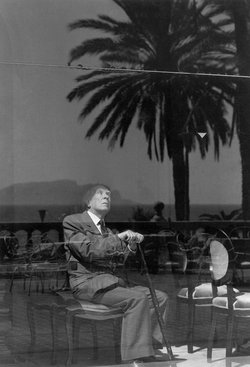
Throughout his life, Jorge Luis Borges was engaged in a dialogue with violence. Speaking to an interviewer about his childhood in what was then the outlying barrio of Palermo, in Buenos Aires, he said, “To call a man, or to think of him, as a coward—that was the last thing…the kind of thing he couldn’t stand.” According to his biographer, Edwin Williamson,1 Borges’s father handed him a dagger when he was a boy, with instructions to overcome his poor eyesight and “generally defeated” demeanor and let the boys who were bullying him know that he was a man.

Swords, daggers—weapons with a blade—retained a mysterious, talismanic significance for Borges, imbued with predetermined codes of conduct and honor. The short dagger had particular power, because it required the fighters to draw death close, in a final embrace. As a young man, in the 1920s, Borges prowled the obscure barrios of Buenos Aires, seeking the company ofcuchilleros, knife fighters, who represented to him a form of authentic criollonativism that he wished to know and absorb.

The criollos were the early Spanish settlers of the pampa, and their gaucho descendants. For at least a century now, the word has signified an ideal cultural purity that, according to its champions, was corrupted by the privatization of the pampa and, later, by the flood of immigrants from Italy and elsewhere in Europe that took place in the late nineteenth and early twentieth centuries.

More here.

The Next Mass Extinction

Lynx

Marek Kohn in More Intelligent Life:

Five times in the history of life on Earth, mass extinctions have eliminated at least three-quarters of the species that were present before each episode began. The likely exterminators were volcanoes, noxious gases, climatic upheavals and the asteroid that did for the dinosaurs. Now a single species threatens to wipe out most of the others that surround it. We are faced with the realisation, as the ecologist Robert May puts it, that we “can now do things which are on the scale of being hit by an asteroid”.

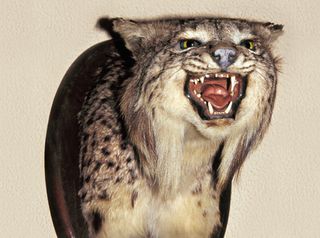
THE LYNX BECAME top predator in Doñana after the last wolf was shot in 1951. That is how it goes with predators and large animals. The bigger they are, the sooner they tend to vanish. Among mammals, the risk of extinction rises sharply for species that weigh more than three kilograms—about as much as a small pet cat. Big creatures need more food and more space to find it in than small ones; they are slower to reproduce, and are apt to get on the wrong side of humans. “The species that tend to go extinct first tend to be the big-bodied things, and the tasty things,” says Rob Ewers of Imperial College London. He is talking about the Amazon forests, but it’s a general truth.

Big animals, particularly those at the top of food chains, “are really fundamentally important to holding ecosystems together,” says Jim Estes, a biologist based at the University of California, Santa Cruz. When they go, ecosystems unravel and reorganise, removing more species in the process. “Apex consumers” can take whole habitats with them. Wolves may protect forests by preying on the deer that browse saplings. If the wolves are wiped out, the deer multiply at the expense of the trees, preventing the forest from renewing itself: the end-point, as on the once-forested Scottish island of Rùm, is a treeless landscape. Globally, the result is the “downgrading of Planet Earth”, as Estes put it in an article for the journal Science in 2011.

The exits began long before roads or rifles were devised. Nearly three-quarters of North American and a third of Eurasian megafauna disappeared between 50,000 and 10,000 years ago. Woolly mammoths, woolly rhinoceroses, giant sloths and sabre-toothed cats were among the species that vanished from the face of the Earth. While climate change was one part of the story, human expansion was another. The selective disappearance of large animals marks this period out from other extinction episodes, and was the start of what Estes and his fellow authors suggested “is arguably humankind’s most pervasive influence on the natural world”. For Estes, it was the beginning of the sixth mass extinction.

More here.

Strange Life

Colin-Wilson

Ken MacLeod in Aeon:

Like Aldous Huxley and C S Lewis with John F Kennedy, the English writer Colin Wilson had the misfortune of dying on the same day as a vastly (and justly) more famous man: Nelson Mandela. When Wilson’s first book, The Outsider, came out in 1956 — coinciding with the arrival of a noisy cohort of anti-establishment writers labelled the ‘Angry Young Men’ — he became an overnight sensation: a self-taught, ‘staggeringly erudite’, working-class, provincial 24-year-old hailed by highbrow reviewers as Britain’s answer to Jean-Paul Sartre and Albert Camus. Almost as quickly, he was dropped, and his subsequent prolific literary career, which moved from philosophy and religion through psychology and parapsychology to the wilder shores of Atlantis and science fiction, is usually taken to vindicate those second thoughts. A handful of obituaries have appeared in the quality press since 5 December. Most have a tincture of condescension, which is understandable. Wilson’s evaluation of his own importance as a writer and thinker was well out of kilter with that of most critics, and indeed with reality.

And yet, and yet… it’s a safe bet that some readers of Aeon will remember him fondly, and owe to him their first introduction to this magazine’s characteristic themes. I’ll cheerfully admit it myself. Reading Wilson’s The Outsider at the age of 16 or so opened my mind to writers, thinkers and ideas I’d never heard of before, and gave a new significance to some that I had. Sartre, Camus, Henri Barbusse, Ernest Hemingway, T E Lawrence, T S Eliot, Friedrich Nietzsche and many others, including William Blake and George Fox, founder of the Quakers, were all portrayed making heroic but usually ill‑fated attempts to storm a fortress of existential perplexity to which Wilson (as he strongly hinted) had found the key. The Outsider ticks all the boxes for a successful cult book: readable style, significant subject-matter, and reckless assertion. The effect was exhilarating.

More here.

Susan Sontag: The Complete Rolling Stone Interview

Jonathan Derbyshire in The Guardian:

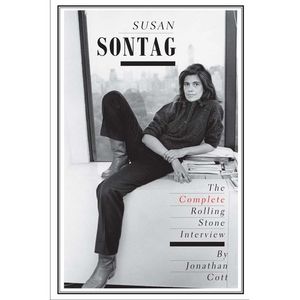
SontagA few months after Susan Sontag died in December 2004, the American literary academic and writer Terry Castle published a wonderful and amusing reminiscence in the London Review of Books of the woman to whom she'd intermittently played the role of “female aide-de-camp”. Castle lives and works in California, and whenever Sontag was on the west coast to give a lecture she'd co-opt her friend as a kind of amanuensis-cum-tour guide and fixer. Castle was happy to play the role of “obsequious gofer” (she had “idolised Sontag literally for decades”), though at its best, she confesses, their relationship resembled the one between Dame Edna Everage and her permanently mournful sidekick Madge Allsopp. (You shudder to think what it was like at its worst.) Castle would drive Sontag (pictured) between San Francisco and the Stanford University campus in Palo Alto. Her other job was to be a sounding board for Sontag's compulsive kvetching – about the “dreariness” of Castle's Stanford colleagues in particular and the provincialism of California in general. The latter was something of a specialist subject for Sontag, as her 1978 Rolling Stone interview with Jonathan Cott, published unexpurgated and at book length for the first time, makes clear.

Sontag was born in Arizona in 1933, and in 1945 she moved with her mother and sister to Los Angeles, where she attended high school. After spending a semester as an undergraduate at Berkeley, she moved to the University of Chicago and, following graduate school at Harvard, eventually ended up in New York, where she fell in with the intellectuals gathered around the Partisan Review. She tells Cott that New York is the place she feels loyal to and that she has the right to “knock California because I know it so well!” In fact, she knocks not just California – “Too many things have just not migrated [there]: the connection with Europe, with the past, with the book world …” – but Californians, too. One of the reasons, she says, that she prefers to be in New York is that she wants to be around people who are “ambitious and restless. You meet a Californian and they say, Hi! … and then there's a big silence.”

This and other passages in Cott's book reminded me of Castle's description of Sontag as a “great comic character” with whom Dickens or Henry James would have had a field day – an odd combination of “carefully cultivated moral seriousness” and gossipy skittishness, plus a rare erotic charisma that ensnared men and women alike. (The jacket photo, in which she lounges smoulderingly in a window seat overlooking Central Park, one elbow on a pile of books and papers, is echt mid-period Sontag.) Cott's interview, which he conducted in Paris and New York during the summer and autumn of 1978, corroborates Castle's judgment and offers rich pickings for a latter-day Dickens or James. It does so partly because he seems to have decided that his job was to act as stenographer to Sontag's performance of her own seriousness. In a somewhat breathless preface, he reports that she spoke to him in “measured and expansive paragraphs”, “precisely calibrating her intended meanings” (by which he means that she used qualifiers like “sometimes” and “occasionally” a lot). He also quotes a journal entry from 1965 in which Sontag vows to “give no interviews until I can sound as clear + authoritative + direct as Lillian Hellman in Paris Review”.

More here.

Why Indian author Vikram Seth is angry

From the BBC:

EthThe celebrated novelist, who is writing a sequel to his epic bestseller A Suitable Boy, is incensed with the recent decision of India's top court to uphold a law which criminalises gay sex – a ruling seen as a major blow to gay rights.

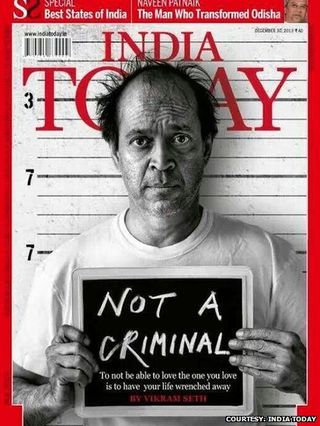
So much so that the usually calm and dapper writer has posed – unshaved, dishevelled and looking distinctly angry – on the cover of India Today magazine holding a plastic chalkboard speaking 'Not A Criminal' to promote hismoving essay in the magazine on gay rights.

No wonder the powerful cover has become a talking point – one doesn't remember any Indian writer doing such a thing ever in the past.

Mr Seth, who took a degree in philosophy, politics and economics at Oxford, was once described by The New York Times as a person with a “polite wit”. I found that wit intact when I spoke to him this morning on the cover that is making waves.

Why are you so angry?

I am appalled by the Supreme Court judgement [criminalising gay sex]. The judgement is intellectually shallow and ethically hollow.

It is slipshod in its reasoning and pusillanimous with regard to defending fundamental rights. It was squarely in the province of the Supreme Court to decide the matter, but this normally activist court has kicked the football onto the pitch of an illiberal parliament.

The constitution protects the liberties and rights of Indian citizens. It is not for the judges to confer rights or take them away.

More here.

opening The Dostoevsky Archive

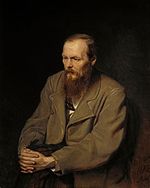
220px-Vasily_Perov_-_Портрет_Ф.М.Достоевского_-_Google_Art_ProjectAndre van Loon at Berlin Review of Books:

The impetus to know about a writer’s life becomes all the stronger when, rather than being unlikely to ever know more, we are instead faced with systematic attempts to obscure. The University of Toronto’s Slavic scholar Peter Sekirin, in compiling and translating around one hundred, rare first-hand accounts of Fyodor Mikhailovich Dostoevsky’s life and career, is driven to allow as many illuminating voices to be heard as were suppressed during the Soviet Union. Dostoevsky started well enough, from the later, official point of view. He debuted with the sentimental, socially conscious novelPoor Folk (1846), became a member of the Petrashevsky socialist circle, and suffered for his politics during his subsequent Siberian imprisonment and enforced military service. What the Soviets could not countenance, however, was the writer’s infuriating, post-Siberian right-wing turn, the erstwhile socialist dreamer becoming an ardent royalist and defender of personal responsibility. Thus, finding out about Dostoevsky became harder than ever during the Soviet era. The official school syllabus mentioned him in scant terms and academics were hampered by the so-called ‘special funds’: library archives requiring official, often denied, approval to access, and from which nothing could be published.

Sekirin has painstakingly managed to trace much of this previously restricted material. Impressively, less than ten percent of his compilation has been previously published in English, with nearly 80 per cent of it dating from the years 1881-1935. Although worldwide Dostoevsky studies can draw on a bibliography of thousands of items, including the monumental, five-volume biography written by Joseph Frank, it is undoubtedly to the field’s benefit that more people who actually knew, lived and worked with Dostoevsky can now be heard.

more here.

translating the golden ass

Ga30J. Kates at Harvard Review:

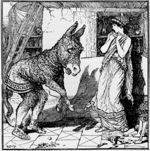
I’ve been looking at asses. More specifically, I have been weighing Sarah Ruden’s 2011 translation of The Golden Ass of Apuleius against the one I grew up with and have been sitting on all my life, Robert Graves’s 1951 version.

Strictly speaking, “The Golden Ass” isn’t the book’s proper name. More sedately known as Metamorphoses, written by the North African writer Lucius Apuleius in the second century CE, this work, often regarded as a proto-novel, follows the adventures of a young man perhaps not coincidentally named Lucius who trespasses trivially on occult secrets and—you’ll have to read for yourself how this is done—becomes the first, but not the last, to make an ass of himself.

Trapped inside his peau de chagrin, Lucius undergoes a number of outrages, overhears far more than he should, and ends up being redeemed after a year by the goddess Isis and inducted into mysteries we are not permitted to share. The Golden Ass is, in Lewis Carrollingian terms[1], what the name of the book has come to be called, presumably to keep it from being confused with Ovid’s. St. Augustine, of all people, is credited with assuring the world of Apuleius’s authority for the title The Golden Ass. There’s nothing at all golden about Lucius either as man or beast, and the name is likely a word play, a pun asinorum.

more here.

For That Zeus Bug in Your Life

Natalie Angier in The New York Times:

GiftsWe may denounce the hyper-consumerism of the Christmas season until we’re Hanukkah blue in the face, but much of our economy relies on the strength of the gift-giving impulse, and with good reason: The drive to exchange presents is ancient, transcultural and by no means limited to Homo sapiens. Researchers have found striking examples of gift-giving across the phyletic landscape, in insects, spiders, mollusks, birds and mammals. Many of these donations fall under the rubric of nuptial gifts, items or services offered up during the elaborate haggle of animal courtship to better the odds that one’s gametes will find purchase in the next generation. Hungry? Why don’t you go ahead and chew on the droplets oozing from my hind-leg spur while I just take a few moments to deposit a sperm packet in the neighborhood of your genitals?

Nuptial gifts can also be a gift for researchers, allowing them to precisely quantify a donor animal’s investment in mating and reproduction, and to track the subtleties of sexual competition and collusion by analyzing the chemical composition of a given bag of courtship swag. “This is an incredibly cool and important topic in sexual selection that we’re just beginning to explore,” said Sara M. Lewis, a professor of biology at Tufts University who has written extensively about nuptial gifts. “The bright side of nuptial gifts is, here’s a way that males can contribute things that are essential to his mate and to his future offspring. “On the other hand, the gifts can be a source of sexual conflict, a way of manipulating the female into doing what he wants,” she said. “So there is a lot of back and forth over evolutionary time.” Other researchers are studying how animals use gifts socially, to foster alliances or appease dominant members of the group. Grooming among primates is considered a form of gift-giving, and in most cases, it’s the subordinates who do the tick-picking: betas groom alphas, females groom males.

More here.