Saturday Poem

Visitors from Abroad

1

Sometime after I had entered
that time of life
people prefer to allude to in others
but not in themselves, in the middle of the night
the phone rang. It rang and rang
as though the world needed me,
though really it was the reverse.

I lay in bed, trying to analyze
the ring. It had
my mother’s persistence and my father’s
pained embarrassment.

When I picked it up, the line was dead.
Or was the phone working and the caller dead?
Or was it not the phone, but the door perhaps?

2

My mother and father stood in the cold
on the front steps. My mother stared at me,
a daughter, a fellow female.
You never think of us, she said.

We read your books when they reach heaven.
Hardly a mention of us anymore, hardly a mention of your sister.
And they pointed to my dead sister, a complete stranger,
tightly wrapped in my mother’s arms.

But for us, she said, you wouldn’t exist.
And your sister — you have your sister’s soul.
After which they vanished, like Mormon missionaries.

Read more »

The Global Mind That Came In From the Counterculture: John Brockman

From Faz.net:

BrockmanThe Internet had yet to be born but the talk still revolved around it. In New York, that was, half a century ago. „Cage,“ as John Brockman recalls, „always spoke about the spirit that we all share. That wasn’t some kind of holistic nonsense. He was talking about profound cybernetic ideas.“ He got to hear about them on one of the occasions when John Cage, the music revolutionary, Zen master and mushroom collector, cooked mushroom dishes for him and a few friends. At some point Cage packed him off home with a book. „That’s for you,“ were his parting words. After which he never exchanged another word with Brockman. Something that he couldn’t understand for a long time. „John, that’s Zen,“ a friend finally explained to him. „You no longer need him.“ Norbert Wiener was the name of the author, Cybernetics: Or Control and Communication in the Animal and the Machine the name of the book. Page by page Brockman battled his way through the academic text, together with Stewart Brand, his friend, who was about to publish the Whole Earth Catalog, the shopping primer and bible of the environmentally-driven counterculture. For both readers, physics and mathematics expanded into an infinite space that no longer distinguished between the natural and human sciences, mind and matter, searching and finding.

Like the idea of the Internet—which was slowly acquiring contours during these rambling 1960s discussions—the idea of Edge, the Internet salon around which Brockman’s life now revolves, was also taking shape. Edge is the meeting place for the cyber elite, the most illustrious minds who are shaping the emergence of the latest developments in the natural and social sciences, whether they be digital, genetic, psychological, cosmological or neurological. Digerati from the computer universe of Silicon Valley aren’t alone in giving voice to their ideas in Brockman’s salon. They are joined in equal measure by other eminent experts, including the evolutionary biologists Richard Dawkins and Steven Pinker, the philosopher Daniel Dennett, the cosmologist Martin Rees, the biological anthropologist Helen Fisher, the economist, psychologist and Nobel Prize winner Daniel Kahneman, the quantum physicist David Deutsch, the computer scientist Marvin Minsky, and the social theorist Anthony Giddens. Ranging from the co-founder of Apple Steve Wozniak to the decoder of genomes Craig Venter, his guest list is almost unparalleled even in the boundless realm of the Internet. Even the actor Alan Alda and writer Ian McEwan can be found in his forum.

More here.

A Vengeful Fury: Slavery, Freedom, and Deception in the New World

Andrew Delbanco in The New York Times:

GregBetween the early 16th century and the middle of the 19th, more than 12 million human beings were shipped against their will from Africa to the New World and sold into slavery. An untold number died at different stages of the journey — overland in Africa, during the “middle passage” at sea or soon after arrival. Among those who perished, most died of disease, some by suicide and still others from wounds or execution following failed revolts.

For nearly four centuries, as Greg Grandin writes in his powerful new book, slavery was the “flywheel” that drove the global development of everything from trade and insurance to technology, religion and medicine. To read “The Empire of Necessity” is to get a sort of revolving scan from the center of the wheel. What we see is an endless sequence of human transactions — the production and exchange of meat, sugar, rice, cotton, tobacco, gold, among many other things — all connected, through slavery, by linkages whose full extent cannot be discerned from any point along the way. Slaves, Grandin writes, “were at one and the same time investments (purchased and then rented out as laborers), credit (used to secure loans), property, commodities and capital.”

More here.

Tyson vs. Ali

Charles Isherwood in the NYTimes:

TysonFor all its physical exuberance — the actors often appear to pummel one another with an intensity that you half expect to draw blood — Mr. Farrington’s approach to the material is primarily cerebral, inspired by his fascination with the psychology of boxing and boxers. Divided into thematic “rounds” (“Beauty and Brutality,” “Endurance/Strategy”), the text employs speeches from interviews and news conferences Ali and Tyson gave, but there’s little in the way of standard information conveyed about the victories, setbacks and scandals of their careers. Mr. Farrington is more interested in the men’s psyches — at times surprisingly similar, despite their very different boxing styles — rather than in their historical achievements and the arcs of their lives.

The four performers try only vaguely to impersonate either Ali or Tyson. Mr. Casey bears a nominal resemblance to Ali, and nails his blustery braggadocio. When they are portraying Tyson, the actors sometimes mimic his oddly endearing, whispery lisp. But if you spend too much time trying to figure out who’s who at any given moment, you’re likely to miss the larger point of the show, which is to excavate the drives, fears and obsessions that race around the heads of boxers before, during and after they meet in the ring.

There are, of course, differences in how each of these two celebrated fighters met the challenges of a brutal game that often involves almost as much psychological warfare as it does physical interaction. “I want him to be the hero,” Ali says, speaking of his opponent. “I want everybody to cheer him, and I want them all to boo me … I always love to be the underdog, the bad man. He’s the good American boy, and I’m the bad boy.”

Ali used that kind of me-against-the-world attitudinizing to pump himself up, but also to disarm opponents, who would then be taken by surprise when the underdog started to bite with unerring aim. We hear Tyson evincing a more conflicted and complex version of the prefight mind-set: “When I come out, I have supreme confidence,” he says, but then follows this Ali-like statement with a seeming contradiction: “I’m totally afraid. I’m afraid of everything. I’m afraid of losing. I’m afraid of being humiliated.

Read more here.

Friday, January 10, 2014

What Can Blind People Tell Us About Race?

Osagie K. Obasogie in the Boston Review:

Obasogie-webFor several years now, a quiet revolution has been underway in consumer electronics. Gadgets that are a part of our everyday lives have learned to see. Relying on optical devices and software that can detect faces and track body motions, cameras, gaming systems, phones, and other tools have gained access to the mechanisms of visions and recognition that were once considered the unique province of sentient beings.

But some of these technologies have a problem: they have a hard time seeing people of color.

In December 2009 Wanda Zamen and Desi Cryer, two employees at a camping supply store in Waller, Texas, noticed something peculiar about an HP computer at the shop. The computer featured a digital camera that detected and tracked human faces. The system had no problem identifying and following Wanda, who is white, but it could not do the same for Desi, who is black. He demonstrates the glitch in a YouTube video that has been viewed almost 3 million times. “As you can see, the camera is panning to show Wanda’s face. It’s following her around. But as soon as my blackness enters the frame, . . . [the camera] stops,” he says.

A similar bug was found in the Nikon Coolpix S630 digital camera. Designed to overcome the timeless challenge of a blinking subject, the camera detects faces and alerts the photographer when it senses closed eyelids. But when Joz Wang, a young Taiwanese woman from Los Angeles, tried to take pictures of her family, the camera kept showing the same error message: “Did someone blink?” To which Wang responded on her blog, “No, I did not blink. I’m just Asian.”

And Microsoft’s popular Xbox 360 Kinect video game system, which uses facial and body-motion detection to enable interaction, has also had trouble recognizing nonwhite faces.

All of these technological errors are correctable, yet the question remains: Why do they happen at all?

More here.

Why did the AK-47 become so popular?

From The Economist:

Kalash29MIKHAIL KALASHNIKOV died on December 23rd, aged 94. But his 66-year-old invention, theAvtomat Kalashnikova, has plenty more shots left to fire. Developed in 1947 and first used by Soviet forces in 1949, the AK-47 assault rifle and its many derivatives are now used by the armed forces of more than 80 countries, and by freelancers in many more. No-one knows quite how many are in circulation: 100m is a reasonable guess. As a proportion of all the guns in the world—another number no-one can be quite sure about—Kalashnikovs probably make up more than one in ten of all firearms. Why does an ageing Soviet invention still dominate modern warfare?

The cultural impact of the AK is felt all over the world. Quentin Tarantino’s villains celebrate its appropriateness for “when you've absolutely, positively got to kill every [enemy combatant] in the room”. Mexican outlaws boast about their cuernos de chivo, or “goat horns”, the nickname given to the rifle because of its curved magazine. In some parts of Africa, where the gun is seen as a symbol of the ousting of colonial rulers, Kalash is a popular name for boys. Mozambique displays the gun on its flag. In Lebanon, a model nicknamed the “Bin Laden” sells for twice the price of the standard AK-47, because it is the type that al-Qaeda’s former boss was seen toting in some of his videos.

The gun is nothing special. Its controls are unsophisticated; it is not even particularly accurate. But this simplicity is a reason for its success.

More here.

The animal that built the strange picket fence structure has been found

Carrie Arnold in National Geographic:

ScreenHunter_488 Jan. 10 20.11Six months ago, visitors to the Peruvian Amazon discovered a mysterious picket fence structure nicknamed Silkhenge. Despite watching the structure for several days, naturalists at theTambopata Research Center couldn’t figure out what type of animal (or fungus) was building it.

When scientist Troy Alexander first announced his find, all he had to show for his discovery was a series of intriguing photographs. He had no idea what Amazonian critter could have created the circular hideaway with a spoke-like outer wall.

After consulting with several entomologists, Alexander hypothesized that it was likely built by a type of cribellate spider, which are known for building elaborate structures.

When we first posted news of the picket fence, readers flooded the blog with suggestions for what had built it and what scientists should name the potential new species. While many of you agreed with Alexander’s hypothesis that the fence was built by a spider, others of you weren’t so sure, guessing that a fungus or caterpillar may have built it.

More here.

THE BODY AS BATTLEFIELD

Tom Shone in More Intelligent Life:

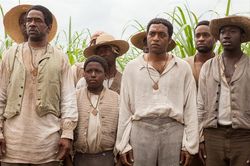
Twelve-years-a-slave-michael-fassbenderThe Oscar for Best Picture is widely expected to go to “12 Years a Slave”. Adapted from Solomon Northrup's 1853 memoir about being snatched from his family in the north and sold into slavery in Louisiana, the film is constructed almost like a horror movie, each circle of hell bigger than the last. Walloped and poked by a slave-trader, Solomon (Chiwetel Ejiofor) is viciously abused by an overseer, only to arrive—out of the frying pan, into hellfire—at the plantation of a “nigger-breaker” (Michael Fassbender) and his wife, whose chief pleasure in life is to see her husband's prized slave mistress suffer. To adapt Martin Amis's line about shotgun blasts in the films of Sam Peckinpah: after “12 Years a Slave”, a whipping ceases to look like something you bounce back from. This is the third film from Steve McQueen, whose work is all about the control of a body. In “Hunger” that body belonged to the hunger-striker Bobby Sands, played by Fassbender, whose emaciated form became a theatre of war. The film was brutal, austere—as furiously controlled as its subject. In “Shame”, the body was that of a sex addict, also played by Fassbender, propelled around lower Manhattan by appetites uncurbed—the opposite of Sands's predicament. Critics snickered, but there was no doubting McQueen's singleness of focus: in his films the body is a battlefield, scarred and cratered by a fierce, existential fight for autonomy.

It was only a matter of time before he embarked on a film about slavery. That he has made the best film ever made on the subject isn't saying that much. Slavery is one of those black-hole subjects, like the Holocaust, that involved so much suffering that the result is either humanitarian kitsch or exploitation: “The Color Purple” or “Django Unchained”. McQueen resolutely refuses to slot into either tradition, combining the cruel spectacle of the latter with the moral anger of the former. Does he want to put the audience through it? No question. In the most memorable scene, Solomon is left hanging from a tree by a noose, barely able to breathe, his toes slipping in the mud beneath him. McQueen holds the shot for several excruciating minutes while Solomon fights to stay upright. Behind him, other slaves go about their chores, and children play beneath the sun-dappled willows.

More here.

the trailer as art

ArticleJ. Hoberman at Artforum:

Even more than Breathless, its trailer is a kind of manifesto. Narrative parameters established, its subsequent attractions include both the specific (“Humphrey Bogart,” “Picasso,” Jean Seberg’s “nice buns”) and the abstract (“tenderness,” “adventure,” “love,” the last accompanied by the image of a book of photographed nudes), and it ends with the filmmaker’s ringing declaration that Breathless is the “best film out now!”

Godard’s follow-up trailer for A Woman Is a Woman (1961) was in the Hitchcockian mode of personal appearance: The screen flashes ATTENTION . . . ATTENTION as the artist announces, “I, Jean-Luc Godard, arrive on the set,” and he begins explaining his artistic method while Anna Karina repeatedly interjects the movie’s title. But the Breathless trailer provided a template for 1963’s Contempt (“the new traditional movie by Jean-Luc Godard”) and 1965’s Pierrot le fou (“a wonderful love story in a tragic setting”), both facilitated by looped bits of theme music. (Whoever cut the American trailer for Sergio Leone’s The Good, the Bad and the Ugly in 1967 employed a similar strategy.)

more here.

jesus, the brat

Childhood-of-Jesus-US-CoverJonathan Ullyot at The Point:

Coetzee’s title suggests an allegory or a contemporary retelling of the Christ narrative. Creative re-imaginings of the historical Jesus have been popular ever since late antiquity and most recently after The Da Vinci Code, itself a recycling of the sensational (and almost completely unfounded) conspiracy theories in the nonfiction work, The Holy Blood and the Holy Grail. José Saramago wrote an alternative history of Christ, The Gospel According to Jesus Christ, which went so far as to depict a teenage Jesus being tempted to have sex with a sheep. Norman Mailer wrote a very orthodox retelling of the life of Jesus in the first person,The Gospel According to the Son. (He followed it with a creative retelling of the childhood of Hitler, The Castle in the Forest.) More recently, Philip Pullman wrote The Good Man Jesus and the Scoundrel Christ, which depicts two brothers: Jesus, a moral and god-fearing man, and Christ, a schemer who wants to build a powerful church. Colm Tóibín’s The Testament of Mary imagines that Mary did not believe that her son was also the son of God and that she refused to collaborate with the writers of the gospels.

Coetzee’s The Childhood of Jesus is a story about a bratty kid in a developing socialist country doted on by two very unsympathetic parents. It is replete with philosophical dialogues about the nature of familial love and the proper way of unloading grain from a ship. Jesus is never mentioned. It is not what we expect to find when we pick up a novel called The Childhood of Jesus.

more here.

from arts and crafts to “makers”

140113_r24479_p233Evgeny Morozov at The New Yorker:

A reluctance to talk about institutions and political change doomed the Arts and Crafts movement, channelling the spirit of labor reform into consumerism and D.I.Y. tinkering. The same thing is happening to the movement’s successors. Our tech imagination, to judge from catalogues like “Cool Tools,” is at its zenith. (Never before have so many had access to thermostatically warmed toilet seats.) But our institutional imagination has stalled, and with it the democratizing potential of radical technologies. We carry personal computers in our pockets—nothing could be more decentralized than this!—but have surrendered control of our data, which is stored on centralized servers, far away from our pockets. The hackers won their fight against I.B.M.—only to lose it to Facebook and Google. And the spooks at the National Security Agency must be surprised to learn that gadgets were supposed to usher in the “de-institutionalization of society.”

The lure of the technological sublime has ruined more than one social movement, and, in this respect, even Mary Dennett fared no better than Felsenstein. For all her sensitivity to questions of inequality, she also believed that, once “cheap electric power” is “at every village door,” the “emancipation of the craftsman and the unchaining of art” would naturally follow. What electric company would disagree?

more here.

Leaked files slam stem-cell therapy

Alison Abbott in Nature:

NatureA series of damning documents seen by Nature expose deep concerns over the safety and efficacy of the controversial stem-cell therapy promoted by Italy’s Stamina Foundation. The leaked papers reveal the true nature of the processes involved, long withheld by Stamina’s president, Davide Vannoni. Other disclosures show that the successes claimed by Stamina for its treatments have been over-stated. And, in an unexpected twist, top Italian scientists are dissociating themselves from an influential Miami-based clinician over his apparent support for the foundation. Stamina, based in Brescia, claims that it successfully treated more than 80 patients, mostly children, for a wide range of conditions, from Parkinson’s disease to muscular dystrophy, before the health authorities halted its operations in August 2012. A clinical trial to assess the treatment formally was approved by the Italian government last May, and an expert committee was convened by the health ministry to study Stamina’s method and to recommend which illnesses the trial should target.

Stamina says that its technique involves extracting mesenchymal stem cells from a patient’s bone marrow, culturing them so that they turn into nerve cells, and then injecting them back into the same patient. But full details of the method have never been revealed, and Vannoni provided the full protocol to the expert committee only in August. In October, the committee’s report prompted health minister Beatrice Lorenzin to halt plans for the clinical trial. That led to public protests in support of Stamina, and, after an appeal by Vannoni, a court ruled in early December that the expert committee was unlawfully biased. Some members had previously expressed negative opinions of the method, the ruling said. As a result, Lorenzin appointed a new committee on 28 December, reopening the possibility of a clinical trial.

More here.

Friday Poem

A Summer Garden

Several weeks ago I discovered a photograph of my mother

sitting in the sun, her face flushed as with achievement or triumph.

The sun was shining. The dogs

were sleeping at her feet where time was also sleeping,

calm and unmoving as in all photographs.

I wiped the dust from my mother’s face.

Indeed, dust covered everything; it seemed to me the persistent

haze of nostalgia that protects all relics of childhood.

In the background, an assortment of park furniture, trees and shrubbery.

The sun moved lower in the sky, the shadows lengthened and darkened.

The more dust I removed, the more these shadows grew.

Summer arrived. The children

leaned over the rose border, their shadows

merging with the shadows of the roses.

A word came into my head, referring

to this shifting and changing, these erasures

that were now obvious—

it appeared, and as quickly vanished.

Was it blindness or darkness, peril, confusion?

Summer arrived, then autumn. The leaves turning,

the children bright spots in a mash of bronze and sienna.

Read more »

Thursday, January 9, 2014

Five books to argue with

Kenan Malik in Pandaemonium:

The best kind of book, to my mind, is the kind of book you can have an argument with. Not a book so wrong that I want to throw it across the room, but one that I disagree with and yet find challenging enough to force me to re-examine my own views, and often to put down my disagreements in writing to help me better to clarify them. So, here are five books for me to argue with over the next few months. And a sixth that I hope everyone else will be arguing about.

Moral Tribes: Emotion, Reason, and the Gap Between Us and Them by Joshua Greene

Greene-tribesThe contradictions of our moral lives, psychologist and philosopher Joshua Greene suggests, lies in our evolutionary history. Our brains were designed for tribal life. But we live in a globalized world that creates conflicts of interest and clashes of values that we find difficult to negotiate. Not only are we caught between the landscape of our evolved minds and the reality of the modern world, we are also caught between two mechanisms for moral thinking. Like a digital camera, human morality can work both in ‘auto mode’ or in ‘manual mode’. In automatic, point-and-shoot mode, the camera can take pictures quickly and easily, but often goes awry in difficult conditions. In manual mode, the camera can be fine-tuned to take perfect photos in even the trickiest conditions. But such fine-tuning is fiddly and takes time. Auto mode, in other words, is fast but inflexible, manual mode highly flexible, but slow and tricky to set up. The same is true, Greene suggests, of moral thinking. Normally we rely on point-and-shoot moral answers, responding quickly, instinctively, almost unthinkingly to moral problems. Our fast, instinctive point-and-shoot moral snapshot answers have developed against the background of our evolutionary history. We can, however, also step back from our intuitions, and reason our way to a moral answer.

More here.

The Unlearnt Lessons of Iraq

Tim Black in Spiked:

ScreenHunter_487 Jan. 09 17.58On 1 May this year, it will be exactly 11 years since the then US president, George W Bush stood on board the USS Abraham Lincoln and said of the US-led invasion of Iraq, ‘mission accomplished’. It was not exactly the most accurate statement, even by Bush junior’s standards. Despite the coalition troops having officially departed Iraq at the end of 2011, the mission, such as it was – and is – remains steadfastly unaccomplished. The insurgence is still surging, and Iraq’s government, led by the divisive prime minister, Nouri al-Maliki, is still begging the US for military help, a request to which President Obama relented a few weeks ago when he agreed to send over missiles and drones.

In fact, the situation in Iraq, a country supposedly liberated over a decade ago, looks to be deteriorating, not improving. The infrastructural basics, from healthcare to public sewerage, are still in a parlous state. The Shia-dominated government, seemingly set against Iraq’s minority Sunni population, appears to be as illegitimate as ever. And according to IraqBodyCount.org, the number of civilians killed last year as a result of the continued insurgency – about 9,000 – makes 2013 the deadliest year since 2008.

In a grisly irony, given the ‘war on terror’ rationale for much of recent Western interventionism, it now seems that the principal beneficiaries of the US-driven destruction of Saddam Hussein’s tinpot tyranny, beginning with the brutal UN sanctions regime imposed on Iraq in the 1990s and culminating in the 2003 invasion, have not been ordinary Iraqis, but a range of al-Qaeda spin-offs and affiliates, backed by various Middle Eastern states jostling for position in Iraq.

More here.

A good new year’s resolution from Sean Carroll

Sean Carroll in Preposterous Universe:

Mandela-cell-jpg_extra_big-300x204Nelson Mandela was a complicated person. He was no pushover; he was an activist, a revolutionary, someone who got things done and wasn’t afraid to break a few eggs when necessary. But his greatest contribution wasn’t the overthrow of apartheid in South Africa, which arguably would have happened at some point anyway — it was the peaceful way in which the transition happened, and the inclusiveness, forgiveness, and ability to look forward with which he led the nation thereafter.

Now, the concept of “New Year’s Resolutions” is a pretty awful one. Most people resolve to lose weight or some generic version of being nicer, and most fall off the wagon pretty quickly. A health club I used to go to would display signs in January saying “Regulars: don’t worry about the crowds, most of them will be gone soon.” Not very encouraging, but pretty accurate.

But the idea of resolving to be a better person is a good one, and the beginning of a new year is as good a time as any. So without making an official resolution, this year I’d like to be more like Nelson Mandela.

More here.

Surreal love in prague

P4_Shore_397411kMarci Shore at the Times Literary Supplement:

It was an ecstatic encounter. The Czech poets fell in love with the French poets – and miraculously for the Czechs, that love was reciprocated. Éluard told Nezval that Paris seemed cold and sad after his time in Prague. Breton wrote that he had taken from Prague the most beautiful memories of his life. He wanted Nezval to know that “you have acquired me completely, that for you I am willing to do everything, that you are my best friends”. The sentiments were mutual. “No feeling”, Nezval told Breton, “has seemed to me so valuable, so sublime as the thought that I can call you my adored friend.” In a letter to Éluard (not cited by Sayer), Nezval enclosed some of his poems in literal French translation: “Dear friend, that these lines have been permitted to find themselves before your eyes has already justified my entire life . . . . I love you. We all love you”.

Nezval represented what was already the third generation of Czech modernists. In the 1890s, Czech modernism had emerged as a revolt against mechanistic positivism and as a call for individualism in an age of nation-building. “We want truth in art”, proclaimed the Manifesto of Czech Modernism (1895), “not truth that is a photograph of exterior things, but honest, interior truth.” This was before Czechoslovakia existed, when the Czech lands were the possession of the Austro-Hungarian Habsburg Empire.

more here.

marshall berman’s last lecture

1388713280bermancrossbronxexpNARA2666Marshall Berman at Dissent:

I would like to begin with a little time travel: first, back to the 1950s, ’60s, and ’70s—and particularly the South Bronx of the 1970s; then, back to the Bible, back to the sixth century BCE, back to the first destruction of Jerusalem, and the start of its renewal; then a final leap into a twenty-first-century Manhattan that is full of echoes of both. I’m not going to talk now about the horrors of 9/11, or of Boston, or about the vulnerability of New York Harbor. I pay homage to the people of those places. But I’m going to focus on a distinctive landscape of ruins, an amazing, dreadful landscape that came to define the South Bronx, and for many people to define New York, for the last decades of the twentieth century. Those ruins were one of New York’s great negatives. I want to try to do what Hegel says: look the negative in the face.

The ruin was a process. It began in the late 1950s and 1960s, when the center of the Bronx was blasted and bulldozed to build the Cross Bronx Expressway. But the ruin grew far beyond anything anyone could imagine. In the 1970s there were waves of fire; in a decade the Bronx lost more than 300,000 people. Life stabilized only at the century’s end. The Bronx is still New York’s poorest borough, but its vast empty spaces are full of people again. Its population has risen, close to its 1950 peak. We will focus on the years when it was down. I invented a word for this process: URBICIDE, the murder of a city. Did I really invent it? Once you said it, it seemed obvious enough. But how do people in a murdered city live?

more here.