
Category: Recommended Reading
Sunday Poem
Deeper
Often at night, sometimes
out in the snow or going into the music, the hunch says,
“Deeper.”
I don't know what it means.
Just, “Push it. Go further. Go deeper.”
And when they come talking at me I get
antsy at times, but mostly I stay put and it keeps saying,
“Deeper. This is not it. You must go deeper.”
There is danger in this, also
beautiful fingers and I believe it can issue in
gestures of concord; but I
cannot control it, all I know is one thing—
“Deeper. You must go further. You must go deeper.”
by Dennis Lee
First Emancipation
From BlackPast.org:
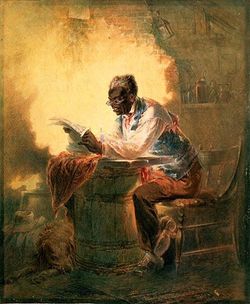
This “first emancipation” set slavery on a course towards extinction in the northern United States. As the first large-scale freeing of slaves in human history, it helped launch a movement that would in less than a century transform slavery from an accepted component of almost every human society since ancient times to something morally suspect, a “peculiar” institution. It marked a turning-point in the black experience in America.
More here. (Note: One post throughout February will be dedicated to Black History Month.)
My hero: Malala Yousafzai
The Costa-winning author Nathan Filer in The Guardian:

I've had my moments. Except then I met Malala Yousafzai. This was at the National Book awards last year. Malala had won the Non-fiction Book of the Year for her memoirI Am Malala. She took to the stage and began to speak to a crowd of gently inebriated literati. I have never had a stronger sense of being in the company of greatness. But also something better than that: goodness. Malala talked of her love of books and her belief in the power and importance of them. She spoke of her faith, of how God had chosen books as the best way to send His message to people. There was a ripple of awkwardness at that, some laughter, but not at what followed. Malala spoke eloquently and profoundly about the 57 million children across the world who still have no access to school, no chance to learn to read. “We must help them,” she told us, the room now silent. “That is what I dream: to see children reading books, and going to school, and I hope that one day we will achieve our goal, and that is my mission.”
So much has been written of this extraordinary young person, and of her achievements in educational activism and rights for women. To begin to discuss this in such a brief column would be to do her a disservice. Instead I'll settle for noting that she was ever-so-slightly shorter than I imagined, and brilliantly, inspiringly human.
More here.
Saturday, February 8, 2014
Robert A. Dahl, 1915-2014
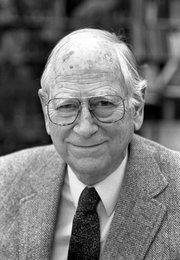
Douglas Martin in the New York Times:
Perhaps Professor Dahl’s best-known work was one of his earliest: “Who Governs? Democracy and Power in an American City” (1961), which examined the political workings of New Haven. In contrast to the view that power in American society was concentrated in a business elite, he depicted a multitude of groups competing for influence. “Instead of a single center of sovereign power,” he wrote, “there must be multiple centers of power, none of which is or can be wholly sovereign.”
New Haven, he argued, had experienced a historical progression from patrician rule to a more contested form of government in which political parties and candidates of different ethnic and economic backgrounds competed.
Professor Dahl initially defended pluralistic competition as inherently democratic, but in later books he theorized that powerful, politically agile minorities could thwart the will of other minorities and, indeed, majorities. He particularly worried that corporate managers could dictate the direction of their companies, often without reference to shareholders. He advocated giving outsiders, including government and interest groups like consumer representatives, a greater role in corporate governance.
He also wrote that citizens in recent years have had less influence over the political process, even as they have demanded more of it. He pointed to growing economic inequality as a threat to the political process.
More here.
Massimo Pigliucci: On Coyne, Harris, and PZ (with thanks to Dennett)
From the IEET website:
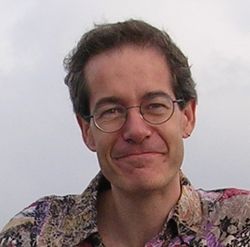
(The same issue of that journal carries a number of other commentaries, from theists and atheists alike.)
I watched the Twitter/blog mini-storm with some amusement (decades in the academy have forced me to develop a rather thick skin). The event was characterized by the usual back and forth between people who agreed with me (thank you) and those who don’t (thank you, unless your comments were of the assholic type). I thought there was no point in responding, since there was very little substance to the posts themselves. But then I realized that the mini-storm was making precisely my point: the whole episode seemed to be a huge instance of much ado about nothing, but nasty. So I decided a counter-commentary might be helpful after all. Here it is, organized by the three major authors who have lashed out at me in such an amusing way. I’ll start with a point-by-point response to Coyne’s longest blog post, followed by a more cursory commentary on PZ (who actually makes most sense out of the whole bunch, and indeed was himself mentioned only in passing in my paper), and ending of course with Harris, in whose case I will simply let Dan Dennett (another NA, did you know?) do the job for me.
More here.
Sue Hubbard: “…yes”
Among the Wolves
Ahsan Akbar in the Dhaka Tribune:
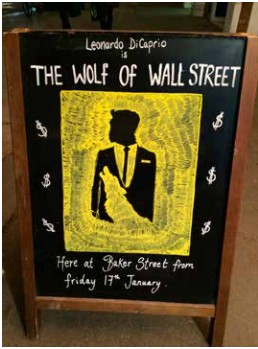
Belfort, a middle-class boy from the suburbs, has only one ambition, to become a millionaire. He will do anything to get there. After losing his job on Wall Street, he soon establishes his own firm, Stratton Oakmont, recruits an unlikely team of men and trains them in the art of selling. They start selling stocks; given their conviction and technique, they could sell ice to Eskimos. Soon, greed gets the better of Belfort, and he runs a number of securities fraud. When things get murky, especially with the FBI watching, he becomes involved in money laundering. One thing leads to another, and before Belfort can get his act straight the chickens come home to roost. It’s a clichéd tale perhaps, but what makes The Wolf different and hugely watchable is Scorsese’s masterly directing, a killer screenplay from Terence Winter, and an eclectic soundtrack. We get the full monty of Belfort’s high life: Ferraris, mansions, yachts, expensive suits, $40,000 watches, call girls, and a whole lot of candycaine. Belfort is different from the investment banker described in Liar’s Poker. For a brief period of time, he is truly a master of the universe, reaching the stratosphere by trading penny stocks and dialing in to Wall Street from Long Island.
More here.
TURBULENCE IN THE WORLD OF SICK BAG COLLECTING
Dorothy Feaver in The Junket:

This article is written at a point when the design and production of unique airsickness bags is decreasing and seeks to touch on the implications of this star in the descendent. It takes its cue from the salutary scene in Wayne’s World, where Wayne and Garth discover their buddy Phil in a bad way:
Wayne: ‘Phil, what are you doing here, you’re partied out man, again.’
Garth: ‘What if he honks in the car?’
Wayne: ‘I’m giving you a no-honk guarantee.’
Garth, doubtful, has the alacrity of mind to pull out a tiny crumpled Dixie cup from his breast pocket and offer it to Phil. If the receptacle is hopelessly sized for the job, the gesture protests that there is no such thing as a ‘no-honk guarantee’.
More here.
Edmund white in paris

The latest installment of White’s life story, “Inside a Pearl,” finds the celebrated author of “A Boy’s Own Story” in Paris in 1983, just after that book had been published. It’s a city White had visited before, but at 43, he felt determined to make the place his own: “I wanted Paris to be a real grown-up, pansexual adventure.” But he knew it wouldn’t be easy, given the obstacles, including “a strange language spoken rapidly, a culture that rivals and a history that far surpasses America’s, winters during which it rains every single day, an exorbitantly expensive town.”
He would, despite the difficulties, spend many years in the city Hemingway had called “a movable feast,” transforming himself from an American writer into something else. “I was too prissy, too refined, too abstemious, too French to be a good American writer,” he notes. The abstemious part refers to his having given up tobacco and alcohol, though he never stinted on good meals or sexual encounters, even after being told he was H.I.V.-positive in 1985. (He was lucky in belonging to a small group of those whose disease progresses slowly.)
more here.
the real beatles
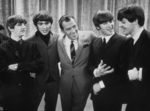
Doggett’s portrait of the band — as businessmen, tied to each other by a partnership they’d entered in their 20s — is fascinating because it addresses them not as idols but as human beings. The tensions are summed up most succinctly by McCartney, who says of his decision to leave the group: “One night I’d been asleep and awoke and couldn’t lift my head off the pillow. My head was down in the pillow and I thought, Jesus, if I don’t do this, I’ll suffocate.”
What McCartney’s describing is, in every way that matters, the flip side of that heady arrival in New York, with its declaration of possibility. It’s also a vivid glimpse from the inside at the price of success, of celebrity.
This is the part of the story no one wants to hear, and yet it’s the part that, finally, resonates. Or, as Lennon observes, looking back to 1964 and its aftermath in “Lennon Remembers” (which gathers his 1970 Rolling Stone interview with Jann Wenner): “We were just a band that made it very, very big, that’s all.”
more here.
Are humans really as unique as we like to think?

You might think we that we humans are special: no other species has, for example, landed on the moon, or invented the iPad. But then, I personally haven’t done those things either. So if such achievements are what makes us human then I must be relegated to the beasts, except in so far as I can catch a little reflected glory from true humans such as Neil Armstrong or Steve Jobs.
Fortunately, there are other, more inclusive, ideas around about what makes us human. Not long ago, most people (in the west) were happy with the account found in the Bible: we are made in the image of God – end of argument. But the theory of evolution tells a different story, one in which humans slowly emerged as a twig on the tree of life. The problem with this explanation is that it is much more difficult to say exactly what makes us so different from all the other twigs.
Indeed, in the light of new research into animal intelligence, some scientists have concluded that there simply is no profound difference between us and other species. This is the stance taken in new books by Henry Gee, palaeontology editor of the leading scientific journal Nature, and by animal behaviour expert Marc Bekoff. But other scientists of equal eminence argue the opposite: that new research is finally making the profound difference between humans and animals clear – and two of them, the psychologists Michael Tomasello and Thomas Suddendorf, have written new books purporting to tell us exactly what it is.
more here.
Continental Drift: how the slave trade turned Jacobins into mercenaries
Victor LaValle in Bookforum:
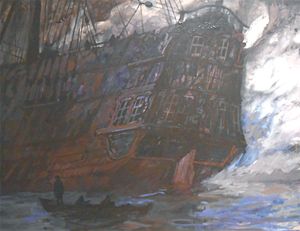
In The Empire of Necessity, Greg Grandin tracks backward from this episode like a sleuth, unearthing the motivations and machinations that collided on that day. We learn about not only Amasa Delano and Benito Cerreño but also, as records allow, the West Africans. Most important, the reader is given an overview of the era that is clear but never simplistic. “This was what historians call Spanish America's market revolution,” Grandin writes in summing up the economic background of the incident, “and slaves were the flywheel on which the whole thing turned.” Melville turned this episode into a rumination on subjugation and subterfuge, the lasting toll of slavery on the European soul. Grandin's vital book reads as a kind of ledger, relaying not just the cost of slavery but its profits, its lure.
…I can't say enough good things about The Empire of Necessity. It's one of the best books I've read in a decade. It should be essential reading not just for those interested in the African slave trade, but for anyone hoping to understand the commercial enterprise that built North and South America.
More here. (Note: One post throughout February will be dedicated to Black History Month.)
Delphi Gymkhana Club Ltd.
The Small Bar
I
There are two bartenders
Shankar and Ramshahai Singhvi Yadav.
Both of them are competent. But given
the choice, I prefer Ramshahai Singhvi Yadav.
Yet, each time one needs a drink,
I call for Shankar , even though I
know Ramshahai Singhvi Yadav will be quicker.
Why? Good question.
Shankar is easy to recall.
This is a truism.
One's name must be simple,
as in the case
with ones' personal philosophy.
And poetry.
II
What do the inebriated talk about?
Relationships.
The unipolar world.
Economic liberalization.
The Congress versus the BJP?
And of death.
Towards the end of the evening,
most people are into long-lasting relationships.
Liquor never lies. It amplifies.
III
There is an unwritten
law of liquor.
No one disagrees with the person
who pays for the round: his word is Law,
usually, till the end of the drink.
But, if one is with friends,
should it be so?
by Sanjeev Sethi
from Nine Summers Later
Har-Anand Publications, Pvt Ltd.1997
Love in the Time of Neuroscience
Helen Fisher in The New York Times:
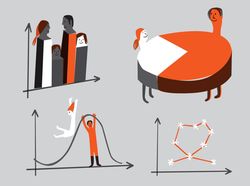
Johnson believes EFT can help couples break out of patterns, “interrupting and dismantling these destructive sequences and then actively constructing a more emotionally open and receptive way of interacting.” She aims to transform relationships “using the megawatt power of the wired-in longing for contact and care that defines our species,” and offers various exercises to restore trust.
More here.
A Valuable Reputation
Rachel Aviv in The New Yorker:
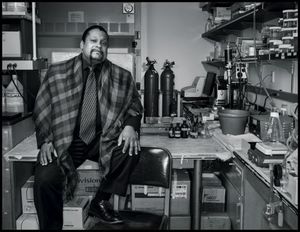
Liu and several other former students said that they had remained skeptical of Hayes’s accusations until last summer, when an article appeared in Environmental Health News (in partnership with 100Reporters)* that drew on Syngenta’s internal records. Hundreds of Syngenta’s memos, notes, and e-mails have been unsealed following the settlement, in 2012, of two class-action suits brought by twenty-three Midwestern cities and towns that accused Syngenta of “concealing atrazine’s true dangerous nature” and contaminating their drinking water. Stephen Tillery, the lawyer who argued the cases, said, “Tyrone’s work gave us the scientific basis for the lawsuit.”
Hayes has devoted the past fifteen years to studying atrazine, and during that time scientists around the world have expanded on his findings, suggesting that the herbicide is associated with birth defects in humans as well as in animals. The company documents show that, while Hayes was studying atrazine, Syngenta was studying him, as he had long suspected. Syngenta’s public-relations team had drafted a list of four goals. The first was “discredit Hayes.” In a spiral-bound notebook, Syngenta’s communications manager, Sherry Ford, who referred to Hayes by his initials, wrote that the company could “prevent citing of TH data by revealing him as noncredible.” He was a frequent topic of conversation at company meetings. Syngenta looked for ways to “exploit Hayes’ faults/problems.” “If TH involved in scandal, enviros will drop him,” Ford wrote. She observed that Hayes “grew up in world (S.C.) that wouldn’t accept him,” “needs adulation,” “doesn’t sleep,” was “scarred for life.” She wrote, “What’s motivating Hayes?—basic question.”
Read the rest here.
Friday, February 7, 2014
atheism is a form of deism
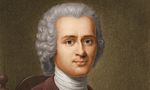
Atheism derives from religion? Surely it just says that no gods exist, that rationalism, or 'scientific naturalism', is to be preferred to any form of supernaturalism. Actually, no: in reality what we call atheism is a form of secular humanism; it presupposes a moral vision, of progressive humanitarianism, of trust that universal moral values will triumph. (Of course there is also the atheism of Nietzsche, which rejects humanism, but this is not what is normally meant by 'atheism').
So what we know as atheism should really be understood as an offshoot of deism. For it sees rationalism as a benign force that can liberate our natural goodness. It has a vision of rationalism saving us, uniting us. For example, AC Grayling, in his recent book The God Argument: The Case Against Religion and for Humanism, argues that, with the withering of religion, 'an ethical outlook which can serve everyone everywhere, and can bring the world together into a single moral community, will at last be possible'. This is really Rousseau's idea, that if we all listened to our hearts, there would be 'one religion on earth'.
On one hand atheism is more coherent than deism – it neatly eliminates the supernatural. But on the other hand it has less self-knowledge: it does not understand that it remains fuelled by a religious-based vision of human flourishing.
more here.
David Shields’s Real Problem

Shields’s recent books have elated critics and reviewers. “The ideas he raises are so important, his interests are so compelling,” wrote Bookforum’s Jan Attenberg, “that I raved about this book the whole time I was reading it and have regularly quoted it to friends in the weeks since.” Other commentators have praised Shields, in less personal terms, for “challeng[ing] our most basic literary assumptions” (Andrew Albanese), and for offering the most “effective description (and example) of the aesthetic concerns of the internet age” (Edward King). Shields “succinctly addresses matters that have been in the air … waiting for someone to link them together,” wrote Luc Sante, in a New York Times review that compared the book to theSurrealist Manifesto.
The project certainly sounds exciting. Shields focuses on the problems of loneliness and ennuithat have worried many recent readers and writers, and he proposes a radical overhaul of literary form to address them. Meanwhile, he brings together dozens of men and women, from the ancient world to the present, who have thought and written about similar problems. Because his work is so broad and ambitious, it’s easy to complain that Shields misuses some of his sources. But he is not doing academic research, and part of the charm of his project is the way he makes such a wide range of figures speak directly to contemporary concerns.
Still, as I read Reality Hunger and How Literature Saved My Life, I began to wonder if they really delivered in the way Shields said they did.
more here.
the genocide at sochi

Beginning Friday night, hundreds of millions of people will tune in to the Winter Olympics, which Russia hopes will prove to the world that the country has re-emerged as a world power after its long, post-Soviet funk—and that Sochi itself deserves “international resort” status. Elided from this narrative, though, is what took place in exactly the same spot 150 years ago, when Sochi's indigenous residents were routed by the Imperial Russian Army, the survivors herded onto ships and exiled, never to return.
Unacknowledged by Vladimir Putin’s government, the ethnic cleansing of the mostly-Muslim Circassians is considered Europe’s first modern genocide by many historians, and provides a gloomy backdrop to the Olympic glamour in this subtropical city—not least for surviving Circassians who are furious over being excluded from the celebration in Sochi.
Circassians have lived on the Black Sea coast since at least the time of the ancient Greeks. They have their own language, but at the time of the Russian invasion they were largely illiterate—they had no Anne Frank, no one who recorded the details of their destruction. The closest equivalent was an anonymous Circassian who sent an appeal to Queen Victoria, dated April 12, 1864.
more here.
Friday Poem
Ghost
After so much time you think
you'd have it netted
in the mesh of language. But again
it reconfigures, slick as Proteus.
You're in the kitchen talking
with your ex-Navy brother, his two kids
snaking over his tattooed arms, as he goes on
& on about being out of work again.
For an hour now you've listened,
his face growing dimmer in the lamplight
as you keep glancing at your watch
until it's there again: the ghost rising
as it did that first time when you,
the oldest, left home to marry.
You're in the boat again, alone, and staring
at the six of them, your sisters
& your brothers, their faces bobbing
in the water, as their fingers grapple
for the gunwales. The ship is going down,
your mother with it. One oar's locked
and feathered, and one oar's lost,
there's a slop of gurry pooling
in the bottom, and your tiny boat
keeps drifting further from them.
Between each bitter wave you can count
their upturned faces–white roses
scattered on a mash of sea, eyes fixed
to see what you will do. And you?
You their old protector, you their guardian
and go-between? Each man for himself,
you remember thinking, their faces
growing dimmer with each oarstroke.
.
by Paul Mariani
from The Great Wheel
W. W. Norton & Company, 1996.