obama and the ‘g’ word

Obama3Cynthia Haven at The Book Haven:

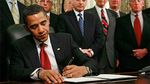
It was, perhaps, his most statesmanlike moment: a president brought to the decision he didn’t want to make, to defend a far-off nation he’d hoped was part of our nation’s past. “Earlier this week, one Iraqi cried that there is no one coming to help,”President Obama said in a somber statement delivered from the State Dining Room. “Well, today America is coming to help.” The New York Times described the situation with a certain amount of prissiness:

Speaking at the White House on Thursday night, Mr. Obama also said that American military aircraft had dropped food and water to tens of thousands of Iraqis trapped on a barren mountain range in northwestern Iraq, having fled the militants, from the Islamic State of Iraq and Syria, who threaten them with what Mr. Obama called “genocide.”

Dropping the “g” word gives gravitas to any presidential statement. What Mr. Obama “called” genocide presumably included not only the attempt to wipe the small tribe of Yezidis off the face of the earth by allowing them to die of thirst and hunger on a mountain, but also the attempt to erase 2,000 years of Christian history in Iraq, along with its Chaldean, Assyrian, and other adherents (some of whom are the last speakers of Aramaic anywhere – we wrote about that here), along with the massacre of hundreds of young Shia men at Takrit, with more, much more, to come.

more here.
West of the Revolution: An Uncommon History of 1776

Sea_lionsAndrew Graybill at The American Scholar:

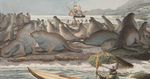
For years, Claudio Saunt vividly recalled the summer of 1976, when as an eight-year-old boy he went to see an enormous birthday cake that had traveled cross-country to his hometown of San Francisco in honor of the U.S. Bicentennial. The cake, purportedly the world’s largest confection, stood three stories tall, weighed 35,000 pounds, and was festooned with scenes from the American Revolution. But as Saunt, now a professor of history at the University of Georgia, explains in his marvelous new book, he was betrayed by his memory. From contemporary accounts, he has learned that the cake was actually a thoroughly local affair, created by a pastry chef to celebrate the Bay Area’s own 200-year anniversary, traced to the establishment of a Spanish outpost there in 1776. As Saunt puts it: “San Francisco’s history was at such odds with the narrative being celebrated for the national Bicentennial that my fourth-grade imagination turned the cake into a tribute to events in Boston, Philadelphia, and elsewhere along the East Coast.”

West of the Revolution is Saunt’s attempt to take in what was happening at other places in North America at the moment that the 13 colonies—which together represent just four percent of the continental landmass—were declaring their independence from England.

more here.

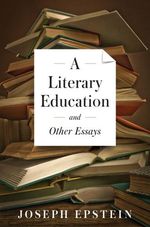
joseph epstein’s literary eduction

331x500xsledge_a_literary_education_cover.jpg,qitok=ICN3crSx.pagespeed.ic.diUvvineelJohn S. Sledge at Virginia Quarterly Review:

On the page, Epstein aspires to be one of the “laughing skeptics” and mostly succeeds. He is mistrustful of “large ideas, and especially idea systems,” but his touch is light, and he dishes out the bons mots without meanness or acerbity. One may not always agree with his judgments, but they are rendered with art and wit. For example, his definition of a “middlebrow” is “anyone who takes either Woody Allen or Spike Lee seriously as an artist.” Contemporary poetry is “slightly political, heavily preening, and not distinguished enough in language or subtlety of thought to be memorable.” He likes Henry James (though his enthusiasm for The Princess Casamassima strikes me, a student of James myself, as somewhat unusual), Willa Cather, and Ralph Ellison. Held in low regard, “second- or third-rate writers,” are Kurt Vonnegut, Toni Morrison, Jack Kerouac, and Adrienne Rich.

In his essay “What to Do about the Arts?” (1995), originally published inCommentary, Epstein relates the story of how, after Bill Clinton’s first inauguration, he was contacted by a British journalist for an opinion about the now-late poet and memoirist Maya Angelou. The man was surprised when Epstein said that he had no opinion about Angelou because he didn’t read her and knew no one who did.

more here.

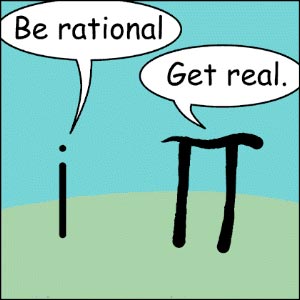
If I Reacted to Other People’s Careers the Way They React to Me Becoming a Mathematician

Jordy Greenblatt in Put It All On Red:

Math-cartoonYou’re a doctor? I don’t really know anything about medicine, but can you explain exactly how the endocrine system works in two minutes or less?

You’re a writer? I had a terrible writing teacher in high school. I bet I wouldn’t like you.

You’re a carpenter? You must be super good at carpentering.

You’re a singer? I stopped singing in 11th grade. The last song I sang was… hmmmmm… let’s see… Mozart’s Requiem. I wasn’t very good at that song.

More here. [Thanks to Jennifer Oullette.]

‘Humans of New York’ Is Suddenly a War Report From Iraq

Emily Dreyfuss in Wired:

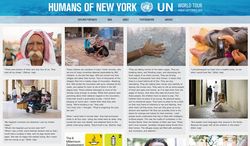
HONY-UN-660x386My favorite thing on the internet might be your favorite thing, too. As of right now 8.8 million people “like” it on Facebook. Humans of New York, the photo blog and Facebook page run by Brandon Stanton, is a bulwark of hope in what sometimes feels like an onslaught of despair. And as of yesterday, it’s operating from a warzone. In case you’re not familiar, Brandon takes a photo of a stranger on the street (usually in New York City, but notably sometimes as far away as Iran) and posts a snippet of conversation with the subject. Somehow this snapshot manages to capture a whole life, and with it parts of our lives, too, our hopes and dreams and sorrows.

…That’s why right now Brandon is travelling with the U.N. on a World Tour. This is not the first time he has partnered with the U.N.: he spoke at the 37th UNIS-UN conference last year. Brandon announced this trip on Wednesday, writing: “The point of the trip is not to “say” anything about the world. But rather to visit some faraway places, and listen to as many people as possible.” While visiting 10 countries, Brandon will be helping to promote the eight Millennium Development Goals that U.N. member states hopes to achieve by 2015, among them eradicating child poverty and hungry and encouraging universal primary education. Commenters have suggested he name the tour Humans of the World, but Brandon is the first to point out that it “would be rather foolish to claim that these portraits and stories somehow represent ‘the world,’ or humanity as a whole.” But, like the snapshots he shares, this glimpse at a part will speak volumes about the whole. He writes, “we hope this trip may in some way help to inspire a global perspective, while bringing awareness to the challenges that we all need to tackle together.” Two days ago he traveled to Iraq. Yesterday morning EST he posted three photos from Irbil, in Kurdistan. Two such photos broke my (and 8 million other people’s) heart. One shows a smiling man in a wheel chair, his underdeveloped legs resting atop a box. This is the caption:

“My happiest moments are whenever I see my mother happy.”
“What’s the happiest you’ve ever seen her?”
“When I was a child, some German doctors told us that I could have a surgery in Italy, and my legs would work again. She was so happy she started crying. But I never had the money to go.”

The next photo is a close up of the man’s phone, his hands and feet out of focus in the background. On the screen is an image he photoshopped of his face onto a healthy body, “to see what I would look like.”

More here.

an Improvisational Genius, Forever Present in the Moment

A O Scott in The New York Times:

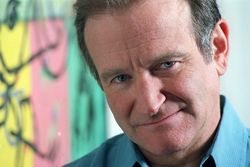
WILLIAMSobit-master675Some years ago, at a party at the Cannes Film Festival, I was leaning against a rail watching a fireworks display when I heard a familiar voice behind me. Or rather, at least a dozen voices, punctuating the offshore explosions with jokes, non sequiturs and off-the-wall pop-cultural, sexual and political references. There was no need to turn around: The voices were not talking directly to me and they could not have belonged to anyone other than Robin Williams, who was extemporizing a monologue at least as pyrotechnically amazing as what was unfolding against the Mediterranean sky. I’m unable to recall the details now, but you can probably imagine the rapid-fire succession of accents and pitches — macho basso, squeaky girly, French, Spanish, African-American, human, animal and alien — entangling with curlicues of self-conscious commentary about the sheer ridiculousness of anyone trying to narrate explosions of colored gunpowder in real time. Very few people would try to upstage fireworks, and probably only Robin Williams could have succeeded. I doubt anyone asked him for his play-by-play, an impromptu performance for a small, captive group, and I can’t say if it arose from inspiration or compulsion. Maybe there’s not really a difference. Whether or not anyone expected him to be, and maybe whether or not he entirely wanted to be, he was on.

…Janet Maslin, reviewing his standup act in 1979, cataloged a tumble of riffs that ranged from an impression of Jacques Cousteau to “an evangelist at the Disco Temple of Comedy,” to Truman Capote Jr. at “the Kindergarten of the Stars” (whatever that was). “He acts out the Reader’s Digest condensed version of ‘Roots,’ ” Ms. Maslin wrote, “which lasts 15 seconds in its entirety. He improvises a Shakespearean-sounding epic about the Three Mile Island nuclear disaster, playing all the parts himself, including Einstein’s ghost.”

More here.

Monday, August 11, 2014

Sunday, August 10, 2014

Isis consolidates

Patrick Cockburn in the London Review of Books:

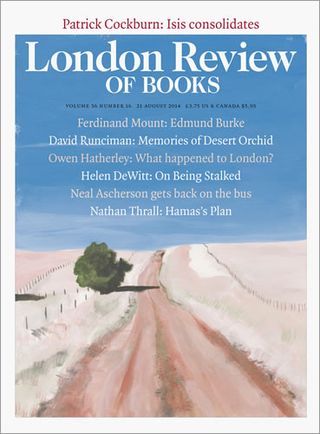
Cov3616As the attention of the world focused on Ukraine and Gaza, the Islamic State of Iraq and Syria (Isis) captured a third of Syria in addition to the quarter of Iraq it had seized in June. The frontiers of the new Caliphate declared by Isis on 29 June are expanding by the day and now cover an area larger than Great Britain and inhabited by at least six million people, a population larger than that of Denmark, Finland or Ireland. In a few weeks of fighting in Syria Isis has established itself as the dominant force in the Syrian opposition, routing the official al-Qaida affiliate, Jabhat al-Nusra, in the oil-rich province of Deir Ezzor and executing its local commander as he tried to flee. In northern Syria some five thousand Isis fighters are using tanks and artillery captured from the Iraqi army in Mosul to besiege half a million Kurds in their enclave at Kobani on the Turkish border. In central Syria, near Palmyra, Isis fought the Syrian army as it overran the al-Shaer gasfield, one of the largest in the country, in a surprise assault that left an estimated three hundred soldiers and civilians dead. Repeated government counter-attacks finally retook the gasfield but Isis still controls most of Syria’s oil and gas production. The Caliphate may be poor and isolated but its oil wells and control of crucial roads provide a steady income in addition to the plunder of war.

The birth of the new state is the most radical change to the political geography of the Middle East since the Sykes-Picot Agreement was implemented in the aftermath of the First World War. Yet this explosive transformation has created surprisingly little alarm internationally or even among those in Iraq and Syria not yet under the rule of Isis. Politicians and diplomats tend to treat Isis as if it is a Bedouin raiding party that appears dramatically from the desert, wins spectacular victories and then retreats to its strongholds leaving the status quo little changed. Such a scenario is conceivable but is getting less and less likely as Isis consolidates its hold on its new conquests in an area that may soon stretch from Iran to the Mediterranean.

More here.

Leo Tolstoy Creates a List of the 50+ Books That Influenced Him Most

Colin Marshall in Open Culture:

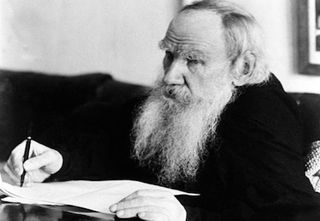
Tolstoy1War and Peace, Anna Karenina, The Death of Ivan Ilyich — many of us have felt the influence, to the good or the ill of our own reading and writing, of Leo Tolstoy. But whose influence did Leo Tolstoy feel the most? As luck would have it, we can give you chapter and verse on this, since the novelist drew up just such a list in 1891, which would have put him at age 63. A Russian publisher had asked 2,000 professors, scholars, artists, and men of letters, public figures, and other luminaries to name the books important to them, and Tolstoy responded with this list divided into five ages of man, with their actual degree of influence (“enormous,” “v. great,” or merely “great”) noted. It comes as something of a rarity, up to now only available transcribed in a post at Northampton, Massachusetts’ Valley Advocate:

WORKS WHICH MADE AN IMPRESSION

Childhood to the age of 14 or so

The story of Joseph from the Bible – Enormous

Tales from The Thousand and One Nights: the 40 Thieves, Prince Qam-al-Zaman – Great

The Little Black Hen by Pogorelsky – V. great

Russian byliny: Dobrynya Nikitich, Ilya Muromets, Alyosha Popovich. Folk Tales – Enormous

Puskin’s poems: Napoleon – Great

Age 14 to 20

Matthew’s Gospel: Sermon on the Mount – Enormous

Sterne’s Sentimental Journey – V. great

Rousseau Confessions – Enormous

Emile – Enormous

Nouvelle Héloise – V. great

Pushkin’s Yevgeny Onegin – V. great

More here.

World War I — the war that inspired innovative art

Hillel Italie in Dawn:

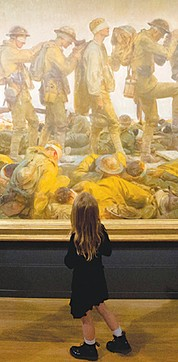
ScreenHunter_738 Aug. 10 16.20In the summer of 1914, with the war in Europe just two weeks old, Henry James knew that something had been lost forever.

“Black and hideous to me is the tragedy that gathers, and I’m sick beyond cure to have lived on to see it,” the American author, an expatriate in London at the time, wrote to a friend. “You and I, the ornaments of our generation, should have been spared this wreck of our belief that through the long years we had seen civilization grow and the worst become impossible. … It seems to me to undo everything, everything that was ours, in the most horrible retroactive way.”

James died in 1916, two years before the armistice was declared between the allies and the Germans, and the wreckage of World War I was beyond even his imagination. Millions were dead, empires dissolved, centuries-old beliefs upended. Many survivors wondered how the world had been caught up in a war fought not for any identifiable cause, but because no one knew how to stop it.

Prolonged conflicts destroy the worlds they were born in, and few did so as thoroughly and as terribly as World War I, which began 100 years ago this month. Among writers, World War I changed both the stories they told and how they told them. Artists in general left behind an extraordinary legacy of painting, music, literature and film and many of the defining achievements of a movement, Modernism, that challenged our very identities and raised questions still being asked today.

More here. [Thanks to Muneeza Shamsie.]

The Assassin’s Fate: Paul Berman Shoots and Misses (Again)

George Scialabba in The Baffler:

103267324-691x1024

Alexander Cockburn

We Sicilians are connoisseurs of malevolence. So I approached Paul Berman’s hatchet job on Alexander Cockburn (The New Republic, August 1) with an alacrity tempered only by my apprehension that Berman wasn’t quite up to the job. His previous attempts at character assassination (Noam Chomsky, Ian Buruma) had been disappointing: shrill, inaccurate, marred by too-obvious rancor and wounded vanity. Cockburn, in the shape of his final collection, A Colossal Wreck, seemed a perfect target: lethally sharp-tongued and infuriatingly charming while alive but now conveniently dead. I feared, though, that Berman would muff it.

From the technical point of view, he turned in a creditable performance this time. Berman (or his editor) managed to leaven his usual portentous and overwrought style—as though the intellectual honor of the age had been entrusted to his keeping—with a few dashes of wit and sly malice. Cockburn was an “eccentric British journalist,” a “famously insolent … old rogue,” who could nevertheless be “wonderfully charming,” with his “odd and clever combination of English literary self-satisfaction and outrageous raillery.” With an “air of bookish sophistication,” he was always dropping authors’ names (“Browning and Conrad and Trollope”) and quotations into his columns, though of course it was just a veneer, as was his insular New Left Review Marxism, at least when compared with the grittier, more rooted democratic socialism of Michael Harrington and Irving Howe. A glib and supercilious Euroscoundrel, in other words, unlike the high-minded, erudite Berman, the plodding but salt-of-the-earth working-class types over at Dissent, and the cold-eyed tragic realists of The New Republic.

More here.

The New Scientism

Kamil Ahsan in Jacobin:

2765274506_049438a5d5_zIn 1964, Stanley Kubrick’s film Dr. Strangelove introduced the character of Gen. Jack D. Ripper, an intensely neurotic, paranoid man who insisted that water fluoridation was a Communist plot hatched against Americans. Ripper was unhinged, of course. But he was also the fictional personification of a real popular anxiety over fluoride’s medicinal benefits.

History is not kind to characters who resist scientific progress: they are consistently painted as inflexible troglodytes. Today, fluoridation sits neatly alongside electrification and other advances, triumphs of the march of technological improvement despite the opposition of a supposedly anti-science public. This is, at least, how the scientific establishment tends to tell it. To them, any criticism of this historical narrative is tantamount to wholesale opposition to science.

This is absurd. There is, of course, no merit to anti-fluoridation quackery. Neither is it correct, contrary to anti-science conservatives, that the scientific community has made a Faustian bargain to keep man-made global warming on the agenda. Similarly, it is unfortunate that after decades of biological discoveries, a third of the American public rejects evolution entirely.

But it is astonishing when defenders of science lump together global-warming-denying conservatives, anti-GMO activists, and grassroots environmental activists, treating each as disturbingly anti-science. This simplistic analysis is rooted in the arrogant assumption that science is somehow above criticism — indeed, that it’s above politics entirely.

More here.

Sunday Poem

Iris Wants to Learn to Float

Her hair knows already, freed
to its red vegetable self. Gravity dampened,
I hold her as I could her first year—
in two palms. Tell me how.

She’s willing to lean back, stare through yards of humid
space. Willing to become still. I say pretend
the water is your bed, but that’s not right.

Outside tall windows, the 21 bus courses by,
lit up. A walking woman’s grey hijaab billows
and snaps. Two boys in down jackets, hands
in pockets. Branches bend, unbend.

The surface a fine chain around my shoulders.
What are the words?

We are the saint’s saliva in a reliquary vial. I can believe
we are held here, carried along.

Think of music. Relax your legs.

What does relax mean?

Like a cooked noodle. Her body lightens,

heavies back. I tap her up, slow upside-down bounce
against the beginning of air.

Briefly, pigeons clutter past, flash
of silver bellies as they turn.

Each lift longer.

And how to say
be. And how to say
float. How to say every
body floats differently. Feel
where you must hold yourself.
.

Carolyn Williams-Noren
from The Baltimore Review, Summer, 2014

Saturday, August 9, 2014

People of the Word: The Jewish encounter with history

Peter Lopatin in The Weekly Standard:

BOB_v19-46_Aug18_LopatinSimon Schama’s choice of “Story” in place of “History” in the title of this impressive new work is fitting, for the history he recounts is not history conceived of as a chronicle of important events, but rather as a compendium of thematically linked stories told throughout the ages by, and about, the lived experience of real people—and of a people. Schama tells these stories in terms of a number of characteristically Jewish oscillations: between exclusivity and inclusivity, differentiation and syncretism, assimilation and rejection, fidelity to law and tradition and the Jewish proclivity for scrutinizing and interrogating both. The myriad ways in which Jews mediated and resolved (or didn’t resolve) these oppositions over the better part of two millennia constitute the warp and weft, the theme and variation, of Schama’s narrative. To tell a story is, necessarily, to adopt a stance, an agenda that informs the story-teller’s choices of what tales to tell and what themes to educe, and Schama lays his agenda on the table at the outset:

What the Jews have lived through, and somehow survived to tell the tale, has been the most intense version known to human history of adversities endured by other peoples as well; of a culture perennially resisting its annihilation, of remaking homes and habitats, writing the prose and the poetry of life, through a succession of uprootings and assaults. It is what makes this story at once particular and universal, the shared inheritance of Jews and non-Jews alike, an account of our common humanity.

It turns out to be an agenda that serves Schama well. Some of the stories he relates are of well-known figures of Jewish history, biblical and otherwise: Ezra and Nehemiah, inveighing against the corruption of Jewish society by “foreign” influences; the important (if ever problematical and dubious) Flavius Josephus, a Jew turned faithful Roman general and chronicler of Jerusalem’s destruction at the hands of his Roman masters; rabbi and philosopher Maimon ben Joseph (known to us today as Maimonides) striving to reconcile faith with reason. And the list goes on, including rabbis and scholars, to be sure, but also mapmakers, courageous wives and daughters, poets, and physicians.

More here.