
Emily Temple at Literary Hub:
 I now present to you the Ultimate List, otherwise known as the List of Lists—in which I read all the Best Of lists and count which books are recommended most.
In all the time I’ve done this, I’ve never seen a book run away with this list like Percival Everett’s James has this year: it was recommended a full dozen more times than the next most popular books. (It also won the National Book Award and the Kirkus Award, and was a finalist for the Booker—and with good reason.)
Overall, this year, I processed 69 lists from 39 outlets, which collectively recommended more than 1,200 individual books (RIP my spreadsheet). As always, these are probably not all the lists, but all universes have to end sometime. Anyway, 90 of those books made it onto 5 or more lists, and I have collated these for you here, in descending order of frequency.
33 lists:
Percival Everett, James
21 lists:
Kaveh Akbar, Martyr!
Miranda July, All Fours
20 lists:
Sally Rooney, Intermezzo
More here.
Enjoying the content on 3QD? Help keep us going by donating now.
 On December 20, OpenAI’s o3 system scored 85% on the
 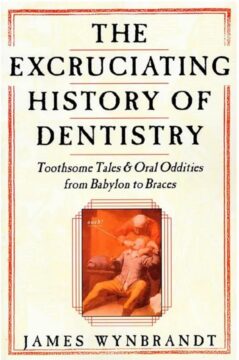 The writer P. J. O’Rourke famously quipped, “When you think of the good old days, think one word: dentistry.” So let us take his advice. James Wynbrandt’s The Excruciating History of Dentistry: Toothsome Tales & Oral Oddities from Babylon to Braces provides plenty to chew on. As the New York Times Book Review put it, “Wynbrandt has clearly done his homework.”
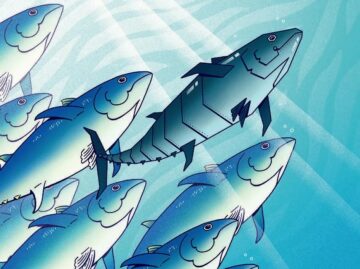 Sharks present an interesting case study because unlike other fast swimmers such as tuna or swordfish, which have smooth skin surfaces, shark skin is rough—covered in teeth-like structures called denticles. Although ichthyologists have known for decades that denticles likely hold the key to a shark’s ability to quickly and efficiently move through the water, how they contribute to speed remained a mystery.
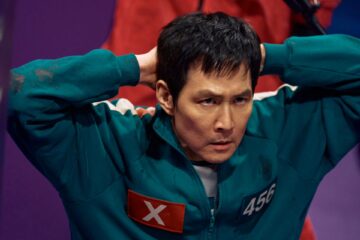 I
I When exactly did we stop
 In 2017, the MIT Media Lab launched MyGoodness, an online game billed as a way to teach players to “maximize the impact of [their] charitable donations.”
 Evolution was a “training process” selecting for reproductive success. But humans’ goals don’t entirely center around reproducing. We sort of want reproduction itself (many people want to have children on a deep level). But we also correlates of reproduction, both direct (eg having sex), indirect (dating, getting married), and counterproductive (porn, masturbation). Other drives are even less direct, aimed at targets that aren’t related to reproduction at all but which in practice caused us to reproduce more (hunger, self-preservation, social status, career success). On the fringe, we have fake correlates of the indirect correlates – some people spend their whole lives trying to build a really good coin collection; others get addicted to heroin.
 One afternoon in the early 1980s, Tariq Ali, wearing only a towel, leapt into a room in Private Eye’s Soho offices. His mission was to liberate the magazine’s editor, Richard Ingrams, from a tiresome interview with Daily Mail hack Lynda-Lee Potter. “Mr Ingrosse, sir,” said Ali, posing as an Indian guru, “Time for meditation. Please remove all clothes.”
 In a 1939 essay, the critic Philip Rahv
  OpenAI’s new o3 artificial intelligence model has achieved a breakthrough high score on a