Sins Of Commission

Sins-of-commission_photo-by-ashok-vahie_caravan-magazine_october-2014_085_1

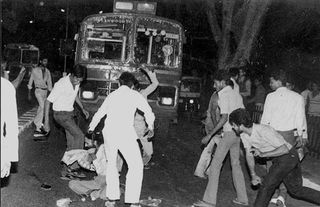
Hartosh Singh Bal in Caravan (photo Ashok Vahie):

ON WEDNESDAY, 31 October 1984, Prime Minister Indira Gandhi was assassinated by two of her guards, both Sikh. In the ensuing violence, which lasted roughly three days, 2,733 Sikhs were killed in Delhi. Sikhs were also attacked in several other Indian cities, including Kanpur, Bokaro, Jabalpur and Rourkela. It remains one of the bloodiest and most brutal episodes of communal violence in independent India.

Over the next two decades, nine commissions of inquiry were instituted. Seven of these investigated specific aspects of the tragedy, such as the death count, which was officially established by the Ahuja Committee in 1987. Two of the panels—the Ranganath Misra Commission, constituted in 1985, and the Justice GT Nanavati Commission, whose final report was published in 2005—were required to look at the violence in its entirety.

The reports of those two commissions still make for startling reading. Each recorded testimonies from numerous victims and witnesses, and took depositions from some of those accused, including police officers who had been on duty in badly affected areas. Yet there is not just a complete mismatch between the testimonies recorded and the conclusions reached—the commissions’ own observations contradict their findings.

For thirty years, it has been persistently claimed—partly on the basis of these findings—that the violence following Gandhi’s death was an unplanned outpouring of grief. But the records of these commissions clearly establish one thing that damns such conclusions: the condemnable but largely spontaneous violence of 31 October transformed into an orchestrated massacre that continued from the 1st to the 3rd of November.

For many years, survivors, witnesses and observers have suspected that the violence was orchestrated by the highest echelons of the Congress party.

More here.
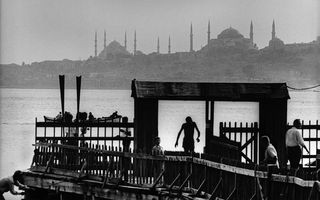
Bonfire of the Humanities: How did History Abdicate its Role of Inspiring the Longer View

Istanbul

David Armitage and Jo Guldi in Aeon (Photo by Ara Guler/Magnum Photos):

The mission of the humanities is to transmit questions about value – and to question values – by testing traditions that build up over centuries and millennia. And within the humanities, it is the discipline of history that provides an antidote to short-termism, by giving pointers to the long future derived from knowledge of the deep past. Yet at least since the 1970s, most professional historians – that is, most historians holding doctorates in the field and teaching in universities or colleges – conducted most of their research on timescales of between five and 50 years.

The novelist Kingsley Amis satirised this tendency towards ever more microscopic specialisation among historians as early as 1954 in Lucky Jim, the work from which all later campus novels sprang. Jim Dixon, an anxious junior lecturer, frets throughout the book about the fate of a well-polished article meant to jump-start his career. Its topic? ‘The Economic Influence of the Developments in Shipbuilding Techniques, 1450 to 1485’. ‘It was a perfect title,’ the narrator tells us, ‘in that it crystallised the article’s niggling mindlessness, its funereal parade of yawn-enforcing facts, the pseudo-light it threw upon non-problems.’ Within only a couple of decades, any PhD supervisor on either side of the Atlantic would have discouraged a topic of such breadth and complexity, spanning almost four decades, as foolhardy in the extreme.

When historians first became professionalised in the late 19th century, it was still possible for them to tackle subjects of genuine breadth and ambition. In the US, Frederick Jackson Turner – later famous for his ‘frontier thesis’ of American national development – wrote his PhD thesis in 1891 on frontier trading posts from the 17th to the 19th centuries. In 1895, W E B du Bois, the first African-American to receive a PhD from Harvard, studied the suppression of the African slave-trade from 1638 to 1870 for his doctoral research.

A recent survey of some 8,000 history dissertations written in the US since the 1880s has shown that the average period covered in 1900 was about 75 years; by 1975, that had shrunk to about 30. (Matters were even worse in the UK, where PhD students had less time to undertake their research and writing than most US students, and timescales were even more abrupt.) Only in the past decade has it rebounded again to somewhere between 75 and 100 years.

More here.

The Birth of the Pill

1012-bks-CARMON-sub-master495Irin Carmon at The New York Times:

By the time Eig’s book opens in 1950, Sanger had fixed her obsession on a contraceptive pill to feed the masses. Along with what Eig sets up as “a group of brave, rebellious misfits,” Sanger helped find the secret by harnessing something simple, something women’s bodies already did when pregnant: not ovulate. Then, as now, the biological problem was largely solved; all that remained was politics. That was a lot. It still is.

Eig’s timing is fortunate; Americans are currently fighting new variations on the same battle, one that has never quite receded but, for political and legal reasons, is under a brighter spotlight than ever. It was one thing to invent the pill and get it approved. It has been quite another for women to have actual access to the contraception that’s right for them, what with this country’s byzantine system of health care delivery and our even more contorted sexual politics.

The creation story of oral contraception, along with the social upheavals attributed to it, is not new territory. The life of Sanger, who founded the precursor to Planned Parenthood, is well documented too, including in a 2013 graphic novel by Peter Bagge, “Woman Rebel,” and a 1992 biography by Ellen Chesler, “Woman of Valor.” Eig, a former reporter for The Wall Street Journal, brings a lively, jocular approach to the story, casting an unlikely four-part ensemble comedy starring Sanger; the iconoclastic lead scientist, Gregory Goodwin Pincus; the Roman Catholic physician John Rock; and the supplier of cash behind it all, Katharine McCormick.

more here.

the other elizabeth taylor

Elizabeth-taylorAdam Z. Levy at The Quarterly Conversation:

One wonders why Taylor, who was hailed by Kingsley Amis as “one of the best English novelists born in this century,” has fallen so far from view in the forty years following her death. She was often faulted by her critics for placing a premium on style over content, with a hint that this style was derivative and dull. Robert Liddell jokingly referred to The Lady-Novelists Anti-Elizabeth League, whose founding members included Kay Dick, Kathleen Farrell, Kate O’Brien, Pamela Hansford Johnson, Stevie Smith, and Olivia Manning. If one were to accept any of these criticisms, it would be that Taylor can, on occasion, be dull; a few stories in You’ll Enjoy It When You Get There feel like labors of language and never quite get off the ground. But it goes without saying that Taylor’s voice is uniquely her own. As William Maxwell put it, “Everything of yours that I have ever read has been identified as yours . . . There isn’t a moment when it doesn’t come through.” Following the reissue of two of her novels, A Game of Hide and Seek and Angel, the addition of the stories collected here will rightly make the claim for her place among the very best in English letters.

Then again, in name alone, Elizabeth Taylor has always had the uncanny ability to be overlooked. You might call it unlucky that the other Elizabeth Taylor’s star-making vehicle,National Velvet, came out the year before the publication of At Mrs. Lippincote’s, in 1945. As a result of the celebrity that the actress brought to her name, search results will forever require disambiguation.

more here.

Patrick Modiano is his own genre

Caad0045-5f06-4c4a-a8c3-12c425cd3222Anne-Sylvaine Chassany at the Financial Times:

It is his ability to “create a world” that makes his work unique, says Marion Van Renterghem, a journalist at Le Monde who knows him well. “Each book is a piece of this world, like ancient translucent parchments that deliver secret messages when you superimpose them,” she says. The streets of Paris are described in minute detail and with evident love. His characters are searching for answers, like the author himself.

Mr Modiano’s writings, which include 29 books and several screenplays and songs, have been largely inspired by the German occupation of Paris. It was during this dark period that his parents, a shadowy Jewish businessman and a Belgian actress from Anvers, first crossed paths. The father of two – and besotted grandfather – reports being troubled by the thought that his parents would never have met had it not been for the horrors of the European midcentury.

“It is bizarre to think that I was born after a catastrophe, born among ruins,” he has said. His disquiet resonated with France’s baby boom generation, as they gradually came to understand the part that their parents had played in the Holocaust.

more here.

Province of Men: In Afghanistan, girls are disguised and raised as boys

Rafia Zakaria in The New York Times:

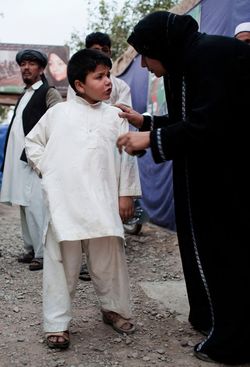
ZakIn August 2010, Time magazine published a picture of a mutilated Afghan girl on its cover — along with a warning to its readers. The image was “distressing” and “scary,” cautioned Richard Stengel, then the magazine’s managing editor, but it would “confront readers with the Taliban’s treatment of women” and allow them to decide “what the U.S. and its allies should do in Afghanistan.” He wrote that he had shown the image of the noseless girl to his own sons, aged 9 and 12. Both of them “immediately felt sorry for Aisha.” Sympathy and the moral righteousness borne of the project of liberating girls like Aisha from the Taliban were then, and are today, dominant frames in how Westerners view Afghan women. The details of Afghan lives that do not fit easily into the plot of pity or the fantasy of freedom are almost always ignored. It is in this realm of overlooked narratives and hidden details that Jenny Nordberg, a journalist who contributed to a Pulitzer Prize-winning series in The New York Times in 2005, sets her investigation into the lives of Afghan women. Her book, “The Underground Girls of Kabul: In Search of a Hidden Resistance in Afghanistan,” delves into the practice of “bacha posh,” in which prepubescent Afghan girls are dressed and passed off as boys in families, schools and communities. Through extensive interviews with former bacha posh, observation of present ones and conversations with doctors and teachers, Nordberg unearths details of a dynamic that one suspects will be news to the armies of aid workers and gender experts in post-invasion Afghanistan.

The central character of Nordberg’s story is a woman named Azita, a member of Parliament from Badghis Province in rural Afghanistan. “She personified the new American plan for Afghanistan,” says Nord­berg, who also wrote about Azita’s family and bacha posh in a 2010 Times article. With the new Afghan Constitution mandating women’s representation at 25 percent, Azita, the wife of a poor farmer, borrows money from a friend, contests elections and wins. There is just one problem with this sudden rise to public life: Azita has four daughters and no sons, signaling a lack of strength. To fix the situation, Azita and her husband make their youngest daughter into a son. The creation of “Mehran,” as the new son is called, solves many problems. A visible male heir bolsters Azita’s public power — and her private power as well, since she is not only the family’s breadwinner but also the only one of her husband’s two wives to produce a son.

More here.

Friday, October 10, 2014

Why Weren’t Alarm Bells Ringing?

Wolf_martin-102314_jpg_250x1482_q85

Paul Krugman reviews Martin Wolf's The Shifts and the Shocks: What We’ve Learned—and Have Still to Learn—from the Financial Crisis, in The New York Review of Books:

The Shifts and the Shocks opens with a long quotation from the late Hyman Minsky, a heterodox economist who had little influence on mainstream economists and policymakers during his lifetime, but whose analysis is now central to the Standard Model. Minsky’s ideas have been cited by monetary officials including Janet Yellen, by business economists like Pimco’s Paul McCulley, and by many academics, myself included. You could say that we are all Minskyites now.

What did Minsky bring to economics? In part, he argued that conventional views of financial crisis were too narrowly focused on the specific issue of bank runs. In Minsky’s vision, excessive leverage—too much reliance on borrowed money—creates a risk of crisis whoever the borrower. Banks, which in effect borrow money short-term from their depositors but invest in assets that can’t easily be converted to cash, may be especially vulnerable. But business and household debt also expose the economy to the possibility of a self-reinforcing downward spiral.

Minsky was not, of course, the first to make this observation; during the Great Depression the great American economist Irving Fisher, in a paper that reads remarkably well to this day, argued that the economy was suffering from “debt deflation,” in which borrowers of all kinds were trying to pay down their debts at the same time, which led to plunging prices of assets and a severe economic slump, which made their debts even less supportable and led to further pullbacks.

What Minsky added, however, was the notion that deflation as a result of excessive debt is fated to happen every once in a while, that periodic financial crises are a more or less unavoidable feature of capitalism. According to his “financial instability hypothesis,” eras of economic stability carry within themselves the seeds of their own down- fall. If there hasn’t been a financial crisis for many years, both borrowers and lenders will become complacent, underestimating the risks of high levels of debt.

More here.

Ignorance of Philosophy, Identity Politics, and the Cosmopolitan Ideal

Yin-en-ucc88beryang-en

Brian Leiter in 3:AM Magazine:

[W]hy don’t Anglo-American philosophers engage with non-Western philosophical traditions? In my experience, professional philosophers today often perceive non-Western thinkers as inferior. Of course, few would say this explicitly. Rather, philosophers often point to non-Western philosophy’s unusual and unfamiliar methodology as the primary reason for the disconnect.’

There is much that seems to me strange and a bit dubious about this. Do we have any evidence that Asian-Americans generally expect the fields they study to feature Asian thinkers? And should we really add East Asian philosophers to the curriculum to satisfy the consumer demands of Asian students rather than because these philosophers are interesting and important in their own right? (Mr. Park, oddly, never explains, or even affirms, the merits of these thinkers.)

But what is quite surprising, and unsupported, is the claim that the absence of non-Western thinkers is due to Anglophone philosophers thinking them “inferior.” I suppose some think that, but philosophers, who are quite opinionated as a group, no doubt hold every opinion under the sun. (My former colleague Herb Hochberg, about as unabashed an apologist for the most parochial conception of analytic philosophy imaginable, thought Kripke “inferior” to Russell.) My own impression, from having talked to a lot more philosophers than Mr. Park and for a much longer period of time, is that most Anglophone philosophers have no opinion at all about non-Western philosophy because they are simply ignorant of it. Some regret the ignorance, others think it is excusable since there are so many philosophical traditions in the world and one can only master so many, and others just don’t think about it at all because it is possible to pursue an academic career in philosophy ignorant of a lot of things, including large swaths of the history of European philosophy (and the further back in the past we go, the more the boundary lines of “what’s European, what’s not” get harder to draw).

More here. (See Terrence Blake's response here.)

The Strange Case of Nicholas Ray’s Johnny Guitar

Image-31-600x450Robert Pippin at nonsite:

What we have instead is typical of Ray’s much more psychologically than politically complex films; that is, we have a great investiture of importance in love and being loved as the central human problem,42 or, we should probably say, we have what has become the central and most difficult human problem, since the Western is now noticeably of historical rather than thematic significance. This is so even though Ray was certainly aware, as few directors ever were or are, of the nearly certain impossibility of such redemption. And yet this does not mean that the film should be characterized as another of the more “psychological” Westerns, such as those by Anthony Mann or Budd Boetticher. It is fair to say that those Westerns explore more self-consciously the psychological costs of the frontier-town transition or the legal-extra-legal violence problem, than the “objective” problem itself. But the Western framework itself is secure, just given a different, more-psychological-than-epic inflection. A question like, “What really is the difference between a sheriff and a bounty hunter, if any?” might be explored by asking “What does it mean for this individual (the Jimmy Stewart character in Mann’s Westerns) to face that challenge?” But it is still the classical question at issue. We are still within the generic language and concerns of the Western.

There is one more element that connects the love story melodrama with the “Western” plot. Put simply, both raise the question of the possibility of “new beginnings,” sort of escape from, or reconciliation with, the past.

more here.

magic kingdoms

07-07excellent_full_600Sophia Nguyen at The Point:

In the dog days of August, two books about the Ivy League landed comfortably on the New York Times bestseller list. One was William Deresiewicz’s Excellent Sheep. The other was Lev Grossman’s The Magician’s Land. Despite their disparate genres, the nonfiction tract ends up in fantasy, while the escapist entertainment roots itself in reality—and both are invested in the drama of gifted children.

Heavily quoting emails and essays from his former students at Yale, Deresiewicz’s higher-ed polemic takes down elite colleges and the adults they produce—zombies with status anxiety where their curiosity and humanity used to be. Rather than challenge students with a rigorous education, Deresiewicz argues, the Ivy League and other elite colleges now promote a narrow notion of success. It begins with admissions offices, which have become inhumanly ruthless sorting machines further stratifying the upper class. Having selected for a certain breed of strivers, the schools then encourage their students to become a conformist herd, seeking meaning in credentials. Failing to find that meaning, the hunger only intensifies.

more here.

Rediscovering Regina Derieva

P15_Haven_1100500hCynthia Haven at the Times Literary Supplement:

The Russian poet Regina Derieva was born on the Black Sea in Odessa, and enjoyed the shifting rhythms of the sea: “Water is the ideal apparel. However many times you get into it, it’s the same”. Her passion for water was shared by her epistolary friend, Joseph Brodsky, who grew up alongside St Petersburg’s canals and spent as much time as he could in Venice, where he is buried on the cemetery island of San Michele. Derieva, whom Brodsky called “a great poet”, viewed a very different landscape, however: from the age of six, she lived obscurely in Karaganda, Kazakhstan, “perhaps the most dismal corner of the former Soviet Union – once the centre of a vast prison camp universe, later just a gloomy industrial city”, according to the distinguished Lithuanian poet Tomas Venclova. For him, Derieva’s precise, epigrammatic poems limn “the concentration camp zone, where space is turned into emptiness, and time turned into disappearance”.

A few days after Derieva’s sudden death last December at the age of sixty-four, I received a letter from her husband, Alexander Deriev, and our ensuing correspondence eventually led to the Stanford Libraries’ acquisition of this astonishing poet’s archive. A single cardboard box postmarked Märsta, Sweden, is all that remains of a long and productive literary life, augmented by a few files of unpublished manuscripts, photographs, letters and drawings Deriev brought with him to California in his backpack.

more here.

Regarding Diptychs

Charlesworth_2.-charlesworth_regarding-venus_1140Eric Dean Wilson at The American Reader:

Generally, a diptych is two panels of equal size joined together by some device, usually a hinge. The form follows a long tradition that began in late Western antiquity, when Romans appointed to the consulate in the 4th – 6th centuries A.D. commissioned ivory tablets carved with their own likenesses on each panel (before we criticize smartphone selfies as a symptom of contemporary narcissism, we might look first to our uncanny doppelgangers, the Ancient Romans). The tablets were connected by a hinge, and closed like a book to protect the inside—a thin layer of cool wax where the consul could write with a stylus and, if necessary, erase. The diptych was, essentially, a ceremonial notebook used to track and record consular appointments by year. When, in the next few centuries, the consular diptychs were reused by the early Christians, the insides of the tablets were erased and used to record prayers for the living church community in Western Europe. In Eastern Europe, they were used to record prayers for the dead. Elsewhere, the ivory tablets were used to keep track of the growing list of saints and their appointments by year. (The early history of the diptych, then, is history itself.)

more here.

Friday Poem

Ask The Moon

1

Wakeful past 3 a.m.
near the frontiers of Nothing
it’s easy, so easy
to imagine (like William Blake)
an archaic angel standing askew
in a cone of light
not of this world;

easy at this cheating hour
to believe an angel cometh
to touch babies’ skulls,
their fontanelles,
deleting the long memory
of generations—
the genesis of déjà vu;

easy to conceive angel-light
bright as that sudden
ordinary window
I saw at midnight
across the road
before the drawing of a blind.

Read more »

Yeah, Baby! Malala Yousafzai and Kailash Satyarthi Are Awarded Nobel Peace Prize

Alan Cowell in the New York Times:

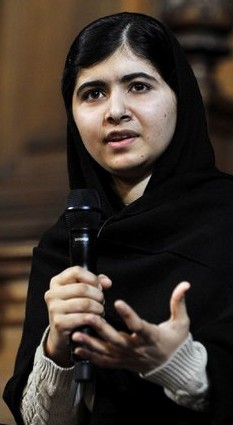
ScreenHunter_830 Oct. 10 12.34Reaching across gulfs of age, gender, faith, nationality and even international celebrity, the Norwegian Nobel Committee on Friday awarded the 2014 peace prize to Malala Yousafzai of Pakistan and Kailash Satyarthi of India, joining a teenage Pakistani known around the world with a 60-year-old Indian veteran of campaigns on behalf of children.

The awards, announced in Oslo by Thorbjorn Jagland, the committee’s chairman, were in acknowledgment of their work in helping to promote universal schooling and in protecting children worldwide from abuse and exploitation.

Pointedly, Mr. Jagland said, “The Nobel Committee regards it as an important point for a Hindu and a Muslim, an Indian and a Pakistani, to join in a common struggle for education and against extremism.” Ms. Yousafzai is 17 while Mr. Satyarthi is 60.

“Children must go to school and not be financially exploited,” Mr. Jagland said, adding: “It is a prerequisite for peaceful global development that the rights of children and young people be respected. In conflict-ridden areas in particular, the violation of children leads to the continuation of violence from generation to generation.”

“Showing great personal courage, Kailash Satyarthi, maintaining Gandhi’s tradition, has headed various forms of protests and demonstrations, all peaceful, focusing on the grave exploitation of children for financial gain,” Mr. Jagland said. “He has also contributed to the development of important international conventions on children’s rights.”

Despite his works, Mr. Satyarthi is not nearly so widely known as Ms. Yousafzai, who was shot in the head by the Taliban in 2012 for her campaigning on behalf of girls’ education in the Swat Valley of Pakistan.

More here.

Salman Rushdie condemns ‘hate-filled rhetoric’ of Islamic fanaticism

Anita Singh in The Telegraph:

Rushdie_3068073bAccusations of 'Islamophobia' are being levelled at anyone who dares to speak out against the “hate-filled rhetoric” of Islamic fanaticism, Salman Rushdie has claimed in a speech condemning Isil and “this new age of religious mayhem”. Rushdie voiced his fears that the language of “jihadi-cool” is seducing young British Muslims, many via Twitter and YouTube, into joining the “decapitating barbarianism” of Isil, the group also referred to as Islamic State or Isis. In his PEN/Pinter Prize Lecture, the author said all religions have their extremists but “the overwhelming weight of the problem lies in the world of Islam”. Last week, Isil beheaded taxi driver and charity worker Alan Henning, the latest Western hostage to die at their hands. The so-called “jihadi-cool” image romanticises Isil, using rap videos and social networking to recruit followers – posing with AK-47s and bragging about their “five star jihad” in videos showing fighters lounging around in luxury villas as they urged the destruction of the West.

Rushdie defined “jihadi-cool” as “the deformed medievalist language of fanaticism, backed up by modern weaponry”, saying: “It's hard not to conclude that this hate-filled religious rhetoric, pouring from the mouths of ruthless fanatics into the ears of angry young men, has become the most dangerous new weapon in the world today”. He said: “A word I dislike greatly, 'Islamophobia', has been coined to discredit those who point at these excesses, by labelling them as bigots. But in the first place, if I don't like your ideas, it must be acceptable for me to say so, just as it is acceptable for you to say that you don't like mine. Ideas cannot be ring-fenced just because they claim to have this or that fictional sky god on their side. “And in the second place, it's important to remember that most of those who suffer under the yoke of the new Islamic fanaticism are other Muslims…

More here.

A little knowledge: The significance of expertise passed on by direct contact

Editorial in Nature:

Images30VEWEIGFor the last two decades of the twentieth century, a cold war rumbled on between the laboratories of physicists in Moscow and in the West over the quality of sapphire. The Russian scientists claimed to have measured the rate of decay of the material’s resonance — a signal of its quality — with what researchers elsewhere considered impossible precision. The stakes were high: sapphire mirrors were being considered for use in a new generation of laser interfero­meter gravitational-wave detectors. But were they up to the task? Labs in the United States and United Kingdom could not reproduce the Moscow findings. The discrepancy fuelled mistrust and antagonism. At the turn of the millennium, the mystery was solved. Measuring the quality of sapphire, it turns out, is as much art as science. The Moscow scientists were expert experimenters, but this expertise was not transferred through the methods sections of their academic papers. The fine fibres used to suspend the sapphire cylinders under investigation were greased with “the presence of a fatty film”, one of their translated papers pointed out. Less explicit was the source of the grease. Only after years of struggling with various lubricants did the Western researchers realize that one member of the Russian group would sometimes run the thread across the bridge of his nose or behind his ear. With the right amount of human ‘flossing’ (and the right human), the Western scientists managed to get similar results.

The thread greasing is an example of tacit knowledge: know-how that can be passed on only through direct contact, and not by written or verbal instruction. How to ride a bicycle is a classic case. How to make an atomic bomb is a less-well-known example: all the instructions to build a nuclear weapon may be there on the Internet, but the ‘been there, done that’ personal experience is not. Indeed, security analysts have suggested that the lack of active testing and consequent erosion of nuclear-weapon tacit knowledge is leading to the “uninvention” of the bomb, and reduced credibility of the nuclear deterrent. In a paper published this month in the journal Science and Public Policy, researchers in the United Kingdom suggest that a reverse process is under way when it comes to biology and biological weapons (J. Revill and C. Jefferson Sci. Public Policy 41, 597–610; 2014). Access to tacit knowledge in the life sciences is not dwindling but proliferating, argue James Revill and Catherine Jefferson. As secrets are shared, chiefly through advances in information and communications technology, tacit knowledge becomes explicit and barriers are demolished.

More here.

Thursday, October 9, 2014

joseph Cornell: the boxes, the films

Joseph-cornell-1Stefany Anne Golberg at The Smart Set:

Less known are Cornell’s films; they are Cornell’s boxes in motion. The films are collages of industrial, scientific and home movies purchased from fellow collectors or pillaged from the trash bins of New York. In By Night With Torch and Spear upside-down men toil away upon their metal fire machines under the watch of silent clouds. Their factory is dark and the machines spit fire — they move in a pagan dance of industry. Titles flash throughout. But the words are backwards and the messages move too fast to read. All at once the men disappear; the machines no longer need them. The factory men become a tribe, marching in the night with arrows and drums, back and forth before a mass of smoke. The word ‘Shepard’ and something else flash in front of a young man blowing into a reed instrument of some primitive kind. He wears a robe and a turban. The word “Egyptian” flashes and “purpose.” We are in the desert with camels. The camels morph into caterpillars that writhe on a leaf. The glowing effect of the negative film turns the caterpillars into amoebic angels. Maybe the caterpillars are a return to a lost primordial state. The caterpillars lead once more to the men, who walk by night, with torch and spear. Finally, we are left with pulsating blobs. Another cycle of history is complete.

By Night With Torch and Spear was never shown publicly while Cornell was alive. It was found after Cornell’s death, in the house on Utopia Parkway where the artist had spent most of his days. Cornell stopped showing his films after a screening in 1936, when Salvador Dalí publicly accused Cornell of plagiarizing his unconscious mind. Dalí knocked over the projector with his umbrella, traumatizing the quiet Cornell. After that, Cornell continued making his films in secret.

more here.

He Has His Tools and Chemicals: A David Lynch Retrospective

Figure-1-Lynch-w-film-reels-243x366Jonathan P. Eburne at the Los Angeles Review of Books:

On the occasion of two major retrospective events in David Lynch’s career, we can return anew to Twin Peaks, in advance of the Showtime series. In late July, CBS and Paramount Pictures released Twin Peaks: The Entire Mystery on Blu-ray; compiling the television series together with the film, the set includes 90 minutes of long-rumored “missing pieces” deleted from the final cut of Fire Walk with Me, among other features.

The second event is all the more comprehensive. On September 12, thefirst major US exhibition of David Lynch’s art opened at the Pennsylvania Academy of Fine Art (PAFA) in Philadelphia; the career retrospective of Lynch’s paintings, drawings, and early short films runs through January 11, 2015.

Do the “missing pieces” of the Blu-ray resolve the lingering questions inTwin Peaks, whether the fate of its characters or the workings of its otherworldly cosmology: the Black Lodge, the Red Waiting Room, and BOB? The box set is terrific, but it remains steadfast in its refusal to do so.

more here.

In one of the harshest camps for refugees of the Syrian conflict

1440cd3299ef46194b88bd4f4c38da290f6ad5bc_originalJoshua Hersh at Virginia Quarterly Review:

Refugees and the displaced never have it good, but by all accounts the conditions at Atmeh by late 2012, when its population was estimated at roughly 15,000 people, were especially wretched. (Atmeh’s population is now believed to be closer to 30,000). In March 2013, the UN conducted a satellite survey of the area and counted around 2,000 tents in a sprawling mass. Two months later, a second tally found more than 3,000 bunched together over two discrete areas—an increase of almost half.

The camp was slowly but undeniably becoming a slum—one that under any other circumstances would be considered uninhabitable. The refugees at Atmeh had just endured the second winter of the war, many of them suffering through it without heat, electricity, running water, or decent toilets, only to find their problems were getting worse. Desperate to keep warm, many took risks—with catastrophic effects. Over New Year’s, a tent fire caused by a family burning a kerosene lantern killed two children and left several others in critical condition. Lina Sergie Attar, a Syrian-American writer and humanitarian worker, happened to be in the camp shortly before the fire, and she met a twenty-year-old mother of two named Manar, who told of a similar experience.

more here.

Does evolutionary theory need a rethink?

Researchers are divided over what processes should be considered fundamental.

From Nature:

Evol2Does evolutionary theory need a rethink? Yes, urgently

Without an extended evolutionary framework, the theory neglects key processes, say Kevin Laland and colleagues.

Charles Darwin conceived of evolution by natural selection without knowing that genes exist. Now mainstream evolutionary theory has come to focus almost exclusively on genetic inheritance and processes that change gene frequencies.

Yet new data pouring out of adjacent fields are starting to undermine this narrow stance. An alternative vision of evolution is beginning to crystallize, in which the processes by which organisms grow and develop are recognized as causes of evolution.

Some of us first met to discuss these advances six years ago. In the time since, as members of an interdisciplinary team, we have worked intensively to develop a broader framework, termed the extended evolutionary synthesis1 (EES), and to flesh out its structure, assumptions and predictions. In essence, this synthesis maintains that important drivers of evolution, ones that cannot be reduced to genes, must be woven into the very fabric of evolutionary theory.

We believe that the EES will shed new light on how evolution works. We hold that organisms are constructed in development, not simply ‘programmed’ to develop by genes. Living things do not evolve to fit into pre-existing environments, but co-construct and coevolve with their environments, in the process changing the structure of ecosystems.

The number of biologists calling for change in how evolution is conceptualized is growing rapidly. Strong support comes from allied disciplines, particularly developmental biology, but also genomics, epigenetics, ecology and social science. We contend that evolutionary biology needs revision if it is to benefit fully from these other disciplines. The data supporting our position gets stronger every day.

More here.