
Enjoying the content on 3QD? Help keep us going by donating now.
Category: Recommended Reading
On Najwan Darwish
Alexia Underwood at the Paris Review:
 “No one will know you tomorrow. / The shelling ended / only to start again within you,” writes the poet Najwan Darwish in his new collection. Darwish, who was born in Jerusalem in 1978, is one of the most striking poets working in Arabic today. The intimate, carefully wrought poems in his new book, , No One Will Know You Tomorrow, translated into English by Kareem James Abu-Zeid, were written over the past decade. They depict life under Israeli occupation—periods of claustrophobic sameness, wartime isolation, waiting. “How do we spend our lives in the colony? / Cement blocks and thirsty crows / are the only things I see,” he writes. His verses distill loss into a few terse lines. In a poem titled “A Brief Commentary on ‘Literary Success,’ ” he writes, “These ashes that were once my body, / that were once my country— / are they supposed to find joy / in all of this?” Many poems recall love letters: to Mount Carmel, to the city of Haifa. To a lover who, abandoned, “shares my destiny.” He speaks of “joy’s solitary confinement” because “exile has taken / everyone I love.” Irony and humor are present (“I’ll be late to Hell. / I know Charon will ask for a permit / to board his boat. / Even there / I’ll need a Schengen visa”), but it is Darwish’s ability to convey both tremulous wonder and tragedy that make this collection so distinct.
more here.
Enjoying the content on 3QD? Help keep us going by donating now.
What Is an AI Agent?
Brian O’Neil in Singularity Hub:
 Interacting with AI chatbots like ChatGPT can be fun and sometimes useful, but the next level of everyday AI goes beyond answering questions: AI agents carry out tasks for you.
Major technology companies, including OpenAI, Microsoft, Google, and Salesforce, have recently released or announced plans to develop and release AI agents. They claim these innovations will bring newfound efficiency to technical and administrative processes underlying systems used in health care, robotics, gaming, and other businesses. Simple AI agents can be taught to reply to standard questions sent over email. More advanced ones can book airline and hotel tickets for transcontinental business trips. Google recently demonstrated Project Mariner to reporters, a browser extension for Chrome that can reason about the text and images on your screen.
More here.
Enjoying the content on 3QD? Help keep us going by donating now.
What Matters More for Longevity: Genes or Lifestyle?
Dana Smith in The New York Times:
 When Dr. Nir Barzilai met the 100-year-old Helen Reichert, she was smoking a cigarette. Dr. Barzilai, the director of the Institute for Aging Research at the Albert Einstein College of Medicine, recalled Mrs. Reichert saying that doctors had repeatedly told her to quit. But those doctors had all died, Mrs. Reichert noted, and she hadn’t. Mrs. Reichert lived almost another decade before passing away in 2011.
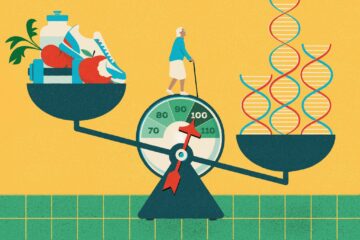
There are countless stories about people who reach 100, and their daily habits sometimes flout conventional advice on diet, exercise, and alcohol and tobacco use. Yet decades of research shows that ignoring this advice can negatively affect most people’s health and cut their lives short. So how much of a person’s longevity can be attributed to lifestyle choices and how much is just luck — or lucky genetics? It depends on how long you’re hoping to live. Research suggests that making it to 80 or even 90 is largely in our control. “There’s very clear evidence that for the general population, living a healthy lifestyle” does extend the life span, said Dr. Sofiya Milman, a professor of medicine and genetics at the Albert Einstein College of Medicine.
More here.
Enjoying the content on 3QD? Help keep us going by donating now.
Sunday, January 12, 2025
Whither Woke?
Gary Younge in The Ideas Letter:
In the film American Fiction, the culturally refined Dr Theolonius “Monk” Ellison, an African American author and professor, is struggling to get his highbrow novels published: the white gatekeepers to the literary world believe they are not “Black enough” and would rather put out ghetto stereotypes. So he writes a spoof novel, set in the hood, under the pseudonym Stagg R. Leigh. He calls it FUCK and pretends to be an author whose identity needs to be protected because he’s on the run from the police. It’s snapped up for a huge sum, giving Monk’s ghettofabulous doppelganger more money and attention than his culturally elevated original ever enjoyed. Later he is asked to join a judging panel for a book award, which has been accused of being too white. “I’m honored you’d choose me out of all the black writers you could go to for fear of being called racist,” says Monk facetiously.
FUCK is shortlisted for the award. The three white judges praise it as “gutsy”, “necessary” and “like gazing into an open wound”. When Monk and the only other Black judge argue that the book should not win the prize they are overruled by the three white judges, the most aggressively liberal of whom states: “I just think it’s essential to listen to black voices right now.” As the Black author of six books, much of the scene rang true to me. Indeed, the film wouldn’t work as a parody if it didn’t bear some resemblance to reality.
More here.
Enjoying the content on 3QD? Help keep us going by donating now.
Politics All the Way Down
Lily Hu in Boston Review:
A new common sense has emerged regarding the perils of predictive algorithms. As the groundbreaking work of scholars like Safiya Noble, Cathy O’Neil, Virginia Eubanks, and Ruha Benjamin has shown, big data tools—from crime predictors in policing to risk predictors in finance—increasingly govern our lives in ways unaccountable and often unknown to the public. They replicate bias, entrench inequalities, and distort institutional aims. They devalue much of what makes us human: our capacities to exercise discretion, act spontaneously, and reason in ways that can’t be quantified. And far from being objective or neutral, technical decisions made in system design embed the values, aims, and interests of mostly white, mostly male technologists working in mostly profit-driven enterprises. Simply put, these tools are dangerous; in O’Neil’s words, they are “weapons of math destruction.”
These arguments offer an essential corrective to the algorithmic solutionism peddled by Big Tech—the breathless enthusiasm that promises, in the words of Silicon Valley venture capitalist Marc Andreessen, to “make everything we care about better.” But they have also helped to reinforce a profound skepticism of this technology as such. Are the political implications of algorithmic tools really so different from those of our decision-making systems of yore? If human systems already entrench inequality, replicate bias, and lack democratic legitimacy, might data-based algorithms offer some promise in addition to peril? If so, how should we approach the collective challenge of building better institutions, both human and machine?
More here.
Enjoying the content on 3QD? Help keep us going by donating now.
Polycrisis & the critique of capitalocentrism
Adam Tooze over at his substack, Chartbook:
2008 and the years that followed delivered a historic shock.
The vertiginous panic of the financial crisis, the protracted eurozone crisis that followed, the Occupy movement and the “inequality moment”, BLM, mounting anxiety about fascistoid politics, the radicalization of the climate crisis, escalating geopolitical tension, all this and more has led to a search for big, urgent, powerful frames of analysis. Anything less seems inadequate to the moment.
One of the responses on the progressive political side has been a return to what you might call classical foundations. For some this was Marxism. For others, myself included, it involved a return to Keynes, left Keynesianism and currents like MMT and the Green New Deal.
This turn was “necessary”. It has been intellectually and politically productive. But it also came at a price.
What I worry about is a double evasion of history, both “real” and intellectual, if such a distinction may be permitted:
a. In real terms: by anchoring critique in classical social theories that were shaped above all by the 1900-1950 moment, we risk underestimating the radicalism of the present. This is not to underestimate the dramas of the early 20th century – I hope I may be spared that accusation. But to insist on the novelty, unprecedented scale and pace of our current predicament.
More here.
Enjoying the content on 3QD? Help keep us going by donating now.
Peter Yarrow (1938 – 2025) Singer/Songwriter
Enjoying the content on 3QD? Help keep us going by donating now.
Carter Funeral
Why We Say Yes When We Don’t Want To
Dr. Sunita Sah in Time Magazine:
 From an early age, we are taught that obedience is good, and disobedience is bad. Saying yes is polite and agreeable, while saying no is often seen as selfish or disruptive. These lessons shape us psychologically, socially, and even neurologically. When we are rewarded for compliant behavior, our brain rewards us with a hit of dopamine, the neurotransmitter associated with pleasure. Repeated compliance strengthens the neural pathways associated with saying “yes.”
On the other hand, acts of defiance—especially when they are met with disapproval—receive no such reward, making those pathways weaker or less likely to develop. Over time, compliance becomes a default response. This tendency is reinforced throughout our lives. At school, we are praised for obedience and penalized for questioning authority. At work, compliance is embedded in professional hierarchies. Even in our personal lives, studies show that those who are conscientious or have agreeable dispositions are more likely to acquiesce to others’ demands. It’s no wonder, then, that saying “yes” feels easier, safer, and even expected—while saying no can feel like swimming against a tide of social conditioning.
More here.
Enjoying the content on 3QD? Help keep us going by donating now.
Charles Person (1942 – 2025) Original Freedom Rider
Enjoying the content on 3QD? Help keep us going by donating now.
Sam Moore (1935 – 2025) Singer
Enjoying the content on 3QD? Help keep us going by donating now.
Sunday Poem
What is Offered
This morning’s counteroffer:
one dead baby snapping turtle,
more tail, nearly, than shell
with one eye missing
in trade for the hangover
from last night’s dream –
the one about your brother
and how he faked his death.
Nothing fake about the turtle’s
but still, you cradle it in the hollow
at the center of your hand, carrying
it to the muddy edge, turning
the one eye toward the water.
Oh, let that one eye looking
see where to go from here,
tail like a rudder,
head swinging side to side
death coming into view –
then the purple asters
bent over and frayed.
by Alexandra Risley Schroeder
from Ecotheo Review
Enjoying the content on 3QD? Help keep us going by donating now.
Friday, January 10, 2025
What Car Crashes Reveal About Human Hubris and Fragility
Sara Mitchell at Literary Hub:
 Crumple zones are a standard safety feature in modern vehicles. Upon impact, your car is designed to crush, mangle, and deform itself in a controlled manner. It absorbs the energy of the crash upon itself, rather than transferring the energy into what’s referred to as “the safety cell,” aka you. Béla Barényi, dubbed by Mercedes Benz as “the lifesaver,” engineered the first crumple zones on an automobile. Mercedes said at the time, “Manufacturers carefully avoided using the term [safety]…nobody wanted to be reminded about the dangers of driving. The topic was viewed as a sales killer.”
But Barényi was ahead of his time when he recognized that the kinetic energy of a crash could be dissipated by the controlled deformation of the vehicle. That it would buy the two most important things needed: time and space between you and your crash. It buys fractions of a second as the hood crumples, before the most dangerous part, when the car stops and your head flies forward and back again. If you’re lucky, you’ll sprain your neck, but if you’re not, you’ll break it, or suffer what’s called a basilar fracture, a break at the base of the skull.
More here.
Enjoying the content on 3QD? Help keep us going by donating now.
Why sabre-toothed animals evolved again and again
Chris Simms in New Scientist:
 Sabre teeth have very specific characteristics: they are exceptionally long, sharp canines that tend to be slightly flattened and curved, rather than rounded. Such teeth have independently evolved in different groups of mammals at least five times, and fossils of sabre-tooth predators have been found in North and South America, Europe and Asia.
The teeth are first known to have appeared some 270 million years ago, in mammal-like reptiles called gorgonopsids. Another example is Thylacosmilus, which died out about 2.5 million years ago and was most closely related to marsupials. Sabre teeth were last seen in Smilodon, often called sabre-toothed tigers, which existed until about 10,000 years ago.
To investigate why these teeth kept re-evolving, Tahlia Pollock at the University of Bristol, UK, and her colleagues looked at the canines of 95 carnivorous mammal species, including 25 sabre-toothed ones.
More here.
Enjoying the content on 3QD? Help keep us going by donating now.
Sean Carroll talks about himself, physics, the world
Enjoying the content on 3QD? Help keep us going by donating now.
The politics of German anti-anti-Semitism
Wolfgang Streeck at the European Journal of Social Theory:

Accessing and explicating the complexities of the collective subconscious that underlies a culture requires a hermeneutic skill and a richness of concepts and examples that is not at my disposal. I have nothing to add to Heidrun Friese’s insightful psycho-analysis of the Tätervolk that wants to draw a Schlussstrich by insisting that it doesn’t want to draw a Schlussstrich, offering reparation, Wiedergutmachung, for what cannot be repaired, hoping to be forgiven the unforgivable by declaring it unforgivable. I will instead focus on a simpler subject, one that lends itself, I hope, to be treated with the less sophisticated toolkit of the political scientist: not the depths of culture but the heights of politics, of government, of state, in particular the contingencies and constraints faced by a German state which had chosen to be the successor state of the Drittes Reich, in its dual relationship with its international context and its domestic society.
When the Federal Republic was founded by the three Western Allies in 1949, its first Chancellor, Konrad Adenauer, had to govern with what the unconditional surrender had left of the Nazi killing machine. There was hardly anybody else, on both the conservative and the social-democratic side, who knew how to run a ministry, a secret service, a police corps, a court of justice, or injustice as the case might have been.
More here.
Enjoying the content on 3QD? Help keep us going by donating now.
Hildegard of Bingen’s Prophetic Enchanted Ecology
Maria Popova at Marginalia:

At seventy-six, Hildegard of Bingen — poet, painter, healer, composer, philosopher, mystic, medical writer — has just finished writing and illustrating her third and farthest-seeing book: The Book of Divine Works, chronicling seven years of prophetic visions. God had first begun speaking to her in “the voice of the Living Light” when she was three, but she never suffered the hubris of a self-appointed prophet — rather, she considered herself “a totally uneducated human being,” a “wretched and fragile creature,” who is merely a channel for divine wisdom. She may be the Western world’s first great crusader against dualism — in the sermons she delivered to priests, bishops, abbots, and ordinary people all over present-day Germany and Switzerland, she preached that “God is Reason,” that “Reason is the root” from which “the resounding Word blooms,” but also that “from the heart comes healing,” that we apprehend the world and its wisdom most clearly through the intuitions of the “inner eye” and “inner ear.”
Hildegard was fifty-six when she began receiving the vision that would become her Book of Divine Works. On its pages, between writings about birds and trees and stones and stars, between reckonings with the nature of eternity and the fundaments of love, she conceptualizes something the word for which would not be coined for another seven centuries: ecology.
more here.
Enjoying the content on 3QD? Help keep us going by donating now.
Voice of the Blood (Hildegard von Bingen)
Enjoying the content on 3QD? Help keep us going by donating now.
Is Civil Commitment Rehabilitating Sex Offenders—Or Punishing Them?
Jordan Michael Smith at Harper’s Magazine:
On Taisa Carvalho Mick’s first day as a psychotherapist with Larned State Hospital’s Sexual Predator Treatment Program (SPTP), her co-workers warned her to be careful around her patients. She shouldn’t get close to them or believe a word they said, other staffers told her. They were untrustworthy predators, liable to manipulate her—or worse. Mick was suprised. She didn’t hear anything about empathy or treating patients with respect, even though the ostensible goal of the program was to provide therapy.
Larned, Kansas, is a city of 3,700 people surrounded by wheat fields and cattle farms. Like nineteen other states, the District of Columbia, and the federal government, Kansas detains many former inmates convicted of sex offenses after they finish serving their criminal sentences. They remain confined in treatment facilities until an evaluator deems them unlikely to reoffend and a judge agrees to their release. Supporters of this practice, which is called civil commitment, defend it as a form of medical treatment necessary for public safety. The handbook provided to those detained at Larned puts it this way: “It is the vision of the SPTP to provide residents with the knowledge and tools needed for their reintegration back into society.”
more here.
Enjoying the content on 3QD? Help keep us going by donating now.