Most People With Addiction Simply Grow Out of It

Banksy-brush

Maia Szalavitz in Substance:

According to the American Society of Addiction Medicine, addiction is “a primary, chronic disease of brain reward, motivation, memory and related circuitry.” However, that’s not what the epidemiology of the disorder suggests. By age 35, half of all people who qualified for active alcoholism or addiction diagnoses during their teens and 20s no longer do, according to a study of over 42,000 Americans in a sample designed to represent the adult population.

The average cocaine addiction lasts four years, the average marijuana addiction lasts six years, and the average alcohol addiction is resolved within 15 years. Heroin addictions tend to last as long as alcoholism, but prescription opioid problems, on average, last five years. In these large samples, which are drawn from the general population, only a quarter of people who recover have ever sought assistance in doing so (including via 12-step programs). This actually makes addictions the psychiatric disorder with the highest odds of recovery.

While some addictions clearly do take a chronic course, this data, which replicates earlier research, suggests that many do not. And this remains true even for people like me, who have used drugs in such high, frequent doses and in such a compulsive fashion that it is hard to argue that we “weren’t really addicted.” I don’t know many non-addicts who shoot up 40 times a day, get suspended from college for dealing and spend several months in a methadone program.

Only a quarter of people who recover have ever sought assistance in doing so (including via 12-step programs). This actually makes addictions the psychiatric disorder with the highest odds of recovery.

Moreover, if addiction were truly a progressive disease, the data should show that the odds of quitting get worse over time. In fact, they remain the same on an annual basis, which means that as people get older, a higher and higher percentage wind up in recovery. If your addiction really is “doing push-ups” while you sit in AA meetings, it should get harder, not easier, to quit over time. (This is not an argument in favor of relapsing; it simply means that your odds of recovery actually get better with age!)

So why do so many people still see addiction as hopeless? One reason is a phenomenon known as “the clinician’s error,” which could also be known as the “journalist’s error” because it is so frequently replicated in reporting on drugs. That is, journalists and rehabs tend to see the extremes: Given the expensive and often harsh nature of treatment, if you can quit on your own you probably will. And it will be hard for journalists or treatment providers to find you.

More here.

Wednesday Poem

The Hart Crane Connection

1.
There’s a connection I’ve made between
the overcrowded livestock
ships in Fremantle harbour, and Hart
Crane’s last voyage.

There are death ships steaming for Bahrain
with five storeys
of corroded sheep yards, the shit spilling
overboard like black hail,

half the bleating cargo either crushed
or starving to death,
and no relief from the septic winds of trade
blowing wavespray through the hold.

Hart Crane rode the full-blown tide cruising
three hundred miles
off Havana, a broken poet at the stern
watching a clipper

pass with a dark consignment
of dying animals: skulls
and sheep skins drying on the mast ropes
like a ghostboat’s ensign,

and the deck hands out smoking on the boards.
That Hart Crane
inhaled a line of uncut snow in his cabin
before going over

the stern rail of the Orizaba is incidental.
He was being shipped
to his death for years, and no amount of drugs
could ever change

his destination. He knelt in solemn meditation
like an Islamic butcher
over the wake, the clipper he’d seen now
tacking out of view.

He watched the bottle-nosed dolphins ride
the wash for awhile
and then, with a curse for the halal killing,
bled himself of poetry.

Stoned, and thick with dread at running aground
in America again,
he wept for the religious exploitation of animals,
then delivered himself to them.

Read more »

Thoughtlessness Revisited

B0165_eichmann_d

Richard Wolin responds to Seyla Benhabib's NYT piece on Hannah Arendt, in The Jewish Review of Books:

Benhabib’s allegations concerning the purported banality of Eichmann’s anti-Semitism are peculiar, since they are fundamentally at variance with Arendt’s central arguments and claims. In fact, in Eichmann in Jerusalem Arendt repeatedly insisted that Eichmann acted not out of ideological conviction, as one might expect of a fanatical anti-Semite, but as a “functionary,” an exponent of what she terms “administrative mass murder.” Thus as she declared in a 1964 interview: “I don’t believe that ideology played much of a role. To me that appears to be decisive.” These observations led Arendt to the (to my mind, quite astonishing and unacceptable) conclusion that “[Eichmann] had no criminal motives.

Thus, it is not really the case, as Benhabib suggests, that Arendt “underestimated Eichmann’s anti-Semitism,” since, as we have seen, Arendt discounted ideological motives entirely. Consequently, Arendt’s interpretive framework leads to the implausible conclusion that someone who proudly claimed responsibility for the murder of six million Jews—and who, on more than one occasion, openly regretted that he had not killed more—remained unaffected by the reigning ideology of the regime he served: anti-Semitism.

More importantly, it is disingenuous to suggest that Eichmann’s anti-Semitism, crude though it may have been, was “banal,” since it was part of an ideological template that underwrote the extermination of European Jewry. As the historian Raul Hilberg observed: “[Arendt] did not . . . grasp the dimensions of [Eichmann’s] deed. There was no ‘banality in this ‘evil.”

More here.

Tuesday, September 30, 2014

The Poor Don’t Need Pity

Scutts_1438424682-web2_850_593

Joanna Scutts reviews Linda Tirado book, Hand to Mouth: Living in Bootstrap America, in In These Times (Photo by Lisa F. Young via Shutterstock):

This is scary to admit. In a country with vast resources but a social safety net that’s been shredded to ribbons, “the layer between lower-middle class and poor is horrifyingly porous from above,” Tirado writes. “A lot of us live in that spongy divide.” Our finely tuned class distinctions are a way of trying to order that “spongy divide” and predict who will fall—not us! Tirado’s distinctions, on the other hand, are rooted in experience: “Poverty is when a quarter is a fucking miracle. Poor is when a dollar is a miracle. Broke is when five bucks is a miracle.” Working class, you have a place to live; middle class, that place is secure, even “nice,” and you can buy furniture and toys; and “rich is anything above that.” This is not about the 99% and the 1%, terms Tirado doesn’t use. When she addresses “rich people,” she means the people who can afford to buy this book and have the leisure to read it—not Koch-level plutocrats. People whose lives are relatively stable, who might have a decent credit score, health insurance, a bank account, retirement savings, the basic requirements of civic life that we have redefined as luxuries for the luckiest.

This important redefining of “rich” means that when Tirado addresses a final chapter to “Rich People,” the reader has to line up with the straw men: right-wing hypocrites who think the poor are lazy, or smug urbanites who believe that a lack of organic kale equals child abuse. I’m not a rich person, you want to protest—I don’t think it’s superior to get drunk on claret in a restaurant rather than on moonshine at the side of the road. But Tirado keeps tapping your knee and she’ll find a place that makes you jerk, where you find yourself thinking, I wouldn’t do that. You should make a different choice. Her refusal to flatter the reader gives the book its urgency and its force. It’s not a sob story (though it could make you weep with frustration); it’s a confrontation with the way that poor people are seen and judged day after day—by good liberals as well as evil Republicans, by the 99% as well as the 0.01%.

Tirado’s stories, her calculations, and her statistics are not new. When you reach a chapter called “You Can’t Pay a Doctor in Chickens Anymore,” you take a deep breath, because you know what’s coming. It’s still shocking, though, that an expectant first-time mother on Medicaid can’t find a clinic to give her care and has to rely on books, friends and Google until she shows up at the ER to give birth. Dental care, mental health care, vision care, preventative care—it all costs money, and its lack is written on the bodies of the poor. We might imagine that people who clean toilets or fry fast food are exhausted and demoralized; we might not appreciate that they probably have to ask their boss for permission to pee, since American workers aren’t guaranteed bathroom breaks. We might not always register that the service worker speaking in perky inanities is reading from a script and can be fired if she misses a word. We might not do the math to calculate that the earnings from a 40-hour-a-week job on minimum wage, after half go to housing, equal $7,540. Per year. Even a more generous calculation—10 bucks an hour, one-third on rent—gives you 10 unallocated dollars a day, so “the world is your oyster.” In case the tone’s too subtle here, Tirado clarifies: “The math doesn’t fucking work.”

More here.

God and Gab: The Second Sex by Michael Robbins

0143126644.01.LZZZZZZZNick Ripatrazone at The Millions:

Piety and profanity both require devotion. Graham Greene knew that. Greene was received into the Roman Catholic Church in 1926, and announced the conversion to his mother by writing “I expect you have guessed that I am embracing the Scarlet Woman.” He later identified as a “Catholic agnostic,” which complemented his baptismal name of Thomas, “after St. Thomas the doubter and not Thomas Aquinas.” He found God, but hadn’t lost his wit.

To say that Greene was a troubled Catholic would be the same as calling him a Catholic at all. He dramatized the obscenities of a Mexican whiskey priest hunted by Tomás Garrido Canabal’s Red Shirts in The Power and the Glory. In one scene, the priest has been jailed for possessing brandy, and shares a dark cell with others, including a couple having sex. A “pious” woman, jailed for having religious books, calls the copulating pair “brutes” and “animals.” She hates their “ugliness.” The whiskey priest knows better. He tells the woman to not believe that, “Because suddenly we discover that our sins have so much beauty.”

Michael Robbins is our contemporary poet laureate for beautiful sins of language. The New Republic calls Robbins a prankster. He rather reminds me of that whiskey priest, his lines by turns abrasive and aphoristic, but never apathetic.

more here.

contemporary art from and about the Arab world

Schwabsky_underpressure_ba_imgBarry Schwabsky at The Nation:

“In the presence of the violent reality of war,” wrote Wallace Stevens in 1942, “consciousness takes the place of the imagination.” What the poet meant is that in wartime, “everything moves in the direction of reality, that is to say, in the direction of fact,” so that “we leave fact and come back to it, come back to what we wanted fact to be, not to what it was, not to what it has too often remained.” But this pressure toward fact and the desire to change, to remake the facts, become “overwhelming.”

It was difficult to look at “Here and Elsewhere,” the capacious exhibition of “contemporary art from and about the Arab world” (to quote from the press release), without sensing this overwhelming pressure toward fact. In part, this was a matter of timing. My first visit to the show, on view at the New Museum in New York City through September 28, took place the day after it opened on July 16, and just after Israel launched Operation Protective Edge, the attack on Gaza that killed more than 2,000 people, most of them civilians and many of them children, and left many more homeless. To encounter so much art so deeply marked by the fact of violence was hard to bear. My attention was relentlessly drawn to works like those from Lamia Joreige’s Objects of War series, begun in 1999, in which videos of people being interviewed about objects that evoke memories of the wars that ravaged Lebanon in the 1970s and ’80s are juxtaposed with the objects themselves. There was also Khaled Jarrar’s 2012 feature-length video Infiltrators, which follows the agonizing efforts of Palestinians to breach the wall separating Israel from the Occupied Territories—not to commit acts of terrorism, but mainly for economic and personal reasons.

more here.

three years on Rikers

141006_r25549-320Jennifer Gonnerman at The New Yorker:

On the morning of July 28, 2010, Browder was awakened at around half past four. He was handcuffed to another inmate and herded onto a bus with a group of other prisoners. At the Bronx County Hall of Justice, they spent the day in a basement holding pen, each waiting for his chance to see a judge. When Browder’s turn came, an officer led him into a courtroom and he caught a glimpse of his mother in the spectator area. Seventy-four days had passed since his arrest. Already he had missed his seventeenth birthday, the end of his sophomore year, and half the summer.

A grand jury had voted to indict Browder. The criminal complaint alleged that he and his friend had robbed a Mexican immigrant named Roberto Bautista—pursuing him, pushing him against a fence, and taking his backpack. Bautista told the police that his backpack contained a credit card, a debit card, a digital camera, an iPod Touch, and seven hundred dollars. Browder was also accused of punching Bautista in the face.

A clerk read out the charges—“Robbery in the second degree and other crimes”—and asked Browder, “How do you plead, sir, guilty or not guilty?”

“Not guilty,” Browder said.

more here.

Animal populations ‘have halved since 1970’

Daniel Cressey in Nature:

Living-planet-2-jayEarth’s wild vertebrate populations have dropped to one-half the size they were in the 1970s, according to an analysis of more than 3,000 species. Researchers from the WWF wildlife NGO, headquartered in Woking, UK, and the Zoological Society of London (ZSL) aggregated data on 10,380 populations from 3,038 species into an index of the health of the five main groups of vertebrates — mammals, birds, reptiles, fishes and amphibians. Set at 1 in 1970, this index has decreased to 0.48 (meaning by 52%) since then, according to their latest report.

This analysis is the tenth ‘Living Planet Index’ from WWF and ZSL, but this year’s has a crucial difference from previous editions in that it is weighted to take account of the make-up of biodiversity in different areas. Previous versions treated every species on which data were available equally, whereas the new edition attempts to correct for the size of each taxonomic group in a region, for example by giving more weight to fish than mammals in the palearctic. The last index – published in 2012 – showed a 28% decrease between 1970 and 2008. The bleaker picture painted by the 2014 edition comes both from real declines in newer data, and from the new weighting.

More here.

Does the history of philosophy matter?

Malcolm Thorndike Nicholson in Prospect:

Bertrand-RussellIf you study philosophy at a British or American university, your education in the history of the subject will likely be modest. Most universities teach Plato and Aristotle, skip about two millennia to Descartes, zip through the highlights of Empiricism and Rationalism to Kant, and then drop things again until the 20th Century, where Frege and Russell arise from the mists of the previous centuries’ Idealism and call for a new kind of philosophy rooted in formal logic, science, and “common sense.” In most of your courses, you will probably be able to do well without reading a single paper written before the 20th century.

This is peculiar because, unlike science, philosophy is not a discipline in which new theories bury the old ones. Philosophers can resurface long after we think we’ve disposed of them. This tendency of old ideas to rise from the dead has led to some of the most interesting work in contemporary philosophy. The revival of virtue ethics owes much to figures such as Philippa Foot, whose re-evaluation of Plato, Aristotle and Nietzsche, helped her form a theory of normative ethics that offered an alternative to the two dominant schools, Kantian ethics and consequentialism. In epistemology, the celebrated American philosopher, Wilfrid Sellars, was deeply influenced by his close reading of Kant and Hegel. (Sellars also famously stated “philosophy without the history of philosophy is, if not blind, at least dumb.”) David Lewis’s reading of St Anselm and Leibniz led him to thinking about so-called “possible worlds;” now one can’t sit in a metaphysics seminar without talking about them.

Scholarship aimed at increasing our awareness of the history of philosophy is, in short, a good thing. That was my optimistic viewpoint as I began reading Peter Adamson’s Classical Philosophy: a history of philosophy without any gaps (OUP, £20), the first instalment of a series of books aimed at producing a more comprehensive history of philosophy.

More here.

Steven Salaita: U. of I. destroyed my career

Steven Salaita in the Chicago Tribune:

ScreenHunter_823 Sep. 30 10.53Being recruited for a tenured faculty position at a major university is no small feat, nor should it be; tenure represents the pinnacle of an academic career. In my case, it involved numerous interviews with faculty in the American Indian studies program at the University of Illinois at Urbana-Champaign and an intensive review of my scholarship, pedagogy and professional service.

I survived this rigorous review and, having accepted an employment offer from the dean of the College of Liberal Arts and Sciences, resigned my tenured position at another university and prepared my family to move. A few weeks before classes were to start, and without any warning, I received a letter from the chancellor, Phyllis Wise, informing me of my termination.

How did this happen?

In the weeks before my move, I watched in anguish as Israel killed more than 2,100 people during its recent bombing of Gaza, 70 percent of them civilians, according to the United Nations. Like so many others, I took to my Twitter account. I posted tweets critical of Israel's actions, mourning in particular the death of more than 500 of Gaza's children.

More here.

God, Darwin and My College Biology Class

David P. Barash in the New York Times:

ScreenHunter_822 Sep. 30 10.33It’s irresponsible to teach biology without evolution, and yet many students worry about reconciling their beliefs with evolutionary science. Just as many Americans don’t grasp the fact that evolution is not merely a “theory,” but the underpinning of all biological science, a substantial minority of my students are troubled to discover that their beliefs conflict with the course material.

Until recently, I had pretty much ignored such discomfort, assuming that it was their problem, not mine. Teaching biology without evolution would be like teaching chemistry without molecules, or physics without mass and energy. But instead of students’ growing more comfortable with the tension between evolution and religion over time, the opposite seems to have happened. Thus, The Talk.

There are a few ways to talk about evolution and religion, I begin. The least controversial is to suggest that they are in fact compatible. Stephen Jay Gould called them “nonoverlapping magisteria,” noma for short, with the former concerned with facts and the latter with values. He and I disagreed on this (in public and, at least once, rather loudly); he claimed I was aggressively forcing a painful and unnecessary choice, while I maintained that in his eagerness to be accommodating, he was misrepresenting both science and religion.

More here.

Monday, September 29, 2014

Sunday, September 28, 2014

Virtue Ethics: an ancient solution to a modern problem

Peter D. O. Smith in Scientia Salon:

69729_aristotle_lgThis article is neither a defense of nor an attack against either religion or secularism. It treats them as well established sociological facts and no more than that. I take them as given and argue that a greater moral good can be achieved if the two belief systems find common moral ground in virtue ethics.

Moral choices infuse most aspects of our life, whether we know it or not. And a great number of these moral choices are bad ones. This is why our prisons are filled to overflowing [1], and recidivism is so high at 66% [2]. This is why we have so many war dead and this is why so many die violent deaths at the hands of murderers or radical ideologues. This is also why we have such an inequitable distribution of wealth. This is why cheating is rampant at schools and universities [3]. We maintain large standing armies to protect ourselves from the bad moral choices of others and on occasion we use it to inflict our bad moral choices on others. This is why we have no qualms in spying on our own citizens [4] or in killing without due process. This is why almost everyone has been the victim of crime, unfairness, injustice, discrimination, bullying [5], sexism, racism, ageism or other forms of bigotry, bias, and discrimination. This is why stalking is commonplace [6].

Bad moral choices touch us all and are the major cause of suffering in today’s world. Every person who has been jilted by a cheating partner has felt that suffering. Marital infidelity is the most common cause of divorce and abuse is another important cause [7]. One in five women are sexually assaulted at university [8]. Even natural disasters such as earthquakes or floods are compounded by moral failures as nations don’t respond adequately. Famines become moral failures when we cannot distribute food where and when it is needed. Our economic systems become moral failures when they turn into instruments of greed. Our political systems become moral failures when they are used for the advantage of the powerful, to exploit or neglect the weak.

The point I am making is that moral suffering is real, pervasive and needs attention. We have made great progress in reducing material suffering, but only some progress in reducing moral suffering. This is the important challenge that faces us today, to reduce moral suffering with the same degree of success that we have reduced material suffering.

More here.

The Viroid: A Tiny Emissary From the Ancient Past

Carl Zimmer in the New York Times:

ScreenHunter_820 Sep. 28 22.28In the early 1920s, farmers in New Jersey noticed their potatoes were shriveling, their leaves becoming deformed. The plants were sick with an illness that came to be known as potato spindle tuber disease. But it took almost five decades for someone to find the cause.

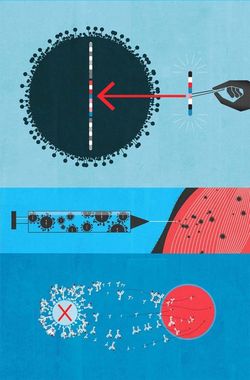
In 1971, Theodor O. Diener, a plant pathologist at the Department of Agriculture, discovered that the culprit is an inconceivably tiny pathogen — one-80th the size of a virus. Dr. Diener called it a viroid.

Since Dr. Diener’s initial discovery, scientists have identified nearly three dozen species of viroids that attack crops from tomatoes to coconuts, as well as flowers such as dahlias and chrysanthemums. In many cases, the only way to stop an outbreak is to destroy all the infected plants. These days many countries require that plants be certified viroid-free before being imported.

But viroids may be much more than agricultural pests. New research suggests that they existed at the earliest stages of life on Earth, enduring in their primitive state for billions of years. These are the pterodactyls of the microbial world — except that they are still very much with us. We just didn’t realize it.

More here.

To end inequality, we must realise that it isn’t about the rich, it’s about the poor

Clare Melamed in Aeon:

ScreenHunter_819 Sep. 28 22.24Close observers of the development scene will have noticed an interesting shift over the past few years. Where once institutions such as the World Bank and charities like Oxfam described their goal as simply ‘ending poverty’, today they tend to frame things in terms of poverty and inequality. Well, that makes sense: doesn’t it seem intuitively obvious that these two things must be connected in some way?

Yet those links can be surprisingly hard to bring into focus. In 15 years of working in the development sector – first for international NGOs and more recently running a research programme on poverty and inequality – I have found myself explaining over and over again exactly what the one has to do with the other. What does it matter to an impoverished farmer in South Sudan if 85 people hold as much wealth as half the world’s population? If those 85 people gave everything away, would that actually help the farmer?

The problem, I have come to think, is that there are two very different ways of thinking about inequality. The first is all about the rich. The second is all about the poor. The first is the one we usually hear about. The second is the one that really matters.

More here.

The Dismal Science

28KRUGMAN-master315-v2 (1)

Paul Krugman reviews 'Seven Bad Ideas,' by Jeff Madrick, in the NYT's Sunday Book Review (picture by Michael Lionstar):

In “Seven Bad Ideas: How Mainstream Economists Have Damaged America and the World,” Jeff Madrick — a contributing editor at Harper’s Magazine and a frequent writer on matters economic — argues that the professional failures since 2008 didn’t come out of the blue but were rooted in decades of intellectual malfeasance.

As a practicing and, I’d claim, mainstream economist myself, I’m tempted to quibble. How “mainstream,” really, are the bad ideas he attacks? How much of the problem is bad economic ideas per se as opposed to economists who have proved all too ready to drop their own models — in effect, reject their own ideas — when their models conflict with their political leanings? And was it the ideas of economists or the prejudices of politicians that led to so much bad policy?

I’ll return to those quibbles later, but Madrick’s basic theme is surely right. His bad ideas are definitely out there, have been expressed by plenty of economists, and have indeed done a lot of harm.

So what are the seven bad ideas? Actually, they aren’t all that distinct. In particular, bad idea No. 1 — the Invisible Hand — is pretty hard to distinguish from bad idea No. 3, Milton Friedman’s case against government intervention, and segues fairly seamlessly into bad idea No. 7, globalization as something that is always good. As an aside, this sometimes makes Madrick’s argument more disjointed than I’d like, with key propositions spread across nonconsecutive chapters. But there is an important point here, and Madrick has clarified my own thinking on the subject.

More here.

The Anti-Academic’s Anti-Academic

220px-ScientificReview

Charles Green in Inside Higher Ed (image from Wikimedia Commons):

Rebecca Schuman…has a Ph.D. in German studies and a forthcoming book on Kafka, Wittgenstein, and Modernism. Despite those impressive credentials, she left academe and the crumbling job prospects of German studies in 2013, so she’s well-positioned to comment on the real crises in higher education. She even professes, in one essay, “I’m a higher-ed expert.”

While I sometimes agree with her, I think she crafts fundamentally anti-academic arguments, anti-academic in that they rely heavily on unsourced and unsupported generality clothed in hyperbole. While she frames her essays with her expertise and experience, she presents a funhouse image of the academic world as the norm and recreates fabulist stereotypes of the ivory tower gone mad. Ultimately, her writing most often fails to offer substantive critique of academe’s problems and instead offers empty amusement that misleads readers about the world she claims to analyze with expertise.

Her July 15, 2014 essay, “Revise and Resubmit,” exemplifies her anti-academic methods. Most prominently in that essay, Schuman revels in psychologizing straw men, scarecrows who lack not brains but hearts: “Think of your meanest high school mean girl,” she writes, “at her most gleefully, underminingly vicious. Now give her a doctorate in your discipline, and a modicum of power over your future. That’s peer review.” The peer reviewer is a type with easily decipherable, easily dismissed motives.

Yes, Schuman’s being amusingly hyperbolic — I see Regina George and the Plastics of Mean Girls with their burn book, telling lesser academics “Stop trying to make ‘synecdochic heteronormativity’ happen. It’s not going to happen. It’s problematic.” If Schuman’s writing then moved to a more complex, realistic, or data-driven exploration of peer review, I might accept one hyperbolic stereotype — but the psychological profile of straw men predominates her argument.

More here. Rebecca Schuman responds.

He even goes so far as to perform what appears to be a rhetorical exegesis of “Revise and Resubmit,” a roast of the humanities peer-review process done in my usual style, which is a mixture of dark humor, open hyperbole, and cutting truth — and which quotes, yes, a small sample of hilarious tweets about peer-review experiences from my readers, which I culled for their sharpness from a much larger “data set” of about 100.

But yes, the piece exaggerated. Every op-ed I write does. Every sentence I say at home does! My voice has, for better or worse, basically been what it is since my first turn as a columnist at the age of 17 (I appeared bi-weekly in Eugene, Oregon’s paper of record from 1993 to 1994 — kind of a big deal, I know). But it was sharpened in graduate school in a particular vein, as I fell in love with the crotchety Austrians who would come to define my research: Robert Musil, whose over-the-top satire of a bunch of rich drifters also belies harsh truths about the decline and fall of the Austro-Hungarian dual monarchy; the playwright Johann Nepomunk Nestroy, whose untranslatable humor involves saying something that is a massive exaggeration and an unfortunate truth at the same time; Karl Kraus, the patron saint of pithy bile and my personal hero.

Is Green correct that my 1,500-word op-eds (the appropriatelength for such a medium, ahem) are not researched with the same rigor as my academic book, which took seven years to write, and for which I am receiving the standard advance of zero dollars? He is.