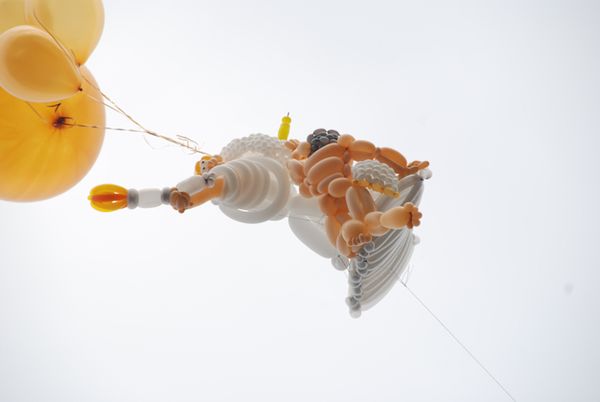
Anne Walsh. Study for The Triumph of Light. 2010.
Video.

by Brooks Riley
James Gingell in The Guardian:
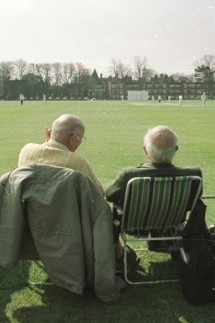
Maybe he liked the game’s hypnotic rhythms, its genteel pace, the easy ebb and flow of an even match. Maybe his eyes and ears enjoyed the game’s distinctive sights and sounds: the flapping white flannels and the rounded knock of bat on ball. Maybe it was the drama, the gladiatorial confrontation of a furious quick bowler hurling rock-hard leather towards a belligerent batsman. All of this grand and strange theatre might have helped him unknit his brow, do some unthinking and achieve the kind of meditative state so important to big intellectual breakthroughs.
For me, though, the more likely draw for Wittgenstein was the game’s language. His whole life was spent attempting to deconstruct the lines of code underpinning evolution’s most fabulous app – verbal communication. And cricket, with its dense and extraordinary quilt of gorgeous words and phrases, must have utterly captivated him.
The complexity of cricket necessitates an equally complex language merely to describe the basics of the game. There’s quite a lot of vocab for a player to learn just to know where to stand on the field. Imagine a circle of radius three metres around a batsman. Any fielder brave enough to stand on that circle can be described as any of (the titular) silly point, silly mid-off, silly mid-on, short leg,backward short leg, leg slip, slip or gully, depending on which point of the compass they are standing on in relation to the batsman.
More here.
Faisal Devji in The Wire:
A journalist I know had the opportunity of meeting Mullah Mohammad Omar early in the Taliban’s career, just as they were embarking upon the conquest of Ghazni, in February 1995. The Taliban leader, he told me, extracted the gilded wrapping-paper from an empty pack of Silk Cut cigarettes and penned instructions for his army on the back of it. In a region where Silk Cut is known as a “woman’s brand,” this image is curious enough. More interesting, however, is the possibility that the shiny cigarette paper served as an impoverished descendant of the gilded edicts or farmans of past monarchs. Did Mullah Omar, I wondered, possess a collection of empty Silk Cut packets for his official pronouncements?
If nothing else, this story tells us how important the aesthetic dimension is for even the most utilitarian militant practices, and how intertwined it is with all that is modern, western and indeed “quotidian” about the world. There is no easy way of distinguishing tradition from modernity here.
The aesthetic dimension of Taliban life is even clearer in these verses from a poet named Sayyed:
I keep the arrows of expectation in my heart like flowers;
My friend, I keep the lamp of hope lit for your coming.
I incite many lovers’ hearts to dance to the sound of my voice;
Always, like the nightingale, I keep the melody of grief in my heart.
Yet it is too young to be hurt; I am afraid it may hurt itself;
I will certainly safeguard this lion from the forest.
Even if time brings the ugliest revolutions,
I will keep the fold of my turban pious.
Sayyed! Even if I am destined to live in far away cities,
I will remain the rough Pashtun of the mountains.
Taken from a collection of Taliban poetry put together by the Kandahar-based researchers Alex Strick van Linschoten and Felix Kuehn, and published under the title Poetry of the Taliban by Columbia University Press, these lines force us to think differently about a group that otherwise receives a great deal of attention, though for different reasons and along very narrow lines.
More here.
Molly Wesling in Brick (via Bookhaven):
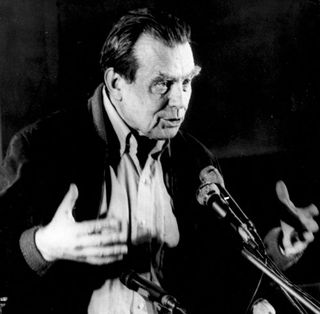
For five years I worked part-time for the poet and Nobel laureate Czesław Miłosz at his home in the Berkeley Hills. Miłosz was seventy-nine when I started taking dictation in Polish and English, helping him answer queries and invitations, mostly finding ways to say “no” in the gentlest of tones. Every so often though, I’d get to transcribe a gem like the letter above.
Once a week I caught the bus to 978 Grizzly Peak Boulevard. Miłosz would greet me at the door, shake my hand with a slight bow, and invite me to his study. By then he had a facial tic: his shaggy eyebrows twitched up and down as he talked. Carol, his American second wife, a lovely, funny woman with a southern twang, would bring Miłosz a glass of vodka. I’d whip out my steno notebook and get to work. Several hours later, Miłosz or Carol would drive me home, a steep descent and a slightly unnerving experience when Miłosz was at the wheel. The view was glorious—often the sun was setting over San Francisco Bay—but I would silently fret about the brakes on his mid-1980s sedan, and the odd headline a mishap might inspire.
To believe you are magnificent. And gradually to discover that you are not magnificent. Enough labor for one human life.
— Czesław Miłosz, Road-side Dog
At the top of his property near the street, Miłosz had a carriage house that he rented out to graduate students, including the sociologist Ted, with whom I fell in love, and, when Ted moved out to live with me, my old friend AnneMarie, a lawyer-in-training. Neither of them had much use for poetry or deference to the landlord called by Joseph Brodsky one of the greatest poets of our time. AnneMarie referred to him as “Cheesy Meatloaf”—her approximation of his Polish name. But she was impressed by the gold medallion that rested on a side table next to the phone in the living room. I’m pretty sure any visitor who used the phone took a surreptitious moment to trace the visage of Alfred Nobel and hold that orb up to the light. When Miłosz went to the University of North Carolina at Chapel Hill for a year as a writer-in-residence, leaving Ted in charge of his cat and his rhododendrons, the medallion remained in situ, just another knick-knack amid the piles of books and papers. Miłosz himself was not much impressed.
Another part of my job was to open and sort the mail, setting aside the letters from Miłosz’s admirers. I wondered about the crumbs tucked into letters from his Polish readers. Later it dawned on me that they were the bruised remains of communion wafers after a journey through the international post. Miłosz dutifully signed blank cards for autograph seekers and sent photos of himself when requested. He didn’t reply to everyone, but some letters caught his fancy, and he would strike up a correspondence—as with this aspiring writer, whose intelligence and longing jump out from the page:
Guilin, Guangxi 541001
P.R. China
October 14, 1993
Dear Mr. Miłosz,
. . . Perhaps having read western literature and philosophy too much, I appear to be a stranger in my own country. Now, I try hard to improve my English writing ability, hoping to express deeply my understandings of Chinese culture in Standard English someday.
As I have longed to be writer from a child, it is not my end to come to America to study Engineering, but I have no other choice. In China, it is difficult to change one’s occupation, at the same time, I am not willing to waste nine hours in a factory every day. I wish I will be admitted to a literary school to read William Faulkner, to study his cycle of stories about Yoknapatawpha County.
I have enjoyed reading an essay excerpted from “Native Realm: A Search for Self-Definition.” Would you please send me this book? For an ordinary Chinese youth like me, it is impossible to obtain any of the original masterpieces. I have taught myself Spanish in order to read Garcia Marquez, for example, but I never get “One Hundred Years of Solitude.”
With kindest regards,
Wei Rui
More here.
Patrick Blanchfield in Daily Beast:
Her case suggests more than just a deep-seated problem, something more than just a highly narcissistic form of histrionic personal disorder, or an unhealthy need for obsession and approval.
Dolezal gives us stories replete with images of grotesque violence: beatings and whippings. Like slavery. Like torture. These are highly choreographed, ritualized sadomasochistic scenes, and to psychotherapists, they’re nothing new.
Therapists since Freud have listened to troubled patients tell stories, both plausible and more dubious, of such violence, and have regularly noticed that they are presented as stories of others being victimized when in fact it is the teller himself who is suffering from persecution that may be real or imagined or both.
And most people, rightly and compassionately, believe these stories. Until, it turns out, these stories are an emotional cover for something that could never be true.
This isn’t the first time this kind of thing has happened—even at this scale, and even with the same profoundly unsettling accusations.
Exactly twenty years ago, readers across Europe were absorbed by a remarkable, increasingly rare literary event: the revelation of a previously unknown Holocaust memoir. Published in German in 1995 as Bruchstücke: Aus einer Kindheit 1939—1948, a slim, hard-hitting first-person account offered a new, horrifying perspective on the Holocaust—that of an extremely young child, a Latvian named Binjamin Wilkomirski. Wilkomirski’s story, told in surreal, dreamlike patches punctuated by moments of stupefying violence, was riveting. Wilkomirski’s first memory, he claimed, was of witnessing his father being beaten to death.
Traveling between the concentration camps at Auschwitz and Majdanek, he claimed to have seen babies gnawing off their own frozen fingers, SS guards mutilating the penises of young boys, and more.
The account was met with considerable acclaim. For The New York Times, Wilkomirski’s prose, even in translation, conveyed “a poet’s vision; a child’s state of grace.” Fragments won the U.S. National Jewish Book Award, while Wilkomirski received numerous personal honors.
The only problem with Wilkomirski’s testimony is that it was full of lies.
More here.
John Gallagher in The Telegraph:
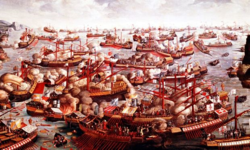
What makes the Mediterranean fascinating is what makes writing its history such a challenge. Noel Malcolm’s magnificent Agents of Empire uses the intertwined stories of two Albanian families – the Brunis and the Brutis – as a prism through which to view the contacts and the conflicts that made the early modern Mediterranean. As diplomats, spies, bishops, soldiers, traders and interpreters, they were mobile and multilingual. From their Albanian roots, networks of kinship and contacts stretched in all directions, crisscrossing barriers of faith and nationality. At the Ottoman court, Bartolomeo Bruti became a protege of the military commander (and later Grand Vizier) Sinan Pasha, an Albanian convert to Islam who happened to be a family relation. Antonio Bruti bargained in Albania for the Ottoman grain necessary to feed Catholic Venice.
More here.
Lee McIntyre in the Chronicle of Higher Education:
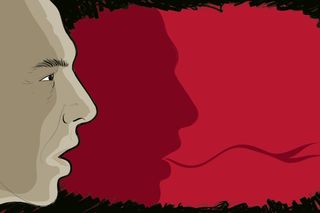
It’s not just garden-variety ignorance that periodically appears in public-opinion polls that makes us cringe or laugh. A 2009 survey by the California Academy of Sciences found that only 53 percent of American adults knew how long it takes for Earth to revolve around the sun. Only 59 percent knew that the earliest humans did not live at the same time as the dinosaurs.
As egregious as that sort of thing is, it is not the kind of ignorance that should most concern us. There is simple ignorance and there is willful ignorance, which is simple ignorance coupled with the decision to remain ignorant. Normally that occurs when someone has a firm commitment to an ideology that proclaims it has all the answers — even if it counters empirical matters that have been well covered by scientific investigation. More than mere scientific illiteracy, this sort of obstinacy reflects a dangerous contempt for the methods that customarily lead to recognition of the truth. And once we are on that road, it is a short hop to disrespecting truth.
More here.
Vivek Wadhwa in The Washington Post:

…The key premise of Bold –that entrepreneurs can solve global-scale problems — is based on a framework called the “six Ds of exponentials:” digitalization, deception, disruption, demonetization, dematerialization, and democratization. These are a chain reaction of technological progress, the path that technology takes, to create the upheaval — and the opportunity.
More here. (Note: Just read this and recommend highly…thanks to Dinesh Paliwal and Vania Apkarian)

There's not much to Milan Kundera's 10th novel, “The Festival of Insignificance” — his first work of fiction since 2000's “Innocence” — but then that's part of the point. Revolving around five middle-aged friends living in Paris, it offers not a narrative so much as a collection of vignettes, or reflections: the novel as a set of asides.
“Time moves on,” one of Kundera's characters tells us. “Because of time, first we're alive — which is to say: indicted and convicted. Then we die, and for a few more years we live on in the people who knew us, but very soon there's another change; the dead become the old dead, no one remembers them any longer and they vanish into the void; only a few of them, very, very rare ones, leave their names behind in people's memories, but, lacking any authentic witnesses now, any actual recollection, they become marionettes.”
This, of course — the issue of meaning in the face of human vanity — has long been at the center of Kundera's work. His first novel, “The Joke,” published in Czechoslovakia in 1967, describes in part the fallout from a satirical postcard (“OPTIMISM IS THE OPIUM OF THE PEOPLE!” it declares. “THE HEALTHY ATMOSPHERE STINKS! LONG LIVE TROTSKY!”) sent by a Czech student to a young woman he wishes to seduce: humor that cannot be read as humor, in other words.
more here.

We instinctively think of “information” as a human phenomenon. But modern science sees it as a measure of something more fundamental: as a point on the continuum between perfect order and perfect randomness, the latter being the state towards which, according to the laws of thermodynamics, the universe inexorably drifts. Flows of energy can fight this tide of entropy, allowing order to develop and pockets of information to be stored — cells, brains and ecosystems are all examples of this process. In Why Information Grows, Hidalgo observes that our economy is full of such energy-fuelled pockets of order. All of the products and services around us are examples, and it is the information embedded in these products and services that gives them their value.
For example, Hidalgo notes that a Bugatti Veyron sports car sells for $2.5m. He then conducts a thought experiment, asking the value if one drove it into a wall — presumably less. Yet all of the atoms in the car would still be there (assuming one kept the broken bits). What has changed is the order or arrangement of the atoms in the car. That order reflects the information embedded in the product, which in turn reflects the knowledge and know-how of its designers and manufacturers. One can think of “knowledge” as information that is useful to humans — when it is embedded in a product, it enables that product to do useful things.
more here.
When I was 15, a shy and bookish sophomore at a high school in Morocco, my French class was assigned Albert Camus’s “The Stranger.” I remember being intrigued by the fact that the story was set in neighboring Algeria. I remember the novel’s indelible first line: “Mother died today.” I remember what an odd hero Meursault seemed to me, unabashed and remorseless, a man who shows no emotion at his mother’s funeral. And I still remember how distressing it was to come upon the crucial scene in which Meursault, walking on a beach under the midday sun, shoots a nameless Arab. Our class discussed Meursault, his mother, his fight with the priest, existentialism and the absurd. All the while, I had to quiet the voice inside me that kept asking, “But what about the Arab?”
The Algerian writer Kamel Daoud has answered this question in his rich and inventive new novel, “The Meursault Investigation.” Its premise is that the murder committed by Meursault in 1942 was a true crime, which catapulted him to worldwide fame after the publication of a book about it. Daoud gives the Arab a name — Musa — and, along with it, a family, a home and a story. But like his Quranic and biblical counterpart, Musa (Moses) isn’t able to speak for himself, so his brother, Harun (Aaron), will do it in his stead. It is Harun who narrates the events of that fateful day, his first line already a counterpoint to Meursault’s: “Mama’s still alive today.”
more here.
Azar Nafisi in The New York Times:
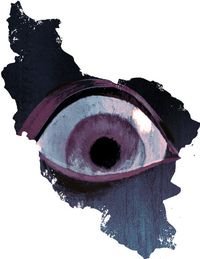
Censorship entered our minds and hearts early. Veils were added to the illustrations of children’s books like “Alice’s Adventures in Wonderland,” “Daddy Long Legs” and “Beauty and the Beast.” A friend’s 8-year-old daughter became afraid to go to the bathroom alone because her religious teacher had told her that if blasphemous thoughts entered her mind there, each strand of her hair would transform into a snake. In university literature classes, love scenes were regularly stricken from novels. The word “wine” was excised from Hemingway’s stories. Censors frowned on villains in fiction or film having beards or having religious names. A theater director I know used to complain that every scene with a husband and wife in a bedroom required a quarrel. Tenderness was too risky.
More here.
W.H. Auden in the NYRB gallery:
In the summer of 1935, Mr. John Grierson asked me to write a chorus for the conclusion of a G.P.O. documentary film called Coal-Face. All I now remember about the film was that it seemed to have been shot in total darkness and a factual statement in the commentary—The miner works in a cramped position. My chorus, he told me, would be set by a brilliant young composer he had hired to work for him, called Benjamin Britten. The following autumn I went myself to work for the G.P.O. Film Unit. What an odd organization it was. John Grierson had a genius for discovering talent and persuading it to work for next to nothing. There was Britten, there was William Coldstream, there was Cavalcanti, among others. Personally I loathed my job, but enjoyed the company enormously. The film which both Britten and myself worked on which I remember best was one about Africa which never got made because it turned out that there were no visuals. Our commentary was a most elaborate affair, beginning with quotations from Aristotle about slavery and including a setting of a poem by Blake. I wonder if Britten still has the score as there was some wonderful music in it.
What immediately struck me, as someone whose medium was language, about Britten the composer was his extraordinary musical sensibility in relation to the English language. One had always been told that English was an impossible tongue to set or to sing. Since I already knew the songs of the Elizabethan composers like Dowland—I don’t think I knew Purcell then—I knew this to be false, but the influence of that very great composer, Handel, on the setting of English had been unfortunate. There was Sullivan’s setting of Gilbert’s light verse to be sure, but his music seemed so boring. Here at last was a composer who could both set the language without undue distortion of its rhythmical values, and at the same time write music to which it was a real pleasure to listen.
More here.
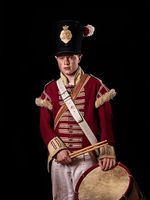
Two hundred years ago, the Battle of Waterloo marked a historic turning point in European history when French forces, led by Napoleon, fell to the British and Prussians—ending French reign of the region and two decades of war. As photographer Sam Faulkner points out, the battle was also the last major European conflict to take place prior to the invention of the camera. As such, no photographs exist of the event or the soldiers involved beyond the imagined ones.
Faulkner’s new book, Unseen Waterloo: The Conflict Revisited, envisions what those photographs could have looked like, featuring portraits of Waterloo re-enactors, clad in ornate military garb and staring straight into the camera after they’ve just come off the battlefield. The photos were shot in a pop-up studio on the field in Belgium where Waterloo was fought, taken during annual reenactments over the course of five years, starting in 2009.
more here.
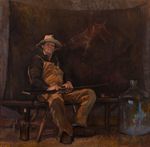
It was a party. There was a curried dish and guacamole and a slow-cooked pork shoulder and there was a mule deer piñata and there were paper plates and heirloom silver and a tuba and sequins and spangles and a general hip and tooth and pink-cheek commotion appropriate for an occasionless celebration. The riflemaker, however, stood apart. He braced himself against the modern countertop in the vacant kitchen. He sipped a tumbler of Scotch. It was ten months prior to my Jackson gun delivery. It was November, and though the evening was cold enough to frost the inside of the window glass, the riflemaker wore shorts. His legs were skinny and fit. His pointed goatee, streaked with gray, served to bring his narrow features into line with those of a well-adapted predator and if there was any incongruity, it resided in his hands and arms, which were Bunyanesque.
I had never met the riflemaker before, and I introduced myself.
Nathan Heineke builds $15,000 custom rifles. He is 41 years old. He works alone. In the 10 years since he left the storied New Jersey gunsmithing shop of Griffin and Howe—where he had worked since completing college—he has, from start to finish, built more than 30 unique rifles. It is a meticulous process, interrupted by walk-ins, supply-chain delays, repairs, the whim of clientele, and some rifles take more than a year to complete.
more here.