
German hegemony: Unintended and unwanted

Streeck_commoncurr_468wWolfgang Streeck at Eurozine:

Germany's new European hegemony is a product of the European Monetary Union in combination with the crisis of 2008. It was not Germany, however, that had wanted the euro. Since the 1970s, its export industries had lived comfortably with repeated devaluations of the currencies of Germany's European trading partners, in response to which much German manufacturing moved out of price-sensitive and into quality-competitive markets. It was above all France that sought a common European currency, to end the humiliation it felt at having to devalue the franc against the deutschmark and, after 1989, to bind united Germany firmly into a, hopefully French-led, united Europe. From its conception, the euro was a highly contradictory construction. France and other European countries, such as Italy, were tired of having to follow the hard-currency interest rate policy of the Bundesbank, which had de facto become the central bank of Europe. By replacing the Bundesbank with a European central bank, they expected to recapture some of the monetary sovereignty they felt they had lost to Germany. Clearly the idea was also to make monetary policy in Europe less obsessed with stability and more accommodating of political objectives like full employment. At the same time, Mitterand and his finance minister Jacques Delors, but also the Bank of Italy, hoped to gain political clout against national Communist parties and trade unions by foreclosing external devaluation and thereby forcing the Left to renounce its political-economic ambitions under the constraints of a harder, if not hard, currency.

more here.

the neuroscience of despair

20150316_BegunHugow650Michael W. Begun at The New Atlantis:

In the two decades following the Second World War, depression was considered a relatively rare disorder, more likely to be experienced by hospitalized patients than otherwise healthy people. Today, however, the Centers for Disease Control and Prevention estimates that 9.1 percent of adults in the United States are currently experiencing depression. A recent editorial in Nature claimed that “measured by the years that people spend disabled, depression is the biggest blight on human society — bar none.” What accounts for this change?

It will help to identify two broad periods in psychiatry’s standard conception of depression: before 1980, when psychoanalysis still held sway, and after 1980, when depression became defined according to symptom-based classification. These two periods are marked by contrasting criteria for diagnosis in the DSM (Diagnostic and Statistical Manual of Mental Disorders), the “bible” of clinical psychiatry published by the American Psychiatric Association. While the use of the DSM in the everyday practice of clinical psychiatry varies greatly and some psychiatrists hardly use it at all, it standardizes definitions of mental disorders and supplies a lingua franca for research, thereby providing a basis for measuring the prevalence of mental disorders and agreeing on their diagnoses.

The change that occurred in 1980 was pivotal for two reasons: first, it introduced a qualitatively different notion of depression, one that focused on overt symptoms rather than internal psychological stresses; second, in ignoring patient history and social context as criteria for diagnosis, it unintentionally led to an increase in the number of diagnoses.

more here.

Why hunting for life in Martian water will be a tricky task

Lee Billings in Nature:

Perspective_1NASA scientists announced today the best evidence yet that Mars, once thought dry, sterile and dead, may yet have life in it: Liquid water still flows on at least some parts of the red planet, seeping from slopes to accumulate in what might be life-nurturing pools at the bases of equatorial hills and craters. These remarkable sites on Mars may be the best locations in the Solar System to search for extant extraterrestrial life — but doing so will be far from easy. Examining potentially habitable regions of Mars for signs of life is arguably the primary scientific justification for sending humans there — but according to a new joint review from the US National Academy of Sciences and the European Science Foundation, we are not presently prepared to do so.

The problem is not exploding rockets, shrinking budgets, political gamesmanship or fickle public support — all the usual explanations spaceflight advocates offer for the generations-spanning lapse in human voyages anywhere beyond low Earth orbit. Rather, the problem is life itself — specifically, the tenacity of Earthly microbes, and the potential fragility of Martian ones. The easiest way to find life on Mars, it turns out, may be to import bacteria from Cape Canaveral, Florida — contamination that could sabotage the search for native Martians. The need to protect any possible Martian biosphere from Earthly contamination, the review’s authors wrote, could “prevent humans from landing in or entering areas” where Martian life might thrive. Although this sentiment is not new, its frank, formal acknowledgement in such an authoritative study is rare indeed. NASA is planning to send humans to Mars as soon as the 2030s; that such missions may unavoidably pose extreme contamination risks is understandably not something the agency is eager to highlight, even as it actively researches possible solutions to the problem.

More here.

Monday, September 28, 2015

The Winners of the 3QD Science Prize 2015

2015ScienceWinner 2015 Science Nick Lane Winner 2015 science Nick Lane

Nick Lane has picked the three winners from the nine finalists:

  1. Top Quark, $500: Ashutosh Jogalekar, The fundamental philosophical dilemma of chemistry
  2. Strange Quark, $200: Aatish Bhatia, The Sound So Loud That It Circled the Earth Four Times
  3. Charm Quark, $100: Nadia Drake, When Hubble Stared at Nothing for 100 Hours

Here is what Nick has to say about the winners:

I hardly need to say that the standard of the nine finalists is extremely high, and any one of them would have been a worthy winner. So I'm sorry to disappoint most of you. In judging, I've had to apply a few criteria (or biases) of my own. The 3QD prize is for a single post, not a blog, and that doesn't reflect how I normally read blogs. I often search for a particular question, come across a fascinating post, and then spend more time than I ever had available reading other posts on the blog. A good blog, to me, is one that has a long run of thought-provoking views.

Those views are expressed not only by the blogger, but also in the comments. As an evolutionary biologist, I'm wary of comments; in my field they often bring out the worst in people. But when it works the other way around, blogs transcend any other medium. Few things are more enjoyable than a well-informed discussion below a post, in which the blogger is actively involved.

When I read a blog, I'm not really looking for a beautiful piece of writing, or stunning visuals, or links to amazing videos, even though these things make a great post. I'm looking for a personal point of view, usually from someone with a particular vantage point, whether scientific or journalistic. I'm looking for something that I couldn't find so easily in the mainstream media, grounded in personal experience, and more idiosyncratic than most magazines would allow you to get away with. (That's one of the things I like about writing books too.)

I don't really know where to draw the line between a blog and a news story, or a feature article, or even a short story. Some of the finalists here did not really write blog posts at all, in my view, but achieved a higher calling, works of art in their own right. So with all that in mind, here goes:

The winner is Ashutosh (Ash) Jogalekar. I loved this post. It is personal and authoritative, and grows from what starts out as a quirky irritation in the day job into a profound commentary on the limits of the controlled experiment in chemistry, stemming from fundamental physics. Ash begins with the different interactions between atoms in molecules – electrical charges, hydrophobic interactions and the rest – and shows them to be different aspects of the same fundamental electrochemical force, making it impossible to achieve any independent changes in a molecule. He finishes with a lovely twist, justifying the thrill of experiment as the only way to explore design in chemistry, making the subject endlessly fascinating.

Ash's writing style is crisp and clean, admirably precise without being patronising, even in the use of italics, which can easily feel preachy. Not here. I followed the links for genuine interest, and there was a great discussion in the comments pointing out an equivalent problem in biology, in the use of knockout models. In an age when science is being pushed towards supposedly managed outcomes, this is a refreshing reminder of why it can't be planned.

Second prize goes to Aatish Bhatia, a previous winner of this prize, for his piece on Krakatoa. This is another beautifully written and presented post that makes full use of the medium, with spectacular links to videos of an exploding sperm whale and the shockwave of a recent volcanic eruption, and even 19th century barometric data of air pressure spikes. For me, this was not quite a blog – more of a feature article on a subject I knew little about (although I'm aware of books on the subject). This was not quite so personal and ruminative, although I liked especially the idea of ‘inching up against the limits of what we mean by sound.' Where this post really came alive for me was in the comments, with a fascinating exchange on the physics of pressure waves, in which Aatish is exemplary in both responsiveness and a deep underlying knowledge, worn lightly. A masterclass.

Third prize goes to Nadia Drake for her post on the Hubble telescope. This combined a fine piece of storytelling with a tremendously important point – that often the most iconic discoveries in science stem from one person's courage and vision to defy conventional wisdom, risking their own position or reputation to do so. In this case the astronomer Bob Williams focused Hubble on an ‘empty' patch of sky for 100 hours. The ‘emptiness' was filled with thousands of galaxies, expanding the estimated number of galaxies in the universe about five-fold. I was reminded of Leeuwenhoek, who more than 300 years ago turned his simple microscope on an ‘empty' drop of water, and discovered an invisible microcosmos of protozoa and bacteria. The spirit of discovery is what draws most of us into science, and I hope that blogs like this might remind policy makers that naïve questions are often the best.

Congratulations also from 3QD to the winners (remember, you must claim the money within one month from today—just send me an email). And feel free, in fact we encourage you, to leave your acceptance speech as a comment here! And thanks to everyone who participated. Many thanks also, of course, to Nick Lane for doing the final judging.

The three prize logos at the top of this post were designed by me, Sughra Raza, and Carla Goller. I hope the winners will display them with pride on their own blogs!

Details about the prize here.

Sunday, September 27, 2015

Conditions of Emergence: On Elena Ferrante

William Deresiewicz in The Nation:

ScreenHunter_1393 Sep. 27 20.23At last, the cycle is complete. The “Neapolitan Novels” of the pseudonymous Italian author Elena Ferrante, a saga of female experience seemingly written in blood, which has taken the international literary world by frontal assault, has now concluded with its fourth installment. You no doubt have an inkling of the story. Two girls, growing up amid the poverty and violence of postwar Naples; two women, making their adulthood in a world of shifting possibilities and ideologies; two friends, locked in a lifelong embrace, sisters, rivals, doppelgängers, opposites. Lenù and Lila: Elena Greco, studious and disciplined, awkward, our narrator; Raffaella Cerullo, willful, tough, incendiary, stunning, her rival, muse, and subject. Around them in their neighborhood are friends, parents, siblings, teachers, shopkeepers, radicals, mad widows, camorristi—supplemented, as the narrative unwinds its length, by lovers, husbands, comrades, bosses, and children. By the end, the cast of characters has swelled to over 60—a Middlemarch of the Mezzogiorno.

Novels of friendship are rare, relative to the relationship’s importance in the modern age. Families fragment, partners come and go; friends are with you to the bitter end—and sometimes, as with Lenù and Lila, from the bittersweet beginning. But friendships, lacking the ceremonies of love or the structures of kinship, seldom offer tidy shapes for narrative consumption. Ferrante embraces the formlessness. The Neapolitan Novels, often pitched at the intensity of opera, have a narrative form that more closely resembles a soap opera. Season follows season, crisis follows crisis—rape, adultery, murder; abandonment, betrayal, retribution—but nothing is ever resolved. You wonder, away from the page, why you bother to put up with it. (Friends are sometimes like that, too.) Then you return, and are captivated by the drama once again.

More here.

That Stinky Cheese Is a Result of Evolutionary Overdrive

Carl Zimmer in the New York Times:

ScreenHunter_1392 Sep. 27 20.10Like many biologists, Ricardo C. Rodríguez de la Vega searches the world for new species. But while other scientists venture into the depths of the ocean or the heart of the jungle, Dr. Rodríguez de la Vega and his colleagues visit cheese shops.

“Every time we’re traveling internationally for a conference or something, we go specifically to the local cheese shop and say, ‘Give me the wildest blue cheese you have,’ ” said Dr. Rodríguez de la Vega, an evolutionary biologist at the French National Centre for Scientific Research in Paris.

The cheese they buy is alive with fungi; indeed, many cheeses require a particular species of mold to properly ripen. To produce Roquefort blue cheese, for example, cheese makers mix Penicillim roqueforti into fermenting curds. The mold spreads throughout the cheese, giving it not only a distinctive blue color but also its (acquired) taste.

To produce soft cheeses such as Camembert or Brie, on the other hand, cheese makers spray a different mold species, Penicillium camemberti, on the curds. The fungus spreads its tendrils over the developing cheese, eventually forming the rind. When you chew on a Camembert rind, you’re eating a solid mat of mold.

In addition to influencing the taste, mold keeps cheese from spoiling by defending it from contaminating strains of fungi or bacteria.

By comparing the genomes of different species of molds, Dr. Rodríguez de la Vega and his colleagues have reconstructed their history. On Thursday in the journal Current Biology, the scientists reported that cheese makers unwittingly have thrown their molds into evolutionary overdrive.

More here.

Forget The Book, Have You Read This Irresistible Story On Blurbs?

Colin Dwyer at NPR:

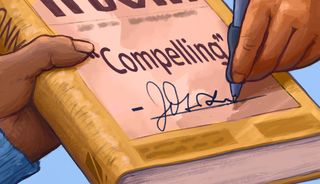
Blurbs-illustration_custom-deda4b17e66307ceba51d188ff112fb50a00f1ed-s800-c85Whatever the old adage might warn, there is a bit of merit to judging a book by its cover — if only in one respect. Consider the blurb, one of the most pervasive, longest-running — and, at times, controversial — tools in the publishing industry.

For such a curious word, the term “blurb” has amassed a number of meanings in the decades since it worked its way into our vocabulary, but lately it has referred to just one thing: a bylined endorsement from a fellow writer — or celebrity — that sings the praises of a book's author right on the cover of their book.

They're claims couched in quote marks, homes for words you might never hear otherwise — like compelling, or luminous, or unputdownable. Heck, at least three books have reportedly inspired celebrated memoirist Frank McCourt to say “you'll claw yourself with pleasure.”

Nearly as long as they've been around, they've been treated by a vocal few with suspicion, occasionally even outright snark and scorn. Author Jennifer Weiner, for instance, sees some value in them, but suggests they've been getting over the top; scholar Camille Paglia, not one to mince words, called them “absolutely appalling” in a 1991 speech.

And if no less a luminary than George Orwell — way back in 1936 — credited the decline of the novel (even then!) with “the disgusting tripe that is written by the blurb-reviewers,” one question naturally arises: Why are blurbs still around — and still, at least among publishers, so popular?

More here.

Surreal Photographs Reveal Africa’s Environment in Crisis

16f15ea61c96cb268bfbadb3b0e5f712

Beckett Mufson in The Creators Project:

Climate change, drought, pollution, rising sea levels, habitat destruction—the world's environmental crises are obscufated by buzzwords, fake controversy, dystopian angst, and politics that make it difficult to actually hold the concepts in your mind, let alone discuss. Enter Belgian-Beninese photographer Fabrice Monteiro, whose new series The Prophecy uses elaborate costumes and sets to put faces and human bodies on the problems facing the world.

Monteiro's work shines a spotlight of many facets of life in Africa, from antiquated slave irons, to the perceotion of albino Africans, to fashion photos. With The Prophecy, his goal is to make important ecological issues accessible for all audiences. “I wanted to create a tale for kids,” Monteiro says in a documentary about the project. “For that I had to build a bridge between art and tradition.” Working with designer Jah Gal, he traveled through Senegal to create 10 surreal characters that look like spirits from the apocalypse, which unfortunately isn't that far off from their actual inspirations.

More here. [Thanks to Georg Hofer.]

Laurel and Hardy: it’s still comedy genius

Martin Chilton in The Telegraph:

Fixer-uppers-xlargeFrank Skinner once admitted that new girlfriends were always “subjected to the Laurel and Hardy test”, when he would play a video of the Laurel and Hardy dance sequence from Way Out West. “If she didn't laugh, I instantly wrote her off as a future companion,” said Skinner, conceding that this wasn't exactly rational behaviour. Perhaps we can all be divided by that Laurel and Hardy test. Those who love the Way Out West dance, which captures perfectly the charm and on-screen chemistry of the comedy duo, will already have been delighted by the news that the BBC1 is to show in 2015 a one-off 90-minute drama called Stan and Ollie – written by Jeff Pope of Philomena note – which is based around their 1953 tour of the UK, during which Hardy suffered a heart attack.

…Kurt Vonnegut, the author of Slaughterhouse Five, said: “I used to laugh my head off at Laurel and Hardy. There is terrible tragedy there somehow. These men are too sweet to survive in this world and are in terrible danger all the time. They could so easily be killed.” They were brilliant physical comedians but there was more to their films than slapstick. Laurel was interested in Surrealism and favoured offbeat dialogue (“You can lead a horse to water, but a pencil must be led”) and they are remembered still for a timeless catchphrase, as Hardy looks deadpan at the camera and says: “Well, here's another nice mess you've gotten me into”. During that 1953 tour, Laurel and Hardy were mobbed wherever they went. When they were in Ireland, as they were walking down the high street of Cobh, the church bells began to ring out with their famous theme tune, The Cuckoo Song. Laurel said: “We both cried at that time, because of the love we felt coming from everyone.”

More here.

Malala Yousafzai’s Fight Continues

Nicholas Kristoff in The New York Times:

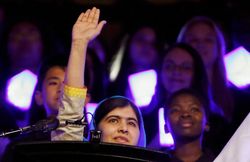
MalalaWHEN the deputy head mistress pulled Malala Yousafzai out of high school chemistry class one morning a year ago, Malala nervously searched her mind for recent offenses. “You usually get a bit scared if your head teacher comes, because you think you are being caught doing something,” Malala recalled. “But she told me: ‘I need to tell you something. You have won the Nobel Peace Prize.’ ” After a brief celebration, Malala returned to class for the rest of the school day; as the world’s news organizations clamored for interviews, she wrestled with physics. She’s a champion of girls’ education worldwide, she explains, and that must include her own. Malala, now a high school junior, was in New York this past week to address the United Nations, attend the premiere of a full-length documentary movie about her life and hound world leaders to pay attention to girls’ education.

…Malala is determined not to be used as window dressing by world leaders, and her advice to presidents and prime ministers is to focus not on elementary school or middle school but on 12 full years of education. “Your dreams were too small,” she tells U.N. members. “Your achievements are too small. Now it is time that you dream bigger.” She scolded Nigeria’s president at the time for not helping girls abducted by Boko Haram. She told President Obama at the White House that drones were counterproductive and that he should invest in education. Just eight days of global military spending, she notes, would pay to get all remaining kids in school worldwide. “No world leader would want nine years of education for their children,” she told me. “Every world leader wants quality education for their children. They need to think of the rest of the world’s children as their own children.”

More here.

Saturday, September 26, 2015

What Can We Learn From TV Coverage of Feminism in 1970?

Bonnie J. Dow in Women's Media Center:

WomenOnce upon a time, there were only three television networks. Before cable and especially before the Internet, a social phenomenon that went unnoticed by the “Big Three”—CBS, NBC, ABC—might as well not be happening at all. That was the case for second-wave feminism before 1970, the year that the national television news networks finally gave airtime to the rapidly growing movement. In Watching Women’s Liberation, 1970: Feminism’s Pivotal Year on the Network News (University of Illinois Press, 2014), I analyze the meaning and influence of that surge of news coverage. In addition to numerous feature stories on the movement as a whole, network news covered important protests that year, such as January’s disruption of Senate hearings on the birth control pill by radical feminists, and the March sit-in at the Ladies’ Home Journal by 100-plus women. The August 26, 1970 Women’s Strike for Equality march, which involved thousands of women across the country and closed down Fifth Avenue in New York City to demand abortion rights, child care, and equal opportunity, led the evening news on all three networks. Yet CBS’s story that night termed the marchers a “militant minority,” even though they included current and former members of Congress, editors from Ladies’ Home Journal and McCall’s, and Cosmopolitan editor Helen Gurley Brown. These 1970 reports were opening salvos in the televised battle over feminism’s public image, one that continues today in a much wider array of media forms.

In 1970, network news coverage of feminism was a surprising mix of positive and negative reporting. Most reports, for instance, treated abortion rights and the ERA as reasonable, even commonsensical, demands.

More here.

Walter Benjamin’s legacy, 75 years on

John Dugdale in The Guardian:

WalterLike many a refugee in southern and central Europe today, Walter Benjamin was in flight from war and persecution 75 years ago, but was blocked at an intermediate border en route to the country chosen as his haven. He was part of a Jewish group which, hoping to escape occupied France, had hiked through a Pyrenean pass in autumn 1940 with a view to entering Franco’s Spain, crossing it to Portugal and then sailing to the US. However, in the words of Hannah Arendt, they arrived in the frontier village of Portbou “only to learn that Spain had closed the border that same day” and officials were not honouring American visas such as Benjamin’s. Faced with the prospect of returning to France and being handed over to the Nazis, he “took his own life” overnight on 26 September, whereupon the officials “allowed his companions to proceed to Portugal”. For Arendt, who successfully reached New York via his intended route a few months later, this was a tragedy of misunderstanding, a poignant but fitting end for a brilliant but misfortune-prone older relative (her cousin by marriage) whom she writes about with a kind of affectionate exasperation.

Yet Edward Stourton, in Cruel Crossing: Escaping Hitler Across the Pyrenees, notes “there are all sorts of unanswered questions surrounding Benjamin’s death. His travelling companions remembered him carrying a heavy briefcase containing a manuscript he described as ‘more important than I am’. No such manuscript was found after his death … A Spanish doctor’s report gave the cause of death as a cerebral haemorrhage, not a drugs overdose. There has been persistent speculation that he was actually murdered, perhaps by a Soviet agent who had infiltrated his escaping party.” By the time Arendt wrote her memoir (later used as the introduction to Illuminations) in 1968 the chaotic freelance critic she evoked, pinballing between temporary homes, disparate obsessions and the incompatible views of his friends Adorno, Brecht and Gershom Scholem, was fast emerging a la Orwell as a giant figure with an unexpectedly substantial estate in print – his collected writings were published in Germany in 1955, eventually followed by a four-volume Harvard edition in English – and formative power in multiple fields.

More here.

Silicon Valley shouldn’t let China strong-arm it into spying

Ken Roth in Quartz:

ScreenHunter_1388 Sep. 26 19.34In an impassioned speech at the White House’s February 2015 cybersecurity summit, Apple’s chief executive Tim Cook argued that in a world where “too many people do not feel free to practice their religion or express their opinion or love who they chose,” privacy can “make a difference between life and death.” In the two years since Edward Snowden’s first revelations about the National Security Agency’s surveillance excesses, Silicon Valley companies such as Apple, Google,Facebook, Microsoft and Cisco have used their influence in meetings with President Obama and concerted lobbying efforts to rein in mass surveillance in the United States.

To date, these efforts have found Silicon Valley allied with its users. But with companies under mounting pressure in places like Russia andChina to aid abusive government surveillance, the industry must decide whether to stand up for their most vulnerable users—those in countries where peaceful dissent can lead to serious reprisals—even if that may affect its business opportunities.

This month’s state visit by Chinese President Xi Jinping is a major test. Xi’s visit opened with US tech executives in Seattle. Chinese officials like Internet czar Lu Wei will also join companies at the US-China Internet Industry Forum, an annual meeting organized by Microsoft and the Internet Society of China. Media reports indicate that executives from Apple, Facebook, Google, Uber and Cisco are invited.

These meetings come at a time when China is considering a raft of new laws—ostensibly about security and counter-terrorism—that would expand digital surveillance and censorship.

More here.