
Venus’s – flytraps
I am five,
. Wading out into the deep
.. Sunny grass,
Unmindful of snakes
. & yellow jackets, out
.. To the yellow flowers
Quivering in sluggish heat.
. Don’t mess with me
.. ‘Cause I have my Lone Ranger
Six-shooter. I can hurt
. You with questions
.. Like silver bullets.
The tall flowers in my dreams are
. Big as the First State Bank,
. & they eat all the people
Except the ones I love.
. They have women’s names,
.. With mouths like where
Babies come from. I am five.
. I’ll dance for you
.. If you close your eyes. No
Peeping through your fingers.
. I don’t supposed to be
.. This close to the tracks.
One afternoon I saw
. What a train did to a cow.
.. Sometimes I stand so close
I can see the eyes
. Of men hiding in boxcars.
.. Sometimes they wave
& holler for me to get back. I laugh
. When trains make the dogs
.. Howl. Their ears hurt.
I also know bees
. Can’t live without flowers.
.. I wonder why Daddy
Calls Mama Honey.
. All the bees in the world
.. Live in little white houses
Except the ones in these flowers.
. All sticky and sweet inside.
.. I wonder what death tastes like.
Sometimes I toss the butterflies
. Back into the air.
.. I wish I knew why
The music in my head
. Makes me scared.
.. But I know things
I don’t supposed to know
. I could start walking
.. & never stop.
These yellow flowers
. Go on forever.
.. Almost to Detroit.
Almost to the sea.
. My Mama says I’m a mistake.
.. That I made her a bad girl.
My playhouse is underneath
. Our house, & I hear people
.. Telling each other secrets.
by Yusef Komunyakaa
from New American Poets of the ’90s
David R. Godine Publishers, 1991
Enjoying the content on 3QD? Help keep us going by donating now.
 RD said:
 DNA is often compared to a written language. The metaphor leaps out: Like letters of the alphabet, molecules (the nucleotide bases A, T, C and G, for adenine, thymine, cytosine and guanine) are arranged into sequences — words, paragraphs, chapters, perhaps — in every organism, from bacteria to humans. Like a language, they encode information. But humans can’t easily read or interpret these instructions for life. We cannot, at a glance, tell the difference between a DNA sequence that functions in an organism and a random string of A’s, T’s, C’s and G’s.
 Over time, as knowledgeable elders pass away, the original rationale for a taboo might be entirely forgotten. In such cases, the origins of a rule might be recoverable only through inference or imaginative reconstruction. Similarly, many widely recognised superstitions, such as those involving black cats, have historical roots that are scarcely remembered today. In medieval Europe, black cats were associated with witches and seen as omens of evil. Today, the belief that crossing a black cat’s path brings bad luck persists as a cultural remnant, entirely disconnected from its original association with witch trials.
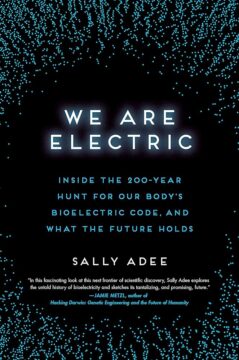 By the turn of the 21st century, however, a renegade group of plant physiologists had had enough. They argued that it was past time to bring existing theories of plant behavior into line with the avalanche of new observations enabled by late 20th-century advances in molecular biology, genomics, ecology and neurophysiology. Perhaps they weren’t reading anyone’s mind, but it sure started to look like plants had (some version of) their own.
 According to legend, the ancient Greek poet Philoxenus wished for a throat as long as that of a crane so he could protract the time he spent swallowing. Another formulation of this desire, writes literary critic and historian of ancient Greek literature Pauline LeVen, comes from the third-century BCE poet Machon, who claimed Philoxenus wished “
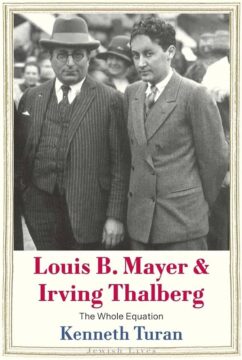 During the high point of Hollywood’s studio era, when motion pictures made their storied transition from silents to talkies, no studio was more glamorous, more lavish, more star-studded than Metro-Goldwyn-Mayer (“more stars than there are in heaven” was its apt motto). It boasted such directorial luminaries as King Vidor, Victor Fleming, George Cukor, and Ernst Lubitsch; its contract writers included Lenore Coffee, Donald Ogden Stewart, Dorothy Parker, and Anita Loos; and its roster of A-listers was seemingly endless—Clark Gable, John Barrymore, Jean Harlow, Greta Garbo, Joan Crawford, Judy Garland, and Fred Astaire were among its brightest talents.
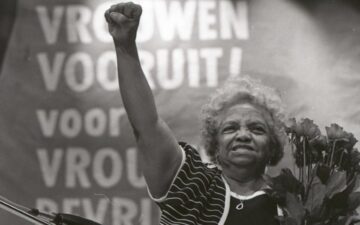 In the summer of 2023, Oxfam launched an initiative called
 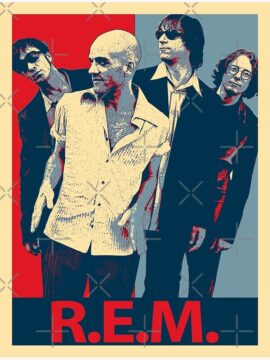 Not since the muzak corporation
 A pair of landmark studies,
  Throughout Donald Trump’s first term, none but the most stubborn could deny that the leading cultural institutions in the United States remained under the dominance of the self-styled progressive left. Circa 2019, prominent progressive scholars such as Corey Robin could be found imploring their peers to wake up and to take stock of just how much ground the left had gained. At the same time, astute readers of online discourse were warning of subterranean rumblings from the manosphere — which in fact began much earlier and for some years seemed to be contained within the same virtual space as what was then a gestating proto-wokeism. I can remember as early as 2014 or so, the most perspicacious of my friends telling me I should really be paying attention to Gamergate if I wanted to understand the future of US politics. I did check in briefly, saw that it was all just a bunch of kids fighting over kids’ stuff, and checked right back out again.
 Like every episode of “Saturday Night Live” since 1975, Sunday’s three-hour anniversary special was a confusing, celebrity-packed, occasionally funny grab-bag. And we have some thoughts.