Neil Drumming in The New York Times:
More here.
Neil Drumming in The New York Times:

More here.
Constantine Sandis and Nassim N Taleb in The Philosophers' Magazine Online:
There are facts that, through no fault of our own, we cannot help but be ignorant of. For example one cannot be expected to know where the next plane crash will take place, but it may be more rational to board an airline with a good record. Let us call this lack of knowledge justified ignorance. Actions affected by such ignorance are risks performed under justified uncertainty. Philosophers will quibble over whether we can ever know anything for certain, but we can all agree that many actions performed by mere mortals involve such risks.
The precise degree of risk and justification is dependent upon the availability of relevant information, and so will vary wildly from one case to another. This need not concern us much here for the rule we shall propose is intended to hold across all cases. Indeed, we maintain that the true measure of risk should not be calculated in terms of the pure probability of outcomes but multiplied by the significance of the outcomes in question. Risking losing one dollar against the ridiculously low chances of winning the lottery is far more prudent than taking a nuclear action that has a 99% likelihood of not ending the world. This is particularly true when it comes to sequences of risky decisions where a small probability of extinction, taken repeatedly, ends up raising the odds to close to certainty.
In moral philosophy there is a famous debate about the relation of duty to ignorance. Some argue that our obligations are tied to how things actually are (or will be), others to how we happen to think they are, and others still to how we can rationally expect them to be, given the information at hand. These views are all united by the thought that there is one right answer to this question of duty. An alternative school of thought maintains that there are several different obligations: the objective “ought”, the subjective “ought”, the “ought” of rational expectation, and so on. We shall not concern ourselves with these questions in this essay, important though they may be. Instead, we shall introduce a normative constraint which cuts across them in the sense that it holds true no matter which of the above views is the correct one to take.
We propose that actions performed under justified uncertainty should be subject to the Silver Rule (SR):
Do not expose others to a harm the near equivalent of which you are not exposing yourself to.
More here.
David Tong (with the Plus team) in Plus Magazine:
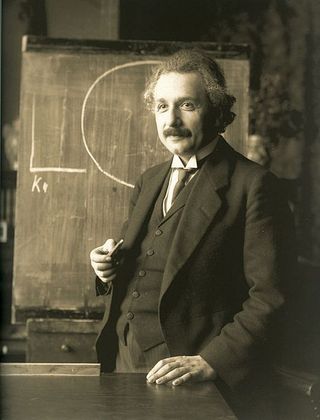
Start with Newton
The general theory of relativity describes the force of gravity. Einstein wasn't the first to come up with such a theory — back in 1686 Isaac Newton formulated his famous inverse square law of gravitation. Newton's law works perfectly well on small-ish scales: we can use it to calculate how fast an object dropped off a tall building will hurtle to the ground and even to send people to the Moon. But when distances and speeds are very large, or very massive objects are involved, Newton's law becomes inaccurate. It's a good place to start though, as it's easier to describe than Einstein's theory.
Suppose you have two objects, say the Sun and the Earth, with masses
and
respectively. Write
for the distance between the two objects. Then Newton’s law says that the gravitational force
between them is
![]() |
where
is a fixed number, known as Newton's constant.
The formula makes intuitive sense: it tells us that gravity gets weaker over long distances (the larger
the smaller
) and that the gravitational force is stronger between more massive objects (the larger either of
and
the larger
).
Different force, same formula
There is another formula which looks very similar, but describes a different force. In 1785 the French physicist Charles-Augustin de Coulomb came up with an equation to capture the electrostatic force
that acts between two charged particles with charges
and
:
![]() |
Here
stands for the distance between the two particles and
is a constant which determines the strength of electromagnetism. (It has the fancy name permittivity of free space.)

More here.
Chelsea Wald in Nautilus:
In his free time, Sven Laumer serves as a referee for Bavaria’s highest amateur football league. A few years ago, he noticed several footballers had quit Facebook, making it hard to organize events on the platform. He was annoyed, but as a professor who studies information systems, he was also intrigued. Why would the young men want to give up Facebook? Social scientists had been saying the social network was a good thing.
“At the time, the main paradigm in social networking research was that Facebook is a positive place, it’s a place of happiness, it’s a place where you have fun, you get entertained, you talk to friends, you feel amused, accepted,” says Hanna Krasnova, an information systems researcher at the University of Bern in Switzerland. Influential studies had shown that the social capital we earn on social media can be key to our successes, big and small. Our virtual connections were known to help us access jobs, information, emotional support, and everyday favors. “Everyone was enthusiastic about social media,” Laumer says.
Laumer, an assistant professor at Otto-Friedrich University in Germany, suspected that quitting Facebook was a classic response to stress. He knew other researchers had looked at something called “technostress,” which crops up in workplaces due to buggy interfaces or complex processes. But that didn’t really fit with Facebook, which is easy to use. Something else seemed to be stressing people out. “We thought there was a new phenomenon on social media in particular,” Laumer says.
Through probing interviews, surveys, longitudinal studies, and laboratory experiments, researchers have begun to shift the paradigm, revealing that Facebook, Twitter, Instagram, Snapchat, and their ilk are places not only of fun and success, but of dark, confronting, and primal human emotions—less Magic Kingdom and more creepy fun house. In many ways, researchers say, these platforms are giant experiments on one of our species’ most essential characteristics: our social nature. So it shouldn’t be a surprise there are unintended consequences.
More here.
Linda Kinstler in The Paris Review [h/t: Dana Hammer]:
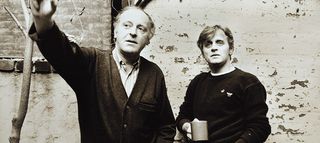
Brodsky couldn’t remember the first time he met Baryshnikov. “We had a few rather close friends in common in Leningrad,” he said in conversation with Solomon Volkov at his apartment on Morton Street in the late seventies. Baryshnikov was also a close friend of Brodsky’s daughter, a fellow dancer; he even drove her home from a Leningrad hospital after she gave birth. But the two men only met many years later, in New York, after Baryshnikov defected from the USSR in 1974.
For Baryshnikov, the memory of their first meeting is all too clear: one evening in 1974, the composer Mstislav Rostropovich organized a party in New York in honor of the visiting Soviet writer Alexander Galich, and took the recently defected Baryshnikov, then in his midtwenties, along. Brodsky was there. “He was sitting, smoking, very red, very handsome. He looked at me, smiled, and said, Mikhail, take a seat, we have a lot to talk about,” Baryshnikov recalled in a Russian-language interview with a Riga magazine in October. “He gave me a cigarette, my hands were trembling … For me, he was a legend.”
After dinner, the two men went on a long walk through the West Village, found a Greek restaurant open late to continue their conversation. They exchanged numbers. Soon, they were talking nearly every day. Brodsky gave Baryshnikov reading assignments, introduced him to his friends—Czeslaw Milosz, Stephen Spender, Susan Sontag. “He kind of put me on my feet,” Baryshnikov recalled. “That was my university.”
Brodsky dedicated several of his poems to Baryshnikov, who carries his friend’s work with him, and resurrects their dialogue on stage. Hermanis, who began developing the idea for the production fifteen years ago, described it to Latvian public media as a “spiritist séance.” He and Hermanis were both born in Riga, and it wasn’t by accident that they chose that city for the debut run of what Baryshnikov has called “the most private and important work I’ve done in my life.”
More here.
Hal Foster at Artforum:
“PICASSO SCULPTURE” is both amazing and appalling. With 141 objects in eleven galleries, the presentation is lucid, stately, almost grand, and the work is inventive in the extreme. Yet there are times when all this creativity betrays a manic energy—I can’t help myself!—as well as an aggressive defiance: I can trump anyone! What else, you say, is new about Picasso?
The master made circa seven hundred objects, which is a lot, but not when compared with roughly forty-five hundred paintings. As the curators Ann Temkin and Anne Umland demonstrate, his engagement with sculpture was episodic: He worked intensely in the medium, then put it aside, and when he came back to it, he often featured a new set of materials, forms, and structures. For a long time, Picasso was reluctant to show his sculpture, and he liked to keep it close by. Why? Was it especially important to him, somehow intimate, even “talismanic” (as the curators suggest), or was he uncertain about its status (which can be improvisatory), or did he feel both things at once?1 Throughout the exhibition, it is difficult to distinguish clearly between research and resolution, minor and major (sometimes a tentative experiment in a new material appears later as a confident statement). Picasso, like Matisse, frequently turned to sculpture to address a problem in painting or to elaborate on an idea, a device, or just a whimsy first developed in two dimensions.
Like his first paintings, his first sculptures in bronze are emulative, sub-Rodin and Rosso, and this is also true of the rough figurines in wood he produced after the Gauguin retrospective in Paris in 1906. Picasso acquired a few Iberian sculptures in early 1907, and his fabled encounter with African and Oceanic art in the Musée d’Ethnographie du Trocadéro, which prompted him to revise Les demoiselles d’Avignondramatically, occurred in May or June of that year; this interest in the archaic and the primitive is manifest in his sculpture no less than in his painting.
more here.
Alison Kinney at The Paris Review:
The Sagas of Icelanders chronicle the settlement of Iceland during the ninth to eleventh centuries, known as both the Viking Age and the Saga Age. “They’re not stories,” Jón gently reproved me: “they’re sagas,” a unique medieval prose form that upends the conventions of domestic drama, genealogy, historical fiction, adventure, and myth. They date not from the Viking Age but from the Christian, multilingual literary society that succeeded it. Around 1130, Ari Þorgilsson, the first recognized Icelandic author and historian, wrote Iceland’s origin story in The Book of Icelanders. By the thirteenth and fourteenth centuries, editors, translators, and even critics abounded, and celebrity poets, such as Snorri Sturluson, toured the royal courts of Scandinavia and England. That period of passionate inquiry and composition might yet be called a Silver Age, for its writers were troubled by lost cultural heritage, civil war, the relinquishment of Icelandic independence to Norway, and a sense of belatedness. Ari had composed the Íslendingabók with the authority of proximity and living witness, within a generation’s memory of the Saga Age. Two centuries later, the anxious writers committing saga-like oral narratives to parchment cited Ari’s book for credibility.
more here.
Margaret Wertheim at Aeon Magazine:
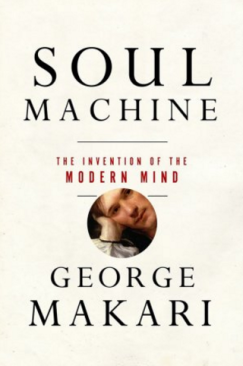
It might seem surprising to many readers but, for 300 years, scientists and philosophers have been debating whether our minds might not operate more like Bitbol’s thermometer. Though Chalmers’ ‘hard problem’ term is new, the questions underlying it have haunted modern science from its beginnings, for the attribution of consciousness is one of the foremost qualities distinguishing us as something other than a complex set of dials.
As one of the founders of empiricism, Locke believed that knowledge comes primarily from sensory experience, with real knowledge beingfelt by conscious beings. In the 17th century, René Descartes had also insisted on the irreducible centrality of subjective experience, arguing that, in principle, we could not build a machine to emulate human behaviour. For Descartes, a conscious machine was an impossibility, and something extra – a soul – was needed to account for the full spectrum of our mental landscape and actions. Like Chalmers and Bitbol today, Descartes and Locke considered conscious experience as something that couldn’t be wholly explained by the laws of physical nature.
But in the early 18th century an emerging group of mechanists began to suggest that feelings and emotions were merely secondary byproducts of the ‘true reality’ of matter in motion.
more here.
Mali, Mai Lai, San Bernardino, Planned Parenthood, Paris,
Doctors Without Borders, Drone death, NRA, Shock and Awe,
Boko Haram, ISIS/Daesh…
……………………………….. —The News
After you died
I stopped reading history.
I took up Cormack McCarthy
for the rage and murder.
Now I return to Gibbon; secure
in his reasonable civilization,
he exercises detachment
as barbarians skewer Romans.
Then Huns gallop from the sunrise
wearing skulls.
by Donald Hall
from Without – Letter After a Year, excerpt
Mariner Books, 1999
Maria Shehata in theFword:
“Do you think women are funny?” Yawn. I am a female stand-up comedian with 11 years experience, and I get asked this in almost every interview. It’s a topic that has been discussed ad nauseam, with documentaries, news articles and Christopher Hitchens’ masterpiece of controversy, the article ’Why Women Aren’t Funny.’ in a 2007 issue of Vanity Fair. In the USA, it’s no longer the debate it used to be. The list of women who disprove this notion keeps getting longer and longer to the point that it’s silly to even bother listing it anymore. Female comedians in the USA have been around long enough to undo all those cognitive schemas in our heads that it’s a man’s world and there’s no place for a woman in it. Women are funny too, and we will continue to see this over and over and over again.
…Asya Yavitz, a female comedian in Moscow, says on stage she plays the role of dumb girl, even though she’s head of her IT department at work, echoing Phyllis Diller in the 1950s playing herself down so she wouldn’t be a threatening woman in the eyes of her audience. “Unfortunately the majority of our audiences are Russian and not foreigners, so you have to joke as a woman, and not as a man.” When I asked her to elaborate she said, “You can say you’re head of a transnational corporation, but you should admit/joke on HOW you got this job, or that you are a blonde who understands nothing … female stupidness is obligatory, even if you’re head of your IT department.”
More here.
Ian Penman in City Journal:
Why do I keep seeing this one image of Joan Didion so often recently? I’ve seen it crown two out of three recent profiles or reviews, and here it is again, in all its icy monochrome perfection, on the front of Tracy Daugherty’s outsize biography. It was even splashed across one side of a season’s briefly fashionable tote bag (the other side proclaiming MAGICAL THINKER, which seemed to me a most un-Didion-like phrase, even if it did sort of recycle one of her most recent titles). Is there some kind of demand being responded to here? Is there something in the air?
“Jacket photograph copyright 1970 Julian Wasser”—which makes the Didion in the photo 36 and returns us to a moment when the woozily optimistic saturnalia of the sixties was shifting down into a murkier time of serial overdose and retreat: the Exile on Main Street years. This was also high times for the so-called New Journalism—almost midway between Truman Capote’s In Cold Blood (1966) and Tom Wolfe’s clamorous manifesto-compilation of 1973. Didion (and her husband John Gregory Dunne) could be found in the contributors’ rolls of the latter, alongside burly big hitters like Norman Mailer, Michael Herr, and Hunter S. Thompson; but her presence on the page was markedly different from these other stars in the “nonfiction” firmament. She didn’t burst from the platform of her magazine work like some raucous volley of fireworks. Didion’s tone was more reserved, more quietly insinuating, and sometimes slightly disturbing; you might occasionally mistake the authorial “I” of those early pieces for a more astringent and censuring sensibility from an earlier century, navigating our choppy twentieth-century rapids.
More here.
Menachem Feuer in Berfrois:
Franz Kafka loved to stay on the move. He traveled and kept a travel diary. From his travel diaries, we also learn that Kafka went to spas; he liked to exercise and move his body. Like many European Jews in his generation, he wanted to be healthy and happy. But when it came to his life, his faith, and his future, Kafka didn’t feel like he was making any progress.
Kafka felt he was failing to move in the right direction. Sometimes he felt he wasn’t moving at all. In order to understand whether or how he could move, Kafka turned the question of movement into parable. By way of his fiction, he encountered the possibilities of movement. Kafka wondered whether fiction would enable him to move or if it suspended movement? Was Kafka, as he says in one journal entry, “stuck to this spot,” or could fiction, as we see in a few of his parables and fictions, help him to transcend his location and go… elsewhere?
These parable-based meditations on movement brought Kafka face to face with failure and the possibility of madness. They prompted him to reflect and decide on whether or not to make a “bargain,” as he says, with madness. This bargain necessarily affected his movement and prompted Kafka to, as he says in his journals, “cultivate” failure.
More here.
Tardigrades are sponges for foreign genes. Does that explain why they are famously indestructible?
Ed Yong in The Atlantic:
The toughest animals in the world aren't bulky elephants, or cold-tolerant penguins, or even the famously durable cockroach. Instead, the champions of durability are endearing microscopic creatures called tardigrades, or water bears.
They live everywhere, from the tallest mountains to the deepest oceans, and from hot springs to Antarctic ice. They can even tolerate New York. They cope with these inhospitable environments by transforming into a nigh-indestructible state. Their adorable shuffling gaits cease. Their eight legs curl inwards. Their rotund bodies shrivel up, expelling almost all of their water and becoming a dried barrel called a “tun.” Their metabolism dwindles to near-nothingness—they are practically dead. And in skirting the edge of death, they become incredibly hard to kill.
In the tun state, tardigrades don't need food or water. They can shrug off temperatures close to absolute zero and as high as 151 degrees Celsius. They can withstand the intense pressures of the deep ocean, doses of radiation that would kill other animals, and baths of toxic solvents. And they are, to date, the only animals that have been exposed to the naked vacuum of space and lived to tell the tale—or, at least, lay viable eggs. (Their only weakness, as a researcher once told me, is “vulnerability to mechanical damage;” in other words, you can squish ‘em.)
More here.
Adil Najam in The Guardian:
It was December 2009. I remember sitting on a plane on my way to Copenhagen. I wondered if this would be the historic moment when the world came to its senses.
There was hope in the air. Indeed, I was greeted by stickers on the subway that renamed Denmark’s capital “Hopenhagen”. I smiled.
There was widespread anticipation – nurtured frantically by the host nation – that the UN-sponsored climate summit (COP 15) would be “historic”. That the impasse on global climate change would be broken. That major CO2 emitters – the US, EU, China, India – would agree on a meaningful binding agreement that would (a) limit their emissions, (b) support developing countries in their transition to low-emission futures, and (c) create a mechanism to assist vulnerable countries in coping with the costs of adaptation and climatic disasters that, by then, had already become inevitable.
That, of course, did not happen.
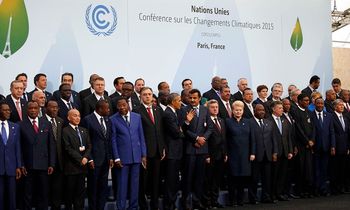
Today I am again on a plane, on my way to Paris for COP 21. This time, I am not holding my breath. Not smiling.
The hype around Paris is not dissimilar to what one remembers before Copenhagen. Except the aspiration is even lower, the proposals less bold. The scientific consensus on the threats posed by climate change even more definitive. And the interests of developing countries even more marginalised.
More here.
Owen Flanagan in the Los Angeles Review of Books:
When I was a wee Catholic lad growing up in the New York City suburbs of the late 1950s and early 1960s, I learned that good people go to heaven after they die. This was consoling. But it made me wonder precisely which part of me would go to heaven: my body, my mind, or my soul. Thanks to dead hamsters and such, I understood that bodies die, decay, and disperse. There was talk in school and at church of the resurrection of the body on Judgment Day, but that event, I reckoned, might not happen for several million years, and surely I’d be well ensconced in heaven by then. My mother tentatively explained that the part of me that loved peanut butter and jelly sandwiches and chocolate ice cream sodas would most likely not go to heaven, or, if it did, would not need or want peanut butter and jelly sandwiches and chocolate ice cream sodas anymore — possibly, I speculated, because, in the heavenly state, I’d be able mentally to conjure those great pleasures without there being actual physical manifestations of me or them. I surmised that those perfectly good human desires would either be gone (because my body would be gone), or somehow be eternally satisfied.
So, which was it, my mind or my soul that would go to heaven? Or both? And how did they differ? I didn’t want to go to heaven without my personality and memories. I wanted to be in heaven with my brothers and sisters, parents and grandparents, if not bodily then at least mentally. But personality and memories were, in my little boy ontology, associated with mind, and there was talk that the part of me that would go to heaven was something more ethereal than my mind. It was my eternal soul. But my soul, unlike my mind, seemed a bit too vague and general to be “me.” I wanted to be in heaven with me as me myself. Such were the vicissitudes of boyhood. I was troubled by three-ism. I was not, and am not, alone.
More here.
D. Graham Burnett at Cabinet Magazine:
It is perhaps not widely understood (outside the specialized domains of risk modeling and property insurance) that the last twenty years have seen the relatively rapid growth of a new kind of financial instrument: the catastrophe bond. I aim in what follows to offer the reader a brief introduction to these innovative money-things, which sit at the precarious nexus of mathematical modeling, environmental instability, and vast sums of capital. Techno-legal creations of considerable complexity (and some genuine elegance), “cat bonds“ circulate in the Olympian air of global high finance, where they afford investors an opportunity to place large bets on the occurrence (and non-occurrence) of various mass disasters: earthquakes, hurricanes, plagues, suitcase nukes. The lengthy, turgid, and highly confidential specifications that make up the prospectuses of these investments might be said to represent a special and entirely overlooked subgenre of science fiction: what we discover, turning the pages of such deals, are fanatically extensive metrical descriptions of countless doomsday scenarios, each story told in lovingly legalistic and scientific detail. Unlike most dystopian fantasizing, however, the worst-case scenarios played out in the appendices of cat bond issues come with very real-world prospective paydays, precisely priced and proper to the consideration of an imaginative portfolio manager looking to diversify her investments.
Put your paranoia aside (at least temporarily). It is quite possible that cat bonds are basically a good thing, creating mechanisms as they do for hedging against the tremendously disruptive costs of low-probability, high-negative-impact natural and/or social events. It is also possible, of course, that they are simply another sophisticated exercise in plutocratic self-dealing. We will bracket that thorny problem for now, and focus here on conveying (1) a general understanding of how these instruments work, and (2) a specific appreciation of the way that they constitute perhaps the most elaborate and powerful social technology currently available for articulating just what we mean when we say “catastrophe.”
more here.
From KurzweilAI:
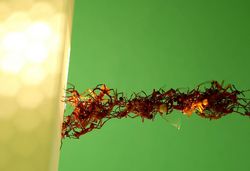
Researchers from Princeton University and the New Jersey Institute of Technology (NJIT) report for the first time that army ants of the species Eciton hamatum that form “living” bridges across breaks and gaps in the forest floor are more sophisticated than scientists knew. The ants exhibit a level of collective intelligence that could provide new insights into animal behavior and even help in the development of intuitive robots that can cooperate as a group, the researchers said. Ants of E. hamatum automatically form living bridges without any oversight from a “lead” ant, the researchers report in the journal Proceedings of the National Academy of the Sciences. The action of each individual coalesces into a group unit that can adapt to the terrain and also operates by a clear cost-benefit ratio. The ants will create a path over an open space up to the point when too many workers are being diverted from collecting food and prey.
Collective computation
The researchers suggest that these ants are performing a collective computation. At the level of the entire colony, they’re saying they can afford this many ants locked up in this bridge, but no more than that. There’s no single ant overseeing the decision, they’re making that calculation as a colony. The research could help explain how large groups of animals balance cost and benefit, about which little is known, said co-author Iain Couzin, a Princeton visiting senior research scholar in ecology and evolutionary biology, and director of the Max Planck Institute for Ornithology and chair of biodiversity and collective behavior at the University of Konstanz in Germany. Previous studies have shown that single creatures use “rules of thumb” to weigh cost-and-benefit, said Couzin. This new work shows that in large groups these same individual guidelines can eventually coordinate group-wide — the ants acted as a unit although each ant only knew its immediate circumstances, he said.
More here.
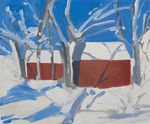
Does anyone today still believe that landscape can be the subject of great painting? Artists as renowned as Gerhard Richter and Alex Katz have made memorable landscape paintings—albeit under the sign of photography in Richter’s case, abstraction in Katz’s, and therefore ostensibly evading the charge of anachronism. Nevertheless, the unspoken assumption of the contemporary art world is that landscape is old-fashioned, a dusty souvenir of the 19th century.
Maureen Gallace thinks otherwise. The 12 small paintings of hers from 2013 to 2015 recently exhibited at the 303 Gallery in New York City could probably, from the viewpoint of technique, have been made at any point in the last 150 years. Their size alone—ranging from nine by 12 inches to 10 by 13—all but dares you to dismiss them as minor. And their subject matter is timeless: trees, flowers, the ocean, houses so plain and rendered with so little detail that dating them seems beside the point. Only the white line down the middle of a road flanked by utility poles indicates the automobile age. Yet there is nothing stale or dowdy about these works. Gallace’s self-consciousness about the conventions of painting (her “postmodernism,” I think it fair to say of an artist who was educated in the 1980s and has been exhibiting since 1990) clicks into place with a fresh, ingenuous responsiveness to things observed in a manner that feels new or at least unfamiliar, no matter the kinship you might sense with Edwin Dickinson or Giorgio Morandi, Lois Dodd or Albert York.
more here.
John Douglas Millar and Hal Foster at Eurozine:
Well the line that comes to mind first is an old statement by Edward Said from The Anti-Aesthetic where he said, “the humanities now represent human marginality or the marginality of the human”. That was over 30 years ago. In my own case it's complicated in the sense that modernism and the question of postmodernism could and were discussed in the remnants of the public sphere. Certainly in the States there once was such a thing as an independent intellectual and public sphere. That's really how October began and that's how I began too; I worked as a writer and editor for art magazines in that context. However, the art market came to dominate in the 1980s and with the triumph of neoliberalism came the deregulation of the art world and of art institutions in general. So, yes, we went to the academy for sanctuary only to discover that work is a commodity there too. Also, ironically that was the moment in the 1980s and into the early 1990s when critical theory had a special cache and itself became a prized commodity. Well that quickly ended when it turned out universities were not so keen to have this critical virus in their midst. The situation with the humanities now is complicated. Like you say, I work at an elite institution, on the other hand because Princeton is wealthy it has abundant scholarships so that if a young person is admitted to Princeton he or she does not have to pay, so it's actually quite economically diverse, if not sufficiently ethnically diverse, and so those kids are not quite so driven to become investment bankers. Ironically then, it's at the state universities that we see the crisis in the humanities where people are asked to develop as human capital, to develop their portfolio of skills to make them good grist for the neoliberal machine.
more here.