Entangled Tensions: Bangladeshi Women Artists

Melia Belli Bose in ArtAsiaPacific:

Bangladeshi03_420Bangladesh has undergone near constant political and cultural flux since its two independences: the first from Britain in 1947, after which it became East Pakistan, and then from Pakistan in 1971. Over the past four decades the nation has endured military dictatorships, natural and industrial disasters, rapid globalization and engagement with “Western” and developed Asian countries, primarily through nongovernmental organizations, businesses and factories established by multinational corporations. Concomitantly, there has been social, religious and economic engagement with the wider Islamic world as hundreds of thousands of Bangladeshis travel to the Gulf and Saudi Arabia annually for employment, or to perform hajj and umrah pilgrimages to Mecca. These events and interactions contribute to constructions of national and personal identities, as well as relationships to the collective past and the world. Many Bangladeshis appear to subscribe to the late Palestinian-American activist and literary critic Edward Said’s notion of “many Islams,” comfortably marrying their Bengali identities with their Muslim ones. They wear sarīs, read the Koran in Bangla, celebrate Hindu holidays and perform namaaz (Muslim prayer). However, many other Bangladeshis feel compelled to conform to the version of the faith they encounter during their travels abroad.

Responding to this pronounced emergence of hybridity in their country, several contemporary Bangladeshi artists have been grappling with issues of national and personal identities, and with the impact of global interactions. Among their many peers, three women artists—Tayeba Begum Lipi (b. 1969), Dilara Begum Jolly (b. 1960) and Nazia Andaleeb Preema (b. 1974)—explore these issues via the lens of gender. Through their use of different media, messages and content, each confronts what it means to be a woman in a changing Bangladesh that nevertheless still retains very specific gendered expectations. Lipi, Jolly and Preema are part of an international group of artists, which includes Mona Hatoum, Lalla Essaydi, Shirin Neshat, Yoshiko Shimada, Suk-nam Yun and others, who address the multiple binds of being a woman in a postcolonial, globalized, patriarchal society.

More here.

Saturday, December 26, 2015

Trump Taps into the Rage of Anxious American Men

&NCS_modified=20151226142012&MaxW=640&imageVersion=default&AR-151229351

Hussein Ibish in The National:

Mr Trump especially appeals to those white American males who feel blamed, collectively, for all the ills of society, and that they, alone, can be vilified not only without restraint, but also usually with applause. This narrative insists that, in reality, it is actually these middle-class white American males who are being unfairly economically disadvantaged.

Mr Trump, the billionaire, is cleverly exploiting the anger of those who feel, often with complete justification, that they are inexorably slipping from the middle class into the bulging ranks of the working poor.

Immigrants and other minorities could not have accomplished this grand theft without the connivance of traitorous “liberal elites”.

Money-grubbing corporations, the mainstream media, academic snobs, arrogant intellectuals and the hated federal government bureaucracy are the core of the liberal cabal that betrayed “real Americans” for ideological or selfish reasons, and consciously and cynically degraded the country. This imaginary grand betrayal is at the centre of Trumpian rage.

The Republican Party establishment is seen as part of the problem. It is either too weak or compromised by corporate and other interests to effectively defend the country. Only – or even especially – someone unquestionably outside of the thoroughly corrupted system can possibly hope to rehabilitate it.

Narratives about radical, emergency measures needed to reverse national devastation caused by parasitical minorities empowered by back-stabbing elites must be immediately recognisable as the stuff of fascism.

Yet it’s not clear what, if anything, Mr Trump actually believes. He hardly seems a would-be dictator. His campaign most often comes across as a gigantic ego trip, and sometimes even an incredibly elaborate practical joke.

But what explains the eagerness with which his lies, fabrications and reversals are championed by his supporters? It somehow doesn’t matter that his wild claims about blacks being responsible for most murders of whites, or thousands of Muslims in New Jersey celebrating the September 11, 2001 terrorist attacks, or Barack Obama not having been born in the United States, are demonstrably and incontrovertibly false.

The facts aren’t relevant. All that’s important is the sentiment, even if expressed through evident lies. The emotional “truths” they articulate are much more meaningful than the claims themselves, and therefore their veracity is incidental.

More here.

Brian Eno on Why Do We Make Art & What’s It Good For?

Colin Marshall over at Open Culture:

“Symphonies, perfume, sports cars, graffiti, needlepoint, monuments, tattoos, slang, Ming vases, doodles, poodles, apple strudels. Still life, Second Life, bed knobs and boob jobs” — why do we make any of these things? That question has driven much of the career (and indeed life) of Brian Eno, the man who invented ambient music and has brought his distinctive, at once intellectual and visceral sensibility to the work of bands like Roxy Music, U2, and Coldplay as well as the realm of visual art. Back in September, he laid out all the illuminating and entertaining answers at which he has thus far arrived in giving the BBC’s 2015 John Peel Lecture.

We featured Eno’s wide-ranging talk on the nature of art and culture, as well as its utility to the human race, back when the Beeb offered it streaming for a limited time only. But now they’ve made it freely available to download and listen to as you please: you can download the MP3 at this link. You can also follow along, if you like, with the PDF transcript available here, which will certainly be of assistance when you go to look up all the people, ideas, works of art, and pieces of history Eno references along the way, including but not limited to the “STEM” subjects, Baked Alaska, black Chanel frocks, the Riemann hypothesis, Little Dorrit, Morse Peckham, Coronation Street, airplane simulators, the dole, Lord Reith, John Peel himself, Basic Income, Linux, and collective joy.

More here. The lecture can be found here.

Has Europe Reached the Breaking Point?

20europe9-articleLarge

Jim Yardley in The New York Times Magazine:

The European Union was supposed to be an economic superpower, but after seven years it is still struggling to recover from the global economic crisis. Economic growth is sluggish at best (and uneven, given the divide between a more prosperous north and a debt-burdened south). Adjusting for inflation, the gross domestic product of the 19 countries now sharing Europe’s common currency, the euro, was less in 2014 than it was in 2007. Widespread joblessness and diminishing opportunities confront an entire generation of young Europeans, especially in Spain, Italy, France and Greece. The economic malaise tinges everything: Young people resist marriage for lack of economic opportunity. Poorer European countries are experiencing brain drains as many of their best young professionals and college graduates move abroad. Numerous Greek doctors, for instance, now work in more prosperous Germany while Greece’s health system is in crisis. Even as Toroczkai pushed back against migrants, he complained to me that too many young Hungarians had to leave for London or elsewhere to find work.

The migrants only accentuate the European paradox: A place of deepening pessimism for many of its own young people has become a beacon of hope and safety for migrants, many of them Syrian refugees who have been through the horrors of civil war. Many are young and educated, seemingly a timely fit for a region with an aging population. Except Muslim immigrants present a challenge to European ideals of tolerance, especially in a year of terror attacks, as far-right extremists and conservative political leaders like Orban warn that Europe’s security and ‘‘Christian values’’ are threatened — a reminder of just how fragile the European system has become.

Currently composed of 28 member states, from Germany, the industrial giant, to Malta, the tiny archipelago, the European Union is a bureaucratic machine jerry-built in pursuit of a utopian dream, the post-World War II vision that a unified Europe would be a peaceful and prosperous Europe. Nationalism and extremism had led to Hitler and the Holocaust and, before that, centuries of war. The New Europe was supposed to make future wars impossible and create harmony.

More here.

In America, only the rich can afford to write about poverty

3000

Barbara Ehrenreich in The Guardian:

I realized that there was something wrong with an arrangement whereby a relatively affluent person such as I had become could afford to write about minimum wage jobs, squirrels as an urban food source or the penalties for sleeping in parks, while the people who were actually experiencing these sorts of things, or were in danger of experiencing them, could not.

In the last few years, I’ve gotten to know a number of people who are at least as qualified writers as I am, especially when it comes to the subject of poverty, but who’ve been held back by their own poverty. There’s Darryl Wellington, for example, a local columnist (and poet) in Santa Fe who has, at times, had to supplement his tiny income by selling his plasma – a fallback that can have serious health consequences. Or Joe Williams, who, after losing an editorial job, was reduced to writing for $50 a piece for online political sites while mowing lawns and working in a sporting goods store for $10 an hour to pay for a room in a friend’s house. Linda Tirado was blogging about her job as a cook at Ihop when she managed to snag a contract for a powerful book entitled Hand to Mouth (for which I wrote the preface). Now she is working on a “multi-media mentoring project” to help other working-class journalists get published.

There are many thousands of people like these – gifted journalists who want to address serious social issues but cannot afford to do so in a media environment that thrives by refusing to pay, or anywhere near adequately pay, its “content providers.” Some were born into poverty and have stories to tell about coping with low-wage jobs, evictions or life as a foster child. Others inhabit the once-proud urban “creative class,” which now finds itself priced out of its traditional neighborhoods, like Park Slope or LA’s Echo Park, scrambling for health insurance and childcare, sleeping on other people’s couches. They want to write – or do photography or documentaries. They have a lot to say, but it’s beginning to make more sense to apply for work as a cashier or a fry-cook.

This is the real face of journalism today: not million dollar-a-year anchorpersons, but low-wage workers and downwardly spiraling professionals who can’t muster up expenses to even start on the articles, photo-essays and videos they want to do, much less find an outlet to cover the costs of doing them. You can’t, say, hop on a plane to cover a police shooting in your hometown if you don’t have a credit card.

More here.

Thoughts on Star Wars: The Force Awakens

Forceawakens24-xlarge-788x1024

First, Todd Alcott (warning–spoilers ahead):

Before I go, I’d like to say one more thing on the politics of The Force Awakens. People have commented on my posts (not here, but elsewhere on the internet) saying that the casting of The Force Awakens is nothing but a cynical cash-grab on the behalf of the studio. They point to The Hunger Games and Jessica Jones as examples of how this is the “hip new thing that people seem to like,” and that this too will pass and The Force Awakens will eventually be seen as dated. Likewise, the “Mary Sue” question of Rey elicits learned, beard-stroking responses from people about how it’s a shame that Rey is so competent, but it is, perhaps, inevitable that Disney would demand such an element in the script in order to expand their audience base. “You know, to bring in the Hunger Games crowd.” They strive in their comments to be wiser-than-thou, in the manner of Republicans saying how it is wiser to know that poor people are lazy and proceed from there. Their tone is exactly the manner of the woman at the party who says “I’m not racist, but…”

The supposition underlying the first remark is that narratives focussing on straight white men are, of course, the absolute norm, and, when the culture has gotten over its current fad of non-white, non-male casting, things will return to normal and all will be well. The supposition underlying the Rey comments, meanwhile, is that females are less than human, and should not be allowed to play in the boys’ sandbox.

More here. And Aaron Bady in The New Inquiry:

To criticize The Force Awakens for “recycling” the first three Star Wars movies—to complain that it’s “un-original” compared to that original work of genius—misses the point of the franchise so thoroughly and dramatically that this critical impulse seems more interesting to me than the movie itself. The one thing the original trilogy wasn’t was original. Similarly, The Force Awakens is great, but it isn’t interesting. The jokes are good, the action is organic and compelling, the characters are well inhabited by competent actors, and the cinematography and music is excellent and consistently inventive. But everything that puts you in the moment, when you’re watching it, falls apart as soon as you turn your brain back on. As experience, as ritualistic performance, as society-wide holiday, and as entertainment-industrial-complex, Star Wars is a strange and magnificent and disgusting enterprise. As original story, it’s total crap.

But of course it is. The more interesting question is why we would expect otherwise? Why would anyone act surprised when the new Star Wars turns out to be precisely as predictable and coherent as the story of Christmas itself, or as nakedly designed to sell toys to children? No one complains that this year’s Christmas only re-packages and recycles the stories of Christmases past, and to pretend to be scandalized by how commercial Christmas is “getting” is, itself, a clichéd-to-death joke. The same is true of Star Wars. You can be cynical or you can enjoy it; you can turn your brain on or leave it off. But you can’t have it both ways. Star Wars is what it is, and you can participate, or not. But there’s nothing else it should be.

More here.

Which inequalities matter and which taxes are appropriate?

Unknown

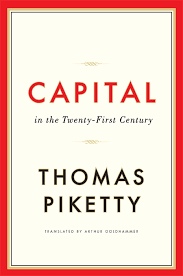
Crooked Timber is hosting a seminar on Thomas Piketty's Capital in the 21st Century. Kenneth Arrow on Piketty:

Professor Piketty and his colleagues at the Top Income Distribution Study have put us all in great debt for the great increase in our knowledge of historical development of inequalities in income and in wealth in a number of leading countries.

Notice I have already mentioned two inequalities, income and wealth. There is one more leading inequality which does not receive much attention in Piketty’s work: consumption. Papers and books have already appeared which try to measure this inequality. Many more inequalities, e.g. health, educational achievement, race, and gender differences have been the subject of study, but these are more specialized and less central to economic analysis.

There is a strong argument for emphasizing consumption. Why, after all, do we consider inequality in wealth, income, or consumption to be undesirable? If we consider only economic arguments, it is because the poor are being deprived of goods that are valuable to their lives, exactly because they are more basic than the desires of the rich.

This has important implications for how we evaluate Piketty’s arguments about inequality. It suggests an alternative metric of inequality, one under which some of the problems that Piketty identifies are not, in fact, problematic.

Consider a world, like that envisioned by Piketty, in which the rich consume relatively little (compared with their property income). They accumulate wealth by investing in industry, thereby increasing output in the future. If they do not consume more in the future, but instead, simply continue to accumulate, then the additional future output is available for the consumption of the poor.

More here.

Why the Left Needs Religion

1444014796Religionpapaboehner666

Elizabeth Stoker Bruenig makes the case in Dissent:

Viewing the relationship between Christianity and leftism as inherently antagonistic is firstly a disservice to history. Despite the efforts of the business leaders who conquered Christian thought during the Great Depression, American Christians have never supported capitalist domination of governance or of society. Consider, for instance, a recent study by historian Heath Carter of the Christian roots of labor union organizing in Chicago during the Gilded Age. In Union Made: Working People and the Rise of Social Christianity in Chicago, Carter recovers what has been lost to the rhetoric of the Christian right, namely that Christianity (even its evangelical iterations) aligns very well with the goals of organizers fighting for justice and dignity in their work. Indeed, America’s labor movement has long enjoyed support from Christianity of all stripes, from the Catholicism of Dorothy Day and the Catholic Worker, to the peace-oriented Protestantism of A.J. Muste and the Society of Friends.

Outside of labor organizing, Christian theology has also influenced other leftist social movements, such as black power in the United States and liberation theology in Latin America. American civil rights activists like Martin Luther King, Jr. invoked this theology of liberation to agitate not only for racial justice, but for equality everywhere and for everyone, including in the sphere of economics. Today, the same line of reasoning is evident in the words and writings of Pope Francis, who has added environmental concerns to the issues we must address so that all can flourish equally.

Christianity, in other words, is no more destined for a cozy relationship with neoliberal, free-market politics than any other ideology, and perhaps less so, given its longstanding interest in the poor. The fact that Christianity is reflexively associated with conservatism in the United States is not so much an accident of history as it is a concerted effort on the part of vested, moneyed interests.

More here. To read the counterpart to Bruenig by Susan Jacoby, click here.

Saturday Poem

Deer Trails:
.

Deer trails run on the side hills

cross country access roads

dirt ruts to bone-white

board house ranches,

tumbled down.

Waist high through manzanita,

Through sticky, prickly, crackling

gold dry summer grass.

Deer trails lead to water,

Lead sideways all ways

Narrowing down to one best path –

And split –

And fade away to nowhere.

Deer trails slide under freeways

slip into cities

swing back and forth in crops and orchards

run up the sides of schools!

Deer spoor and crisscross dusty tracks

Are in the house: and coming out the walls:

And deer bound through my hair.
.

by Gary Snyder
.

What’s Your Favorite Poem?

Marian Bantjes in The New York Times:

ALAN CUMMING: Yeats’s poem “Aedh Wishes for the Cloths of Heaven” is just eight lines long:

PoetHad I the heavens’ embroidered cloths,
Enwrought with golden and silver light,
The blue and the dim and the dark cloths
Of night and light and the half light,
I would spread the cloths under your feet:
But I, being poor, have only my dreams;
I have spread my dreams under your feet;
Tread softly because you tread on my dreams.

The first time I heard this poem I knew it would be forever in my life. If you’re ever having trouble trying to explain to someone how much you love them, this is the poem to reach for. I read it to my husband at our wedding. But making a gesture like that also has a cost: The heart is completely open and vulnerable, and so the poem ends a little needily, and I can relate to that too.

TA-NEHISI COATES: For me, at this point in my life, it has to be Robert Hayden’s “Middle Passage.” It is the poem I return to over and over — both for what it says about my country, and how it says it. Hayden wrote an origin myth for America and placed it right where it belonged — in enslavement. The narrators of this myth are the enslavers themselves. The irony of our history drips from every one of their lines. “Lost three this morning,” a ship’s captain observes. “Leaped with crazy laughter / to the waiting sharks, sang as they went under.”

More here.

Friday, December 25, 2015

A Harvard Medical School professor makes the case for the liberal arts and philosophy

David Silbersweig in the Washington Post:

DavidheadshotRecently, when philosophy and America’s higher education system were devalued by Sen. Marco Rubio during the Republican presidential debate and in subsequent statements, my thoughts returned to my sophomore year at Dartmouth, when I went back to my childhood dentist during a school break.

In the chit-chat of the checkup, as I lay back in the chair with the suction tube in my mouth, he asked: “What are you majoring in at college?” When I replied that I was majoring in philosophy, he said: “What are you going to do with that?”

“Think,” I replied.

And what a continuously giving gift philosophy has been. While it seemed impractical to my dentist, it has informed and provided a methodology for everything I have done since.

More here.

The Argument for Universal Basic Income

Tom Streithorst in Evonomics:

ScreenHunter_1586 Dec. 25 17.33The Basic Income Guarantee (BIG) is back in the news. The Finns are considering implementing it, as are the Swiss, replacing all means tested benefits with a simple grant to every citizen, giving everyone enough money to survive. Unlike most current benefits programmes, it is not contingent on being worthy or deserving or even poor. Everybody gets it, you, me, Rupert Murdoch, the homeless man sleeping under a bridge. Last seriously proposed by Richard Nixon in 1969, more and more economists and bloggers aresuggesting that the Basic Income Guarantee may ultimately be the salvation of capitalism. The BIG will eliminate poverty, lessen inequality, and vastly improve the lives of the most vulnerable among us. But that is not why we need it. It may seem impractical, even utopian: but I am convinced the BIG will be instituted within the next few decades because it solves modern capitalism’s most fundamental problem, lack of demand.

Technology and capitalism have largely solved the problem of supply. We are able to make more stuff, with fewer inputs of labour and capital, than ever before. We have the knowhow, we have the resources, we have the trained labour, we have the money. The only thing businesses lack is customers. Making stuff has become easy. It is selling it that keeps entrepreneurs (and central bankers) awake at night. Stagnant wages tell us that the supply of labour exceeds demand. Microscopic interest rates tell us that we have more capital than we need. Since the Great Depression most economists have recognised that demand is the Achilles heel of the modern economy.

More here.

What in today’s world will appal our grandchildren?

Henry Marsh in More Intelligent Life:

TenIt is estimated that in developed countries about 75% of an individual’s lifetime medical costs are spent in the last six months of life. This is clearly money wasted. We are wired by evolution to fear death, to cling to life, and yet in the modern world, where most of us will live into our 80s or beyond, extra life is often bought at the cost of gruesome treatment, such as chemotherapy, or prolonged incarceration in miserable hospitals. And even if the treatment is successful, as so often it is not, it may well allow us only to linger on a little longer in a nursing home, with the chances of dementia increasing steadily with age. When doctors like me face these difficult decisions as patients, they seldom choose the same solution for themselves that they often recommend to their patients. I hope that my grandchildren, not as doctors but as educated consumers of health care, will be appalled at the way that so much suffering was inflicted on the elderly in the past. I hope that the doctors of the future will be able to provide patients with better and more realistic predictions of what treatment will achieve, and that they will be more honest.

All over the world, health-care costs are escalating beyond the rate of inflation, which is not sustainable. Much of this is based on folly, greed and denial of the inevitability of death. I hope my grandchildren will understand that the problem facing us is not how to live a long life, but how to live a good life, and how to end it with a good death.

More here.

The Neglect and Abuse of Pakistan’s Tribal Areas

Umar Farooq in the Boston Review:

ScreenHunter_1585 Dec. 25 16.38Kabir Afridi gingerly makes his way through the bustling bazaar in Jamrud, past hawkers offering everything from cheap cell phones and fresh fruit to heroin and American military boots and flak jackets. Located in Pakistan’s Federally Administered Tribal Areas (FATA), along the highway between Peshawar and Kabul, the bazaar offers, among other things, items pilfered from the stream of trucks carrying supplies to American forces in Afghanistan. Few of the thieves are caught. And then there are the chronic militant attacks.

FATA has earned a reputation for chaos. President Obama, justifying more than 400 drone strikes that have hit the region, describes a “remote tribal” territory where Pakistan “cannot or will not effectively stop terrorism.” Academics and media organizations have taken to calling it a “lawless” place.

This characterization is false, though, as Afridi can attest. There is law, if not stability.

One morning last fall, Afridi was in the bazaar buying vegetables when his phone rang. “I got a call from a relative saying there had been an attack in our area,” he recalls. Gunmen had assaulted two tankers carrying fuel for American troops. Two drivers were killed and the trucks set ablaze. It was the third attack in a week on the same stretch of highway.

Soon an officer from the Khasadar—a militia commanded by an Islamabad-appointed official known as a “political agent”—sought out Afridi, a bearded man wearing a flowing white tunic and a tightly wrapped turban. “There are orders from inside,” the officer told Afridi, as he brought him to a cell in the agent’s office. Within a few hours, Afridi was joined by twenty-five other members of his Tor Khel tribe. Afridi, who denies ever participating in violence, has been arrested four times for attacks on NATO trucks and three times for attacks on government officials.

He laughs when I ask if his case is unusual. “There are thousands like me,” he replies. “Every time something happens, the political agent arrests us, holds a press conference to show he is taking action. Then our elders pay a fine and we are released.”

More here.

Friday Poem

Christmas Trees

The city had withdrawn into itself
And left at last the country to the country;
When between whirls of snow not come to lie
And whirls of foliage not yet laid, there drove
A stranger to our yard, who looked the city,
Yet did in country fashion in that there
He sat and waited till he drew us out
A-buttoning coats to ask him who he was.
He proved to be the city come again
To look for something it had left behind
And could not do without and keep its Christmas.
He asked if I would sell my Christmas trees;
My woods—the young fir balsams like a place
Where houses all are churches and have spires.
I hadn’t thought of them as Christmas Trees.
I doubt if I was tempted for a moment
To sell them off their feet to go in cars
And leave the slope behind the house all bare,
Where the sun shines now no warmer than the moon.
I’d hate to have them know it if I was.
Yet more I’d hate to hold my trees except
As others hold theirs or refuse for them,
Beyond the time of profitable growth,
The trial by market everything must come to.
I dallied so much with the thought of selling.
Then whether from mistaken courtesy
And fear of seeming short of speech, or whether
From hope of hearing good of what was mine,
I said, “There aren’t enough to be worth while.”
“I could soon tell how many they would cut,
You let me look them over.”

“You could look.
But don’t expect I’m going to let you have them.”
Pasture they spring in, some in clumps too close
That lop each other of boughs, but not a few
Quite solitary and having equal boughs
All round and round. The latter he nodded “Yes” to,
Or paused to say beneath some lovelier one,
With a buyer’s moderation, “That would do.”
I thought so too, but wasn’t there to say so.
We climbed the pasture on the south, crossed over,
And came down on the north.
He said, “A thousand.”

“A thousand Christmas trees! —at what apiece? ”

He felt some need of softening that to me:
“A thousand trees would come to thirty dollars.”

Then I was certain I had never meant
To let him have them. Never show surprise!
But thirty dollars seemed so small beside
The extent of pasture I should strip, three cents
(For that was all they figured out apiece) ,
Three cents so small beside the dollar friends
I should be writing to within the hour
Would pay in cities for good trees like those,
Regular vestry-trees whole Sunday Schools
Could hang enough on to pick off enough.
A thousand Christmas trees I didn’t know I had!
Worth three cents more to give away than sell,
As may be shown by a simple calculation.
Too bad I couldn’t lay one in a letter.
I can’t help wishing I could send you one,
In wishing you herewith a Merry Christmas.

by Robert Frost

.

.

Did historical Jesus really exist?

Raphael Lataster in The Washington Post:

JesusDid a man called Jesus of Nazareth walk the earth? Discussions over whether the figure known as the “Historical Jesus” actually existed primarily reflect disagreements among atheists. Believers, who uphold the implausible and more easily-dismissed “Christ of Faith” (the divine Jesus who walked on water), ought not to get involved. Numerous secular scholars have presented their own versions of the so-called “Historical Jesus” – and most of them are, as biblical scholar J.D. Crossan puts it, “an academic embarrassment.” From Crossan’s view of Jesus as the wise sage, to Robert Eisenman’s Jesus the revolutionary, and Bart Ehrman’s apocalyptic prophet, about the only thing New Testament scholars seem to agree on is Jesus’ historical existence. But can even that be questioned? The first problem we encounter when trying to discover more about the Historical Jesus is the lack of early sources. The earliest sources only reference the clearly fictional Christ of Faith. These early sources, compiled decades after the alleged events, all stem from Christian authors eager to promote Christianity – which gives us reason to question them. The authors of the Gospels fail to name themselves, describe their qualifications, or show any criticism with their foundational sources – which they also fail to identify. Filled with mythical and non-historical information, and heavily edited over time, the Gospels certainly should not convince critics to trust even the more mundane claims made therein.

The methods traditionally used to tease out rare nuggets of truth from the Gospels are dubious. The criterion of embarrassment says that if a section would be embarrassing for the author, it is more likely authentic. Unfortunately, given the diverse nature of Christianity and Judaism back then (things have not changed all that much), and the anonymity of the authors, it is impossible to determine what truly would be embarrassing or counter-intuitive, let alone if that might not serve some evangelistic purpose. The criterion of Aramaic context is similarly unhelpful. Jesus and his closest followers were surely not the only Aramaic-speakers in first-century Judea. The criterion of multiple independent attestation can also hardly be used properly here, given that the sources clearly are not independent. Paul’s Epistles, written earlier than the Gospels, give us no reason to dogmatically declare Jesus must have existed. Avoiding Jesus’ earthly events and teachings, even when the latter could have bolstered his own claims, Paul only describes his “Heavenly Jesus.” Even when discussing what appear to be the resurrection and the last supper, his only stated sources are his direct revelations from the Lord, and his indirect revelations from the Old Testament. In fact, Paul actually rules out human sources (see Galatians 1:11-12).

More here.

Thursday, December 24, 2015

What was Prohibition really about?

151221_r27379-320x240-1449780586Kelefa Sanneh at The New Yorker:

People have known since the Stone Age that sugary liquids, given time, have a salutary tendency to ferment, transforming themselves into something like beer or wine. Distillation, a more sophisticated process, was perfected only in the past few hundred years, and wherever it went it upended social customs. In “Deliver Us from Evil,” a crisp history published in 1976, Norman H. Clark explained that nineteenth-century temperance movements in the U.S. distinguished gin, whiskey, and other distillates from milder beverages, which were considered part of the common diet. “Many Americans of the New Republic simply did not regard beers and wines as ‘intoxicating,’ ” he writes. By contrast, hard liquor was prohibited in some American territory even before the country formed: in 1733, James Oglethorpe, the founding governor of the British province of Georgia, banned “the importation of ardent spirits.”

In the early nineteenth century, though, the country had a vibrant distilling industry, to supply a demand that scholars have struggled to quantify, though they agree that it was enormous. By one estimate, in 1810 the average American consumed the equivalent of seven gallons of pure alcohol, three times the current level. Nineteenth-century temperance campaigners deployed a familiar cast of stock figures: starving children, battered wives, drunks staggering and dying in the streets. (Researchers were just figuring out the science of liver failure, which bloated and killed so many heavy drinkers.) During a visit to Philadelphia, Alexis de Tocqueville was informed that, although the “lower classes” were drinking too much cheap liquor, politicians didn’t dare offend their constituents by imposing heavy taxes.

more here.

The Strange Paradise of Paul Scheerbart

ScheerbartAdam Kirsch at The New York Review of Books:

Scheerbart often reads like an apocalyptic mystic out of the Middle Ages who was somehow transported to the age of railroads and telegraphs. He returns again and again to the idea that existence—our own, or those of aliens on other planets—can be transformed into a paradise inhabited by beings who are like gods. In the introduction to a small new Wakefield Press volume, Rakkóx the Billionaire & The Great Race, the translator W.C. Bamberger recommends Scheerbart to the reader with the imprimatur of Gershom Scholem and Walter Benjamin, both of whom liked his work. And it was surely this oddball utopianism that so appealed to Scholem and Benjamin, each of whom was in his own way obsessed by the messianic. Scheerbart, Benjamin wrote, seemed “never to forget that the Earth is a heavenly body”; science fiction was a way of forcing the reader to see humanity in a cosmic, celestial perspective.

Yet the agency of earthly renewal, in Scheerbart’s work, is not divine—at least, not directly. It is, rather, the power of human ingenuity, operating with hitherto unimaginable tools and techniques, that will literally remake the face of the earth. Scheerbart is a mellow Marinetti; his faith in modern technology is not suffused with Futurist aggression, but with a dreamy aestheticism.

more here.