Larry Schwartz in ESPN:
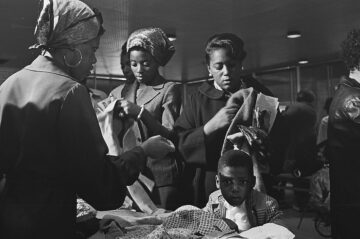
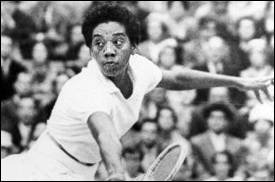 Before Althea Gibson could play — much less win — major tennis tournaments, another opponent had to be defeated. But Gibson had less control against this foe, which went by the name segregation. Jackie Robinson played in the major leagues (1947) before a black was permitted to play tennis at the U.S. National Championships. But cracks soon developed in the lily-white sport. And finally, in 1950, when Gibson was 23 years old, she was permitted to play at the U.S. Nationals, becoming the first black to compete in the tournament.
She also later cracked the color barrier at Wimbledon.
In 1956, Gibson made history by becoming the first black person to win the French championships. The next year, she made more history by winning Wimbledon and the U.S. Nationals, the first black to win either. She must have liked winning the world’s two most prestigious tournaments, too, because she repeated the accomplishments in 1958.
More here. (Note: In honor of Black History Month, at least one post will be devoted to its 2025 theme of “African Americans and Labor” throughout the month of February)
Enjoying the content on 3QD? Help keep us going by donating now.
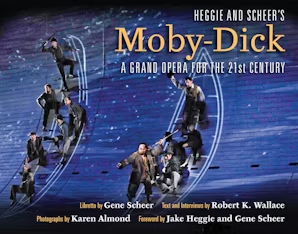 When the composer, Jake Heggie, said to the Dallas Opera, “We want to do Moby-Dick,” the artistic director Jonathan Pell asked, “Is there anything else you’d like to do?” So, yes. It was a daunting prospect, and it took a long time to figure out a way into it. For the first six months of the process, I just read and reread the book, which I hadn’t done since high school—and back then I probably skipped some chapters. I was also reading criticism about it. I was concerned not just with how to cut it down but also with how to really adapt it for the stage. The nature of Moby-Dick, or any novel, is that it’s telling a story. The narrator is very prominent. In the theater, we’re in the business of showing a story. Rather than what the characters are saying, it’s a question of what they’re doing and how the action can bring life to the story. But I could also see the possibilities immediately for the adaptation. There’s so much about Moby-Dick that is operatic—the language, the themes, and the power of the story. Throughout the book, there are these dramatic, incredibly poetic passages that I could imagine being sung, especially if they were distilled down. And the thing about Moby-Dick is that while it is a very long book and one that’s deep and dense, it does have a very compelling adventure story at the center of it. I knew we could exploit that.
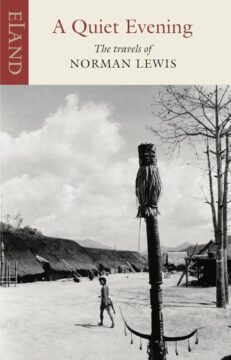 Norman Lewis (1908–2003) was arguably the finest English travel writer of his generation. Other contenders for the title – Robert Byron, Peter Fleming, Graham Greene, Evelyn Waugh, say – were all Oxford-educated, but Lewis was a product of Enfield’s grammar school and its public library. A devotee of the classics – Herodotus, Suetonius, Chekhov, Turgenev – he was attracted southwards. Federico García Lorca was his favourite poet. He gracefully reconfigured his first book, Spanish Adventure, written at twenty-six, into his last book, The Tomb in Seville, at the age of ninety-four. Just as a matador conceals his sword behind a bright muleta cape, he masked a tragic sensibility with a comic style.
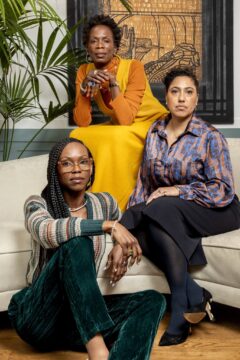 The jewelry designer Lola Oladunjoye remembers that she was sketching in the studio of her Paris apartment one day in late May 2020. She looked up at the television and, on CNN, watched in horror a video of George Floyd being fatally restrained
  R
R To keep my vocabulary from shrinking, I signed up for one of those
  Researchers and companies have been working for years to build quantum computers, which
  T
T P
P
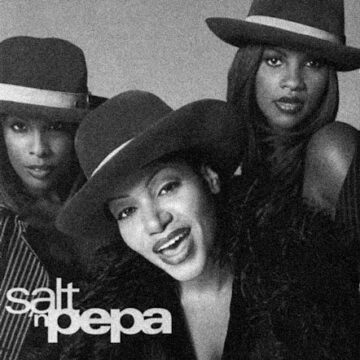 Rap is original poetry recited in rhythm and rhyme over prerecorded instrumental tracks. Rap music (also referred to as rap or hip-hop music) evolved in conjunction with the cultural movement called hip-hop. Rap emerged as a minimalist street sound against the backdrop of the heavily orchestrated and formulaic music coming from the local house parties to dance clubs in the early 1970s. Its earliest performers comprise MCs (derived from master of ceremonies but referring to the actual rapper) and DJs (who use and often manipulate pre-recorded tracks as a backdrop to the rap), break dancers and graffiti writers.