frank gehry on zaha hadid

ArticleFrank Gehry at Artforum:

WHEN I LAST SAW my friend Zaha Hadid, it was a few weeks before her death, at the Yale School of Architecture. We liked being together when we taught, so over the years we managed to arrange our schedules to be at Yale at the same time so that we could meet and greet and talk and drink and complain and have fun.

I first met Zaha many years ago, when she had just been announced to the world as the winner of the competition for the Peak Leisure Club in Hong Kong. The drawings and paintings that she produced for her project were mesmerizing and suggested a new idea, a new world, for architecture. Her style was clearly grounded in Constructivism, a movement that had inspired me for years, but Zaha’s personal touch gave it a new freedom, a new engagement, a new opportunity. And wow.

At that time, I was working for the Vitra furniture company on their campus in Weil am Rhein, Germany. Rolf Fehlbaum, whose family owns the company, was enamored with the idea of creating a center of works by architects whom he found to be particularly interesting. Nicholas Grimshaw had done the first factory, and I was given the second factory and a small design museum. Tadao Ando and Álvaro Siza did buildings as well, and there was a small fire-station project that I, along with the others, thought would be perfect for Zaha.

more here.

In Praise of Jet Lag

Beth Ann Fennelly in Orion Magazine:

JetHere are some memories I can claim simply because I was in the right place at the wrong time: In Japan, lifting my head from my hammock to see three monks with surfboards run past, tear off their saffron robes, and plunge into the sea. Sleeping on an unfinished roof in a São Paulo favela beneath a sky bewitched and bollocksed — the Southern Cross replacing the Big Dipper, Orion turning a cartwheel — and being awakened by a crowing rooster. All my life, cartoon roosters have crowed at the dawn, and here — here! — for the first time, I hear it, this rooster, this dawn, this girl called me. In Morocco, abandoning my attempt at sleep and making my way to the hotel’s “nonstop gym” — bathroom-sized, just a lone treadmill, occupied by a small boy (the maid’s son?) curled in slumber, sheeted with a hotel towel. How, while I gazed at him, the Muslim call to prayer came from outside, how the boy’s long eyelashes flicked, how I backed out and padded to my room and crawled into my foreign bed, how I slept and slept and slept.

Of course in all these places I eventually adjusted, my body’s rhythms harmonizing again with Mother Nature’s, and I dined at the dinner hour, stayed awake through the concert’s encore. But looking back, those offpeak, offkilter visions are some of my most strongly etched souvenirs. If there were a remedy to dispense with jet lag, would I take it? Sure thing. In the same way that I’d take one that blocked fevers. In the same way I’d have been tempted to frog leap the hardest weeks of pregnancy. But until that elixir is elixired, what can we do but jet and then lag, wait for our demanding body to sync with the lobby clock, sync with the brain it lifts like a flower on its stem. We might as well marvel as we pass through the two-headed doorway, a door through which we must go, both because we have no way around it and because we must keep moving, because if we lean against the doorjamb, we’ll fall asleep.

More here.

Cancer therapy: Defining stemness

Hans Clevers in Nature:

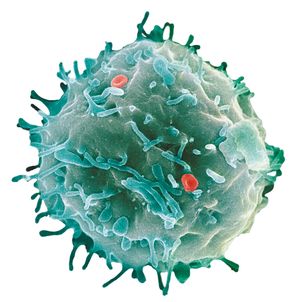
StemI have always felt uncomfortable about the concepts and definitions that we use in the stem-cell field. Some of the arguments seem circular; observation and assumption are not well separated. I once asked a colleague for their best definition of a stem cell. The answer: a cell that can self-renew. What, then, is self-renewal? The immediate reply: what stem cells do. Fuzziness in stem-cell concepts and definitions has significant consequences. It affects how we design, conduct and interpret experiments, how we communicate our discoveries and, ultimately, how we design therapies aimed at supporting the regenerative capacity of healthy stem cells or eradicating those that fuel the growth of tumours. Despite these concerns, as an experimentalist I could never put my finger on where exactly scientific common sense is failing.

Enter Lucie Laplane and her book Cancer Stem Cells. Trained as a science philosopher, Laplane also spent time at the bench in two stem-cell labs. Her book is the culmination of a six-year effort to describe and structure the philosophical underpinnings of stem-cell science. In addition to absorbing essentially all the relevant experimental literature — historical and scientific — she interviewed some of the leading international stem-cell researchers and clinicians. She discussed her emerging insights with fellow philosophers and science historians. Starting from an interest in cancer stem cells (CSCs), the book, despite its title, builds a much broader framework for understanding the biology of stem cells of all types. Central to CSC theory is the observation that not all tumour cells are equal. The bulk of a tumour consists of short-lived proliferative cells and differentiated cells. But some tumour cells seem to be the malignant equivalents of tissue stem cells. Much as normal stem cells maintain healthy organs by producing new tissue cells, CSCs drive the persistence of malignant tumours by producing new cancer cells.

More here.

Thursday, June 9, 2016

T. M. Scanlon’s Egalitarian Philosophy

Martin O’Neill in the Boston Review:

O'Neill-Scanlon-bannerSome years ago, I had the privilege of studying in graduate school at Harvard under T. M. Scanlon—Tim, as everyone who knows him calls him. As of a few days ago, he has taught his last class as a full-time member of the Harvard philosophy department, where he arrived from Princeton in 1984. But, though he is freshly retired, he has, I hope and expect, not taught his last student. Because Scanlon’s intellectual contributions are important and enduring.

Scanlon is a modest man, so he might not appreciate my saying it, but he stands as one of the most powerful and insightful moral and political philosophers of recent decades. His largest book, What We Owe to Each Other (1998), develops and defends a distinctive approach to interpersonal morality, known as contractualism. Scanlon’s idea is that interpersonal morality—giving others their due—involves being able to justify your conduct to others. Doing right by other people means treating them in ways they cannot “reasonably reject.” More recent work includes a subtle account of the role and function of moral blame in Moral Dimensions (2008) and, in 2014’s Being Realistic About Reasons, a defense of a kind of moral realism, the claim that moral truths exist independently of humans’ beliefs and attitudes.

While Scanlon has been a system-builder in moral philosophy, his work in political philosophy, by contrast, focuses on particular values. His 2003 book The Difficulty of Tolerance includes an account of freedom of expression as well as insightful essays on toleration, human rights, and punishment, among other topics. Now Scanlon is at work on a book whose subject has concerned him for a long time, but which has in just the past five or so years emerged as a central axis of political debate: inequality.

More here.

How An Icon of Evolution Turned to the Dark Side

Ed Yong in Not Exactly Rocket Science:

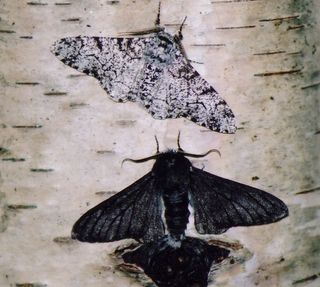
BistonC-T1-1024x919In the early 19th century, coal-fired factories and mills belched a miasma of soot over the English countryside, blackening trees between London and Manchester. The pollution was bad news for the peppered moth. This insect, whose pale speckled body blended perfectly against the barks of normal trees, suddenly became conspicuous—a white beacon against blackened bark, and an easy target for birds.

As the decades ticked by, black peppered moths started appearing. These mutants belonged to the same species, but they had traded in their typical colours for a dark look that once again concealed their bodies against the trees. By the end of the century, almost all the moths in Manchester were black.

As British air became cleaner and trees lighter in colour, the black moths faded back into obscurity. But in their brief reign they became icons of evolution. As geneticist Sewall Wright put it, they are “the clearest case in which a conspicuous evolutionary process has actually been observed.”

The story has endured a fair amount of controversy. Creationists asserted that the blackening of the moth was just a case of shifting gene frequencies rather than an outright change from one organism into another, ignoring that the former is the very definition of evolution.

More here.

What Makes the Stanford Rape Case So Unusual

Adrienne Lafrance in The Atlantic:

It’s impossible to know how many sexual assaults go unreported. But the 23-year-old victim in a sexual assault case that has touched off a national uproar did speak out. “You don’t know me, but you’ve been inside me, and that’s why we’re here today,” she said in a statement, which she read to her attacker in a Palo Alto courtroom last week. The woman went on to describe, in painstaking detail, what she experienced in the hours and months after she was found half-naked and unconscious behind a dumpster on Stanford’s campus the night of the attack. The victim’s statement to Brock Turner, the former Stanford student convicted of sexually assaulting her, has been viewed online millions of times since last week. A CNN anchor read the statement, in full, on television. Representative Jackie Speier, a California Democrat, read it aloud on the House floor. The case, which resulted in a six-month jail sentence and probation for Turner, has touched off furor among those who say the punishment is too light, and sparked vigorous debate about the intersection of sexual assault, privilege, and justice.

This is an astounding moment, in part because it’s so rare for sexual violence, despite its ubiquity, to garner this kind of attention. “It’s incredible,” said Michele Dauber, a Stanford Law School professor who has pressed for the recall of the judge who sentenced Turner. “Why did that happen? First of all, it’s the tremendous power and clarity of thought that is reflected in the survivor’s statement.” “She is helping people to understand this experience in a visceral and clear way,” Dauber added. “And she’s brushing away all the really toxic politics around campus assault that have built up. People have said, ‘How can we really believe these women? It’s his word against hers.’ This men’s rights movement has emerged. And there’s been a lot of rage happening out there. Then, whoosh, [this statement] really reframed it.”

More here.

The Totality of Facts

Christopher Fenwick in The Point:

ScreenHunter_2018 Jun. 09 18.36According to the early Wittgenstein, language is isomorphic to the world: it maps onto it like a kind of grid, such that every meaningful sentence corresponds to a fact. His book’s opening propositions—“The world is all that is the case” and “The world is the totality of facts, not of things”—point to the interrelation of language, logic and objective reality. The world is not simply the sum of all the “things” in it. Rather, it is the sum of everything we can assert about it, i.e. the relations between these different things. For Wittgenstein in the Tractatus, then, the “world” is already the world of logical space, of statements that can be true or false. Language is a direct representation of this logical space. This means that “facts” in objective reality are not only what make a sentence true or false, but alsomeaningful, rather than nonsensical. Meaningful sentences have a logical form and correspond to a set of primitive objects that can determine their truth. For this reason, Wittgenstein claims that aesthetics and ethics—which cannot formulate propositions about such objects—essentially produce meaningless sentences. Indeed, aesthetics and ethics “are one.”

More here.

Computing’s Search for Quantum Questions

Stephen Ornes in Quanta:

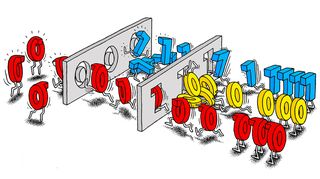
Qubits_1KIt was billed as the vindication of the quantum computer. Late last year, researchers at Google announced that a quantum machine called the D-Wave 2X had executed a task 100 million times faster than a classical computer. The claim implies that the machine can complete in one second a task that might take a classical computer three years.

It also erased one facet of the skepticism that has long faced this particular version of a quantum computer. In the past, critics of so-called “quantum annealers” made by the Canadian company D-Wave Systems have wondered if the machines make use of intrinsically quantum processes at all.

Part of the problem lies in the catch-22 of quantum computing: The quantum features only work when they’re not being observed, so observing a quantum computer to check if it’s exploiting quantum behavior will destroy the quantum behavior being checked. “It’s hard to devise a physics experiment to study something you aren’t allowed to observe,” said Catherine McGeoch, a computer scientist at D-Wave. December’s news convincingly satisfied critics that the quantum annealer really does exploit uniquely quantum effects.

But it didn’t settle a more important question: What can these computers do that classical computers can’t? The claim of a 100-million-factor speedup did not conclusively prove that the D-Wave 2X — and quantum annealers in general — will profoundly surpass the abilities of classical machines.

More here.

In the Depths of the Digital Age

Edward Mendelson in the New York Review of Books:

ScreenHunter_2017 Jun. 09 18.03Every technological revolution coincides with changes in what it means to be a human being, in the kinds of psychological borders that divide the inner life from the world outside. Those changes in sensibility and consciousness never correspond exactly with changes in technology, and many aspects of today’s digital world were already taking shape before the age of the personal computer and the smartphone. But the digital revolution suddenly increased the rate and scale of change in almost everyone’s lives. Elizabeth Eisenstein’s exhilaratingly ambitious historical study The Printing Press as an Agent of Change (1979) may overstate its argument that the press was the initiating cause of the great changes in culture in the early sixteenth century, but her book pointed to the many ways in which new means of communication can amplify slow, preexisting changes into an overwhelming, transforming wave.

In The Changing Nature of Man (1956), the Dutch psychiatrist J.H. van den Berg described four centuries of Western life, from Montaigne to Freud, as a long inward journey. The inner meanings of thought and actions became increasingly significant, while many outward acts became understood as symptoms of inner neuroses rooted in everyone’s distant childhood past; a cigar was no longer merely a cigar. A half-century later, at the start of the digital era in the late twentieth century, these changes reversed direction, and life became increasingly public, open, external, immediate, and exposed.

Virginia Woolf’s serious joke that “on or about December 1910 human character changed” was a hundred years premature. Human character changed on or about December 2010, when everyone, it seemed, started carrying a smartphone.

More here.

the search for the real byron

Byron_1813_by_PhillipsCorin Throsby at the Times Literary Supplement:

Byron knew, more than any author before him, the power of an ellipsis. Foreshadowing twentieth-century theorists such as Wolfgang Iser, who posited that it is primarily the reader who creates a poem’s meaning by navigating gaps in the text, Byron filled his work with tantalizing omissions to fire the imagination. One of his bestselling poems, The Giaour, a classically Byronic tale of a brooding hero avenging his murdered beloved, was subtitled “A Fragment” to create an illusion that the full story lay elsewhere. The poem is riddled with as­terisks that mark supposedly lost sections. “An outline is the best,” Byron wrote in his final epic Don Juan, “– a lively reader’s fancy does the rest”.

The poet invited conjecture not only about his work but also about his personal life. Readers were quick to see a link between Byron’s melancholic aristocratic heroes and the poet himself. In his preface to the work that made him famous in 1814, Childe Harold’s Pilgrimage, Byron insisted that his character was not based on a “real personage”, but purely “the child of imagination”. Yet he continually gave his heroes the same dark hair and pale brow that readers were seeing in reproduced portraits of the poet that hung in countless print shop windows, and he often dropped in teasing autobiographical references to ancestral homes and heroic acts abroad. Readers looked for coded messages that they felt revealed the real Byron amid the gossip, and the Byronic hero was just ambiguous enough for them to see in him whatever suited them.

more here.

The Enduring Legacy of The Twilight Zone

Twilightzone1280jpg-b68ece_1280wBrian Murray at The New Atlantis:

In his 1961 address to the annual convention of the National Association of Broadcasters, Newton Minow famously offered a pessimistic assessment of America’s most exciting new industry. Television, declared Minow, was turning into a “vast wasteland” of “blood and thunder” and “formula comedies.” Minow, the recently appointed head of the Federal Communications Commission, specified only one weekly series he found “dramatic and moving,” a hopeful sign of what broadcast television could become. This was The Twilight Zone, which its creator and chief writer, Rod Serling, described as “a series of imaginative tales that are not bound by time or space or the established laws of nature.”

The Twilight Zone won numerous industry awards and wide critical praise during its five-season run from 1959 to 1964 on CBS, confirming Serling’s place as one of the most prolific and innovative writers and producers to emerge from the live-drama era of the 1950s, television’s original “golden age.” But by the time he died in 1975, Serling was probably less well known for his writerly creativity than as the host of a quiz show and as the face of TV commercials for cigarettes and cars.

What happened? How did the man who longed to be — and arguably was — television’s answer to Arthur Miller end up instead as an edgier version of Ed McMahon?

more here.

Roald Dahl’s Letters to his Mother

51nTDFSZ38L._SY344_BO1,204,203,200_Christopher Hart at Literary Review:

The whole world knows Roald Dahl as the creator of Charlie and the Chocolate Factory, Matilda and the unspeakably disgusting Twits. His characters are marked by a wickedly mocking view of the adult world (a sine qua non for any children’s writer of worth), an imagination that knows no rules and at times a distinct whiff of cruelly funny misanthropy.

In his letters home to his mother, argues Donald Sturrock in the introduction to this entertaining and eye-opening collection, we see Dahl’s talent being born. Her only son, Dahl began to write letters in 1925, at the age of nine, from prep school; they continued until two years before his mother’s death in 1967. He was a born entertainer, a writer without realising it, and he wrote with that jaunty cheerfulness, come what may, which often marked the generation who lived through the horrors of the Second World War.

His mother’s letters to him, sadly, have not survived. Sofie Magdalene Dahl was born in Oslo in 1884 to ‘solid middle-class parents’, says Sturrock: her father worked for the Norwegian Public Service Pension Fund. On her mother’s side, though, she was descended from William Wallace, so memorably depicted on screen by Mel Gibson as a Scottish football hooligan with hair extensions. She adored her Boy and was pragmatic, unsentimental and evidently completely unshockable. ‘Dauntless’ was how her son described her in his memoir Boy and ‘undoubtedly the primary influence on my own life’.

more here.

Muhammad Ali, the Political Poet

Henry Louis Gates Jr. in The New York Times:

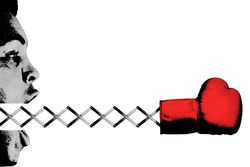
AliA friend asked me the other day to choose my favorite Muhammad Ali fight. “The Rumble in the Jungle,” I responded. I was thinking of all the rhymes that accompanied it, from “You think the world was shocked when Nixon resigned? Wait till I whip George Foreman’s behind,” to the very phrase “rope-a-dope”, as he named the strategy he used to defeat a superior opponent in the heat of Kinshasa. It was an athletic event but it was also a linguistic one.

Almost from the beginning of his career, when he was still called Cassius Clay, his rhymed couplets, like his punches, were brutal and blunt. And his poems, like his opponents, suffered a beating. The press’s earliest nicknames for him, such as “Cash the Brash” and “the Louisville Lip,” derived from his deriding of opponents with poetic insults. When in the history of boxing have critics been so irked by a fighter’s use of language? A. J. Liebling called him “Mr. Swellhead Bigmouth Poet,” while John Ahern, writing in The Boston Globe in 1964, mocked his “vaudeville” verse as “homespun doggerel.” Time magazine, in a particularly nasty triple dig in 1967 over Ali’s opposition to the Vietnam War, his embrace of the Nation of Islam and his name change, called him “Gaseous Cassius.” But the same verse can strike one critic as doggerel and another as art, and not everyone missed the power — and the point — of Ali’s poetics. Even Ahern admitted that “the guy is a master at rhyming,” and The New Yorker editor and Ali biographer David Remnick would eulogize him as “a master of rhyming prediction and derision.” Perhaps Maya Angelou, whose own poetry is sometimes labeled doggerel, said it best: “It wasn’t only what he said and it wasn’t only how he said it; it was both of those things, and maybe there was a third thing in it, the spirit of Muhammad Ali, saying his poesies — ‘Float like a butterfly, sting like a bee.’ I mean, as a poet, I like that! If he hadn’t put his name on it, I might have chosen to use that!”

Edmund Wilson once said that “we have produced some of our truest poetry in the folk songs that are inseparable from their tunes.” Likewise, the power of Ali’s poetry, often bland on the page, is inseparable from the compelling resonance of his voice.

More here.

Wednesday, June 8, 2016

Why Do the Poor Make Such Poor Decisions?

Rutger Bregman in Medium:

ScreenHunter_2016 Jun. 09 08.27On November 13, 1997, a new casino opened its doors just south of North Carolina’s Great Smoky Mountains. Despite the dismal weather, a long line had formed at the entrance, and as people continued to arrive by the hundreds, the casino boss began advising folks to stay at home.

The widespread interest was hardly surprising. Harrah’s Cherokee was and still is a massive luxury casino owned and operated by the Eastern Band of Cherokee Indians, and its opening marked the end of a ten-year-long political tug of war. One tribal leader had even predicted that “gambling would be the Cherokee’s damnation,” and North Carolina’s governor had tried to block the project at every turn.

Soon after the opening, it became apparent that the casino would bring the tribe not damnation, but relief. The profits — amounting to $150 million in 2004 and growing to nearly $400 million in 2010 — enabled the tribe to build a new school, hospital, and fire station. However, the lion’s share of the takings went directly into the pockets of the 8,000 men, women, and children of the Eastern Band Cherokee tribe. From $500 a year at the outset, their earnings from the casino quickly mounted to $6,000 in 2001, constituting a quarter to a third of the average family income.

As coincidence would have it, a Duke University professor by the name of Jane Costello had been researching the mental health of youngsters south of the Great Smoky Mountains since 1993.

More here.

thinking about france

E87e24cb-1c8c-49b4-85af-cc41f6d14a85Jeremy Harding at the London Review of Books:

A stand-off in Sudan in 1898 between the British and the French was attended by a prodigious rattling of sabres in London and Paris. The two armies in the field never came to blows, but France lost face at Fashoda and a tide of Anglophobia engulfed the Parisian press. It lasted through the Boer wars and beyond. Le Petit Journal, a scurrilous right-wing Republican daily, which rounded on Dreyfus, then Zola, took up the cudgels on behalf of oppressed Afrikaners. Among the sins it couldn’t forgive the British was the deadpan expression of Joseph Chamberlain, secretary of state for the colonies, when he toured the battlefields of South Africa. The paper had a point: the Boers fought – and lost – one of the first modern anti-imperialist struggles in Africa. Britain’s concentration camps in South Africa gave the world a glimpse of wars to come.

Le Petit Journal had a healthy print run, half a million in its heyday: it reeled in readers like idle fish on an appetising bait of faits divers. Parisian hoodlums – a particular type known as ‘apaches’ – were said to be keen browsers, partly because the paper loved to relate their fearsome deeds, and in return its editorial line rubbed off on them. They became human parchment for the journal’s opinions: in 1902 the police arrested 15 apaches and found they were covered in tattoos – among them, images of the Boer leader, Paul Kruger.

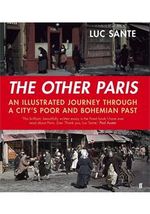
Apaches, as Luc Sante explains in The Other Paris, were propelled to fame by imaginative fin-de-siècle journalists and pamphleteers who felt the city was at risk from ‘an army of crime’.

more here.

On Jean-Marie Straub and Danièle Huillet

EmpedoclesMax Nelson at n+1:

IN 1988, THE FRENCH-BORN DIRECTORS Jean-Marie Straub and Daniéle Huillet hosted a conference at a Paris film school. Before the assembled crowd, they explained with the help of labeled diagrams why they had chosen to shoot a sequence for their film The Death of Empedocles (1986) in a particular way. The scene shows the title character, a heretical pre-Socratic philosopher, standing in an outdoor clearing and addressing a group of five Sicilian townspeople, including the two oligarchs responsible for his exile, who stand arranged in a straight row opposite the philosopher and his young disciple. At the start of the scene, the white-haired Empedocles is fixed in a tight medium shot, from mid-chest up, looking like a talking bust. Leaves and ferns flutter behind his head. As he delivers his speech, we watch him contort his lips to best expel each syllable:

Even as a boy my pious heart
Avoided you who soil all you touch;
My pious heart, intensely loving, clove
To sun and ether, all the messengers
Of our grand nature intimated from afar.
For surely even then I felt it, I feared,
That you would bend my heart’s free love
Of gods to some obnoxious servitude.
That I would treat all things as you treat them.
Begone! I cannot bear to face a man who
Abuses holy things as stock in trade.

When Straub and Huillet cut to a wider shot of Empedocles’ two main accusers standing side by side, they too seem frozen in space. All their energy is concentrated in their facial muscles as they articulate the text’s sharp consonants and rolling vowels. Watching these shots, what’s striking is the variety of movement Straub and Huillet have purged from their images—all the cinematic devices that have been “avoided” on the suspicion that they will “soil” the shot or “bend” it “to some obnoxious servitude.”

more here.

Translating Adonis’s “Elegy for the Times”

Adonis_imageRobyn Creswell at The Paris Review:

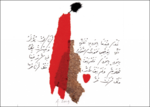
The speaker of “Elegy for the Times”—a long prose poem by the Syrio-Lebanese poet Adonis, a master of Arabic verse—is not an “I” but a “we,” an anonymous collective that travels through a nightmarish landscape of tombstones, locusts, and sand. The journey is what the ancient Greeks called a catabasis, a descent from the interior to the coast, “the sea’s abyss.” Adonis’s “we” is a community in flight, but the end of the poem suggests that the sea may offer no escape, or that it may be the final, most harrowing obstacle.

The poem, which I translated for our Summer issue, is visionary in scope, yet attentive to haunting details: the light glinting off a helmet, the stains of sweat on a dancer’s loincloth. Beyond the controlled hysteria of its images, I was drawn to the poem because it seems to have leaped from today’s headlines, conjuring the civil war in Syria and the vast migrations it has provoked. The scale of this ongoing tragedy defies the imagination, yet Adonis’s elegy is one of those rare works that aligns with Seamus Heaney’s definition of poetry: “a search for images and symbols adequate to our predicament.” (Heaney was thinking of Ireland’s own time of troubles.)

But Adonis’s poem actually has nothing to do with the predicament of present-day Syria—or at least, it wasn’t inspired by current events. “Elegy” was written more than fifty years ago, on a wholly different occasion.

more here.

Calm down. Trump won’t be President

Ian Leslie in New Statesman:

Gettyimages-537763914In the last two weeks Trump has viciously and repeatedly abused a Mexican-American judge, who ruled against him on a law suit concerning his fraudulent ‘university’, as being unfit to pass judgement because he has Mexican parents. The very definition of racism. He followed that up by referring to a supporter as “my African-American”– pretty much the dumbest thing a white American can say. Those senior Republicans who, like Paul Ryan, trusted they would civilize the savage, are already looking foolish. So are those of us who thought there was a Trump beyond the Trump we have. I think Josh Marshall is right, and that Trump is essentially trapped inside his own invective. The more violently he attacks Clinton, the more unstable and unlikeable he seems. He does not have a plan B. He is not thinking coolly or strategically. He is a dyspeptic gorilla in a cage, and on the evidence of a veryeffective opening salvo, Clinton knows exactly how and what to poke through the bars. Electorally, that means that Trump is not going to expand his appeal greatly beyond his existing constituency. Of course, he will pick up some of the Republicans who didn’t vote for him in the primary but will take the party line whoever the candidate, especially when the alternative is Hillary Clinton. But he won’t make in-roads into independents, among whom he only gets more unpopular, the more they see of him.

He certainly won’t make progress with non-white voters. If he wins as many Hispanic and black votes as Romney did – and he very probably won’t – he’ll have to win nearly two thirds of white voters to get to a majority. I just don’t think there are nearly enough angry racist white men in America to get him to the White House. It will soon become apparent that the big mistake of this whole electoral cycle was not, “We had no idea how popular Trump could be.” It was, “We had no idea how removed a large segment of the core GOP electorate has become from the rest of the nation.” Another factor is that the American media – finally, belatedly – have him in their sights, and they smell blood. Befuddled and dazzled by his rise, they didn’t scrutinize him aggressively, or call out his racism (and neither did his political rivals). Eager to make amends, they are now starting to make up for it. Interviews like this or this are just the beginning.

More here.