
Video length: 43:00
Category: Recommended Reading
Why Liberals Aren’t as Tolerant as They Think
Matthew Hutson in Politico:
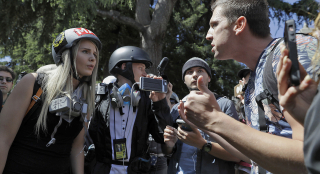
For years, it’s conservatives who have been branded as intolerant, often for good reason. But conservatives will tell you that liberals demonstrate their own intolerance, using the strictures of political correctness as a weapon of oppression. That became a familiar theme during the 2016 campaign. After the election, Sean McElwee, a policy analyst at the progressive group Demos Action, reported that Donald Trump had received his strongest support among Americans who felt that whites and Christians faced “a great deal” of discrimination. Spencer Greenberg, a mathematician who runs a website for improving decision-making, found that the biggest predictor of voting for Trump after party affiliation was the rejection of political correctness—Trump’s voters felt silenced.
So who’s right? Are conservatives more prejudiced than liberals, or vice versa?
More here. [Thanks to Patrick Lee Miller.]
on the impact of the great Mississippi flood of 1927
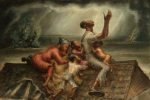
At the flood’s height, an expanse equivalent to all the New England states was awash, and the river was 80 miles wide in places. As Vernon Tull, a character in William Faulkner’s novel, As I Lay Dying (1930), put it, you “couldn’t tell where was the river and where the land. It was just a tangle of yellow and the levee not less wider than a knife-back”. According to the American Red Cross, which spearheaded relief efforts, the death toll was 246. But this figure did not include the deaths of black Americans; the total body count was probably over a thousand. Between 700,000 and 900,000 people were rendered homeless. Around 130,000 homes were destroyed. Some 300,000 African Americans were consigned to makeshift refugee camps. At Mounds Landing, just north of Greenville, Mississippi, when a crevasse appeared in the levee on April 21, 1927, a wall of water poured through with a force equivalent to that of Niagara Falls. Around 13,000 residents were evacuated to higher ground, and local black men toiled at gunpoint to shore up the defences. This incident inspired the husband and wife duo, Kansas Joe McCoy and Memphis Minnie, to record “When the Levee Breaks” (1929), a song reworked in 1971 by Led Zeppelin for their fourth album.
The flood of 1927 has multiple dimensions: the harrowing individual sagas of up to a million refugees; a relief effort of unprecedented scale in American history; the hubristic “levees only” conviction of over-confident hydraulic engineers that the unruly, indomitable river had finally been tamed in the early twentieth century by lining its entire lower stretch with enormous dykes 30 feet high and 188 feet wide at the base; the uneven impact of the disaster on blacks and whites, rich and poor, and the inequitable, often brutal treatment of African Americans in the relief camps; the forced levee and relief work imposed on African Americans in a variation on debt peonage and convict-lease, and white bosses’ coercive attempts to prevent the loss of a cheap and servile black labour force enticed by the “promised land” of northern cities and factory jobs; the exacerbation of already entrenched racial tensions in the Jim Crow South, from which charitable operations were in no sense exempt (“Farms, cattle, furniture and houses may be washed away by the disastrous Mississippi flood, but race prejudice remains as prominent as a butte on a Western plain.
more here.
Farewell to the Horse: The Final Century of Our Relationship
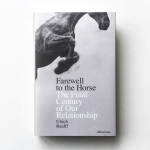
This unusual book is a series of airy, winging essays that alight briefly on world history, art, literary criticism and historiography before leaping on to make new, often surprising connections. Raulff’s animal is the source of ‘every single great idea that fuelled the driving force of the nineteenth century – freedom, human greatness, compassion, but also the sub-currents of history uncovered by contemporaries such as the libido, the unconscious and the uncanny’. This is not the Pony Club Manual or a trot through the more familiar sights of equestrian art history; it’s Kafka, Aby Warburg, Tolstoy, psychoanalytic theory, Nietzsche and bleak monochrome photos in the style of Sebald. This epic enterprise is relieved by Raulff’s spare, vivid style and deep learning. He is as comfortable analysing the etymology of Pferd andRoss as he is discussing the Chicago School, Clint Eastwood and the Amazons, and he rarely loses his audience.
The first of four parts, ‘The Centaurian Pact, or Energy’, comes the closest to a conventional history of the horse. It includes not just remarkable statistics relating to horses – in 1900 there were 145,000 horses in the French army and 130,000 horses working in Manhattan, while at the same time in Australia there was one horse to every two humans – but also sections on the scents and sounds of that world and explorations of subjects as obscure and essential as the role of oats in the landscape. The second part, ‘A Phantom of the Library, or Knowledge’, loops through the development of equine studbooks and the parallel emergence of human equivalents, such as the Almanach de Gotha, pausing to consider the author’s godfather, who adored fine horses and, under the Nazis, became a member of a mounted SA division.
more here.
Accelerationism: how a fringe philosophy predicted the future we live in
In our politically febrile times, the impatient, intemperate, possibly revolutionary ideas of accelerationism feel relevant, or at least intriguing, as never before. Noys says: “Accelerationists always seem to have an answer. If capitalism is going fast, they say it needs to go faster. If capitalism hits a bump in the road, and slows down” – as it has since the 2008 financial crisis – “they say it needs to be kickstarted.” The disruptive US election campaign and manic presidency of Donald Trump, and his ultra-capitalist, anti-government policies, have been seen by an increasing number of observers – some alarmed, some delighted – as the first mainstream manifestation of an accelerationist politics. In recent years, Noys has noticed accelerationist ideas “resonating” and being “circulated” everywhere from pro-technology parts of the British left to wealthy libertarian and far-right circles in America. On alt-right blogs, Land in particular has become a name to conjure with. Commenters have excitedly noted the connections between some of his ideas and the thinking of both the libertarian Silicon Valley billionaire Peter Thiel and Trump’s iconoclastic strategist Steve Bannon.
“In Silicon Valley,” says Fred Turner, a leading historian of America’s digital industries, “accelerationism is part of a whole movement which is saying, we don’t need [conventional] politics any more, we can get rid of ‘left’ and ‘right’, if we just get technology right. Accelerationism also fits with how electronic devices are marketed – the promise that, finally, they will help us leave the material world, all the mess of the physical, far behind.”
more here.
God in the machine: my strange journey into transhumanism
Meghan O'Gieblyn in The Guardian:

“The 21st century will be different,” Kurzweil wrote. “The human species, along with the computational technology it created, will be able to solve age-old problems … and will be in a position to change the nature of mortality in a postbiological future.”Like the theologians at my Bible school, Kurzweil, who is now a director of engineering at Google and a leading proponent of a philosophy called transhumanism, had his own historical narrative. He divided all of evolution into successive epochs. We were living in the fifth epoch, when human intelligence begins to merge with technology. Soon we would reach the “Singularity”, the point at which we would be transformed into what Kurzweil called “Spiritual Machines”. We would transfer or “resurrect” our minds onto supercomputers, allowing us to live forever. Our bodies would become incorruptible, immune to disease and decay, and we would acquire knowledge by uploading it to our brains. Nanotechnology would allow us to remake Earth into a terrestrial paradise, and then we would migrate to space, terraforming other planets. Our powers, in short, would be limitless.
More here.
Marijuana May Boost, Rather Than Dull, the Elderly Brain
Stephani Sutherland in Scientific American:

Other experts praised the study but cautioned against extrapolating the findings to humans. “This well-designed set of experiments shows that chronic THC pretreatment appears to restore a significant level of diminished cognitive performance in older mice, while corroborating the opposite effect among young mice,” Susan Weiss, director of the Division of Extramural Research at the National Institute on Drug Abuse who was not involved in the study, wrote in an e-mail. Nevertheless, she added, “While it would be tempting to presume the relevance of these findings [extends] to aging humans…further research will be critically needed.”
More here.
Wednesday, May 10, 2017
the soviet calendar
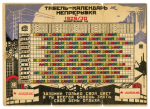
Among the many things to disappear during the world-shaking turmoil of the Russian Revolution—along with czarism, the aristocracy, private banks, landownership—were the first thirteen days of February. On 24 January 1918, Lenin signed a decree ordering the country to switch from the Julian calendar, used by the Orthodox Church, to the Gregorian, bringing revolutionary Russia into line with the rest of Europe. The two systems had been drifting more and more out of alignment since the sixteenth century, so much so that by 1918, making the change meant skipping directly from 31 January to 14 February. From then on, anyone referring to events that took place before this interregnum had to be clear whether the date they were using was Old Style or New Style. The shift also explains why the anniversary of the Great October Revolution was always celebrated in November, which often puzzled visitors to the USSR.
The 1918 calendar reform was an abrupt, one-off change, designed to signal the irreversibility of the leap from the ancien régime to the new. Undoing the revolution would now mean literally turning back time—which is what some upper-crust characters attempt to do in Sigizmund Krzhizhanovsky’s 1929 novella Memories of the Future when they ask the inventor of a time machine to take them back to the days of serfdom. Pushing the calendar forward was only one part, however, of a much broader campaign to sweep away backwardness and superstition and, in particular, to loosen the grip of religion on everyday life. Early on, the Soviets invented a series of ceremonies designed to replace Orthodox rituals: in addition to secular weddings and funerals, the government introduced “Octobering,” a Leninist alternative to baptism. There was also a weekly paper called Bezbozhnik—“Atheist,” “Godless One”—and, from 1925, a League of the Militant Godless.
more here.
REVISITING FLORINE STETTHEIMER’S PLACE IN ART HISTORY

It is is a good time to take Florine Stettheimer seriously. The occasion is a retrospective of the New York artist, poet, designer, and Jazz Age saloniste, at the Jewish Museum, titled “Florine Stettheimer: Painting Poetry.” The impetus is an itch to rethink old orders of merit in art history. It’s not that Stettheimer, who died in 1944, at the age of seventy-three, needs rediscovering. She is securely esteemed—or adored, more like it—for her ebulliently faux-naïve paintings of party scenes and of her famous friends, and for her four satirical allegories of Manhattan, which she called “Cathedrals”: symbol-packed phantasmagorias of Fifth Avenue, Broadway, Wall Street, and Art, at the Metropolitan Museum.
She painted in blazing primary colors, plus white and some accenting black, with the odd insinuating purple. Even her blues smolder. Greens are less frequent; zealously urbane, Stettheimer wasn’t much for nature, except, surreally, for the glories of the outsized cut flowers that barge in on her indoor scenes. She painted grass yellow. She seemed an eccentric outlier to American modernism, and appreciations of her often run to the camp—it was likely in that spirit that Andy Warhol called her his favorite artist. But what happens if, clearing our minds and looking afresh, we recast the leading men she pictured, notably Marcel Duchamp, in supporting roles? What’s the drama when Stettheimer stars?
Born in 1871, in Rochester, New York, Stettheimer was the fourth of five children of a banker, who ran out on the family when she was still a child, although they remained well off financially. The two oldest offspring married. Florine and her sisters Carrie and Ettie—“the Stetties,” as they were known—never did. They lived with their mother, Rosetta, first on the Upper West Side and, later, near Carnegie Hall.
more here.
Osip Mandelstam and the perils of writing poetry under Stalin
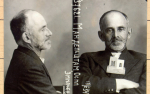
One of the most revealing photographs of Osip Mandelstam still in existence is a mugshot taken in the Lubyanka, on the occasion of his first arrest, in 1934. In the side-on view, it’s of little significance: he looks like any balding 1930s labourer from almost anywhere. Face on, though, arms folded and lips firmly pursed, he presents another proposition entirely. In this shot Mandelstam looks directly into the lens as though he is staring down the photographer. His eyes conceal any trace of the fear that must have been coursing through him; rather, his expression is the very manifestation of contempt. It is the face of a man who has never and will never let anyone, including himself, off the hook.
By the time of this first arrest, Mandelstam had already lived for several years with the knowledge that the long-term aim of the Soviet state machine was to take his life – the method and the timescale were all that remained to be revealed. “Only in Russia is poetry respected,” he is quoted as saying. “It gets people killed. Is there anywhere else where poetry is so common a motive for murder?”
The truth of this statement had been borne out long before Russia arrived at the great Yezhov terror of 1937-38, which was to provide Mandelstam and so many others with their end. Anna Akhmatova’s former husband, the poet and founder of the Acmeist movement, Nikolai Gumilev, had been arrested by the Cheka, the secret police, framed for participating in a fictitious tsarist plot and summarily executed in 1921.
more here.
Raymond Roussel’s lonely place in literary history
Ryan Ruby in Lapham's Quarterly:
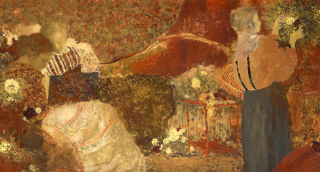
The day I visited him, it was gray and rainy and cold. There were few people in the normally well-frequented cemetery. When I finally managed to locate Division 89, I was delighted to see a gaggle of fellow Rousselians hovering near his grave, umbrellas resting awkwardly on their shoulders as they snapped photos with evident excitement. But as I approached it became clear that they had their backs to his tomb. They were taking pictures of someone else. When the group cleared out, I looked at inscription on the black crypt that had attracted their attention. It read “Famille George Harrison” and had a large cross on top. Puzzled, I took my phone out of my pocket, did a quick Google search, and confirmed what I suspected: George Harrison, the real George Harrison, guitarist of the Beatles, died in Los Angeles and had his ashes scattered over the Ganges. Poor Roussel, I thought. Always being overshadowed by someone more famous.
More here.
The great climate silence: we are on the edge of the abyss but we ignore it
We continue to plan for the future as if climate scientists don’t exist. The greatest shame is the absence of a sense of tragedy.
Clive Hamilton in The Guardian:
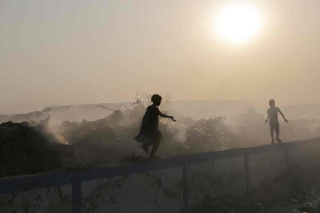
Our best scientists tell us insistently that a calamity is unfolding, that the life-support systems of the Earth are being damaged in ways that threaten our survival. Yet in the face of these facts we carry on as usual.
Most citizens ignore or downplay the warnings; many of our intellectuals indulge in wishful thinking; and some influential voices declare that nothing at all is happening, that the scientists are deceiving us. Yet the evidence tells us that so powerful have humans become that we have entered this new and dangerous geological epoch, which is defined by the fact that the human imprint on the global environment has now become so large and active that it rivals some of the great forces of nature in its impact on the functioning of the Earth system.
This bizarre situation, in which we have become potent enough to change the course of the Earth yet seem unable to regulate ourselves, contradicts every modern belief about the kind of creature the human being is.
More here.
Ken Roth: Horrific sarin attack only part of the Syrian people’s suffering
Ken Roth at CNN:
Was Trump simply demonstrating that he is not President Barack Obama, responding militarily to the chemical weapon "red line" that Obama chose instead to enforce through the negotiated removal of what President Bashar al-Assad claimed were all of his chemical weapons? Or was Trump showing that even he has limits to the atrocities he will tolerate?
Russia claims that the April 4 attack was a Syrian conventional bomb that happened to hit a "terrorist" chemical weapons cache on the ground. That cover story was quickly undercut by the fact that Khan Sheikhoun residents began suffering symptoms from a sarin attack five hours before Russia said the conventional attack took place.
Then, last week, Human Rights Watch decimated the cover story. Dozens of local residents interviewed said that a crater in the middle of a paved road appeared to have been the epicenter of the chemical exposure and that there were no indications that other sites attacked that morning contained any stored chemicals.
More here.
Marcus du Sautoy: What We Cannot Know
Video length: 51:37
Can Zapping the Vagus Nerve Jump-Start Immunity?
Douglas Fox in Scientific American:
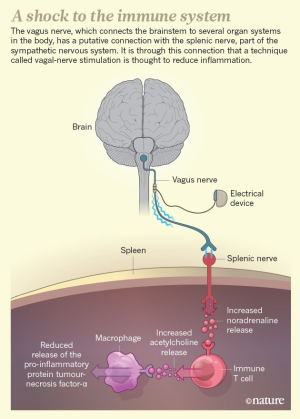
For Kevin Tracey, a neurosurgeon at the Feinstein Institute for Medical Research in Manhasset, New York, the vagus nerve is a major component of that connection, and he says that electrical stimulation could represent a better way to treat autoimmune diseases, such as lupus, Crohn's disease and more. Several pharmaceutical companies are investing in 'electroceuticals' — devices that can modulate nerves — to treat cardiovascular and metabolic diseases. But Tracey's goal of controlling inflammation with such a device would represent a major leap forward, if it succeeds. He is a pioneer who “got a lot of people onboard and doing research in this area”, says Dianne Lorton, a neuroscientist at Kent State University in Ohio, who has spent 30 years studying nerves that infiltrate immune organs such as the lymph nodes and spleen. But she and other observers caution that the neural circuits underlying anti-inflammatory effects are not yet well understood. Tracey acknowledges this criticism, but still sees huge potential in electrical stimulation. “In our lifetime, we will see devices replacing some drugs,” he says. Delivering shocks to the vagus or other peripheral nerves could provide treatment for a host of diseases, he argues, from diabetes to high blood pressure and bleeding. “This is the beginning of a field.”
More here.
Tuesday, May 9, 2017
Hope Deferred
John Thomason in The Point:
A few years later, during Obama’s second term, a different young white man journeyed to a different black church. He too felt he had to take action against an evil he believed to be nourished there. And he too was surprised to find himself moved by the kindness he encountered. In this case, however, it was not enough to stop him. He drew his handgun and killed each parishioner in the sanctuary, one by one.
Barack Obama, through no fault of his own, was implicated in both events. After his first presidential campaign brought intense scrutiny upon his hometown church, anti-American remarks uttered during sermons in the early 2000s incubated fevered conspiracy theories in the young Texan and countless others. Years later Dylann Roof massacred a Bible study group at Emanuel AME in Charleston, South Carolina, because he felt blacks were “taking over” the country. It does not take much imagination to conclude the president was among those he had in mind.
More here.
The most promising route to “mental superpowers”
When people are given a way to see what’s happening inside their head in real-time, they can rapidly learn how to dampen pain, enhance self-control and boost mental ability. If more of us had access to this technique, it could be transformative.
Bobby Azarian at the BBC:
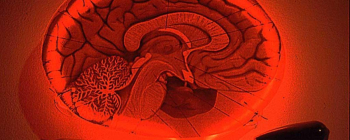
Now imagine if you could see what was happening inside your brain as you experienced emotions and sensations such as pain, anxiety, depression, fear, and pleasure – all in real-time. Suddenly, why you feel the way you feel might not be such a mystery, and the effectiveness of the little mental techniques you use to deal with daily life would be clearly visible.
That’s the idea behind a new technique known as “real-time fMRI”. By receiving specific visual feedback about brain activity while executing mental tricks and strategies, we can learn to consciously control our emotions, sensations and cravings as if they were being manipulated by a volume knob on a stereo. Through practice, you can learn to strengthen control over the mind similar to how a weightlifter targets a specific muscle group – and it raises the tantalising possibility of a future where we can train advanced mental abilities far beyond our own today.
More here.
Mohsin Hamid: India seems to be making some of the same mistakes that Pakistan made
Man Booker Prize-nominated author Mohsin Hamid’s opens up on his latest novel Exit West, his dreams of a borderless world and how India needs to learn from Pakistan’s mistakes.
Shikha Kumar in the Hindustan Times:
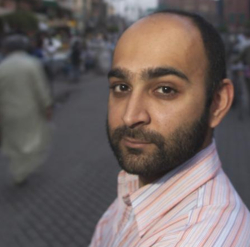
Mohsin Hamid’s Exit West captures the complicated dynamics of lovers-turned-refugees. Over a Skype interview from Lahore, the Man Booker Prize-nominated author discusses his newest work, creative restrictions and more.
What led you to writing about migration, something that’s both topical and political right now?
I’ve been thinking about migration, and the backlash against refugees for a long time. I also take it personally, as somebody who’s lived a lot of his time in America and Britain. For mongrelized, hybridized people like me, these walls that are coming up between countries are terrible as it makes it impossible to connect the two parts of yourself. Also, after I moved back to Lahore eight years ago, the horrors that have happened in Syria and other places make a part of your mind say ‘what if it happened here?’ I wanted to explore this through a kind of first love – a love between two people who are young and changing very rapidly.
More here.
Anil Seth: The Neuroscience of Consciousness
Video length: 1:00:13
SHANGHAI NOIR: FROM 19TH-CENTURY PIRATES TO 21ST-CENTURY BUREACRATS

For a city with such a reputation—back in the old days of foreign gunboats, spies and revolutions as well as now in the boom-boom modernity of the skyscraper city—Shanghai hasn’t generated that much crime fiction. Indeed, it has to be said, for a megalopolis of maybe as many as 24-million people it’s a pretty safe place. Novels about Shanghai have preferred to focus on the glitz, the glamour, the style of the city—China’s “capital of cool.” But, of course, there always was, and still remains, an underbelly down beneath the neon lights and the luxury penthouse apartments.
Shanghai has been such a success because it’s a port town at the end of the mighty Yangtze River where it meets the South China Sea, and port towns always have a reputation. And perhaps Shanghai’s modern origins are deeply entwined with crime? In the mid-19th century the British grabbed Shanghai after the First Opium War, declaring it a “treaty port,” throwing it open to any and all buccaneers and capitalist freebooters to moor up alongside the opium hulks on the Huangpu River as they fought to preserve the opium trade—perhaps the most pernicious of modern trade wars.
Shanghai’s attraction to a multinational bunch of ne’er-do-wells, pirates and gunrunners attracted thriller and crime writers early on. Francis Van Wyck Mason’s The Shanghai Bund Murders (1933) is full of warlords, gunrunners and damsels in distress. Mason, a Bostonian novelist, had a long and prolific career spanning 50 years and 65 novels mostly featuring his proto-James Bond character Captain Hugh North, a detective in America’s G-2 Army Intelligence.
more here.