Papineau vs Dennett: a philosophical dispute

Tim Crane in the Times Literary Supplement:

ScreenHunter_2780 Aug. 03 20.11Readers familiar with contemporary philosophy of mind may have been a bit puzzled by David Papineau’s recent critical review of Daniel Dennett’s From Bacteria to Bach and Back in the TLS (June 30). They will know that one of the big debates here is between materialists – who think the mind is wholly material or physical – and dualists – who think that the mind is something else, something over and above its physical basis in the brain. But Papineau and Dennett are both well-known materialists. So why did Papineau object to so much in Dennett’s book? Is this disagreement a bit like the bitter disputes between tiny left-wing Marxist splinter groups – Monty Python’s People’s Front of Judea versus the Judean People’s Front – or is something more substantial going on?

There were two main lines of criticism in Papineau’s review: one concerns Dennett’s doubts about explicit understanding or “comprehension”; the other concerns his views about consciousness. On comprehension, Dennett maintains that much animal and indeed human behaviour displays “competence without comprehension”, achieving ends without the subject’s understanding why. In a similar vein, he holds that human cultures can develop blindly, due to the natural selection of the “informational viruses” that Richard Dawkins has labelled “memes”, including some of the greatest products of human culture (hence Bach and bacteria). Papineau argues that Dennett fails to justify his downgrading of animal intelligence or his exclusion of deliberate design from cultural innovation, and hence that Dennett does not take sufficiently seriously the widespread role of intelligent insight. On consciousness, Papineau takes issue with Dennett’s view that consciousness is a kind of illusion (“illusionism”) and argues that materialists should have no difficulty accepting the reality of consciousness – the difficulty is finding the material basis of this reality in the brain.

More here.
Climate change to cause humid heatwaves that will kill even healthy people

Damian Carrington in The Guardian:

ScreenHunter_2779 Aug. 03 19.59Extreme heatwaves that kill even healthy people within hours will strike parts of the Indian subcontinent unless global carbon emissions are cut sharply and soon, according to new research.

Even outside of these hotspots, three-quarters of the 1.7bn population – particularly those farming in the Ganges and Indus valleys – will be exposed to a level of humid heat classed as posing “extreme danger” towards the end of the century.

The new analysis assesses the impact of climate change on the deadly combination of heat and humidity, measured as the “wet bulb” temperature (WBT). Once this reaches 35C, the human body cannot cool itself by sweating and even fit people sitting in the shade will die within six hours.

The revelations show the most severe impacts of global warming may strike those nations, such as India, whose carbon emissions are still rising as they lift millions of people out of poverty.

More here.

Ode to the Liberal Muslim

Rafia Zakaria in The Baffler:

ScreenHunter_2778 Aug. 03 19.53On the second grim Friday following President Donald Trump’s victory in the November elections, I attended a Friday service at the Women’s Mosque of America. Held at a community center in Los Angeles, the service was organized entirely by a group of women seeking to further women’s leadership within the American Muslim community. Unlike other mixed mosque congregations, women deliver the call to prayer, they give the sermon, they set up and they pick up, they talk and they pray. We did all of those things that day; we also worried and cried and listened to announcements about self-defense classes—very important, the speaker emphasized, given recent developments. I left both drained and heartened, feeling at once unsure of an America mired in Islamophobia and yet hopeful for an American Muslim community led by women. Could the two co-exist, I wondered? How long before the demands of survival as American Muslims wipe out the efforts of resisting patriarchy as American Muslim women?

The same amalgam of terror and hope I felt that day is reflected in the results of a Pew survey[*] on American Muslims released last Wednesday. According to its results, the American Muslim community has changed markedly since the last time Pew polled them ten years ago. From the viewpoint of an ever-suspicious America, unsure of the assimilative abilities of troublesome American Muslims, the news is mostly good. Muslims are now “more liberal,” a fact meant to be celebrated. To get the party started, CNN helpfully highlights a statistic telling us that the numbers of those American Muslims who believe society should be tolerant of homosexuality has nearly doubled (up from 27 percent to 52 percent), with millennial Muslims leading the charge of change. Nearly two-thirds of Muslims believe in the validity of varying interpretations of faith, and 6 percent more than in 2007 self-identify as politically liberal. To top it off, the vast majority—nearly eight out of ten of the roughly 1,000 polled—voted accordingly, casting their ballots for Hillary Clinton.

At the same time, while American Muslims are more liberal, they are also rather replete with dread, or, like me, just plain terrified.

More here.

Psychedelics

PeyoteJosh Raymond at the TLS:

Psychedelic drugs have an appropriately colourful history. The word’s origin is Greek (“mind-manifesting”, literally) and it was coined by the psychiatrist Humphry Osmond in an exchange of letters with Aldous Huxley; LSD, the quintessential psychedelic, first came to Britain in 1952, in the luggage of a psychoanalyst called Ronnie Sandison. Sandison had met the drug’s discoverer, Albert Hoffman, on a visit to Switzerland, and Hoffman believed LSD to be miraculous – “You see the world as it really is”. Sandison administered it to thirty-six patients with “very difficult psychiatric problems . . . all in danger of becoming permanent mental invalids”. The Journal of Mental Science write up in 1954 claimed more than half recovered completely.

Humphry Osmond used it to treat alcoholism. By the late 1960s he and his colleagues had treated over 2,000 people, more than 40 per cent of whom did not drink again within a year. The randomized-controlled portions of this work were reviewed and found valid in 2012. LSD was also tested by the military at Porton Down, first as a “truth serum” for interrogations, for which it proved useless, and then as a mass battlefield incapacitant, where results were inconclusive. A thoroughly researched history of LSD in Britain can be found in Albion Dreaming(2012) by Andy Roberts.

more here.

a possible keats

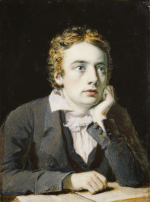
Keats-by-severnFleur Jaeggy at the NYRB:

In 1803, the guillotine was a common children’s toy. Children also had toy cannons that fired real gunpowder, and puzzles depicting the great battles of England. They went around chanting, “Victory or death!” Do childhood games influence character? We have to assume that they do, but let’s set aside such heartbreaking speculations for a moment. War—it’s not even a proper game—leaves influenza in its wake, and cadavers. Do childhood games typically leave cadavers behind in the nursery? Massacres in those little fairy-dust minds? Hoist the banners of victory across the table from the marzipan mountain to the pudding! It’s perhaps a dreadful thought, but we’ve seen clear evidence that both children and adults have a taste for imitation. Certainly, such questions should be explored, and yet let us allow that there is a purely metaphysical difference between a toy guillotine and war. Children are metaphysical creatures, a gift they lose too early, sometimes at the very moment they learn to talk.

John Keats (1795-1821) was seven years old and in school at Enfield. He was seized by the spirit of the time, by a peculiar compulsion, an impetuous fury—before writing poetry. Any pretext seemed to him a good one for picking a fight with a friend, any pretext to fight.

more here.

On two modes of witnessing: Azadeh Akhlaghi and Gauri Gill

Sarover Zaidi in Chapati Mystery:

They ask me to tell them what Shahid means—

Listen: It means “The Beloved” in Persian, “Witness” in Arabic

—Agha Shahid Ali, In Arabic, 2003

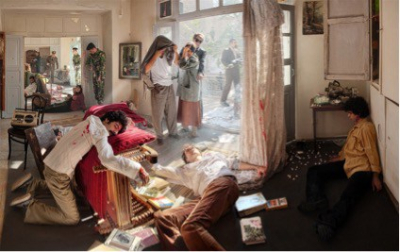
ShariatiAli Shariati, the Iranian revolutionary and socialist, died mysteriously in 1977. Shariati, also a sociologist, wrote Jihad and Shahadat, a rendering of the historico-mythical battle of Karbala, retelling it as the first red revolution. Composed as a testimonial to the dead, Shariati portrayed the female protagonist Zainab as the last witness to this bloody battle of loss, death and mourning. Unfortunately, at the peak of Cold War politics, prior to Khomeini’s rise to power in Iran (1979), Shariati had been found dead under mysterious circumstances (1977). Shariati’s own death went without witnesses or testimonials, or the image and space of mourning it demanded. Forty years later, Azadeh Akhlaghi, a photographer, provides a testimonial to Shariati’s death, in her experimental series ‘By an Eyewitness’.

Akhlaghi works with 17 renditions of witnessing deaths and events that had slid under the archives or had not been allowed to have one. She provides in the hyper-image-fetishizing code of contemporary photography, an original injunction. Akhlaghi’s exhibit works with actors and staged sets to produce events that had missed photographic documentation and presence in the archive of a nation-state. Using newspaper reports, records and interviews, she, bit by bit, pieces together scenes of assassinations, accidents, political deaths and funerals. She seamlessly, brilliantly, and self-consciously provides the role of the fabricator in photography, but one that hinges on photography’s original injunction, that of providing evidence, by staging 17 unaccounted for deaths in Iranian history.

More here.

CRISPR fixes disease gene in viable human embryos

Heidi Ledford in Nature:

EmbryoAn international team of researchers has used CRISPR–Cas9 gene editing — a technique that allows scientists to make precise changes to genomes with relative ease — to correct a disease-causing mutation in dozens of viable human embryos. The study represents a significant improvement in efficiency and accuracy over previous efforts. The researchers targeted a mutation in a gene called MYBPC3. Such mutations cause the heart muscle to thicken — a condition known as hypertrophic cardiomyopathy that is the leading cause of sudden death in young athletes. The mutation is dominant, meaning that a child need inherit only one copy of the mutated gene to experience its effects. In the gene-editing experiment, published online today in Nature1, the embryos were not destined for implantation. The team also tackled two safety hurdles that had clouded discussions about applying CRISPR–Cas9 to gene therapy in humans: the risk of making additional, unwanted genetic changes (called off-target mutations) and the risk of generating mosaics — in which different cells in the embryo contain different genetic sequences. The researchers say that they have found no evidence of off-target genetic changes, and generated only a single mosaic in an experiment involving 58 embryos.

…Mitalipov’s team took several steps to improve the safety of the technique. The CRISPR system requires an enzyme called Cas9, which cuts the genome at a site targeted by an RNA guide molecule. Typically, researchers wishing to edit a genome will insert DNA encoding CRISPR components into cells, and then rely on the cells' machinery to generate the necessary proteins and RNA. But Mitalipov’s team instead injected the Cas9 protein itself, bound to its guide RNA, directly into the cells.

More here.

Wednesday, August 2, 2017

Katherine Boo’s 15 rules for narrative nonfiction

Katia Savchuk at the Nieman Foundation:

ScreenHunter_2777 Aug. 03 00.47When I first came across Katherine Boo’s work in journalism school, I was immediately taken with her ability to expose injustice while weaving gorgeous narratives. I carved up her stories in The Washington Post and The New Yorker with a black pen, hoping I could figure out their magic.

Next I devoured Boo’s book, “Behind the Beautiful Forevers: Life, Death, and Hope in a Mumbai Undercity,” which extended her probing and compassionate portrayal of poverty to India. Before becoming a journalist, I had spent nearly two years working with grass-roots groups in Mumbai slums just like Annawadi, the one she spent three years chronicling for the book. I’d been so upset by journalistic portrayals of these neighborhoods that I wrote an entire master’s thesis about the subject. Now, finally, here was an account that took slum residents seriously as protagonists in their own lives, without dismissing the inequality and corruption that stymied them.

When I learned that Boo was speaking at the Mayborn Conference in Grapevine, Texas, this year, I secretly hoped she’d give a crash course in her craft. But I’ve heard enough journalism keynotes to know that speakers are more likely to rehash their career paths or pontificate on subjects they’ve written about. So I was pleasantly surprised on Friday when Boo announced that she planned to give us our money’s worth by sharing 15 rules that guide her during the reporting and writing process.

More here.

Maryam Mirzakhani, A Candle Illuminating The Dark

Paul Halpern in Forbes:

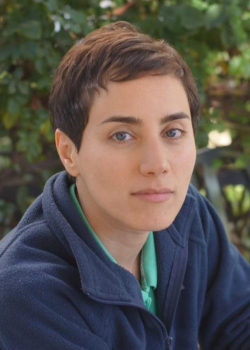
ScreenHunter_2776 Aug. 03 00.38Abstract mathematics sometimes has surprisingly practical applications, to not only physics but other arenas as well. Take, for example, the work of extraordinarily innovative mathematician Maryam Mirzakhani, whose recent death at the age of 40 has been mourned around the world. One of the theorems she co-developed sheds light on several related longstanding physics quandaries having to do with ricocheting and diffusion—of light, billiards, the wind, and other entities. Undoubtedly, given its generality, it will find many uses in science, sports, and beyond, for years to come.

The class of problems Mirzakhani was interested in dates back more than a century. In 1912, Austrian statistical physicist Paul Ehrenfest and his wife, the Russian mathematician Tatjana Afanassjewa-Ehrenfest, proposed the ‘wind-tree’ model as a way of trying to understand how impediments in a system affect diffusion. (In this context, diffusion means the spreading out of particles, light, gases, etc., due to their natural motion.) They imagined a bounded forest that was empty except for regularly spaced trees—symbolized as rectangles forming a periodic pattern within a square lattice. Imagine the wind entering the forest from a certain direction and scattering off the various trees according to the law of reflection (incoming angle equals outgoing angle). How quickly, they wondered, would nearby streams of air particles separate from each other and spread throughout the entire forest?

More here.

Traditionalists and Activists are Both Wrong About Sex and Gender

Gregory Gorelik in Quillette:

ScreenHunter_2775 Aug. 03 00.30Wading into the turbulent rapids of the politics of sex, gender, and gender identity requires a life vest. Inevitably, one is bound to upset one or another political current, be it transgender rights or support for traditional gender roles. If I cannot hope to achieve a rapprochement between the two sides, I can at least try to anger both. But before I get into why many of today’s gender activists are misguided, I will first explain where traditionalists go wrong.

In support of transgender rights, and in opposition to reactionary ideologues intent on drawing battle lines across America’s public bathrooms, it is a fact that transgender identity cannot be dismissed as a whimsical choice made by some jaded, politically correct millennial.

Nor can it simply be reduced to a mental disorder that is in need of immediate medical treatment. History and anthropology present us with numerous examples of individuals not conforming to traditional gender roles, from Roman emperors to entire social classes of people.

And in the scientific realm of sex development, it is well established that sex-typical (normal) development is not activated by a single, binary switch, but relies on a complex process regulated by genes, hormones, and biochemical receptors.

More here.

JONATHAN LETHEM’S LATEST QUARTET

28686837Christopher Wood at The Quarterly Conversation:

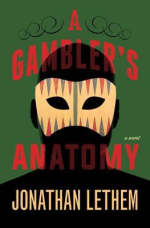
With A Gambler’s Anatomy, Jonathan Lethem has written yet another quite ambitious novel that challenges American fiction’s low tolerance for thinking-as-art. This now makes four in a row that have either risked sinking from bravura and scope or have appeared too light and clever on the surface to be matched seriously with earlier feats. For instance, rather than Chronic City being a kitschy map for traversing Web-dominant culture, it tries to salvage what’s left of the literary and humane while honoring skeptical avant-garde traditions that inherently distrust the novel form.

Up until The Fortress of Solitude, admirers could content themselves, to a degree, with parodied tributes and deconstructions of old styles without having to imagine the positive role Lethem charted for novels in the future. As described in his essay on White Elephant and Termite postures attempted as a novelist, his books in recent years puzzle through this dialectic of positive and deconstructive values, and A Gambler’s Anatomy continues the course.

Author interviews support a first impression that Gambler was quickly dashed off, except that at least two of its long scenes appear as carefully worked as any section of the previous “big books,” Dissident Gardens (2013) or Chronic City (2009). A better way of setting A Gambler’s Anatomy apart from the other two is by noting the more surfacy, cinematic strategy of the prose.

more here.

Not drowning but suffocating

Edward Lucas in More Intelligent Life:

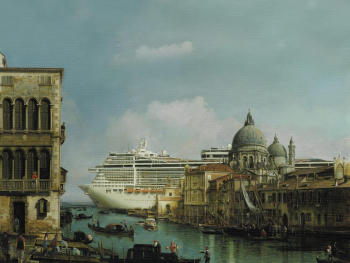
VeniceSome cities you go to for the galleries, some for the restaurants, some for the nightlife. You visit Venice to stroll through the alleys, bridges and squares that make up the most beautiful public space in the world. The walk that is richest in architectural delights and historical significance follows the route from the Rialto Bridge to St Mark’s Square. The bridge was the hub of the trading empire that brought in the booty and paid for the city’s unique concentration of artistic masterpieces. The merchants of Venice hung around the bridge for information on promising deals and lost cargoes. “What news on the Rialto?” asks Shylock. Wiggle eastwards from the business district of the ancient city through the narrow passageways and sotoporteghi (alleys that pass through buildings) and you emerge through the great arch at the base of the 15th-century clock tower and into Venice’s political and religious heart – St Mark’s Square. The walk is a little more than half a mile, and shouldn’t take you longer than ten minutes. It will, though. Much longer. For during the warm months of the year the route is jammed with a slow-moving flotilla of tourists. Many are oblivious to those around them, having tuned out to listen to their guide through their headsets. You become wedged, unable to go forwards or back.

When rain falls and umbrellas sprout, which is often, new problems arise. Venetian alleys are wide enough to allow two people to pass comfortably – but not two umbrellas. Someone must give way. Venetians have rules for this: an informal arrangement whereby people drop and tilt their umbrellas in unison. But visitors don’t know these rules, so tourist umbrellas lock and fight. The pushing and shoving, the bags and the body odour quickly dispel the thrill of being in Venice. The city’s delicate mystery cannot survive the crush.

More here.

The artist as astronaut

Aleksandra Mir in Nature:

Probes-LiverpoolIn 2014, Aleksandra Mir began a journey into the unknown. The London-based artist started talking with scientists and engineers about space — a realm in which she was a complete novice. The result of Mir’s dive into the cosmos is Space Tapestry, a vast wall hanging 3 by 200 metres, hand-drawn — in collaboration with 25 young artists — with fibre-tipped pens on synthetic canvas. Inspired in part by the eleventh-century depiction of Halley’s Comet on the Bayeux Tapestry, the work unfolds like a giant graphic novel to explore the unfathomable distances of space, the quest for extra-terrestrial life, and the impact of space technology on humans – from observing Earth to the politics of space. As the piece goes on show at Tate Liverpool, UK, Mir talks about her quest to get under the skin of science.

Why did you choose this format for Space Tapestry?

I wanted to create an immersive environment, almost like a stage set. And I wanted to introduce a new aesthetic. Whenever you see a science illustration you get what I call the “sleazy aesthetic”: supposed to convey fact but made to seduce with their slickness, intense colours and airbrushed surfaces. There are other ways of picturing phenomena that can be as realistic. And some phenomena beyond our technologies or perception can also be portrayed poetically. This is where art becomes relevant to science. My original inspiration for the project was the 1066 Bayeux Tapestry. It features a very early portrayal of Halley’s Comet: you have this little group of characters staring out in horror and fascination, and there’s this simple line drawing of the comet. What was interesting to me is that it doesn’t look anything like an actual comet, but conveys a tremendous amount of scientific information – it has a direction, a velocity and luminosity – which makes it valuable for contemporary scientists. So this became the key to my ‘tapestry’: images with validity for the science community, but also treated in a very poetic, freestyle, emotive and personal way.

More here.

Wednesday Poem

ID Card

Write it down! I’m an Arab
My card number is 50000
My children number eight
And after this summer, a ninth on his way.
Does this make you rage?
I am an Arab.
With my quarry comrades I labor hard
My children number eight
I tug their bread, their clothes
And their notebooks
From within the rock
I don’t beg at your door
I don’t cower on your threshold
So does this make you rage?
Write it down!
I am an Arab.
I am a name with no honorific.
Patient in a land
Where everything lives in bursting rage
My roots were planted before time was born
Before history began

Read more »

Tuesday, August 1, 2017

A journalist uses statistics to uncover authors’ ‘cinnamon words’

Julia Franz at PRI:

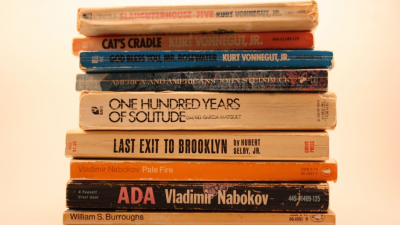
IMG_5471Nabokov’s Favorite Word is Mauve: What the Numbers Reveal About the Classics, Bestsellers, and Our Own Writing,” is a statistical analysis of famous books — and in it, Blatt uncovers some surprising facts about well-known writing.

For instance, did you know that the word “she” only appears once in J.R.R. Tolkien’s “The Hobbit”? Or that James Patterson averages 160 clichés per 100,000 words in his best-selling Alex Cross detective novels?

The statistical study of literature isn’t just trivia worthy: As Blatt points out in the book’s introduction, two statisticians in the 1960s used word frequency and probability to pinpoint the authors of "The Federalist Papers," which had been a mystery since 1787. Blatt wanted to apply a similar analysis to a larger body of literature, to get a better understanding of how great books — and less-great ones — are constructed.

“One thing that made this book possible is that writers are consistent from book to book and really years and decades later,” he says. “It's not that in one book they write one way, in one book they write another way. There are some words and patterns and techniques that they use that are remarkably consistent over the course of their life.”

In the book, Blatt refers to these patterns as an author’s “stylistic fingerprint.” In one line of inquiry, he dusts for prints by calculating famous authors’ favorite words — the terms they use “at an extreme ratio” compared to other writers. He calls them “cinnamon words,” after an anecdote about the novelist Ray Bradbury.

More here. [Thanks to Anjuli Fatima Raza Kolb.]

We assume that microbes evolved to attack humans when actually we are just civilian casualties in a much older war

Ed Yong in Aeon:

ScreenHunter_2774 Aug. 01 20.37The classic novel by H G Wells, The War of the Worlds (1898) – a tale of England besieged by Martian conquerors – ends not with a rousing and heroic victory but an accidental one. The aliens subjugate humanity with heat rays and black smoke but, at the height of their victory, they die. Their machines come to a standstill amid the ruins of a deserted London, and the birds pick at their rotting remains. The cause of their downfall? Bacteria. As the novel’s unnamed narrator says, they were ‘slain, after all man’s devices had failed, by the humblest things’.

Wells’s logic was simple. Humans have immune systems that protect us from the infectious germs that we’ve been exposed to since our earliest origins. We still get diseases, but at least we can put up a fight. The Martians, despite their technological superiority, could not. ‘There are no bacteria in Mars,’ the narrator explains, ‘and directly these invaders arrived, directly they drank and fed, our microscopic allies began to work their overthrow.’

When I first read the book about two decades ago, this final twist seemed like a cop-out. It comes out of nowhere – a sort of deus ex microbia rescue – and, besides, Earth’s microbes could not possibly grow in an alien body. But more recently, I have come to realise that Wells, writing at the close of the 19th century, was inadvertently hinting at a truth about bacteria that even today’s microbiologists sometimes forget: these organisms can become lethal through evolutionary accidents.

More here.

Not all politics is identity politics

Kenan Malik in Pandaemonium:

Serena-winther-self-portrait-1‘All politics is identity politics.’ And ‘Without identity politics there can be no defence of women’s rights or the rights of minority groups.’ So run the two most common contemporary defences of identity politics. As criticism of the politics of identity has become more developed and fierce, so has the defence. So, I want here to begin a critique of the critique, as it were, and in so doing reassert the necessity for challenging identity politics.

Identities are, of course, of great significance. They give each of us a sense of ourselves, of our grounding in the world and of our relationships to others. At the same time, politics is a means, or should be a means, or taking us beyond the narrow sense of identity given to each of us by the specific circumstances of our lives and the particularities of personal experiences. As a teenager, I was drawn to politics because of my experience of racism. But if it was racism that drew me to politics, it was politics that made me see beyond the narrow confines of racism. I came to learn that there was more to social justice than challenging the injustices done to me, and that a person’s skin colour, ethnicity or culture provides no guide to the validity of his or her political beliefs. Through politics, I was introduced to the ideas of the Enlightenment, and to the concepts of a common humanity and universal rights. Through politics, too, I discovered the writings of Marx and Mill, Baldwin and Arendt, James and Fanon. Most of all, I discovered that I could often find more solidarity and commonality with those whose ethnicity or culture was different to mine, but who shared my values, than with many with whom I shared a common ethnicity or culture but not the same political vision.

Politics, in other words, did not reinforce my identity, but helped me reach beyond it. If I was growing up today, though, it is quite possible that my political education would be much narrower, because it would be shaped primarily by my personal identity and experience, rather than providing a means of transcending it; because all politics has, for so many, come to be seen as identity politics.

To understand the characteristics of contemporary identity politics, we need first to go back to the origins of modern politics, at the end of the eighteenth-century.

More here.