How Putin came to rule the Middle East

John R. Bradley in The Spectator:

Putin-coverWhen Russia entered the Syrian civil war in September 2015 the then US secretary of defense, Ash Carter, predicted catastrophe for the Kremlin. Vladimir Putin was ‘pouring gasoline on the fire’ of the conflict, he said, and his strategy of fighting Isis while backing the Assad regime was ‘doomed to failure’. Two years on, Putin has emerged triumphant and Bashar al-Assad’s future is secure. They will soon declare victory over Isis inside the country. The dismal failure turned out to be our cynical effort to install a Sunni regime in Damascus by adopting the Afghanistan playbook from the 1980s. We would train, fund and arm jihadis, foreign and domestic, in partnership with the Gulf Arab despots. This way we would rob Russia of its only warm-water naval base, Tartus, on Syria’s Mediterranean coast. In the process we would create a buffer between Iran and its Lebanon-based proxy, Hezbollah, to divide the anti-Israel Shia axis. And we would further marginalise Iran by extending the influence of our Sunni Gulf allies from Lebanon deeper into the Levant. Half a million Syrians were slaughtered as a consequence of this hare-brained scheme, which geo-politically has resulted in the exact opposite of the intended outcome.

Putin, though, had grasped the reality at the outset. Unlike Afghans, ordinary Syrians were used to living in a liberal, diverse culture that, while politically repressive, championed peaceful religious co-existence. Most of them were nervous about seeing their country transformed into a Wahhabi theocracy. Assad, for all his faults, was the buffer between them and internecine carnage. They stuck with the devil they knew, and there was no popular revolution against Assad — nothing compared to the Tahrir uprising that ousted the hated Egyptian dictator Hosni Mubarak. The millions-strong demonstrations in Damascus were pro-regime. Among the two-thirds of the Syrian population now living in government–controlled parts of the country, Assad is more popular than ever, and Putin is a hero.

Small wonder Putin recently mocked Washington for ‘not knowing the difference between Austria and Australia’.

More here.

Saturday, October 7, 2017

The cosmological constant and the creation of the universe

Thanu Padmanabhan in Nautilus:

ScreenHunter_2850 Oct. 07 16.56There are two tantalizing mysteries about our universe, one dealing with its final fate and the other with its beginning, that have intrigued cosmologists for decades. The community has always believed these to be independent problems—but what if they are not?

The first problem has to do with the existence of something called “dark energy,” which is today accelerating the expansion of the universe and will determine its final fate. Theorists tell us that the effects of dark energy can be explained by introducing a term into Einstein’s equations of gravity called the cosmological constant. But, for this explanation to work, the cosmological constant must have a very specific—and tiny—value. In natural units, the cosmological constant is given by 1 divided by a number made of 1 followed by 123 zeros! Explaining this value is considered one of the greatest challenges faced by theoretical physics today.

The second problem relates to another crucial number that shapes our universe, and is related to the formation of structures like galaxies and groups of galaxies. We know that the early universe, while being very smooth, also contained tiny fluctuations in density that acted as seeds for all the cosmic structures we see today. These fluctuations must have a specific magnitude and shape to be consistent with present-day observations. Understanding how these tiny fluctuations were created during the earliest stages in the evolution of the universe, and explaining their magnitude and shape, is an equally fascinating mystery in cosmology.

In the conventional approaches to cosmology, these two numbers—the numerical value of the cosmological constant and the magnitude of initial perturbations—are considered unrelated.

More here.

FOLLOWING THE PEREGRINE

The-peregrine-bakerAdam Kosan at The Quarterly Conversation:

Baker tells us that he followed peregrines for ten years, and that his book is the record of one season’s pursuit, lasting October to April. In fact his book is a compression of ten years of experience and observation into a focused period of mystical journeying toward the outward edge of things. It’s a quest poem in prose, but lacking the human-centered incidents typical of quest poems and fiction, and with an unusual reticence. Not only does the narrator say nothing about his life or his past, he also abstains from the contemplative involvement of, say, the narrator in Walden. He is shorn of biography, austere like Wallace Stevens’s snow man: moving through isolation, stopping for long periods to observe what occurs apart from him, aware of the breath that leaves the heat of his body for the cold of the land. The action, so to speak, emerges around the falcon and Baker’s dogged pursuit of it. When he provides rare self-portraits of himself as pursuer, he appears like one of the slinking creaturely specters of Beckett’s fiction: “I crept towards them along a dry ditch, inching forward like the tide. I crawled across stubble and dry plough.” He aims to achieve alarm-dissipating invisibility: “Hood the glare of the eyes, hide the white tremor of the hands, shade the stark reflecting face, assume the stillness of a tree.”

If this is a grail poem, though, why does Baker chase the falcon? It’s not to capture or tame it, and certainly not to kill it. He wishes to join it, but even in moments of greatest identification, when his language shifts from metaphor and longing into consummation, it isn’t long before the dream of union breaks up: “I shut my eyes and tried to crystallise my will into the light-drenched prism of the hawk’s mind.

more here.

the Renaissance gossip of Giorgio Vasari

Giorgio_Vasari_SelbstporträtMichael Dirda at the Washington Post:

Today, Giorgio Vasari (1511-1574) is usually remembered only as the author of “The Lives of the Most Excellent Painters, Sculptors, and Architects,” one of the foundational works of art history and a book nearly as entertaining as its models, Plutarch’s “Lives of the Noble Grecians and Romans” and Suetonius’s “Lives of the Caesars.” In its fullest edition, Vasari presents gossipy biographical portraits of seemingly all of Renaissance Italy’s major (and minor) artists, including Cimabue, Leonardo, Botticelli, Raphael, Titian and Michelangelo.

As Ingrid Rowland and Noah Charney remind us in “The Collector of Lives,” scholars still turn to Vasari as a primary source, albeit with caution: He is hardly what one would call impartial or disinterested. Vasari badmouths his enemies (such as Cellini), while his novella-length account of Michelangelo approaches hagiography. Moreover, rather than verify his facts, he tends to “print the legend.” Did the young Giotto really draw a perfect O when asked to supply an example of his work? Did Piero di Cosimo really live almost entirely on hard-boiled eggs? Maybe, maybe not. Some stories are too good to check. Rowland lives in Rome and is the author of a fine biography of the philosopher Giordano Bruno and of a guide to Pompeii ; Charney, who resides in Slovenia, founded the Association for Research Into Crimes Against Art.

more here.

Why Harvey Weinstein’s apology is so hard to believe

Amanda Marcotte in Salon:

WeinsteinI don't buy Harvey Weinstein's apology. I realize this isn't really a novel opinion, as social media is burning up with people mocking the statement he released to the New York Times after Times reporters Jodi Kantor and Megan Twohey published an exposé chronicling decades of allegations of sexual harassment against the renowned studio executive. Still, it's an opinion worth explicating because the excuses that Weinstein trots out in his statement are the kinds of excuses that sexual harassers and abusers all too often get away with, even in the 21st century. Weinstein is trying to gaslight us all. An insincere apology is no apology at all, and people should not accept it. "I came of age in the 60’s and 70’s, when all the rules about behavior and workplaces were different. That was the culture then," Weinstein wrote. "I have since learned it’s not an excuse, in the office — or out of it. To anyone." First, if it's not an excuse, then why offer it up as one? Second, the claim that he didn't know any better is particularly hard to believe in light of the eight legal settlements — that we know about — uncovered by the Times. After you have repeatedly paid out hundreds of thousands of dollars to women who say you have behaved inappropriately, that might have been a clue that something was wrong. But mostly, the whole "I didn't know better" claim, common to sexual harassers, needs to be understood as the nonsense that it is. Sexual harassers know better. They know it's wrong. They know their behavior upsets women.

That's why they do it.

A lot of sexual harassers want to pass off their behavior as merely awkward or unwelcome advances, knowing that draws sympathy. Who among us hasn't flirted with someone who didn't flirt back? Who hasn't worried about asking someone out for fear of rejection? That's how the harassers want you to imagine them: hapless Romeos, guilty not of being cruel but of having no game. Well, don't believe it. As most women who've been targeted by creeps — which is most women, by the way — can tell you, what is usually obvious is how much of the creep's pleasure depends on knowing he's making you uncomfortable. The stories relayed by women to the Times reporters suggest that's the case here. Many of the women describe Weinstein making excuses to get them alone in a hotel room. Making sure there are no witnesses to the behavior doesn't suggest a well-meaning guy who doesn't know better, but someone who knows exactly what he's doing and how he plans to get away with it.

More here.

Kazuo Ishiguro: a novelist for all times

John Mullan in The Guardian:

IshiA few years ago in a panel discussion at a literary festival I was asked to name a recent British novel that readers and critics would still be talking about in a hundred years’ time. On the spur of the difficult moment I plumped for Kazuo Ishiguro’s Never Let Me Go. Only as I tried to explain my choice did I realise why I had given this answer. It was not just a novel I enjoyed and admired, it was also a novel that enacted something elementary and elemental: a human’s need to imagine his or her origins. The Swedish Academy has made some dubious – and last year attention-seeking – decisions in recent years, but this year its 18 voters have got it right. While the choice has come as a surprise to some – Ishiguro at 62 is relatively youthful; he was not on the list of bookies’ favourites being touted in the press – in literary fact it is not. The Nobel prize for literature, according to the official wording, is for “the most outstanding work in an ideal direction”. Translated from the original Swedish, it is an awkward phrase, but does suggest something important: that the prize should reward universality rather than topicality, literature about the way we always live, not just the way we live now. Ishiguro’s novels step aside from contemporary mores and pressing social issues. Audaciously, sometimes bewilderingly, they abstract us from our times.

How brilliant it is that Never Let Me Go opens with a page that says only “England, late 1990s”. Narrated by a young woman who is a clone, created, like her fellow clones, to provide organs for those requiring transplant surgery, it takes place in a version of Britain both cosily provincial and utterly strange. The countryside, the liberal boarding school, the English seaside town have never made for such a disturbing backdrop. Similarly, the novel that made him famous, The Remains of the Day, took a character familiar from a hundred English books and films – the butler in a country house – and gave him a narrative of painstaking evasiveness. For all the teasing period detail, it was a novel about human self-denial and self-deception at any time and in any place.

More here.

How Morton Feldman’s music inspired the architecture of this major new arts complex at Princeton

Raphael Mostel in Architectural Record:

Holl-Princeton-Arts-01Steven Holl frequently seeks ideas in the Architectonics of Music, and as a composer I consulted on the Lewis Arts Complex.

Visiting the finished building now, I see the ideas of Morton Feldman’s music everywhere in Steven’s magnificent realization—and not just in the rugs of the Music Building that reproduce the graphic notation of Feldman’s early works. Steven’s architecture embodies the spirit of Feldman’s expansive and mystical late works.

Although written in conventional notation and with great precision, Feldman’s late compositions direct attention away from the tick-tock that keeps most music earthbound. They likewise eschew amorphousness. Likewise Steven’s designs disdain both quotidian regularity and deliberate disorientation.

Feldman achieves a ‘tapestry of sound’ not only in the multi-layered terms of harmony, but also in the more profound sense as a totally integrating force of expanding self-referential relationships, weaving and knotting ever widening loops, through sequences with repetitions and near-repetitions. Each note always in relation to many others, and the group relation always clearly related to a larger perspective, and an even larger perspective in turn. By this musical alchemy every individual note gains an almost physical presence and sense of integrity as a participant in emergent patterns and then patterns-in-patterns, even with altered positioning in these patterns.

More here.

Friday, October 6, 2017

Is The Painting Counting?

Morgan Meis in The Easel:

Johns1To grasp the excitement (positive and negative) produced by Jasper Johns’s flag and target paintings of the mid- to late 1950s, you have to consider the situation of American painting at the time. That means thinking about Abstract Expressionism. In the mid-1950s, Barnett Newman was still making his zips. Willem de Kooning was churning out shake-and-bake canvases filled with his signature dancing shapes and colours. Jackson Pollock, alas, was dead by 1956, but his all-over-the-canvas drip paintings had become standard-bearers for what ‘serious painting’ should look like. The Ab Exers more or less held sway.

They held sway partly because they were producing visually stunning work, and partly because they were able to express, in both words and paint, a powerful sense of artistic urgency. Abstract Expressionists were given to asking big questions like: what does painting do? Is painting about itself? Should painting reproduce what we see in the world, or does it, rather, ‘express’ something in the mind or soul of the painter? Does painting reach beyond the visual into the fundamental building blocks of reality, be those mental, physical, or spiritual?

Painting in America in 1955 was, in short, a heady affair. To be a painter was to have accepted a kind of ideological calling. In 1943, Mark Rothko, Adolph Gottlieb and Barnett Newman wrote a short manifesto in the form of a letter to the art editor of the New York Times in which they claimed: ‘to us art is an adventure into an unknown world, which can be explored only by those willing to take the risks.’ They also wrote: ‘It is our function as artists to make the spectator see the world our way not his way.’1 Rothko, Gottlieb and Newman wanted serious painting to fly in the face of everyday perception. Standing in front of one of Newman’s imposing zips, one is inclined to feel that the painting hovers at the very edge of what the mind can grasp.

More here.

Reality is an Activity of the Most August Imagination: A Conversation With Tim O’Reilly

Tim O'Reilly at Edge.org:

51qYUTqxKOL._SX328_BO1 204 203 200_The thing I've been struggling with is understanding the relationship of technology and the economy. There's a narrative today about AI eliminating human jobs, and it's pretty clear to me, based on history, that it's wrong. History teaches us that if we use technology correctly, we increase productivity. The fundamental questions that we're facing today are not about how technology will inevitably put people out of work, they're questions about how to distribute the fruits of that productivity, and what we have to do differently in order to get a different outcome than the one we’re facing now.

We seem to be in the throes of technological determinism. The future is determined by the choices we make. If you look at the history of how we've dealt with past technological revolutions, there's been a social conscience that arose where we decided to change the way our society works.

I'm trying to figure out how to change the rules of the game and get people to think differently about the future. It's pretty clear to me that there is plenty of work to be done that technology can help us with, huge problems to be solved. What's keeping us from putting today's technology to work on those problems and instead forcing us to spend time on so much triviality? In particular, I'm thinking a lot about the kind of advice I as a technologist could give to policymakers, people in Washington, or Brussels, or China—to say, "Here's what you ought to be doing; here's what the real path of technology teaches us; here are the choices that you should be setting up for our society; this is the kind of leadership that you should be exerting."

More here.

American Crackup: Why Our Politics Are Broken

Harvey Silverglate at the website of WGBH:

The_age_of_trump_article2Are you as confused as I am by what passes for political commentary and analysis? Is there anybody who understands the current political mood of the nation, much less is able to figure out who is on what side? Why is the tension between left and right so vicious, so disorienting and disabling? Why do members of Congress have such difficulty “crossing over the aisle,” something that was so common as recently as the 1980s when Republican President Ronald Reagan and Democratic Speaker of the House Thomas P. (“Tip”) O’Neill, Jr., famously dined and joked together regularly? Does it all make any sense?

It makes perfect sense if one abandons the long-outmoded notion that the nation is divided into Democrats and Republicans or into liberals and conservatives. In fact, the body politic these days is divided into no fewer than four general sectors – five, if one deems the libertarians to be a discrete category.

The impact of this division is best understood by examining the warring camps in an actual case that has set left against right – the struggle over whether transgender students should be allowed to use the school restrooms of their chosen gender identity rather than their biological sex as recorded on their birth certificates.

More here.

Michel Houellebecq as visual artist

ArticleMathieu Malouf at Artforum:

In accordance with his deep and well-documented admiration for Arthur Schopenhauer and Auguste Comte, Houellebecq says that his visual art, like his novels, is an attempt to “tell the truth about the world.” Once past the almost complete absence of ambiguity in his work, the viewer may find something very refreshing in his overbearingly earnest, intently reactionary craft as an artist, which serves as a severely executed extension of his poetry in the visual realm. The photographs of crumbling highway exchanges, rotted-out monuments, and monumental office towers in Houellebecq’s visual art become fully sincere Baudelairean signifiers of a European civilization in decline, expressions of a soul in deep pain and in search of meaning; he has referred to their effect as “visual electricity.”

The first gallery of “French Bashing” was lit only by framing projectors illuminating individual aluminum-mounted digital prints. A lot of what was on display here looked like badly plotted airport ads, but the presence of these works in a gallery setting evoked that strain of contemporary art in which Photoshop looms large, Simon Denny’s mass-produced canvases being among the most obvious examples. Mission #001, 2016, reassembles an oversize printout of a Tumblr meme dripping with teenage angst. VOUS N’AVEZ AUCUNE CHANCE (You don’t stand a chance), reads a sentence superimposed on a grim, grayscale view of a small town from a plane window. CONTINUER? Underneath, a solitary OS X–style “OK” button seals the deal. Life must go on despite the fact that it is painful, albeit less painful than finding the strength to kill yourself.

more here.

the myth-making around freud

D015b348-a8ff-11e7-b9a3-2cac9d6c85bd4Antonio Melechi at the TLS:

Contrary to the heroic folklore served up by Ernest Jones, Anna Freud and the other faithful apparatchiks, psychoanalysis had rarely, if ever, involved any kind of attentive listening on Freud’s part. In fact, as Frederick Crews convincingly demonstrates in Freud: The making of an illusion, the talking cure was from its very beginnings deaf to its clientele. The inconvenient “rabble” that made their way to Berggasse 19 impinged on Freud’s time to write and theorize, reaffirming his misanthropic contention that “few patients are worth the trouble we spend on them”.

One of America’s foremost critics and essayists, Crews fell under the sway of psycho­analysis in the late 1950s. Once Henri Ellenberger and other psychiatric historians began to unpack the founding myths of psychoanalysis, showing Freud’s breakthrough “self-analysis” to be as questionable as his proprietary attitude to “the unconscious”, Crews’s position – and register – shifted. Aligning himself with Adolf Grünbaum’s anti-inductivist critique of psycho­analysis, he threw his hat in with the small band of academics whose critical assault on Freud was revitalized by the publication of his most disarming correspondence with Wilhelm Fliess.

more here.

The Short Daring Life of Lilya Litvyak

2tfx2vr-1024x679Edward White at Paris Review:

During her several months of training, Litvyak took every opportunity to assert her individuality. First, she refused to have her light brown curls cut short like all the other recruits. When she finally relented, she got hold of peroxide to bleach her hair white-blonde. When handed her standard-issue uniform, she customized it with a glamorous fur collar, an offence for which she was, briefly, arrested. It may seem odd that Litvyak felt so free to express her sense of agency given that she was forever being watched, not only by her military superiors, but by agents of party and state. Yet, despite the horrors it brought, many Soviet citizens experienced the war as an oasis of (relative) freedom, when one could speak and act without worrying about toeing the party line. “To think,” the writer Nadezhda Mandelstam acidly remarked to her friend Anna Akhmatova, “that the best years of our life were during the war when so many people were killed, when we were starving, and my son was doing forced labor.” Ivakina branded Litvyak “a swanky, flirtatious, aviatrix.” It was meant to be a lacerating indictment, but if she’d been asked to describe herself in three words, Litvyak might’ve plumped for the same ones.

Despite Ivakina’s reservations, Raskova felt that Litvyak’s obvious flaws were outweighed by her instinctual brilliance in the air. It was a rare gift that no amount of training could provide. Nothing threatened Litvyak’s place in Air Group 122, not even the revelation that she had lied on her application form and grossly overstated her experience as a pilot .

more here.

How to Obfuscate

Finn Brunton and Helen Nissenbaum in Nautilus:

AirplaneDuring World War II, a radar operator tracks an airplane over Hamburg, guiding searchlights and anti-aircraft guns in relation to a phosphor dot whose position is updated with each sweep of the antenna. Abruptly, dots that seem to represent airplanes begin to multiply, quickly swamping the display. The actual plane is in there somewhere, impossible to locate owing to the presence of “false echoes.” The plane has released chaff—strips of black paper backed with aluminum foil and cut to half the target radar’s wavelength. Thrown out by the pound and then floating down through the air, they fill the radar screen with signals. The chaff has exactly met the conditions of data the radar is configured to look for, and has given it more “planes,” scattered all across the sky, than it can handle. This may well be the purest, simplest example of the obfuscation approach. Because discovery of an actual airplane was inevitable (there wasn’t, at the time, a way to make a plane invisible to radar), chaff taxed the time and bandwidth constraints of the discovery system by creating too many potential targets. That the chaff worked only briefly as it fluttered to the ground and was not a permanent solution wasn’t relevant under the circumstances. It only had to work well enough and long enough for the plane to get past the range of the radar.

Many forms of obfuscation work best as time-buying “throw-away” moves. They can get you only a few minutes, but sometimes a few minutes is all the time you need. The example of chaff also helps us to distinguish, at the most basic level, between approaches to obfuscation. Chaff relies on producing echoes—imitations of the real thing—that exploit the limited scope of the observer. (Fred Cohen terms this the “decoy strategy.”2) As we will see, some forms of obfuscation generate genuine but misleading signals—much as you would protect the contents of one vehicle by sending it out accompanied by several other identical vehicles, or defend a particular plane by filling the sky with other planes—whereas other forms shuffle genuine signals, mixing data in an effort to make the extraction of patterns more difficult. Because those who scatter chaff have exact knowledge of their adversary, chaff doesn’t have to do either of these things.

TrackMeNot, developed in 2006 by Daniel Howe, Helen Nissenbaum, and Vincent Toubiana, exemplifies a software strategy for concealing activity with imitative signals.

More here.

Thursday, October 5, 2017

My advice for successful writing: ditch the guidebooks

Oliver Kamm in The Times of London:

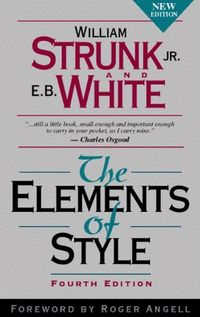
51q3tYpGjnLAlmost at random, I pick from my shelves the celebrated American manuals The Elements of Style by William Strunk and EB White and On Writing Well by William Zinsser, along with On Writing by the bestselling author Stephen King and Do I Make Myself Clear? by the former newspaper editor Sir Harold Evans. All say the same thing: omit needless words, avoid the passive voice, and cut out adjectives and adverbs.

The hollowness of this advice is inadvertently demonstrated by the authors themselves, for in giving it (and apparently without realising it) they extensively employ the passive voice along with adjectives and adverbs. “Adverbs, like the passive voice, seem to have been created with the timid writer in mind,” writes King (the words I’ve italicised are a passive clause). Most adjectives are “unnecessary”, declares Zinsser, using the adjective unnecessary. Adjectives are “seductive”, warns Evans, using the adjective seductive. “With adverbs,” continues King, “the writer usually tells us he or she is afraid he/she isn’t expressing himself/herself clearly, that he or she is not getting the point or the picture across” — using the adverbs usually, clearly and across.

See what I mean? Even famous writers aren’t necessarily able to explain good writing or even understand grammatical categories.

More here.

Mass Killings: An Evolutionary Perspective

Robert J. King in Psychology Today:

(Typically, I wait until our work has gone through peer review before blogging about it. This work is technically in review at the moment, but several people (including journalists) have asked about it for reasons that will shortly become obvious.)

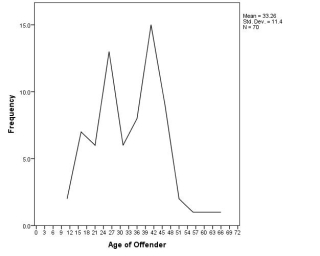
Age_distribution_of_spree_killersMass killings are unusual events but devastating when they occur. Although the absolute risk of dying at the hands of such a killer is low, people stubbornly refuse statisticians’ earnest assurances of relative safety. This should not surprise us. Mass killings are, among many other things, a deliberate attempt to drive a wedge into the existing social order. That is why they are public, and why the killer seeks to maximise attention, and rarely seeks to escape. Some of these motives are obviously political—the intent is to sow fear and destabilize government–and I am not going to have anything much to say about those. What about people with more individual motives?

Attention to our evolved natures can cast some light on this. (1) Notice I say some light. The evolutionary perspective adds depth to existing accounts—it is an “added value” aspect of psychology, not a replacement for other—more local—explanations such as individual pathology, or why a location or victim was chosen.

I’ve likened the evolutionary account of a trait, to knowing the etymology of a word. For instance, knowing that the origin of the word “lemur” (those beautiful dark-eyed primates) comes from the Latin for “spirits of the dead” adds something to our understanding of the word. Not everything. Something. Sorry to have to keep saying this but, well, apparently I have to keep saying this. Let’s move on.

More here.

At the core of the war in Syria

Bente Scheller at the Heinrich Böll Stiftung:

ScreenHunter_2849 Oct. 05 20.36Those of you who visited Syria before 2011 may tend to remember their journeys as fondly as I do: A country in which buildings from a variety of eras bear witness to a long history of many peoples and religions. The old town of Damascus in which the Umayyad mosque rises atop the foundations of the ancient Roman temple of Jupiter, an environment characterised by tradition in which people, in between prayer calls and church bells, go about their everyday lives which in turn could be thought to have emerged from the tales of the Arabian Nights.

Engulfed by the scent of jasmine and cardamom coffee, a foreigner can easily forget about the dark side of Syrian life. Syria was not only a country in which you could positively feel the heartbeat of thousands of years of ancient societies, but also a state in which the most enormous security apparatus in the Middle East virtually strangled its citizens.

The widely praised peaceful coexistence of religions was certainly no feat of Hafez al-Assad who had gained hold of power in the country by means of a coup in the 1970s. It was rather a characteristic of Syrian history without which so many small and minuscule communities of different religious affiliations could never have developed and persisted.

Yet his grasp for power brought on a religio-political issue for Hafez al-Assad.

More here. [Thanks to Idrees Ahmad.]