Saturday Poem

Racists

Vas en Afrique! Back to Africa! the butcher we used to patronize in the
Rue Cadet market,
beside himself, shrieked at a black man in an argument the rest of the
import of which I missed
but that made me anyway for three years walk an extra street to a shop
of definitely lower quality
until I convinced myself that probably I'd misunderstood that other thing
and could come back.
Today another black man stopped, asking something that again I didn't
catch, and the butcher,
who at the moment was unloading his rotisserie, slipping the chickens
off their heavy spit,
as he answered—how get this right?—casually but accurately brandished
the still-hot metal,
so the other, whatever he was there for, had subtly to lean away a little
so as not to flinch.

C.K. Williams
from Selected Poems
Harper Collins, 1994
.

Mobile magnates

Eve Watling in The Economist:

VIN_02_inlineGrowing up in a conservative suburb of Toronto, Bella McFadden stood out. “Everyone in my high school was either a football bro or a basic girl that only shopped at the mall,” she says. In her second-hand chequered trousers and velvet dresses, paired with purple lipstick and a choker, she looked like she was from a different planet. Short of local soulmates, she turned to social media. Under the handle @internetgirl, she built up a large following that shared her passion for retro, thrift-shop fashion. “I loved my friends that I would make online, because I didn’t have friends in my day-to-day life,” she says.

Two years ago, Bella dropped out of college and began monetising her social-media presence on Depop, an app on which people trade second-hand clothes. At 22 years old, she has amassed close to half a million followers on Depop, placing her consistently in the platform’s top ten global sellers. She now employs two assistants, recently opened up her own website selling unworn second-hand stock, and has started her own fashion line. Fans often approach her in the street asking for autographs and selfies. The clothes that alienated the once-lonely teenager from her peers have built her an adoring fanbase and a career.In 2014, Bo Brearley returned to her parents’ home in London from university and discovered her favourite old jumper was missing. She confronted her 15-year-old sister, Eve. Eve confessed – she had sold it on Depop. Nearly four years on, Bo, now 22, hasn’t entirely forgiven her. “I loved that jumper!” she howls when she remembers it. Nevertheless, the sisters teamed up to create a shop on Depop called Past Trash, selling party clothes from the Nineties and early Noughties. It became the biggest selling Depop shop in the world in terms of volume of stock sold, shipping 500 items a week to everywhere from Barbados to Norway.

Depop was launched in 2011 when Simon Beckerman, an Italian entrepreneur, decided to make a new, hip online marketplace by creating an app that merged editorial and sales. “I realised most of the decision-making in buying fashion was through references,” says Beckerman, who had previously founded a youth-culture magazine and then a sunglasses brand. “I realised Depop needed to be social.” The team designed the app with Instagram-style features, with “follow” and “like” buttons, comments and chat, already familiar to social media users. Users download the app, make a profile, upload photos of clothes they want to sell, scroll through the “explore” page of items recommended by the Depop team, search for a specific item or browse their Facebook friends’ stores. When you buy an item, the individual seller is responsible for packaging and sending it to the buyer. Money changes hands through PayPal, or users can meet in person.

More here.

Friday, February 16, 2018

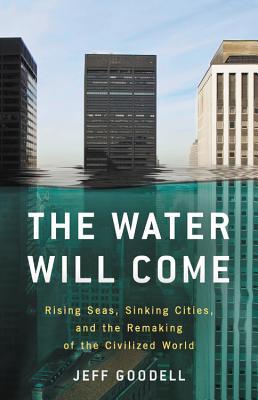
Rising Seas, Sinking Cities and the Remaking of the Civilised World

Meehan Crist in the London Review of Books:

34523152After Hurricane Sandy hit in 2012, I helped a friend in Brooklyn remove her car battery, put it in a backpack and lug it over to Wall Street. The subways were flooded, so we took a ferry across the East River to downtown Manhattan, where a muddy grey waterline cut across ground-floor walls and windows. The ocean had come and gone, and the mouldering streets were deserted. The air smelled of briny rot and the only sound was the industrial hum of generators pumping water from flooded basements. Orange accordion tubing snaked in and out of waterlogged buildings. We turned into the lobby of an apartment building where residents wandered in a commiserating daze and an exhausted man in uniform was laying out a plate of fresh fruit, presumably procured from somewhere far uptown, where people still had power and running water and the sudden absurdity of brunch. A paraplegic friend on an upper floor needed the car battery to help power her ventilator. The elevators were out of commission, so we walked up twenty narrow flights of stairs, lighting our way in the dark with torches. Inside the apartment, the friend and her roommate, also paraplegic, had abandoned their motorised wheelchairs and lay in their beds in a sunny front room, laughing and chatting. It wasn’t clear when the power would be back, but when things returned to normal they planned to have a party. I don’t think anyone in that room fully grasped, then, that the ocean would be coming back to stay.

Global sea level rise is hard for scientists to predict, but the trend is clear.

More here.

Transgender woman is first to be able to breastfeed her baby

Jessica Hamzelou in New Scientist:

Gettyimages-125979222A 30-year-old transgender woman has become the first officially recorded to breastfeed her baby. An experimental three-and-a-half-month treatment regimen, which included hormones, a nausea drug and breast stimulation, enabled the woman to produce 227 grams of milk a day.

“This is a very big deal,” says Joshua Safer of Boston Medical Center, who was not involved with the treatment. “Many transgender women are looking to have as many of the experiences of non-transgender women as they can, so I can see this will be extremely popular.”

The transgender woman had been receiving feminising hormonal treatments for several years before she started the lactation treatment. These included spironolactone, which is thought to block the effects of testosterone, and progesterone and a type of oestrogen.

This regimen enabled her to develop breasts that looked fully grown, according to a medical scale that assesses breast development based on appearance. She had not had any breast augmentation surgery.

More here.

What Explains U.S. Mass Shootings? International Comparisons Suggest an Answer

Max Fisher and Josh Keller in the New York Times:

ScreenHunter_2969 Feb. 16 23.41When the world looks at the United States, it sees a land of exceptions: a time-tested if noisy democracy, a crusader in foreign policy, an exporter of beloved music and film.

But there is one quirk that consistently puzzles America’s fans and critics alike. Why, they ask, does it experience so many mass shootings?

Perhaps, some speculate, it is because American society is unusually violent. Or its racial divisions have frayed the bonds of society. Or its citizens lack proper mental care under a health care system that draws frequent derision abroad.

These explanations share one thing in common: Though seemingly sensible, all have been debunked by research on shootings elsewhere in the world. Instead, an ever-growing body of research consistently reaches the same conclusion.

More here.

On the Polish Holocaust law debate

Eurozine-Liebich-AuschwitzAndré Liebich at Eurozine:

Until now, puncturing the belief in Polish innocence has been the work of academics, often located abroad, such as Jan Gross, a Princeton professor and former Polish dissident, and Jan Grabowski, a sometime specialist on native Americans now at the University of Ottawa, who has written about betrayal of the Jews by ethnic Poles during the War in selected areas of Poland. A narrow segment of the Polish intelligentsia is also experiencing pangs of conscience over the revelations of past Polish misdeeds, particularly since the publication of Gross’s book on the pogrom in the village of Jedwabne in 1941, almost two decades ago. This fraction of the intelligentsia is, in any case, not the electorate on which the governing party depends.

Loss of support from its main ally, the United States, is, however, a major source of concern. Poland relies upon Washington to shield itself from pressure from the European Union to which it belongs, and it founds much of its international legitimacy upon American approval of its policies. The Polish government’s efforts to curb international indignation – indignation commended by Nazi hunters as proper but selective given the woeful record of Holocaust revisionism in other post-Soviet countries – have been clumsy and unsuccessful. Most recently, Jarosław Kaczyński praised Israel and sought to condemn antisemitism, but blamed its recent upsurge on the enemies of Poland, ‘one can even say the devil’.

more here.

THE LIFE AND LEGACY OF THING

Article_largeSolveig Nelson at Artforum:

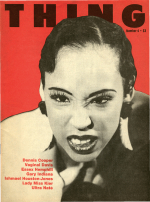
IN 1991, at “SPEW: The Homographic Convergence”— a showcase of queer zines, T-shirts, videotapes, and performance that took place at the Randolph Street Gallery in Chicago—Robert Ford described Thing as a “black gay and lesbian underground arts journal and magazine kind of thing.” The publication, which he founded in 1989 with Trent Adkins and Lawrence Warren, highlighted what Ford called a “black sensibility” in the underground. Published “capriciously”—typically every three or four months—it featured original interviews, writing, and photographs by artists, musicians, writers, activists, and performers from queer scenes across the US,including figures such as Vaginal Davis, RuPaul, Joan Jett Blakk, Lady Bunny, Willi Ninja, Dorian Corey, Essex Hemphill, Lyle Ashton Harris, and many others. “We knew for ourselves what a rich and important cultural thing gay black men have and share,” Ford later told the writer Owen Keehnen. “We wanted to make a magazine that would be a way of documenting our existence and contribution to society. Our idea was not so much [to] radicalize or subvert the idea of magazines as to make one from our own point of view.” This was a necessary intervention, Ford said at SPEW, because there was “so little of us in ‘mainstream media.’”

Thing’s title was in part a reference to self-organized, DIY culture, as in “do your own thing”; it sought in particular to build networks of “things” within and among underground cultures in Chicago and beyond. Ford described wanting to create alternative familial ties, inspired by the support he received from his parents and sister after he came out as gay.

more here.

Marilynne Robinson writes in defence of the American character in 2018

6f833578-1178-11e8-aa39-e7299ff3a5e84Marilynne Robinson at the TLS:

Europeans often say our culture is Puritan – Lollard, according to Freud – and we don’t know enough history to understand what they might mean by this. We have made a project of freeing ourselves of even minimal standards of taste or discretion, and still the word clings. Ethical rigor, aversion to display, the ideal of vocation are all diminished things among us, and still we are Puritan. Most recently I heard us denounced in these terms at a dinner table in London. How horrifying our rules against sexual harassment! It is the most natural thing in the world for students to fall in love with their professors, subordinates with their superiors! And so on. My suggestion that this might all seem very different from the perspective of the student or the subordinate, and my thoughts about fairness, merit, and so on, were not of interest. They were merely one more Puritanical pretext for denying the pleasures of life. I think in many cases Puritanical may simply mean “reformist,” tending to assume that even very settled cultural patterns and practices can be called into question, that they are not presumptively endorsed by culture, that what is traditional cannot claim therefore to be rooted in human nature. We tend to forget that our revolution was one in a series – Geneva expelled its Savoyard rulers and was governed by elected councils. The Dutch expelled the Hapsburg emperor and in the process trained sympathetic British volunteers who took the experience home with them. Then with the Puritan Revolution England tried and executed its king and attempted a decade of parliamentary government. More than a century later the American colonies rejected monarchy as a system on the basis of the abuses of the king then in power. This is not logical, strictly speaking, but it affiliated the Americans with the great precedent of the English revolution, the revolution of Milton and Marvell.

more here.

Friday Poem

13 bystanders

1

there are suitcases in my room
full of old photographs
packed and ready to go
i never want to see them again

2

the men who came to do the concreting
ripped out all my father’s boxing
he didn’t know that with an elephant truck
full of slurry
our driveway could be trumpeted in one

3

my mother’s engagement ring
with its four diamond twinkle
on the deciding finger of her nurse
to keep it or take it to a fence
or keep it

4

spending my inheritance
on this flight
as the greenarse gases
make life difficult for all of us
not in first class
unable to get up
or stretch

5

revisit my teacherly turn of the head
as i graded your story
and did not look back
at the stains on the sleeping bag
to see how they got there
and what you’d said

Read more »

Thursday, February 15, 2018

GUNS ARE ABOUT FREEDOM: OUR FREEDOM TO LIVE

David Byrne at his own website:

Rs-196218-481397697It’s not hopeless.

No matter what some of my friends seem to imply, I firmly believe we can have gun control and reduce gun violence in this country. Allow me to be optimistic. At this point, any cause for hope is worth considering.

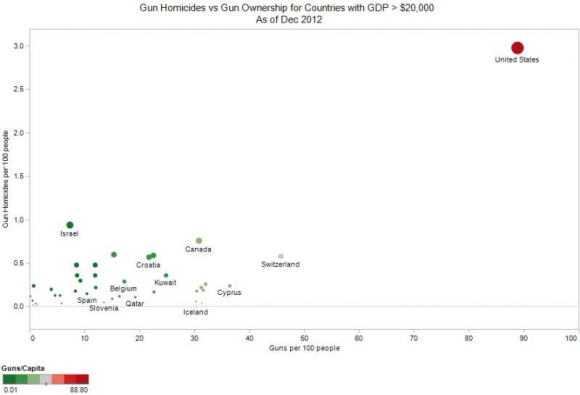
First off, I guess I have to be clear that I am for gun control. I believe the situation in the U.S. is unacceptable; more controls are necessary, and there is proof that they can work. Just look at the data. There is a staggering split in U.S. gun deaths and gun deaths in a host of other countries, as a New York Times report recently found. This is not news, but it bears repeating. They note that being killed by a gun in Germany is as common as being killed by a falling object in the U.S. Yet the results are pretty much the same, as the graph below from KD Nuggets shows:

Gun-homicides-vs-ownership-gdp-20k-large_800_545_60

We are at war here. Just look at those numbers. How could you conclude anything other than that we Americans are living in a war zone? More people die of violent gun-related deaths in Chicago than American soldiers in Afghanistan, a sad fact that has given the Second City an unfortunate nickname—one that inspired Spike Lee’s latest film. And just days after the rampage in Orlando, a columnist for the Philadelphia Daily News bought an assault weapon in 7 minutes.

More here.

INSIDE THE TWO YEARS THAT SHOOK FACEBOOK—AND THE WORLD

Nicholas Thompson and Fred Vogelstein in Wired:

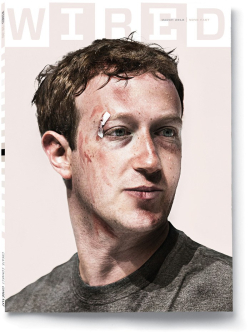
2603_cover_facebook_zuckerbergOne day in late February of 2016, Mark Zuckerberg sent a memo to all of Facebook’s employees to address some troubling behavior in the ranks. His message pertained to some walls at the company’s Menlo Park headquarters where staffers are encouraged to scribble notes and signatures. On at least a couple of occasions, someone had crossed out the words “Black Lives Matter” and replaced them with “All Lives Matter.” Zuckerberg wanted whoever was responsible to cut it out.

“ ‘Black Lives Matter’ doesn’t mean other lives don’t,” he wrote. “We’ve never had rules around what people can write on our walls,” the memo went on. But “crossing out something means silencing speech, or that one person’s speech is more important than another’s.” The defacement, he said, was being investigated.

All around the country at about this time, debates about race and politics were becoming increasingly raw. Donald Trump had just won the South Carolina primary, lashed out at the Pope over immigration, and earned the enthusiastic support of David Duke. Hillary Clinton had just defeated Bernie Sanders in Nevada, only to have an activist from Black Lives Matter interrupt a speech of hers to protest racially charged statements she’d made two decades before. And on Facebook, a popular group called Blacktivist was gaining traction by blasting out messages like “American economy and power were built on forced migration and torture.”

So when Zuckerberg’s admonition circulated, a young contract employee named Benjamin Fearnow decided it might be newsworthy. He took a screenshot on his personal laptop and sent the image to a friend named Michael Nuñez, who worked at the tech-news site Gizmodo. Nuñez promptly published a brief story about Zuckerberg’s memo.

More here.

Against National Security Citizenship

Aziz Rana in the Boston Review:

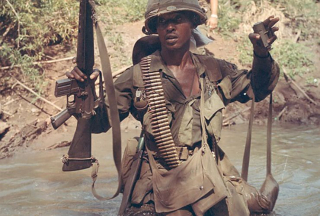
RanaVietnam_featureNo part of the vision statement for the Movement for Black Lives received as much immediate mainstream pushback as its stinging repudiation of U.S. foreign policy. Its demands, which included a call for military and security divestment, permanent opposition to the War on Terror, and a declaration of solidarity with Palestinians, generated criticism about specific policies (especially with respect to Israel and Palestine) and about the perceived disconnect between police brutality toward black citizens and U.S. military practices in distant lands. The implication was that by extending their vision beyond the national borders, black freedom activists were combining issues that were not inherently connected and better left to the security experts.

Moreover, critics were uncomfortable with the statement’s rejection of one of the most common mechanisms for outsider groups to gain inclusion in U.S. life: national security citizenship. By this I mean the idea that one shows one’s worthiness for membership by supporting—and being willing to fight and die for—the security policies of the state. To this day, the idea that oppressed groups earn inclusion through sacrifice on behalf of the state remains a potent one. Simply recall Bill Clinton’s effort during his 2016 Democratic National Convention speech to reach out to Muslims, a group that had been targeted and demeaned by Donald Trump’s campaign. “If you’re a Muslim and you love America and freedom and you hate terror,” Clinton offered, “stay here and help us win and make a future together.” Behind the rosy rhetoric, the clear implication was that Muslim’s rights were conditional on their support of U.S. security commitments and that such support was how Muslims cemented their status as Americans.

More here.

Thursday Poem

Dreams

in my younger years
before i learned
black people aren’t
suppose to dream
i wanted to be
a raelet
and say “dr o wn d in my youn tears”
or “tal kin bout tal kin bout”
or marjorie hendricks and grind
all up against the mic
and scream
“baaaaaby nightandday
baaaaaby nightandday”
then as i grew and matured
i became more sensible
and decided i would
settle down
and just become
a sweet inspiration

by Nikki Giovanni
from Black Feeling, Black Talk, Black Judgment
HarperCollins Publishers, 1968

The Lost World Between Scotland and England

Download (12)Alan Taylor at Literary Review:

Like the much-mythologised Wild West, the Debatable Land was terra nullius, where the writ of law was by and large ignored and bad men roamed at will. Situated where the northwest of England meets the southwest of Scotland, it was long an inhospitable, inhuman corner of the country: hilly, boggy, inaccessible and, five centuries and more ago, a tapestry of trees. The weather was similarly forbidding. When it rains in these parts, which it does more often than not, it is with torrential relentlessness.

Why anyone with a choice in the matter would want to live hereabouts is not easily explained. Graham Robb, whose books include biographies of Balzac, Hugo and Rimbaud as well as an innovative history of Paris, moved in 2010 from cloistered Oxford to a pile in the middle of nowhere. One of its former owners was Nicholas Ridley, of Northumbrian stock, who as a minister in the Thatcher government was responsible for launching the poll tax at his Scottish neighbours. As Robb writes, ‘The fact that Ridley had settled on the border itself was a kind of provocation, as was the title he chose for himself when he was created a life peer: Baron Ridley of Liddesdale.’

more here.

How Gordon Matta-Clark Saw the City

Matta-250x220Jillian Steinhauer at The New Republic:

In 1972, artist Gordon Matta-Clark began entering abandoned apartment buildings in the South Bronx and cutting holes in the floors. His cuts were strategic: neat rectangles whose clean lines contrasted with the decay around them, even as their geometry echoed nearby windows and door frames. They were also thorough: He sliced through all the layers of a given floor and removed the cutout section. In his black-and-white photographs of the series, Bronx Floors, a sunlit window can often be glimpsed through the freshly carved holes. The cuts appear as portals. They connect spaces above and below, inside and outside.

Matta-Clark knew how buildings were made. In the late sixties, he’d returned home to New York City from Cornell University, where he’d gotten an undergraduate degree in architecture. But he wasn’t interested in erecting more modernist monoliths. The buildings New York already had were crumbling, along with its infrastructure, and the city had neither the money nor the will to fix them. Matta-Clark knew firsthand the enormous cost of this neglect; his cousin died in 1973 when the Broadway building he lived in collapsed. In words that remain chillingly prescient, Matta-Clark identified the South Bronx as a neighborhood “where the city is just waiting for the social and physical condition to deteriorate to such a point that the borough can redevelop the whole area into the industrial park they really want.”

more here.

Why do white people like what I write?

41P-7PjUPDL._SX327_BO1 204 203 200_Pankaj Mishra at the LRB:

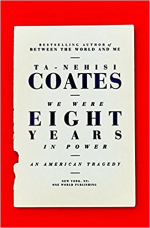
In many ways, Coates’s career manifests these collateral trends of progress and regress in American society. He grew up in Baltimore at the height of the crack epidemic. One of his own friends at Howard University in the 1990s was murdered by the police. Coates didn’t finish college and had been working and writing for small magazines when in 2008 he was commissioned by the Atlantic to write a blog during Obama’s campaign for president. Three books and many blog posts and tweets later, Coates is, in Packer’s words, ‘the most influential writer in America today’ – an elevation that no writer of colour could previously have achieved. Toni Morrison claims he has filled ‘the intellectual void that plagued me after James Baldwin died’. Philip Roth has been led to histories of American racism by Coates’s books. David Brooks credits him for advancing an ‘education for white people’ that evidently began after ‘Ferguson, Baltimore, Charleston and the other killings’. Even USA Today thinks that ‘to have such a voice, in such a moment, is a ray of light.’ Coates seems genuinely embarrassed by his swift celebrity: by the fact that, as he writes in his latest book, We Were Eight Years in Power, a collection of essays published in the Atlantic between 2008 and 2016, ‘I, who’d begun in failure, who held no degrees or credentials, had become such a person.’ He also visibly struggles with the question ‘Why do white people like what I write?’ This is a fraught issue for the very few writers from formerly colonised countries or historically disadvantaged minorities in the West who are embraced by ‘legacy’ periodicals, and then tasked with representing their people – or country, religion, race, and even continent (as in the New York Times’s praise for Salman Rushdie: ‘A continent finding its voice’). Relations between the anointed ‘representative’ writer and those who are denied this privilege by white gatekeepers are notoriously prickly. Coates, a self-made writer, is particularly vulnerable to the charge that he is popular among white liberals since he assuages their guilt about racism.

more here.