
Justin E. H. Smith in his blog:
 I was at an academic conference last week, somewhere in America, where we were invited by our hosts to place a ‘preferred pronoun’ sticker on our nametags. “If you could pick one of those up during the next break, we’d appreciate it.” The options were, ‘He’, ‘She’, ‘They’, ‘Ask Me’, and one with a blank space for a write-in. Coming from my adoptive France, I had heard of this new practice in my country of origin, but somehow I had convinced myself that it was mostly mythical. Yet there were the stickers, and there were all my fellow participants, wearing them with straight faces.
I did not pick one up. As is my practice at these events, I do not even wear the nametag that has been provided for me, so there would have been nothing to put the sticker on. But if there had been any direct and explicit pressure on me to wear one, rather than just a general announcement, I would have been constrained to explicitly refuse to do what was being asked of me. I would have been a conscientious objector.
In the future I will avoid meetings at which I know in advance, or I have a reasonable expectation, that there will be such stickers. I am strongly opposed to this convention, I think it is ridiculous and offensive, and I am only thankful that, for now, it is only a convention and not a compulsion. But the line is not so clear. It is not a compulsion for me to wear a sticker, because I am privileged and basically indifferent as to whether I ever get invited to an academic event again. The quality of my life is enhanced by not going to academic events, and reduced by going to them. If I can’t go because social pressure would require me to wear a sticker, well, tant mieux. But this is not the case for younger scholars who are precariously employed. It is in part for their sake that I feel the need to make explicit my opposition to this practice.
More here.
 As a system, art fairs are like America: They’re broken and no one knows how to fix them. Like America, they also benefit those at the very top more than anyone else, and this gap is only growing. Like America, the art world is preoccupied by spectacle — which means nonstop art fairs, biennials, and other blowouts. Yet the place where new art comes from, where it is seen for free and where almost all the risk and innovation takes place — medium and smaller galleries – are ever pressured by rising art fair costs, shrinking attendance and business at the gallery itself, rents, and overhead. This art-fair industrial complex makes it next to impossible for any medium/small gallery to take a chance on bringing unknown or lower-priced artists to art fairs without risking major financial losses. Meanwhile high-end galleries clean up without showing much, if anything, that’s risky or innovative.
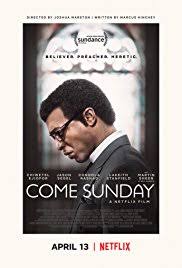 COME SUNDAY, A FILM RELEASED
 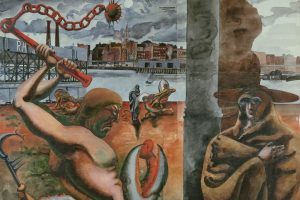 Each of the ensuing chapters of 12 Rules is a series of meditations – or, less kindly, digressions – leading up to its titular rule, presented as the solution to a problem revealed therein about life and how to make order out of chaos. The chaos is in turn presented as a universal, ahistorical fact about the nature of Being or human existence. Given all this, it is striking how many of the discussions reduce to advice about how to win at something, anything, nothing in particular: and how not to be a “loser”, in relation to others whose similarity to oneself is secured by the time-honoured narrative device of anthropomorphization, under a more or less thin veneer of scientism. Rule One is “Stand up straight with your shoulders back”, to avoid seeming like a “loser lobster”, who shrinks from conflict and grows sad, sickly and loveless – and is prone to keep on losing, which is portrayed as a disaster.
 The brutal truth of literary careers is that the reputation of most great writers would not have been affected – and might even have been improved – by earlier death. Philip Roth, though, is a very rare example of a front-rank author whose later work is also the greater work. If the obituaries of Roth had appeared in the mid-Eighties of the last century rather than his own mid-80s this week, then he would likely have been remembered as a writer whose best efforts had been, in two senses, devoted to self-exploration. That early oeuvre might easily have been dismissed as penis-waving – the masturbatory comic classic, Portnoy’s Complaint(1969) – giving way to navel-gazing, in the quartet of stories – from The Ghost Writer (1979) to The Prague Orgy (1985) – that playfully dramatised, via a fictional Jewish American novelist called Nathan Zuckerman, the deranging fame and accusations of anti-semitism that resulted from the novel about the furiously self-abusing young Jew, Alexander Portnoy, or, as he became in Zuckerman’s surrogate version, Carnovsky.
 Some people heard
  There’s a passage in Carlo Rovelli’s lovely new book, “The Order of Time” — a letter from Einstein to the family of his recently deceased friend Michele Besso: “Now he has departed from this strange world a little ahead of me. That means nothing… The distinction between past, present and future is only a stubbornly persistent illusion.” Rovelli comments that Einstein was taking great poetic license with the temporal findings of his relativity theory, even to the point of error. But then the author goes on to say that the great physicist was addressing his letter not to scientists or philosophers, but to a bereft family. “It’s a letter written to console a grieving sister,” he writes. “A gentle letter, alluding to the spiritual bond between Michele and Albert.” That sensitivity to the human condition is a constant presence in Rovelli’s book — a book that reviews all of the best scientific thinking about the perennial mystery of time, from relativity to quantum physics to the inexorable second law of thermodynamics. Meanwhile, he always returns to us frail human beings — we who struggle to understand not only the external world of atoms and galaxies but also the internal world of our hearts and our minds.
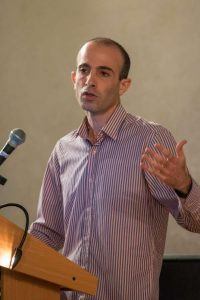 In 2015, Israeli historian Yuval Noah Harari published Sapiens, a sweeping and widely acclaimed history of humankind. In it, he discusses a phenomenon he calls “humanism.” Humanism, as he defines it, is a family of “religions (that) worship humanity, or more correctly, homo sapiens.” This worship of humanity, he argues, has made modernity “an age of intense religious fervor, unparalleled missionary efforts, and the bloodiest wars of religion in history.” The crimes of genocidal Nazism, Stalinist communism, and environmental destruction, he argues, can all be traced to the central tenets of humanism. If Harari is right, humanists need to engage in some serious soul-searching.
 By the time he came to write Finnegans Wake, Joyce had moved beyond trying to imitate musical forms, and described his novel not as a “blending of literature and music”, but rather as “pure music”. Writing to his daughter Lucia, Joyce explained, “Lord knows what my prose means. In a word, it is pleasing to the ear . . . . That is enough, it seems to me”, and in conversation, he declared, “judging from modern trends it seems that all the arts are tending towards the abstraction of music; and what I am writing at present is entirely governed by that purpose”. This offers perhaps the best way to approach his most complex work. Joyce emphasizes how, “if anyone doesn’t understand a passage, all he need do is read it aloud”, and such an approach certainly helps here: “and the rhymers’ world was with reason the richer for a wouldbe ballad, to the balledder of which the world of cumannity singing owes a tribute for having placed on the planet’s melomap his lay of the vilest bogeyer but most attractionable avatar the world has ever had to explain for”.
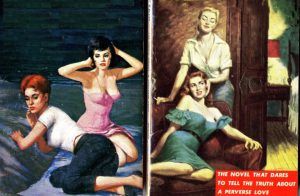 Another early lesbian-pulp and layered reading experience is Spring Fire (1952), by Vin Packer (one of the pseudonyms of the prolific author Marijane Meaker). Although its seemingly naive Americana tone reads today as camp, the novel plays with semantics and morality in its own way. Within this supposed “steamy page-turner … once told in whispers” is the tale of a newbie Midwestern student named Susan Mitchell. (She goes by—you guessed it—Mitch.) Mitch is seduced by her sorority sister, the come-hither green-eyed Leda, when she asks Mitch to give her a back rub and then suddenly “rolled over and lay with her breasts pushed up toward Mitch’s hands.” Although the prose at first rings as high-strung, it echoes with complex undertones. “There are a lot of people who love both [men and women] and no one gives a damn, and they just say you’re oversexed,” Leda explains to Mitch. “But they start getting interested when you stick to one sex. Like you’ve been doing, Mitch. I couldn’t love you if you were a Lesbian.” (Note the capital l.)
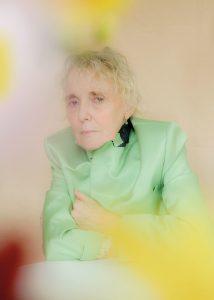 Denis’s films are filled with lush scenes of the natural world—African deserts, snowy Alpine fields, and the mineral-green waters of the South Pacific—and characters who tend to reveal themselves not through dialogue but through how they move and look. Alex Descas, one of the actors with whom Denis has worked longest, and who credits her with writing complicated, realistic roles for black actors at a time when few others did, described her artistic mode succinctly: “Film is not theatre,” he told me. Last month, at a screening of her latest movie, “Let the Sunshine In,” at the IFC Center, in Manhattan, Denis said, “I once read that I like to film bodies. No! But, if you choose someone, that person hasa body. They have feet, hands, hair, breasts, ass—all of that is part of what is important.” The film stars Juliette Binoche, as a divorced painter who dates men she shouldn’t: a married banker, a narcissistic actor, a standoffish curator. “She wanted my character to be beautiful and desirable and luminous,” Binoche told me. In the final shot, the camera—which one critic described as “smitten”—stays on her smiling face, which is ablaze with delusion and hope. Denis, according to Binoche, “works like a portrait painter.”
 One evening in March, a pale-blue layer of light began spreading across the plaza outside the United Nations headquarters in New York. Emanating from banks of leds, it appeared to undulate like the surface of the sea high above the heads of passing pedestrians. The effect may have been ethereal but the warning was all too real: the light submerged the plaza to the same depth that water may do if nothing is done to control rising sea levels. Called “Waterlicht” (Waterlight), the installation was the work of Daan Roosegaarde, a Dutch artist; New York was just one stop on a tour of global cities. Roosegaarde’s intention is to focus people’s minds on the prospect of a watery future. “Above all it gets people who might never do so talking about water and global warming,” he says. Often the conversation turns to keeping water out. But increasingly urban planners and designers are taking their cues from Rotterdam, the city where Roosegaarde lives and works: they are working out how to let water in. Like thousands of coastal cities from Shanghai to Miami, Osaka to New York, Rotterdam is under threat. More than 80% of this port on the Netherlands’ North Sea coast lies below sea level, the ocean kept at bay by a sophisticated system of levees, dykes, dams and storm-surge barriers known as the Delta Works. But by the end of the century those sea levels are predicted to rise by around a metre and the Netherlands is already seeing an increase in rainfall and flooding. To make matters worse, the thousands of pumps that remove groundwater up and down the country are causing the peat to dehydrate and the ground to sink. In recent years this has led to a shift in thinking: instead of working against the water, why not re-engineer the city to work with it?
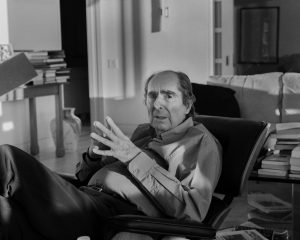 One time, I was having a conversation with
  Artificial intelligence owes a lot of its smarts to Judea Pearl. In the 1980s he led efforts that allowed machines to reason probabilistically. Now he’s one of the field’s sharpest critics. In his latest book,
  I leapt into the air, screaming at the top of my lungs with tears rolling down my cheeks as the news sank in. I had lost both of my parents when I was 16 years old, and I had often been sent home from school for unpaid tuition as I worked my way to a bachelor’s degree in my home country of Zimbabwe. But now, I was a Fulbright fellow. I was convinced that the award would propel my career to unconceivable heights. It was all the sweeter when I thought of my mother and how she used to cry over my report cards. At the time, I thought it was because I had not done well enough, but I later realized she was crying because she could not bear the idea that her poverty would keep me from reaching my full potential. I carried the burden of wanting to do her proud, and the fellowship was a huge step in that direction. It would also help me prove to the world that I was more than my family’s poverty. The numerous first-time opportunities the fellowship afforded—flying on a plane, staying in a hotel, moving to the United States—earned me respect in my small farming town. The chance to study and work abroad raised my own expectations sky-high as well.