
by Bill Murray
 Polynesia could swallow up the entire north Atlantic Ocean. It’s that big.
Only half of one per cent of Polynesia is land, and 92 per cent of that is New Zealand. Then there’s Tonga and Samoa, the Cook and Hawaiian islands, the French possessions, and back in its own lonely corner, Rapa Nui, the famous Easter Island. Four and a half hours flying time to South America and six hours to Tahiti, Rapa Nui is a mote, a tiny place that feels tiny, forlorn, a footnote.
How in the world did proto-Polynesians cast their civilization from Papua New Guinea all the way to Rapa Nui in canoes, with thousand year old tech, sailing against prevailing winds and all odds?
If you think about it at all, you might suppose Rapa Nui was an accidental discovery, storm-damaged canoes drifting off course, perhaps, or voyages of exile dashed upon obscure rocks. Who imagines resolute, purposeful voyages of discovery on stone-age ships no match for the vastness of the sea?
I do. I fancy single-minded voyages of exploration carried out by well-provisioned scouts sailing with, say, a month’s food, who set out in the more difficult direction, “close to the wind.” If no land were found in a fortnight, when half the food was gone, they could sail home downwind, faster. Read more »
 spanning George Boole to Claude Shannon. By some measures the works of these men combine to give us our modern, programmable computer.
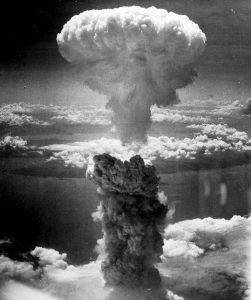 Will you know what to do when the atomic bomb drops?
  The movement for Boycott, Divestment and Sanctions against Israel – known as BDS – has been driving the world a little bit mad. Since its founding 13 years ago, it has acquired nearly as many enemies as the Israelis and Palestinians combined. It has hindered the efforts of Arab states to fully break their own decades-old boycott in pursuit of increasingly overt cooperation with
  It’s one of the greatest stories in science, right up there with Neil Armstrong’s small step on the moon and Jane Goodall’s
  Nobody wants to feel helpless or desperate. The days of charities showing people as one-dimensional victims are – hopefully – numbered. Theo Sowa, chief executive of the African Women’s Development Fund, has said: “When people portray us as victims, they don’t want to ask about solutions. Because people don’t ask victims for solutions.”
 “Hijra,” a term of South Asia which have no exact match in the modern Western taxonomy of gender, designated as male at birth with feminine gender identity and eventually adopts feminine gender roles. They are often grossly labeled as hermaphrodites, eunuchs, transgender or transsexual women in literature. presently a more justified social term for them is the “Third Gender.” Transcending the biological definition, hijras are a social phenomena as a minority group and have a long recorded history in South Asia. However, their overall social acceptance and present conditions of living vary significantly in countries from Bangladesh, India and Pakistan. Perhaps the Hijras in Bangladesh face the worst situation, which forces a good number of them to leave their motherland and migrate to India. Instead of coming from various social and family backgrounds, Hijras feel the strongest sense of belonging with their own group—fellow Hijra. These groups give them the shelter of a family and the warmth of human relationship. Outside the group, they are discriminated and scorned almost everywhere. Traditionally, these individuals earned their living based on the cultural belief that Hijras can bless one’s house with prosperity and fertility. Because of the shared geographical and cultural history of the subcontinent, this particular Hindu belief slowly made room in the Muslim culture of this land. Times have changed and Hijras have lost their admired space in the society. Now they make a living by walking around the streets collecting money from shopkeepers, bus and train passengers or through prostitution.
 When
When 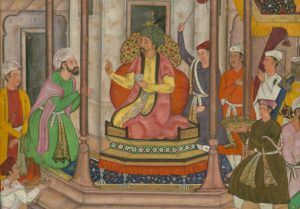 ZAHIR AL-DIN MUHAMMAD, THE 16TH
  Far from just being the product of our parents, University of Adelaide scientists have shown that widespread transfer of genes between species has radically changed the genomes of today’s mammals, and been an important driver of evolution.
 A seasonal
 Why do wealthy societies spend good money on projects such as this? Higgs bosons and images from the Voyager spacecraft don’t do anything useful and don’t make any of us richer, as Radford acknowledges, though he has no time for such philistinism. His heart and his mind are with the Roman thinker
  Gossip, speculation, and longing—and the discomfort (and occasional pleasure) of perpetual doubt—are the grounds on which contemporary queer men and women have become used to constructing our genealogies. We possess historical facts enough to fantasize about our “great-grandparents”: the evasive extravagance of Oscar Wilde; the repression with which E.M. Forster asks us to “only connect”; the ambiguity in Djuna Barnes’s famous claim, “I am not a lesbian, I just loved Thelma”; or the half-missing archive of Emma Goldman’s correspondence with women. The following generation of gay men was decimated by a plague, meaning that 30- to 50-year-old gay men will be the first generation to be both openly gay and alive. Even if it is easier now to imagine a queer family of brothers and sisters, it remains much more difficult to imagine a queer lineage. We long for a family tree that never quite appears in full: for queer mothers and fathers that could somehow supplement (or replace) the biological ones whose lives differ so greatly from our own. We construct these families through gossip and speculation, staring at chapter breaks and ellipses until they give us that aunt we might have had. Looking hard enough, we hope, we all might have that aunt.
 Hopkins is the laureate of “all things counter, original, spare, strange”. He is also, to my mind, the most exquisite English poet of the 19th century. In life, however, he felt the censure not only of his strict Catholicism but also of his own isolation. In one of his late sonnets, he summed up his position as an unpublished – and perhaps unpublishable – poet. A reader unfamiliar with Hopkins’s work will feel immediately the taut difficulty of his language, the force of his sound-scapes, and the miraculous effect of his anthimeria, as in his striking use of “began” as a noun:
 A killer stalks the American street. Its weaponry is subtle, but it is responsible for the demolition of countless lives, and the damage of many communities. After it sneaks into a home, it creates social pathology and helps harvest political cruelty. It is loneliness. The United States of America has created a culture of solitary struggle and isolation. It should not shock too many careful observers who consider the predictable consequences of building an entire civilization on the mud and sewage of cutthroat, competitive corporate capitalism. The true meaning of icy bromides like, “rugged individualism,” “pull yourself up by your bootstraps,” and “no free lunch,” is not a celebration of individual freedom as much as it is a “you’re on your own” ethic, or lack thereof, resulting in communal fissure and political friction.