Diane Mehta in Longreads:
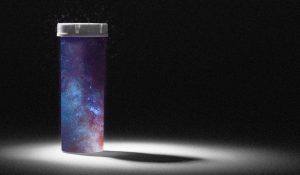 “You’re dead,” said the meditation guide. “You’ve been dead a long time.” I start crying. “What do you see?” she asked. I whimpered, “My dad somewhere, cremated, maybe a river, gone for decades. My son is older. He has a family. He thinks of me sometimes. I can’t stand it.”
“They’ve been gone a long time. You’re fine. Part of the universe. The beginning of what you were meant to be. Does that beanbag chair in the house that you don’t like matter? What about your job and the argument you had with your boyfriend, that burger you had for dinner? Your dresses, your shoes, your jewelry, your house, your keys. Throw your keys away. Throw them into the magnetic sun. Whoosh. Do it again. Whoosh. How do you feel?” I wiped my tears and scanned my imagination. Exploding galaxies to explore, strange dimensions, star clusters, sunbursts, Earthrise over our moon, star-forming nebula, cosmic microwave background left over from the Big Bang. What does a black hole feel like when you’re disembodied and inside of it? My mind was clear. A cool mist like summer rain while scuba diving underwater but without equipment. She continued to encourage me to throw things away. “It gets easier. Throw it away. Nothing matters. Whoosh.” I winced, then felt relieved, then felt horrible and finally caved and decided to be dead, dead, dead. As shock left me, I imagined looking around at my new home out in space: stars blinked on and off like fireflies, nearby yet distant, planets with inconceivable colors of lilac-brown and red-rust that hadn’t been refracted through an atmosphere and the curve of the turning Earth. Everything gets easier according to everyone who believes that life is a positive cult. This guide said she used to have an argument with the world. She was angry at all corners of her soul. “I’m happier,” she said calmly. “You have a very open mind. You’ll do well here.” I panicked and came back to Earth. My feet reappeared, and my hands, which I’d watched burn away, per her instructions, grew back like a starfish regenerating its limbs. Whole again. Beanbag chair and teenager and dog and boyfriend, jobs and writing to do and the whole shebang of worries. I forced a breath out. She was wrong about me.
***
The goal of this style of meditation, which my boyfriend signed me up for (sigh — my anxiety is not fun for the people around me, either) and which, in the interest of being a good sport, I agreed to try for a month, was to achieve oneness with the universe. I had just finished a final draft of a novel that had sustained me for seven years, and felt utterly empty without it. Looking for a job felt dreary and anxiety-creating. What would I do for the rest of my life? What should I do from day to day? I couldn’t relax. From meditation I expected breathing exercises, which are scientifically proven to manage anxiety. Instead I stared at a reflective silver circle on the wall, a sticker about five inches in circumference that conceptually embodied the magnetic sun, and called one memory after another up, and threw it into that shiny gravity-sucking sun.
More here.

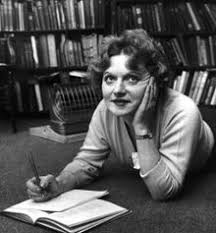 The flight path of Muriel Spark is a wonder to behold. Her conviction was that the purpose of writing is to give pleasure, and in all her books she paid attention only to the innermost self that was her exclusive guide to that end. She had a poet’s instinct for the right form and a colloquial style all her own that allowed her to range the whole way from the comedy of manners up to the great unanswerable questions of the human condition. In an age when writers expect to be judged primarily by their sexual, social, and political commitments, and are therefore encouraged to be each one more shocking than the next, Muriel’s wit and independent mindset were conservative as well as revolutionary, that strange combination that surfaces when things go wrong. Since she was speaking for lots of people with hopes and fears like hers, she was successful—and deserved to be.
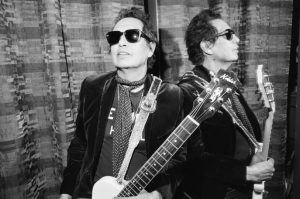 Alejandro Escovedo, the singer and songwriter, likes to have a proper Mexican breakfast before a long drive. “Let’s go here,” he said. He pulled into the back lot of a restaurant called El Pueblo, across from the Tornado bus terminal on East Jefferson Boulevard, in the Oak Cliff section of Dallas. El Pueblo, he said, is where travellers arriving by bus from Mexico often go to eat and to get their bearings. He ordered in Spanish, then remarked that his Spanish was poor. The plates came quickly. Chorizo con huevos. “This is bad_ass_, man,” he said. An elderly vagrant looked in through the window and then walked in. Escovedo gave him a dollar. “When I was small, I used to be able to see the pain in people,” he said.
 When I was 11, I read Little
 Recently, CNN sent their reporter to cover yet another Trump rally (in Pennsylvania), but this time reporter Gary Tuchman was assigned the more specific task of interviewing Trump supporters who were carrying signs or large cardboard cut-outs of the letter “Q” and wearing T-shirts proclaiming “We are Q”.
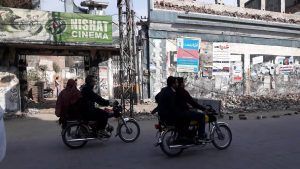 In the 1960s, in the sleepy little city of Sialkot, almost in no-man’s land between India and Pakistan and of little significance except for its large cantonment and its factories of surgical instruments and sports goods, there were two cinema houses, all within a mile of our house, No. 3 Kutchery Road. Well three to be exact, the third being an improvisation involving two tree trunks with a white sheet slung between them at the Services club and only on Saturday nights.
 Would I rather go deaf or blind? Every once in a while, I come back to this question in some version or another. Say I had to choose which sense I’d lose in my old age, which would it be? I always give myself, unequivocally, the same answer: I’d rather go blind. I’d rather my world go darker than quieter. I imagine it as a choice between seeing the world and communicating with it; in this hypothetical, communication with the world is all-encompassing, its loss more devastating than the loss of sight. It is perhaps clear from the mere fact that I pose this question that I do not live with a disability involving the senses. Individuals who are vision- or hearing-impaired would have an entirely different take on this question and on the issues I raise below, but hopefully what I write here will go beyond stating my own prejudices.
 The idea of ‘good corporate citizenship’ has become popular recently among business ethicists and corporate leaders. You may have noticed its appearance on corporate websites and CEO speeches. But what does it mean and does it matter? Is it any more than a new species of public relations flimflam to set beside terms like ‘corporate social responsibility’ and the ‘triple bottom line’? Is it just a metaphor?
 Learning Objectives. Measurable Outcomes. These are among the buzziest of buzz words in current debates about education. And that discordant groaning noise you can hear around many academic departments is the sound of recalcitrant faculty, following orders from on high, unenthusiastically inserting learning objectives (henceforth LOs) and measurable outcomes (hereafter MOs) into already bloated syllabi or program assessment instruments.

 One of the problems in discussing censorship is that we often don’t recognize censorship for what it is. There is no longer the Lord Chamberlain marking scripts and cutting out the unacceptable. Instead, we, in effect, ourselves mark them. And that, ironically, makes censorship not more, but less, visible.
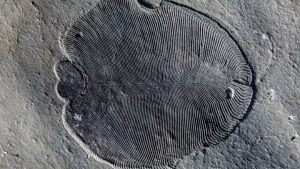 Around 558 million years ago, a strange … something dies on the floor of an ancient ocean. Its body, if you could call it that, is a two-inch-long oval with symmetric ribs running from its midline to its fringes. It is quickly buried in sediment, and gradually turns into a fossil.
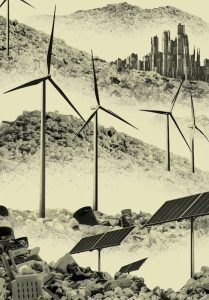 Warnings about ecological breakdown have become ubiquitous. Over the past few years, major newspapers, including the Guardian and the New York Times, have carried alarming stories on soil depletion, deforestation, and the collapse of fish stocks and insect populations. These crises are being driven by global economic growth, and its accompanying consumption, which is destroying the Earth’s biosphere and blowing past key planetary boundaries that scientists say must be respected to avoid triggering collapse.
 It was entirely a coincidence that I found myself reading Jonathan Haidt and Greg Lukianoff’s
  I have spent much of the last few days destroying my own work. It turns out that obliterating it neatly is almost as difficult as making it. It’s publication week of my latest, The Book of Humans, and we’ve been running various competitions to draw people’s eyes in. I have great fondness for hiding secrets in my books. In one, I encoded a message in the letters of the genetic code – an email address that revealed the instructions for a treasure hunt. For The Book of Humans – surely conceived by me as an epic act of procrastination – I have dug out a hole in the middle of one copy, as if to hide a wad of cash, and inside this book-box I’ve stashed a small treasure, something mentioned in the book and of relevance to the story. So far, I’ve destroyed two practice copies with a multi-tool trying to carve and glue a neat rectangular box inside 250 pages of human evolution. I’ll push the button for this hunt to begin on Twitter this week. Let’s see how long it takes people to work out what’s in the box.