
Nicolas Léger at Eurozine:
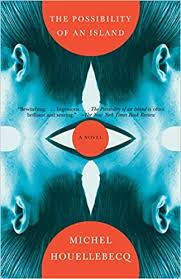 Two bodies of work, both particularly symptomatic of the bankruptcy of egalitarianism and the triumph of individualism against a background of Western resignation, have been hugely successful both in France and elsewhere (a sign that they resonate deeply in an era of globalization and crisis). Virginie Despentes and Michel Houellebecq, each in their idiosyncratic way, do not just describe these social changes and their effects, but have also set about identifying their horizons, or the possibilities of survival beyond them. They take the way the naturalist novel depicts society and adapt it to suit their purposes, adding imagery and narrative techniques borrowed from a strand of English-language literature hitherto referred to condescendingly as ‘popular’. But it is precisely these influences, the product of a counterculture born out of globalization and the twentieth century, that enable them to bear the weight of the singularities of our contemporary modernity: science fiction in in Houellebecq’s Atomised (1998), futuristic dystopian narrative in his Submission (2015), or crime noir in Despentes’s Vernon Subutex (2015–2017).
more here.
 “Voices from the Moon” is my favorite of all Andre Dubus’s stories and novellas. It concerns itself unabashedly and unsentimentally with love—the love of parents for their children, of men for women and women for women, of a boy’s love for God, and a teenage girl’s love for cigarettes. The story is too rich to paraphrase, but in brief, a divorced man has fallen in love with his son’s ex-wife, and she with him. They mean to live together. The family is shaken to its roots by the apparent betrayals involved, and not least by the social impropriety of such an arrangement—its radical flouting of convention. Yet as the story proceeds we see its people react not with the sort of virtuous outrage we might expect, but with hard-won understanding, generosity, forgiveness, and love. In essence, the family members declare their independence from submissive concern or embarrassment about how things might look to others, finding freedom in their refusal to let their lives be shaped by the expectations and decorums of social custom. Sensational as the premise of the story may be—it was inspired by a newspaper article Dubus happened upon—he illuminates his people’s lives not by heating up the drama inherent in their situation, but by allowing each of them quiet, ordinary moments in which to reveal themselves, to profound, extraordinary effect. It is altogether Dubus’s strangest, most moving and beautiful piece of work.
 Reading medieval literature, it’s hard not to be impressed with how much the characters get done—as when we read about King Harold doing battle in one of the Sagas of the Icelanders, written in about 1230. The first sentence bristles with purposeful action: “King Harold proclaimed a general levy, and gathered a fleet, summoning his forces far and wide through the land.” By the end of the third paragraph, the king has launched his fleet against a rebel army, fought numerous battles involving “much slaughter in either host,” bound up the wounds of his men, dispensed rewards to the loyal, and “was supreme over all Norway.” What the saga doesn’t tell us is how Harold felt about any of this, whether his drive to conquer was fueled by a tyrannical father’s barely concealed contempt, or whether his legacy ultimately surpassed or fell short of his deepest hopes.
 They put GPS chips in pets and migratory birds now. How can someone flying around in a 65-million-dollar machine get lost?” With these words – spoken by a US airman who has just crashed his jet in an unnamed desert –
  In the five years since I moved to Paris as an American philosopher working within the French system, my disdain for what Americans know as ‘French theory’, and particularly for the American reception of it, has only deepened. Sometimes I find it burdensome to be pursuing my work so close to the belly of this noisome beast (my campus of the University of Paris lies on the city’s southeastern border, while the belly, properly anatomically speaking, is two RER stops to the west (its external gonads are up in St. Denis)), but for the most part I am happy to process this unanticipated twist in my career as one of my life’s animating ironies, and to milk this irony for insights that I would not be able to come by if I were either geographically far away from this intellectual culture, or a fawning convert to it.
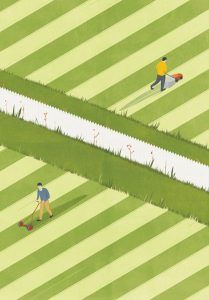 An abundance of social science research indicates that high economic inequality comes along with several undesirable outcomes, such as higher levels of violence and lower levels of health, happiness and satisfaction with life. But inequality has been rising in almost all developed countries since the 1970s, which raises an important question. If high inequality is detrimental to the well-being of a large majority of the populace and if democracy is about realizing “the will of the people,” why has inequality been allowed to increase in most democracies? Put differently, if most people would benefit from enhancing equality, why have voters not elected politicians who would implement policies to do that? This is one of the most significant paradoxes of our time.
 “Marnie,” my new opera, which has
  Early in
 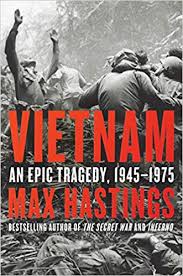 According to Max Hastings, it was ‘an epic tragedy’ for those who lived through it. From start to finish, the wars for Vietnam sowed death and destruction across the land. Starting with the outbreak of the French war with Ho Chi Minh’s Viet Minh in 1945 and ending with the inglorious American evacuation from Saigon in 1975, Hastings focuses on how combatants and civilians experienced war. He draws upon an impressive range of sources to take the reader into the line of fire. Through vivid descriptions and moving prose, he shows us the suffering, trauma and death that the French and especially American campaigns inflicted upon the civilians and soldiers on all sides who found themselves caught up in what turned into a conflagration of mind-boggling violence.
 Berlin’s absorption in the history of ideas dates back almost to the beginning of his academic career. In 1933 he was commissioned to write a book on Karl Marx, which was published in 1939 and is still in print today. His reading of Marx and Marx’s predecessors, especially the philosophers of the Enlightenment, and even more their opponents, the “Counter-Enlightenment” as he called them, fuelled his thought for the rest of his life.
 Who am I? It is difficult for me to recognise myself in a photo taken when I was 5 and to identify with the thoughts I had when I was 16. But I can do that because I have a ‘sense of self’ which includes beliefs about myself that address two basic questions: which person I am and what type of person I am. The first question can be answered by reference to my life history (e.g., when I was born, who my parents are, what my job is) and the second question concerns my personality and dispositions (e.g., whether I am loyal, whether I am good at playing volleyball, whether I like Russian literature). How do I keep all the relevant information about myself together to attain a sense of self? Well, I do what humans do best, tell stories. Self-narratives are the means by which I establish continuity between my past, present, and future experiences and impose some coherence on my disparate traits and features. I am not alone in doing this: we all create stories that make sense of the experiences we remember and connect our life events in some meaningful way using the literary devices stories have, plots helping us see how some events follow from other events and twists acknowledging surprising developments that have a big effect on the course of our lives.
 Cuttlefish are masters at altering their appearance to blend into their surroundings. But the cephalopods can no longer hide their inner thoughts, thanks to a technique that infers a cuttlefish’s brain activity by tracking the ever-changing patterns on its skin. The findings, published in Nature on 17 October
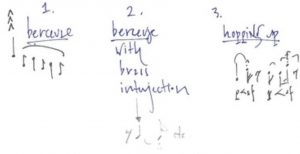 I avoid reading accounts of other composers’ ways of working. I’ve only ever been disappointed by stories of their abusive and antagonistic relationships with the people they’re close to, or, in the case of historical figures, wild speculation about their mental states or marital problems or excessive drinking. When I talk to my colleagues, I am of course happy to hear about their sex dramas and squabbles with the landlord, but what I really want is shop talk: what kinds of pencil are you using? How are you finding this particular piece of software? Do you watch the news while you work? I find these details telling.
 In the spring of 2017, Urmila Mahadev found herself in what most graduate students would consider a pretty sweet position. She had just solved a major problem in quantum computation, the study of computers that derive their power from the strange laws of quantum physics. Combined with her earlier papers, Mahadev’s new result, on what is called blind computation, made it “clear she was a rising star,” said
  In more than twenty years of running diversity-training and cultural-competency workshops for American companies, the academic and educator Robin DiAngelo has noticed that white people are sensationally, histrionically bad at discussing racism. Like waves on sand, their reactions form predictable patterns: they will insist that they “were taught to treat everyone the same,” that they are “color-blind,” that they “don’t care if you are pink, purple, or polka-dotted.” They will point to friends and family members of color, a history of civil-rights activism, or a more “salient” issue, such as class or gender. They will shout and bluster. They will cry. In 2011, DiAngelo coined the term “white fragility” to describe the disbelieving defensiveness that white people exhibit when their ideas about race and racism are challenged—and particularly when they feel implicated in white supremacy. Why, she wondered, did her feedback prompt such resistance, as if the mention of racism were more offensive than the fact or practice of it?
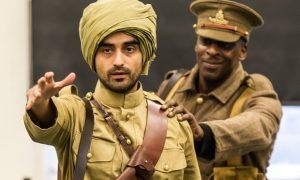 History does not record whether there was any contact during the first world war between the men of the Indian army who were being treated in hospitals in