Brian Gallaghar in Nautilus:
 In the Netflix anime series Knights of Sidonia, humankind is marooned in a spaceship 500,000-strong, refugees constantly on the run from shapeshifting aliens who destroyed Earth over 1,000 years ago. Both the patriarchy and poverty have been smashed. Advances in genetic engineering have allowed androgynous individuals to proliferate and asexual reproduction to become commonplace. Everybody (except the protagonist, a clone of his grandfather) can photosynthesize, drastically reducing the need to eat. A plot twist near the end of the first season, released in 2014, revealed the existence of a shadow government called the Immortal Ship Committee which, in the last several centuries, had grown in number, from less than 10 members to just under 30, becoming more and more corrupt and self-serving. One of them, a 600-year-old woman named Kobayashi, captains the ship behind a mask, concealing her unaging, youthful complexion. She helps orchestrate fake news of alien encounters to justify the emergency powers of the committee’s undemocratic puppet government front.
The potential for undying tyrants or tyrannical bodies is one reason Leonard Hayflick, one of the world’s preeminent experts on aging (he was a founder of the Council of the National Institute on Aging), is against slowing down or eliminating the aging process. He has other reasons, too, like avoiding the father-daughter situation in Interstellar, where, due to the time-dilation effects of traveling in different gravitational fields, the daughter caught up to her father in years, and eventually died of old age first. “To slow, or even arrest, the aging process in humans is fraught with serious problems in the relationships of humans to each other and to all of our institutions,” he told Jordana Cepelewicz, a former editorial intern at Nautilus. “By allowing antisocial people—tyrants, dictators, mass murderers, and people who cause wars—to have their longevity increased should be undesirable…I would rather experience the aging process as it occurs, and death when it occurs, in order to avoid allowing the people who I just described to live longer.”
Despite his reservations about radical life-extension, Hayflick is a big proponent of studying aging at a more fundamental level, he said. “Most studies are either descriptive, studies on longevity determinants, or studies on age-associated diseases. None of this research will reveal information about the fundamental biology of aging. Less than 3 percent of the budget of the National Institute on Aging in the past decade or more has been spent on research on the fundamental biology of aging.” He’s a bit annoyed, for instance, that about a half of the National Institute on Aging’s budget goes toward researching Alzheimer’s disease.
More here.

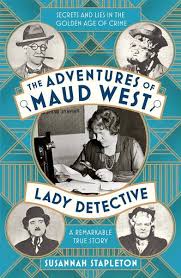 Unconventional lives can tell us much about the conventions and social currents of their times. Susannah Stapleton’s compulsively absorbing book about Maud West centres on a woman who was a splendid one-off and yet somehow entirely of her age. It is not quite a biography and not quite a personal quest, but a bit of both. Tracking her quarry through the last decades of the 19th century and the first decades of the 20th, Stapleton found that West eluded her at every turn. The bewildering array of red herrings, dead ends, fibs, disguises, half-truths and plain deceptions she encountered becomes the story not only of West herself but also of the world in which she lived. The 1920s and 1930s were the golden age of British detective fiction and many of its most famous authors were women. Maud West, with her magnifying glass and her box of disguises, could have been a character in a Dorothy L Sayers novel – and in fact, she seemed to have lived her life as though it were a continually unfolding story, complete with cloaks and daggers.
 The history of philosophy usually tells us how one set of ideas gave birth to another. What it tends to overlook are the political forces and social upheavals that shaped them. Witcraft, by contrast, sees philosophy itself as a historical practice. For much of its career, it was never easy to distinguish from political conflict, religious strife and scientific controversy. For some 17th-century Puritans, philosophy was a satanic pursuit, an impious meddling with sacred truths. There was a battle between the church and the universities on the one hand, with their reverence for Aristotle and the schoolmen, and on the other the humanists, scientists, atheists and radicals. It is the stuffy old university of Wittenberg versus the humanistic Hamlet and his sceptical friend Horatio.
 Quinn Slobodian in Boston Review:
 Matteo Pucciarelli in New Left Review:
 Joe Humphreys in The Irish Times:
 Dan Bessner in The New Republic:
 It’s the question on every cancer patient’s mind: How long have I got? Genomicist
 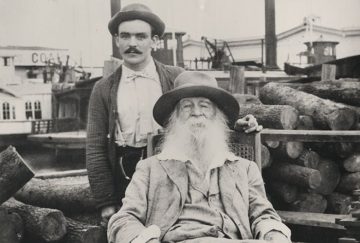 “Whitman demonstrates part of his Americanness by placing cocksucking at the center of Leaves of Grass.” Gay liberationist Charles Shively—not one to mince words—wrote this in Calamus Lovers: Walt Whitman’s Working Class Camerados (1987), his revelatory, if sometimes risible, account of the poet’s queer egalitarianism. Whether cocksucking is central to Whitman’s book, or even uniquely American, is debatable; more pertinent is the implied connection between Whitman’s homosexuality and his patriotic fervor.
 Commentators from across the political spectrum warn us that extreme partisan polarization is dissolving all bases for political cooperation, thereby undermining our democracy. The near total consensus on this point is suspicious. A recent Pew study finds that although citizens want politicians to compromise more, they tend to blame only their political opponents for the deadlock. In calling for conciliation, they seek capitulation from the other side. The warnings about polarization might themselves be displays of polarization.
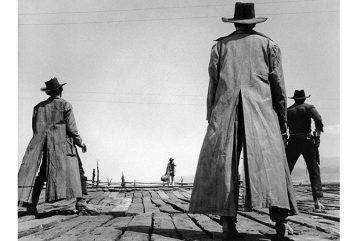 The movie that made me consider filmmaking, the movie that showed me how a director does what he does, how a director can control a movie through his camera, is Once Upon a Time in the West. It was almost like a film school in a movie. It really illustrated how to make an impact as a filmmaker. How to give your work a signature. I found myself completely fascinated, thinking: ‘That’s how you do it.’ It ended up creating an aesthetic in my mind.
 The press photographer’s task is to obtain a likeness of the person who is at the center of the news. This proves difficult when the subject, who is either accused of crimes or tied, however flimsily, to someone who is, wants to avoid being photographed at all costs. Hounded at every step, unable to escape, even in shackles, the subject resorts to makeshift concealments—hat, sleeve, lapel, handkerchief, newspaper—in order to prevent facial capture. The photographer can only pursue, shadow, perhaps verbally goad the subject, waiting for a slip or a stumble that will cause the mask to drop. When that fails to happen, the photographer’s sole option is to photograph the mask. The public, inflamed by press coverage of the case, wants a face it can charge with blame (and, often enough, spread the blame to faces that bear it a superficial resemblance), but is instead offered a metonym: hat, handkerchief, newspaper. The photographer, in quest of a portrait, has delivered in its place an event: the defeat of portraiture by the subject.
 There is intense debate as to what the outcome tells us about voter support for Brexit, with both Leavers and Remainers claiming vindication. The most striking feature of the results, however, is the polarisation they reveal. The result of a botched Brexit has been the Europeanisation of British politics, with the old centre ground falling away.
 As a literary scholar and authority on African American history, Henry Louis Gates Jr. has written or co-written 24 books and serves on the faculty of Harvard University. But he didn’t achieve broad public attention until he began hosting “Finding Your Roots,” a popular PBS series in which celebrities explore their ancestry, often with surprising results. During an episode of a related program, “African American Lives 2,” comedian Chris Rock discovers that his great-great-grandfather, Julius Caesar Tingman, had fought for the Union with the United States Colored Troops during the Civil War, then served in the South Carolina legislature under its Reconstruction government. The revelation brought the typically glib Rock to tears. “How in the world could I not know this?” Rock asked Gates.
 Trying to get a point across in public writing, whether established or clickbait media (a distinction of vanishing significance), with just the nuance, force, and connotations you intend, is like trying to perform a violin solo underwater. You can be as virtuosic as you like, but the medium you’re playing in is going to distort the signal to the point that your effort becomes a vain expenditure, and the result of it comes across as a dull, warped, and muted sound wave to which silence would have been preferable.