
Costică Brădăţan at The American Scholar:
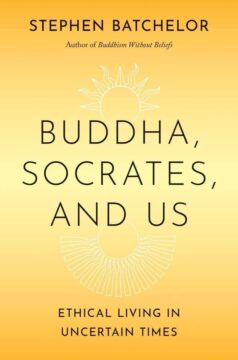 “Raised in Britain as a post-Christian secular humanist and trained in Asia as a Tibetan and Zen Buddhist monk,” Stephen Batchelor writes at the end of his book, Buddha, Socrates, and Us, “I find that I can no longer identify exclusively with either a Western or an Eastern tradition.” Decades of dwelling in these traditions—each with its own intellectual, spiritual, and philosophical riches—have left him strangely homeless. Far from making him unhappy, though, this state of existential homelessness has given Batchelor access to what he sees as a higher life. For, while “unsettling and disorienting” at times, such “spaces of uncertainty seem far richer in creative possibilities, more open to leading a life of wonder, imagination, and action.”
At its core, Batchelor’s Buddha, Socrates, and Us may be read as a response to a simple, yet important observation: everything in life tends to fall into patterns, to settle into habits and routines. Not even matters of the spirit—religion and philosophy, beliefs and ideas, thinking and writing—seem to escape this fate. Such mindless repetition makes our lives easier and more comfortable, at least on the outside, but to do things mechanically and unthinkingly is to invite emptiness and meaninglessness into our existence.
more here.
Enjoying the content on 3QD? Help keep us going by donating now.
 Apples and bananas may be some of America’s favorite fruits. But nutrition experts say that kiwis deserve a spot in your shopping cart. These brown, fuzzy fruits with green, yellow or even red flesh are packed with beneficial nutrients like fiber and vitamin C. And on TikTok, wellness influencers rave about their
  The US sits atop vast reserves of fossil fuels, which have underpinned its national prosperity for decades. They have lit cities, powered factories, stimulated postwar job growth, and forged
  For those contemplating mass casualties, biotoxins like ricin are easy to produce. But delivering them effectively is difficult, requiring specialized techniques like aerosolization. Conversely for chemical warfare agents like sarin, synthesis (because of restricted precursors) has traditionally been the hard part, even if delivering them
  Recent assaults on DEI from the right have caused people who care about a diverse, inclusive America to circle the wagons against
 Consider Friedrich Nietzsche, one of the first thinkers of the
  P
P Born in 1720, White was educated at the University of Oxford, UK, before settling at The Wakes — his family home in Selborne, UK — in around 1757. Then, from 1768, he worked for 25 years on his Naturalist’s Journal, a columnar diary in which each page covered a week of observations on fruit and vegetable experiments, local creatures and weather conditions. White’s daily entries in Selborne were often haiku-like in their simplicity. He described “vast rocklike, distant clouds” or simply stated “Bees swarm much. Sheep are shorn.”
 When I was a girl in the 1950s women, for the most part, got married, gave birth, and stayed home; if necessary, they went to work as schoolteachers or secretaries or salesgirls. They did not enter the professions, start a business, serve in government, or become university professors; nor did they climb a telephone pole, go down in the mines, or compete in a marathon. Today a girl is born with the knowledge that not only can she do any or all of the above, it is even assumed that she will pursue a working life as well as a domestic one. The change in social expectations for women, nothing short of monumental, is due to the Second Wave of American feminism (otherwise known as the Women’s Liberation Movement), a political and social development characterized by the twin efforts of liberals who worked throughout the 1960s, ’70s, and ’80s to achieve equality for women under the law and radicals who worked to eradicate deep-dyed, historic sexism through a change in cultural consciousness. Among the leading figures in this second group was Shulamith Firestone, of whom it was said, “I think of her as a shooting star. She flashed brightly across the midnight sky, and then she disappeared.” That’s exactly how I remember her.
 ‘I
‘I