
Charles McGrath in The New Yorker:
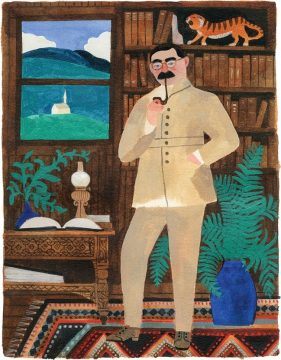 Rudyard Kipling used to be a household name. Born in 1865 in Bombay, where his father taught at an arts school, and then exiled as a boy to England, he returned to India as a teen-ager, and quickly established himself as the great chronicler of the Anglo-Indian experience. He was Britain’s first Nobel laureate in literature, and probably the most widely read writer since Tennyson. People knew his poems by heart, read his stories to their children. The Queen wanted to knight him. But in recent years Kipling’s reputation has taken such a beating that it’s a wonder any sensible critic would want to go near him now. Kipling has been variously labelled a colonialist, a jingoist, a racist, an anti-Semite, a misogynist, a right-wing imperialist warmonger; and—though some scholars have argued that his views were more complicated than he is given credit for—to some degree he really was all those things. That he was also a prodigiously gifted writer who created works of inarguable greatness hardly matters anymore, at least not in many classrooms, where Kipling remains politically toxic.
In a prologue to “If: The Untold Story of Kipling’s American Years” (Penguin Press), Christopher Benfey, a professor at Mount Holyoke, writes that some of his friends, when they learned what he was working on, asked him what on earth he was thinking, and warned that he’d better be ready to defend himself. Benfey’s best defense turns out to be the book itself, which doesn’t attempt a full-throated rehab job. An Americanist who has written very good books about Emily Dickinson and Stephen Crane, among others, Benfey mostly steers clear of Kipling’s politics, and instead concentrates on a little-known chapter in Kipling’s life: the four years that this outspoken defender of the British Empire spent living just outside Brattleboro, Vermont, where he wrote some of his best work, including “The Jungle Book” and “The Second Jungle Book,” “Captains Courageous,” and the first draft of “Kim.” Kipling’s American sojourn is hardly an “untold story”—it figures in all the biographies—but Benfey tells it well, catching nuances that some biographers have missed. He argues that Kipling was profoundly altered by his experience of America, and that America, in turn, was altered by its experience of Kipling. But you could also make a case that neither was changed enough. Kipling never learned to lighten up—or to appreciate American humor and informality—and America, by his lights, never got over being headstrong and overly sure of itself.
More here.
 At three o’clock in the afternoon on September 4, 1882, the electrical age began. The Edison Illuminating Company switched on its Pearl Street power plant, and a network of copper wires came alive, delivering current to a few dozen buildings in the surrounding neighborhood. One of those buildings housed this newspaper. As night fell, reporters at The New York Times gloried in the steady illumination thrown off by Thomas Edison’s electric lamps. “The light was soft, mellow, and grateful to the eye, and it seemed almost like writing by daylight,”
 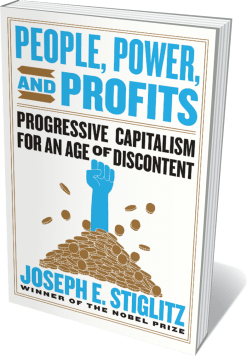 A diverting Beltway pastime during the heyday of the Washington Consensus was to gently mock Joseph E. Stiglitz. It was remarkably easy for pundits to wave away his prestigious awards (Nobel Prize in Economics) and positions (World Bank chief economist, chairman of Bill Clinton’s Council of Economic Advisers) and dismiss his warnings about “market fundamentalism” as overripe hyperbole. In 2004
  When
When  The US military’s carbon bootprint is enormous. Like corporate supply chains, it relies upon an extensive global network of container ships, trucks and cargo planes to supply its operations with everything from bombs to humanitarian aid and hydrocarbon fuels. Our
  There is something very moving about the conversation between these young women, a sense of generational rise that, as we know from every precedent from the Renaissance onwards, has the power to ignite movements and change history.
 The popularity of video games is staggering. Last year, the top 25 public game companies—China’s Tencent, Sony, and Microsoft ranking highest—had annual earnings of more than $100 billion for the first time.1 The United States video game industry earned more than global box office movie ticket sales, U.S. video streaming subscriptions, and the U.S. music industry.2 By 2021, according to Statista, a market research firm, 2.7 billion people will be playing video games, up from 1.8 billion five years ago. A Pew survey reveals the age group that plays most often is 18 to 29.3In the 30 to 49 age group, nearly 50 percent of men and 40 percent of women play. A study in Europe shows people 45 and up are more likely to play video games than children aged 6 to 14.
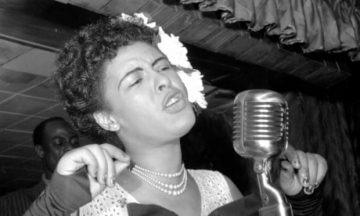 Within the first few pages of
 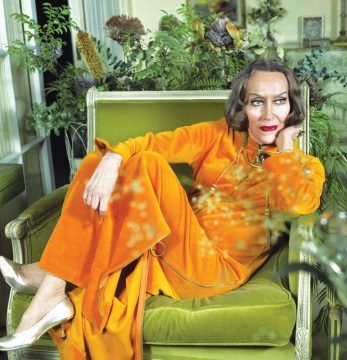 One evening in early 1950, the film mogul Louis B. Mayer hosted a small dinner party for the actress Gloria Swanson. She was fifty-one years old, which was not considered an ancient, crone-like age, even in an industry that values youth above all else. Still, she was in need of a professional boost. Mayer’s small soiree was something of a ceremonial gesture. Here was one of the last tycoons of classic Hollywood extending his hand and his hospitality to an actress who was tottering, on marabou-covered heels, back into the business after a decade-long fermata.
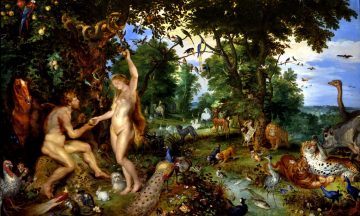 The gospels (which show knowledge of the fall of the Jerusalem Temple in AD70) were written at least two decades after Paul’s epistles. And the Gospel of John was possibly written as late as the second century. It presents a Jesus who talks a great deal about his own status as God’s son. This more likely reflects the beliefs of a later era than that of Jesus himself, and John’s gospel may indeed be a biography of Christ written to suit the interests and beliefs of John’s own particular branch of Christianity. The episode of the woman taken in adultery – “He that is without sin among you, let him first cast a stone at her” – which appears only in this gospel, is not found in the earliest manuscripts, and is likely to be an even later addition.
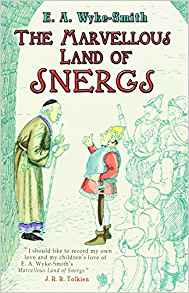 Suppose you were to mash up three of the greatest of all children’s fantasies: J.M. Barrie’s
  Evgeny Morozov in The New Left Review:
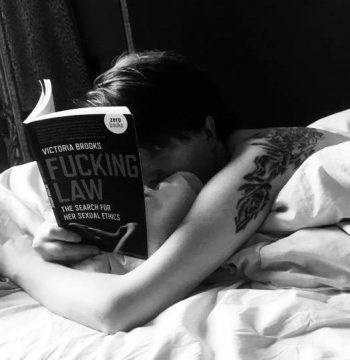 Andy West interview with Victoria Brooks in 3:AM Magazine:
 Felicia Wong in the Boston Review:
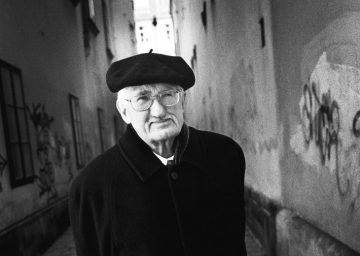 Thomas Meaney in The New Statesman: