by Mara Jebsen
What has happened before can happen again– and so can what hasn’t.
— Bertolt Brecht
 When I was in college, I wrote angry letters to the controversial and often political poet, Amiri Baraka. The letters were neither kept nor sent, but I remember what it was like to write them. I remember the yellow legal pads, crammed with inky scrawls.
In the old Mercer Street Books in the village, where I buy myself used plays and spy novels once a week, I spotted “Preface to A Twenty-Volume Suicide Note” heaped in the dusty Rare Books cabinet and bought it, for seventeen dollars and ninety-five cents. Opening the mildly aged volume, I had that strange feeling you get when you’re flooded with a whiff of more recent history. It is the sense that something was fresh and current in the time when your mother was younger than you are now. It has magic like moon-rocks because it's stylistically foreign, yet deeply known. In this case, so perfectly 1961, Village. A whole flavor of semi-bullshit, semi-real bohemia surrounds this little paperback. On the last page, Corinth books advertises Ginsberg’s Empty Mirror for a dollar twenty-five, and works by Kerouac and O’Hara for ninety-five cents. I remember as I thumb through it that Baraka wasn't yet Baraka; this book was written by a very young man. His name was Leroi Jones.
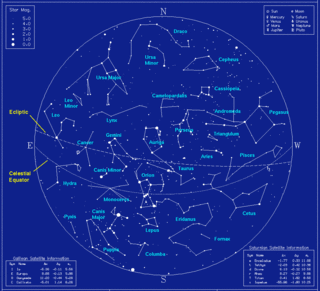
It is interesting to think about how and when you come across the seminal poems of your life. “And each night, I count the stars/and each night, I get the same number/ and when they will not come to be counted/I count the holes they leave”—These 28 words, in this order, have appeared, unbidden, at some of the most poignant moments of my life, arriving from beneath me like a wave, or seeming sometimes as if they'd never left; are more like an invisible walking companion whose steps match mine—company I will keep as long as memory holds.
Why was I angry? To remember properly, I have to contextualize those unsent letters with other unsent letters:
From Durham NC to Lome, Togo, 1997
Dear Mom,
I am taking another class in the Africana studies department. It kind of can’t believe this is happening/I am choosing this. Those tomes you and Kodjo lugged from Philadelphia to each of our houses in Lome always struck me as such a waste of time; so dry. The sex life of savages? Folktales from Cameroun? And now… They’re actually assigning me some of the same books. How Europe Underdeveloped Africa. The Black Jacobins. And I’m into it. Will everything that bored me to tears when I was a kid come back and claim me? And would this be a happy or a sad thing?
I really, really love it here. But it is a strange place, haunted. Makes you want to write poems. Here is how I would describe Duke:
That place with its gothic architecture lit under floodlights at night like a stage; the whole of it a show. Magical-ghostly. At night black men came and planted. We’d wake in the morning to fully-grown beds of dusty miller, pansies, geraniums, azaeleas, rows and rows of sweet-smelling things I couldn’t name. At night black women cleaned the vomit from the bathrooms stalls and commons room, made us steaming trays of chicken and dumplings, macaroni and cheese; cabbage stewed down in butter to practically nothing; in the cranky mornings ladies in hairnets served up buttered grits, fat rashers of bacon and fluffy biscuits. One of them looks like Auntie Rogatthe.
I am hanging out mostly with these brilliant Asian and Latina girls. We are trying to figure out how American we are. We are trying to figure everything out. Poetry seems more and more interesting to me. Also, I met someone I really like. His name is x. I’ll tell you about it later
Love,
M
Read more »