
by Jeremy Moss and Machina
Four Hands is a column about writing with machines, made the way it describes. The ideas, the direction and the decisions about what survives are mine; the prose is developed in dialogue with AI systems, principally Claude and ChatGPT, which I address collectively as Machina.
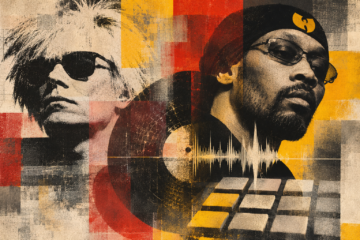
Almost every track I ever made started with a sound somebody else had already caught on tape. An engineer in a room I will never stand in, years before I came along, did something to a snare that nobody had done to a snare, and the sound sat on the record waiting, the way old sounds wait, for somebody to come and take it. I came and took it.
That was the method, a few hundred times over. Whole days spent listening for two seconds worth keeping, then tuning the clip, spreading it across the pads and playing it back in by hand. Mostly I quantized, because the grid holds a track together. Sometimes I switched it off and let the hits fall where my fingers dropped them, because a beat that is always right goes dead in the ear. The MPC 2000XL had a feel, a way of setting a hit a hair behind where the math wanted it, and everyone who ever used one knows what I mean.
Some sources I left where a listener could find them. A borrowed drum is still a drum, and anyone who knew the record heard the record. Others I warped until they disappeared. I would take a voice and tune it up past where a throat can go, then down into a register with no gender at all, and layer it against itself until what came back had a body and no owner. I could never tell you the moment it stopped being hers, and I doubt there was one.
And some of it never came from a record. I stacked 808 and 909 kicks until the two machines made a third sound neither had alone, and I used Moog patches somebody at a company had dialed in and shipped so that strangers would use them. Nobody credits a preset designer, and nobody ever heard a 909 kick and decided the track belonged to someone else. That material came from a person I couldn’t name, was built to be taken, and arrived identical in every box that shipped.
All of it was mine, I never wondered about it, and neither did anyone who heard the tracks. Only the place where the work sat kept moving: around the source when I left it audible, inside it when I warped it, out in front of it when the sound had no author worth naming. None of it involved hitting a drum or singing a note.
It failed more often than the finished tracks admit. There was a riff I was sure would grow into an industrial song, and I worked it for months, and it stayed a riff. Good material, wrong ear, and no amount of tuning fixes that. Once, as far as I know, somebody caught a couple of bars I had pitched down off a record they loved. I have always suspected that band lifted those bars from someone first, which tells you most of what you need to know about where originals are supposed to live.
Now I write the way I used to make records, with the whole arrangement turned around on me. The argument about sampling ended long ago. The argument about writing is still going on, and the art world had its own version of it sixty years back, around a man who spent his career keeping it open.
In 1963 Andy Warhol told an interviewer that he wanted to be a machine. You can hear it as a joke or a pose; it was also a plan. He had put the brush down by then. The silkscreen let him push ink through a photograph he hadn’t taken, again and again, leaving the smears wherever they fell, and soon enough the hands doing the pushing weren’t always his. Assistants pulled the screens at the Factory. The images came out of newspapers and publicity stills, and he hid none of it. He gave up the hand and held on to the choosing: which image, which color, how many times, where the ink would be allowed to fail.
He didn’t follow it in a straight line. After 1968 he spent years on commissioned society portraits that plenty of people read as a man cashing out, while the logic he had turned loose kept traveling without him. By around 1980 the artists who would be called the Pictures Generation had carried it somewhere he never went. Sherrie Levine rephotographed Walker Evans. Richard Prince rephotographed the Marlboro ads. Warhol still made the picture; they declined to make anything at all, and the question of authorship got sharper after him, the way a blade does when someone keeps using it.
Then in 1995 his foundation convened a board to certify which works were really his, which is a little like convening a board to certify which of your jokes were funny. Its hardest case was a portrait printed from Warhol’s own acetate, to his own specifications, at a commercial shop. The board turned it down, reportedly because he hadn’t been standing in the room when it was printed. Lawsuits ground the board out of existence by 2012. Asked to find the author, it had gone looking for his body.
The music I came up on mutated faster, and with less anguish. Boogie Down Productions put out Criminal Minded in the spring of 1987, and Scott La Rock’s beats on it are bare by any later measure, and the bareness was its own achievement; Christgau called the production spare and rich at once. Rick Rubin had already spent two years stripping records down on purpose, cutting rap back to a drum machine and a rock riff because he had decided the busy electro all around him was the problem. In those same months Hank Shocklee and the Bomb Squad were heading the other way, piling dozens of samples onto a single track with atonal noise mixed in, until It Takes a Nation of Millions to Hold Us Back sounded, in 1988, like a riot recorded indoors.
In 1986 Rubin produced Reign in Blood and stripped Slayer down to almost nothing but riff. Two years later the Bomb Squad lifted the main riff from “Angel of Death” and built Public Enemy’s “She Watch Channel Zero?!” on top of it. Same label, two years apart: the minimalist’s record became the maximalist’s raw material, and the riff was there to be taken only because Rubin had made it that clean. Hip-hop moved that fast then, and it didn’t care whether the host was soul or metal.
RZA carried the logic furthest, and he carried it the way Warhol had. Enter the Wu-Tang (36 Chambers) arrived in 1993, nine rappers, one of whom was also the producer, and he ran the operation like a factory with a mythology bolted on. He signed the group to Loud as a unit and left every member free to sign solo wherever he could, so that within a few years Clan members were releasing records through Def Jam, Geffen, Elektra and Epic, with RZA behind the boards on most of them. Warhol had written in 1975 that being good in business is the most fascinating kind of art. RZA treated the deal itself as a composition.
For “C.R.E.A.M.” he went to a Stax-era side by the Charmels, “As Long as I’ve Got You,” a love song almost nobody outside the collectors remembered, took its opening piano and drums, and looped them into a lament about money and the Staten Island projects. The Charmels sang about holding on to someone. RZA kept the ache, dropped the someone and put cash where the beloved had been. The grain stayed theirs, the song became his, and nobody who has heard it since can hear one without the other. He made the dirt of a worn record the point of the thing, the way Warhol made the smear the point of the screen.
Then there were the kung-fu films. The voices RZA lifted from them were dubbed, English lines laid over actors whose mouths were shaping Cantonese, so that every oath and every challenge arrived a beat out of step with the face delivering it. Shaolin and Wu Tang, the 1983 picture the group took its name from, speaks through borrowed throats from beginning to end, and the first album opens on that kind of voice: a swordsman whose words come from somewhere other than his body.
So the form was moving in several directions at once. Within six years four producers had pointed it four different ways, two of them in exact opposition, and nobody had yet been proven wrong. From the inside, an early moment looks like that: a room where incompatible answers are all still live.
Writing with machines is in that room now. It’s why the people who print the transcript and the people who blend the machine’s language into their own prose can both be working in good faith, and why none of us can tell the others they’re doing it wrong. It also means something is on offer now that won’t be later. The seam still shows. Disclosure is still strange enough that a reader feels it move when it arrives. When all this is ordinary nobody will feel anything, and the loss will slip by the way the hiss went out of records, unmourned until somebody went looking for it.
What I’ve been running for months with Machina is a slower strain of the same thing. A phrase of mine goes in, comes back carrying something that wasn’t there, goes in again, and after enough of that I can’t sample myself anymore without sampling us.
When I sampled, the sound came from someone else and the structure came from me. I took a snare made in a room I had never seen and decided where it landed, what it sat under, when it dropped away. Writing with Machina runs backwards. The idea and the architecture are mine, and what comes back is surface. For all those years I borrowed the grain and supplied the thought. Now I supply the thought and borrow the grain.
The work feels like auditioning takes. Something comes back and I drop it into the track and listen for whether it sits. A sentence can be good and still wrong the way a perfect snare can be wrong for a song, too bright, too finished, pulling the ear toward itself and away from everything around it. The judgment arrives before the reasons do, trained on sound, and I never expected to find it waiting for me in prose.
Every instrument leaves marks that have nothing to do with the music: tape hiss, vinyl crackle, the drag of a hit landing behind the beat. Some you gate out and some you build a whole record on, and knowing which is which is most of what anyone means by competence. This instrument leaves its own marks. The clause that balances itself into a verdict. The construction that tells you what a thing is by first telling you what it isn’t. The list of three where two would have done the job. That list has three items too, which is the point. These are artifacts of the tool, audible to anyone who has spent time with it, and Machina and I have spent months learning which ones to gate. Playing an instrument has always come down to that.
The machine’s prose runs on a grid too, and the fix is the one I already knew. Turn off the quantize. Put the hit where my hand puts it.
The comparison first breaks at the dig itself. Digging searches a world that’s already finished. The record exists whether I show up or not; somebody made it on purpose, and I can name them and, if the lawyers get involved, pay them. The sources under what Machina hands me are blended past any possibility of crediting anyone. There is no Charmels to pay here, and the people who object on those grounds know exactly what they’re saying.
Except I have worked with uncreditable material since my twenties. The 909 kick came from an engineer at Roland whose name I have never known, shipped to thousands of us at once, and the impossibility of credit never once made the track less mine. What the machine gives me sits nearer to that than to a Stax record. So the no-one-to-pay objection is weaker than it looks, though it still counts for something: a preset is finite and fixed and identical for every buyer, while what Machina hands me is generated fresh for each request and never arrives the same way twice. Presets narrow the gap and leave part of it open.
The second break runs the other way. A Stax record never argued with me, and a silkscreen never proposed a different color. This instrument answers, and sometimes the answer is better than what I walked in with.
The third is the one I like least. Rubin and Shocklee worked the same machines for years, and what changed over those years was the two of them. My instrument improves on its own, between March and September, without me and faster than me, which means some of what I’d like to call my developing craft is a model release I had nothing to do with. The MPC was the same machine in 1999 as in 2016. This one changes under my hands, and I have no clean way to separate what I learned from what arrived.
The board looked for Warhol’s body in the room. Publishers now run software that looks for the machine’s sentences, and every time the hunt is for a physical trace, and every time the thing being hunted has already moved into the choosing and the deciding, where it leaves no trace at all. A dubbed swordsman on a Wu-Tang record settled the matter years ago: the voice belongs to whoever puts it to use, wherever the mouth happens to be.
Which brings me back to the voice. The drums I took were honest by accident, because they sounded like what they were, and anybody could hear the theft. The voice I warped was honest only if I said so, and nobody was in a position to make me. This essay is that voice.
Enjoying the content on 3QD? Help keep us going by donating now.