[This is an edited version of my presentation on This I Don’t Believe: A Fulfilling Life without Meaning* at the Unitarian Universalist Fellowship in Salina, KS, on November 1, 2026. Video of the event will be aired on C-SPAN’s Book TV network.]
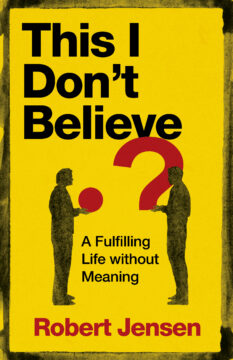
I have spent much of my life on the run—not legally, but emotionally and intellectually—first running away from what I didn’t understand about myself and then running toward what I wanted to understand about the world. My new book, This I Don’t Believe: A Fulfilling Life without Meaning, is an account of how I slowed down.
I’m grateful for the little bit of understanding I think I have scratched out from all that running, but these days I’m willing to accept what we can’t understand—about ourselves and the larger world.
These days, I’m trying to stay home and be decent.
I borrow the phrase “stay home and be decent” from Wendell Berry, via Wes Jackson. In one of his talks at The Land Institute’s Prairie Festival, Wes poked fun at people who claim to be leading the parade, telling a story about how he and Wendell once got invited to a conference that promised talks by a number of “intellectual frontiersmen.” Wendell declined, saying that he preferred to stay home and be decent.
But life is full of contradictions. I once heard Wendell quip that he spent a lot of time traveling around the country telling people they ought to stay home. Wes has spoken often about his love for his home on Kansas prairie, but that didn’t stop him from frequent flying all over the world to spread the gospel of Natural Systems Agriculture. Doing the right thing is complicated.
A quick pause. Some of you may be thinking that I’m not-so-subtly associating myself with two insightful writers on ecological and cultural matters so you’ll think of me in the same category. I hope that worked. But I also want to emphasize the need for humility: We all build on the work of those who came before us, and that’s especially true of my writing.
I want to start by marking Wendell’s passing in August and acknowledge how much I learned from his writing, even when I disagreed with his analysis. And I want to honor Wes, who’s here today with his wife, Joan. Perhaps more than any other thinker, Wes’ work reshaped how I saw the world, starting nearly four decades ago when I read New Roots for Agriculture. It’s been an honor—and great fun—to move from being a reader of Wes to a coauthor. More important is that I count Wes and Joan as friends. As many of you know, The Land Institute wouldn’t have thrived without them. They have made important contributions to the human future (if there is going to be a human future much longer) right here in Salina.
Not Special
This I Don’t Believe: A Fulfilling Life without Meaning is an unconventional mix of philosophy and memoir, abstraction and experience, self-reflection about my life and my species. But it’s mostly a plea for humility.
At the core of the book is one simple point: I’m not special. I hope you read it, but I can’t claim to offer new insights into the human condition. My goal was to make sense of important, but sometimes arcane, philosophical and theological debates in plain language for ordinary people, of which I am one.
But don’t get cocky. I’m not special, but you’re not special either. More importantly, we aren’t special. We are a clever species, but we aren’t special. The book tries to come to terms with how we can love our places and people without assuming we’re special, individually or collectively.
A bit of my background might be helpful here. I’ve been writing in public since I wandered into my high school newspaper office 52 years ago, when I was 16. I stuck with newspapering through my 20s, then wandered off to grad school, got a Ph.D., and landed a job at the University of Texas at Austin, where I taught for 26 years and did a lot of community and political organizing, all of which generated books. Depending on how you count them, This I Don’t Believe is my 13th effort—books on media strategy, militarism and war, racism, sexism and sexual exploitation, progressive Christianity, love and friendship, the erosion of critical thinking, Jackson’s work, and the multiple cascading ecological crises and the likelihood that a large-scale human presence on Earth won’t continue for much longer.
I’m not special, but many people have told me that I’m a bit odd. I describe myself as unexceptionally unusual. I’m a mostly unremarkable fellow from North Dakota, culturally unsophisticated with average intellectual ability and no discernable creative talents, and I was a late bloomer. It’s hard to figure how I managed to become a full professor at a major university and write books, especially given the trauma that defined my childhood and haunted me most of my adult life, which I describe in the book.
I also don’t fit into conventional political or philosophical categories. One reason I’m an oddball can be found in Carl Jung’s famous statement, “Man cannot stand a meaningless life.” Well, I can stand a meaningless life just fine and, as the subtitle of my book suggests, I consider that meaningless life to be fulfilling.
Meaning and Purpose
By meaning, I mean a Big Source of Meaning beyond everyday experience, the kind of meaning people find through transcendence, seeking the sacred and mystical; the kind of meaning that comes with believing we have a Grand Purpose that emerges from that transcendence. I have rejected the common sources of meaning—belief in God, spirituality, Nature mysticism, and free will. Those things, I don’t believe.
But back to humility. I’m not arguing that I’ve definitively answered these big questions. When I say that people can live a fulfilling life without meaning, I’m really saying that I live a fulfilling life without meaning. I don’t need to prove I’m right because these aren’t the kinds of questions that have right-and-wrong answers. This I Don’t Believe tracks my philosophy through four of those big questions:
- Is there a God or gods?
- Even if there is not, is there some spiritual plane of human existence beyond the physical?
- Even if not, can we trust in Nature (with a capital N) to provide meaning?
- Even without those sources of meaning, do we at least have free will within the physical world?
Most people answer “yes” to at least one of those, and in that “yes” find grounding for that Big Meaning and Grand Purpose in their lives. My answer to each is “no.” I don’t see a basis for believing that my life—or our lives—have inherent or externally generated meaning or purpose. How do I find fulfillment without meaning? The last section of the book explains that for me, a life of Thinking (specifically about how the world works) and Work (at productive tasks that are worth doing), grounded in Routines (to give structure to the days, and years) has been enough. I’m satisfied with the ordinary.
First, about God. When folks ask me if I believe in God, I ask them to define God, which turns out to be difficult for most people. In my experience, people use the term in two different ways. One is a description of a force, entity, or being that created the world and has the power to direct history. Call that a supernatural God. Others use the term to talk about the vastness of what we don’t understand. Call that a symbolic God. I don’t believe in a supernatural God because I have never found evidence for such a force, entity, or being, and I see no reason to exempt questions about God from regular processes of evaluating evidence. And I negotiate the complexities of life without a symbolic God.
The same analysis applies to “spiritual,” a term that some use to describe a nonphysical plane of existence, a space in which the concept of a nonmaterial soul makes sense. Others use it as a synonym for living an engaged and ethical life that isn’t defined solely by short-term success and pleasure. Again, I don’t believe in the former and have no idea what a “soul” might be. And I don’t need the term spiritual to describe the quest to be a good person.
The chapter on Nature (with a capital “N”) may be a bit more contentious, especially for those with an ecological worldview. Of course, I believe in nature (small “n”), using the term to describe the physical world on which our lives depend. We are part of that nature. But I don’t see any Big Meaning or Grand Purpose in capital-N Nature. I don’t assign to that physical world any mystical characteristics. By observing ecosystems, we can find patterns and learn things that might enhance human flourishing and slow the rate of ecosystem degradation. But we have to work at learning those lessons; they don’t float down from a mystical realm. When Wes talks about “nature’s wisdom” being superior to “human cleverness,” I take him to mean that we should pay close attention to nature to understand those patterns, not wait for Nature to convey wisdom to us.
I think many of my comrades in the left/progressive/environmental movements, who often aren’t religious or spiritual, hold on to Nature Mysticism as a source of hope, which I understand but don’t share. I also think it’s why environmentalists so often offer Indigenous Wisdom as a source of solutions to the multiple cascading ecological crises that overwhelm us. (An aside: We should separate a much-needed critique of European barbarism in the New World, and of the ongoing failure of US policy toward native nations, from theological/spiritual/philosophical questions.)
Is there such a thing as Indigenous Wisdom? Yes, just as there is wisdom in every tradition. But we should be realistic about what that wisdom offers at this moment in history. Native North American societies were more sustainable than the European societies that replaced, and sometimes eliminated, them. But those were low-energy societies with relatively low population densities. The highest estimate I’ve seen for the precontact population of the continental United States is 15 million. Today, 340 million people live on that same land. The lifeways developed for a pre-fossil fuel society may offer insights but won’t support more than 20 times the population. No society—indigenous or colonial, First or Third World, white or nonwhite—provides a blueprint for getting to “fewer and less”: fewer people consuming less energy, the phrase Wes and I think should guide economic and ecological policy planning.
Nothing I’ve said excuses European barbarism or denigrates indigenous societies. I’m simply stating the obvious: If there is to be a long-term and large-scale human presence on Earth in the future, it won’t be achieved with appeals to a past that can’t be replicated.
Finally, my rejection of free will is rooted in a physicalist worldview that doesn’t elevate science beyond its limits but takes seriously the findings of science. In philosophical terms, I’m a monist and determinist. That’s a longer story we don’t have time for now, but I’m happy to talk about it during the conversation period.
And, you’ll be happy to hear, I’m about to shut up and turn things over to all of you.
Against Arrogance
A quick summary of what I’m rejecting. A recent essay by a philosopher focused on two questions relevant to our discussion: Is human life meaningful? Is the universe pointless?
He summed up his project this way: “the Universe has a purpose that the human mind can intuit as the realisation of freedom in the sphere of conscious beings and the perfection of nature in the sphere of nonconscious beings.” That I don’t believe. There’s not a single claim in that sentence that makes sense to me.
But one final note about humility. When I reject these beliefs, I’m not claiming to have answered unanswerable questions. It’s possible to engage these questions, including the threats of those multiple cascading crises, without arrogance. I want to end with one of my favorite sentences that I have written.
Because no one has a workable plan for a graceful human retreat from ecological overshoot, I have argued that “the moral high ground is a dangerous place to stand, even when it’s warranted.” That doesn’t mean we shouldn’t try to live moral lives but only that no one has neat and tidy answers to intractable problems, and being cocky about political programs and personal choices doesn’t help anyone.
This I do believe: “the moral high ground is a dangerous place to stand, even when it’s warranted.”
—-
* An explanation of the book’s title, which may sound familiar. “This I Believe” was a 1950s radio program hosted by Edward R. Murrow that featured short essays about where people found meaning in their lives. National Public Radio revived the project in the 2000s, producing radio essays and books. My title acknowledges my contrarian streak.