
by Robert Jensen
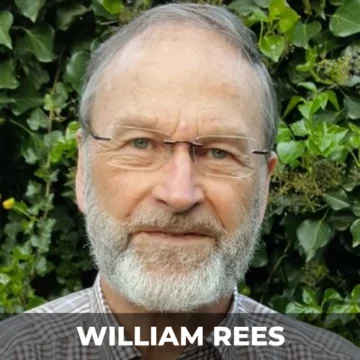
Bill Rees likes to say that ecological footprint analysis began with an epiphany—when he was 10 years old.
Sitting down to lunch on his grandparents’ Ontario farm with relatives he had worked with that morning, the sweaty kid realized he had played a small part in raising everything on the table—beef, chicken, potatoes, carrots, and a few other items the farm had produced so far that season.
Rees remembers the moment as thrilling. “You know the expression, ‘You are what you eat’? As a child, I realized I am what I eat, and that I grew what I ate,” said the renowned ecological economist, now 82. “I knew deep in my bones that farm work and food made me a product of soil and sun.”
That may seem simple, but how many people think about the importance of soil? Today’s high-energy/high-technology culture too easily obscures our dependence on ecosystems. Rees has spent his career trying to alert people to the consequences of ignoring ecological realities.
With his coauthor and former student Mathis Wackernagel, Rees in 1996 published Our Ecological Footprint: Reducing Human Impact on the Earth. Perhaps today’s most well-known sustainability metric, Ecological Footprint Accounting (EFA) estimates human demands on the carrying capacity of Earth. Comparing human consumption of bio-resources with Earth’s regenerative capacity, EFA shows that we are in overshoot—consuming resources faster than they can be replenished and generating wastes faster than they can be absorbed.
Rees retired from teaching at the University of British Columbia in 2012 but continues to sound the warning: Modern techno-industrial (MTI) society is unsustainable. Humanity’s total biological resource consumption and waste production exceed ecosystems’ regenerative and assimilation capacities.
Developing an Ecological Worldview
When Rees got to college, those farm experiences led him to the Life Sciences program in biology and ecology at the University of Toronto, where he went on to earn his Ph.D. in population ecology in 1972. He landed a faculty job in UBC’s School of Community and Regional Planning, where the director asked him to develop an interdisciplinary program on the ecological basis of economic development.
In planning meetings with economists, engineers, hydrologists, and geographers, Rees offered his early thoughts on carrying capacity. Senior colleagues assured him that globalization and free trade could alleviate the problem of local ecological limits and that free markets would stimulate development of substitutes for depleted resources. The not-too-subtle caution was that challenging the conventional wisdom that population growth and economic expansion could continue indefinitely would not help his career.
Rees’ deference to elders didn’t stop him from rethinking the standard definition of carrying capacity. Yes, trade and technology can ease local resource constraints, temporarily, but Rees’ farm-based awareness of our dependence on the land helped him invert the framing. Instead of asking how large a population a given area can support in an existing economic system, we should be asking how large an area is needed to support a given population, regardless of the location of the land providing sustenance. For example, the question isn’t “How many people can a city’s infrastructure support (subsidized by the sleight-of-hand tricks of trade and technology)?” but “How much distant land is needed to support the city’s residents?” Urbanites’ ecological footprints extend far beyond the city limits.
EFA uses consumption data from numerous sources to answer two questions. First, in any given year, how much of Earth’s bio-productive land and water (such as cropland, grazing land, forests, fishing grounds) are used to support a population, including the ecosystems needed to assimilate its emissions? Second, how much productive bio-capacity is available for that population to draw on? EFA shows that the human enterprise today is in overshoot, drawing down stocks of so-called natural capital and over-filling nature’s waste sinks.
The Problem of Overshoot
Most people treat climate change as the greatest ecological threat posed by MTI society. Rees offers a friendly but crucial amendment: Climate destabilization is a derivative of overshoot.
In 2024, 8.2 billion people had a total ecological footprint of approximately 21.4 billion global hectares (gha), an average of 2.6 gha per person. Available global bio-capacity was 12 billion hectares, or 1.5 gha per person. Not everyone consumes the same amount, of course, but as a species we are exceeding the planet’s regenerative capacity by about 75 percent. If we could replace all fossil fuels with alternative energy—but with the same number of people and the same aggregate consumption—we would still be in overshoot.
In other words: MTI society is unsustainable. Overshoot is, by definition, a terminal condition.
(A footnote: EFA is based on varied data sources and can’t be precise, given the margin of error in large-scale estimates. Critics suggest that this makes it unreliable as a sustainability metric. Rees argues that, if anything, EFA assessments underestimate humanity’s eco-predicament. Data from the Food and Agriculture Organization and other UN agencies, for example, reflect yields and productivity but not the depletion of the soil and water on which those yields depend. Also, EFA estimates only human demand for productive ecosystem area (bio-capacity); not all human demands on nature, such as toxic pollution, are captured by the method.
What’s Necessary?
A stable human presence on Earth will require far less consumption. Rees estimates that living within planetary bio-capacity would mean reducing economic throughput (energy and resource consumption, and pollution) globally by half. But to safeguard 85 percent of bio-diversity, half of global bio-capacity would have to be reserved for nature, which suggests that humanity’s current ecological footprint may be three times too large and require up to a 70 percent reduction. And sustainability with justice—greater equality of access to economic and bio-physical wealth—would mean that those with above-average wealth would have to reduce their consumption even more dramatically.
That leads to a question that has no definitive answer: How many people can Earth support, at what level of consumption?
Based on ecological footprint data, Rees suggests Earth might support up to 2 billion people living at Western European material standards. That roughly matches the estimates of other ecologists but may be optimistic, he said. Given non-renewable resource depletion and the degraded state of the ecosphere today, a human population compatible with long-term sustainability might be in the tens or hundreds of millions.
“’What’s the optimal population?’ really is an unanswerable question because of the known unknowns and unknown unknowns,” Rees said. “How would the fractious, competitive, sometimes warring, and grossly unequal global community agree on an adequate material standard of living? What is the trajectory of climate change, especially if we use all economically accessible deposits of fossil fuels? And if we do that, how do we maintain food production and supplies of other crucial resources? How would we provision megacities that are dependent on diesel-fueled transportation?”
But we do know enough to recognize the outlines of humanity’s eco-predicament, Rees said. “We have a fairly firm grasp of the bio-physical trends that threaten the ecosphere and humanity’s future, and we are coming to understand the most significant anthropogenic drivers of overshoot. This means that we actually know what must be done to change our relationship with nature to reverse threatening trends. The problem is that all the effective whats involve a smaller economy with greatly reduced energy and material throughput, and lower populations.” Collective action is essential, but difficult.
“After two centuries of explosive growth, MTI societies have enormous cultural and population momentum fueled by bio-physically unrealistic material expectations,” Rees said. “Any significant structural changes are vigorously opposed by corporate entities—some more powerful than many nations—that have a vested interest in maintaining the status quo. So, while science tells us what to do, we do not yet know the how of making the necessary civilizational-level shifts in beliefs, values, attitudes, behaviors and power structures. We’re flying in the face of culturally entrenched habits and innate behavioral barriers.”
What’s Possible?
Rees said that social policy should be shaped by data, logic, and a love for others and nature. But political and economic institutions find it easy to ignore the overshoot predicament. In his cultural analysis, Rees remains an ecologist, thinking about humans as products of evolution, not creatures with magical capacities. Overshoot can’t be blamed on a few bad actors but rather is the product of understandable human tendencies.
Like other species, humans are capable of exponential population growth and tend to harvest all accessible resources as rapidly as their technology allows. Unfortunately, for the past 200 years—thanks largely to improved population health (falling death rates) and fossil fuels (making rapid growth possible)—our species has been embracing our expansionary potential, Rees said.
Unlike other species, we create complex stories and behavioral norms that guide both individual and group behavior. These social constructs are powerful enough to obscure ecological reality and encourage self-destructive behaviors.
Almost all humans now live in social arrangements dramatically different from the smaller, more cooperative groups in which we evolved, when we inhabited limited territory and extracted far less energy from the landscape, Rees said. With the rise of competitive and hierarchical civilization, humanity expanded over the entire Earth. Here are a few more evolved human characteristics that he said keep us from facing overshoot.
- Most people are temporal, social, and spatial discounters, favoring the here-and-now, close relatives, and friends—to the detriment of the future, foreign places, and strangers.
- Most nations are reluctant to share their wealth or sacrifice comfortable lifestyles for the general welfare, present or future, particularly if they think few others will do the same.
- Because human societies are competitive, open-access resources such as deep-sea fisheries or the atmosphere that are “rivalrous and nonexcludable” (not owned by anyone and accessible to everyone) can be overexploited.
Rees said the reason to be honest about today’s “genetically induced cultural lethargy” is not to promote apathy but to be clear about impediments. There is little immediate incentive for individuals or nations to act alone in ways that are consistent with sustainability science, and insufficient agreement and mutual trust to motivate collective action to reduce the human footprint.
What’s Left to Do?
Given what Rees knows from more than a half-century of research, why does he still spend so much time advocating change that seems unlikely?
“I suppose it’s what I do to keep my internal fires burning,” he said. “And there is some small reward in hearing from former students, some from decades ago, who say they were skeptical about issues we studied in class but now see it all unfolding just as we discussed way back then.”
Does he resent being ignored by colleagues for so long, or by the public even today?
“I got used to being ignored, mostly by traditionally trained economists, geographers, and planners,” he said. “For many years, I was barely tolerated by certain colleagues, maybe because students who took my courses started asking difficult questions in courses taught by growth- and development-oriented colleagues.” Change came only as it became harder for even conventional scholars to ignore ecological degradation.
Rees said he is grateful for the recognition that eventually came his way—the Blue Planet Prize with Wackernagel, along with other awards in the field of ecological economics, and being named a Fellow of the Royal Society of Canada.
“The success of the ecological footprint concept meant that students who worked with me could find good jobs, which is a personal boost”, he said. “But policy wonks, politicians, and other major decision-makers give no more credence to findings based on EFA documentation of gross eco-overshoot than they did to The Limits to Growth report [a presciently accurate account of overshoot published in 1972]. Fifty-four years later, the human enterprise is on track for significant contraction later in this century, just as Donella and Dennis Meadows and their coauthors projected and our work affirmed.”
Rees hasn’t slowed down, continuing to publish in scholarly journals, write for popular publications, update his Substack, speak on countless podcasts, and advise advocacy groups.
“I suppose I have to admit to a minor human failing,” Rees said, “one articulated by an ecologist friend who told me that he took pleasure in being able to say to former doubters, ‘I told you so!’”
Given the stakes, Rees would love to be proved wrong. But an honest conversation requires that we set aside fantasies such as colonizing Mars and work to get it right here, Rees said. “Earth is likely the only home H. sapiens will ever know.”
We also have to recognize that our relationship to Earth is asymmetrical.
“The ecosphere is totally indifferent to whether human civilization, or even our species, survives,” Rees said. “On the other hand, humans cannot be indifferent to maintaining the functional integrity of the ecosphere. Without that, we’re toast.”