by Dwight Furrow
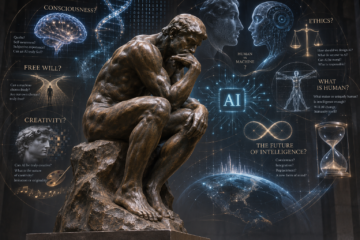 Two arguments coming from the AI crowd seem to be the loudest: (1) We’re all going to die rather soon, but (2) if we survive, we will live in a utopia. (1) comes from the concern that a superintelligence that cannot be aligned with human values will have no use for inferior creatures like us and will wipe us out. (2) is based on the claim that an aligned superintelligence creates an abundance of everything we could want without the input of human labor. Neither argument is supported by credible, corroborated evidence. They are wildly speculative predictions about a very uncertain future but are asserted with the zeal and vigor of undergraduate dorm room debates fueled by alcohol and unmentionable other substances.
The moral justification for organizing our priorities around these predictions is based on a view, widely held in Silicon Valley, called effective altruism. Effective altruism is a diverse movement, but in its most comprehensive theoretical formulation, it asserts that society and each individual in society should use scientific evidence and cost-benefit analysis to identify which actions save the most lives or prevent the most suffering per unit of resource and then endeavor to put those findings into practice by maximizing the expected value of every dollar or hour spent. The most prominent branch of effective altruism, called longtermism, asserts that future generations have the same moral value as people living today, even though they have not been born yet. Because humanity could potentially exist for millions or billions of years, meaning the number of future lives at stake is astronomically large, their welfare far outweighs the welfare of earth’s current inhabitants and their immediate progeny.
Both the claim that AI threatens human extinction and the claim that we are on the cusp of a world of radical abundance are based on assumptions about the power of this technology and our ability to control it. But the claim that these two scenarios should be top of mind—at the forefront of policy debates and cultural influence—follows from the confluence of effective altruism and longtermism. Longtermists argue that if humanity survives and builds aligned superintelligence, we could cure all diseases, end poverty, and eventually colonize the stars. Because the universe could support trillions of happy future humans (or digital minds) over billions of years, the expected value of achieving an AI utopia is astronomically large. Conversely, if unaligned superintelligence wipes us out, the loss isn’t just the 8 billion people currently alive—it is the permanent erasure of all those trillions of potential future lives.
Because the stakes of both outcomes are astronomical, they create the urgency that drives the AI industry’s behavior. Even if an AI researcher thinks there is only a 5% chance that AI kills everyone, multiplying a small probability by an infinitely bad outcome like eternal extinction makes preventing AI doom the single most important moral priority in human history. This explains why effective altruist-linked organizations, especially Anthropic, focus so heavily on aligning AI behavior with human values rather than on immediate, everyday issues like the environmental costs of data centers. And it is why Anthropic thinks only they can be trusted to safely build AI. On the flip side, some factions within effective altruism argue that delaying superintelligence is also a moral catastrophe. Every day we delay an AI-driven utopia of radical abundance is another day millions of people suffer and die from preventable diseases and poverty. Therefore, building superintelligence quickly while trying to keep it safe is framed as a moral duty.
Now if you recall some of those dorm room conversations you enjoyed many years ago, you might be hearing an echo. The philosophical engine driving Silicon Valley’s effective altruism and longtermism debates is almost entirely recycled 19th- and 20th-century utilitarian theory. If you read William MacAskill’s What We Owe the Future or Nick Bostrom’s papers, you are looking at tech-flavored repackaging of debates that Henry Sidgwick, Derek Parfit, and Peter Singer already mapped out in exhaustive detail decades ago. Denizens of Silicon Valley have long thought of themselves as being on the cutting edge of culture, but their intellectual foundations are as shop-worn as a prosperity preacher’s promise that wealth is proof of virtue.
To refresh your memory, utilitarianism is an ethical theory in which the morally right action is the one that maximizes net aggregate well-being. In the philosophical literature, there are endless permutations and qualifications proposed as riders to this basic principle, but that principle captures the basic intuition that we should always strive to produce as much good as possible. On the surface, that sounds plausible. But two main problems emerged from these debates. The demandingness objection is that utilitarianism requires individuals to sacrifice too much of their personal time, money, and projects in order to maximize global well-being. Because every person’s happiness counts equally, utilitarianism leaves virtually no room for personal priorities whenever you could be helping someone in greater need. Effective altruism doesn’t solve this problem, but it offers a workaround based on efficiency. If you give away all your money and work yourself to death at a meaningless job, you will burn out and stop contributing. Effective altruism encourages people to pursue lucrative careers that fit their skills and interests, donating a meaningful portion of their income while maintaining a high quality of life. They help themselves to several dollops of moral self-esteem while contributing to our utopian future by getting rich. How special.
But the moral intuitions get even worse. Traditional utilitarians argued about maximizing the happiness of current and near-future populations without prioritizing radically uncertain distant-future calculations. But longtermists like Nick Bostrom calculate that if humanity colonizes the observable universe, we could sustain 1058 sentient digital lives in the future. It is all of those lives we should care about. In this framework, the “demandingness problem” is weaponized: if the future stakes are that high, then protecting human rights or worrying about current poverty looks statistically insignificant. The only thing worth doing is working on AI safety and productivity.
But on what moral grounds can we discount assignable harms to people alive today or in the near future in favor of hypothetical beings in the distant future whose lives we know nothing about? The handwaving by the tech futurists is enough to generate a hurricane.
This brings me to a second problem with utilitarianism which has come to be known as the repugnant conclusion. When you maximize aggregate welfare, a massive population whose members have lives barely worth living can be better than a smaller population enjoying a high quality of life. Derek Parfit in 1984 formulated it this way: for any population of at least ten billion people with a very high quality of life, there exists a much larger population whose existence would be better, even though everyone’s life is barely above zero in well-being. That seems to promote a population policy aiming to produce as many miserable people as possible, valuing sheer quantity of lives over the quality of life. Repugnant indeed. Silicon Valley treats this as an engineering problem to be optimized with trillions of dollars. But, of course, the math doesn’t math out. According to the repugnant conclusion, no matter how abundant our lives become in the future, there will always be a better society to strive for that consists of a much larger population of miserable people.
Tech billionaires use their highly uncertain calculations to justify prioritizing AI development over demonstrable benefits for people alive today. Traditional utilitarians debated human rights versus the greater good using classic, grounded examples (e.g., “Should we torture one person to save a city?”). But the contemporary movement replaces mundane ethics with worries about future existential risk heavily influenced by science fiction tropes and the transhumanist view that we should use technology to overcome all human limitations. We limited beings just don’t matter.
While this is all a rehashing of old debates, what is genuinely new is the sociological profile of who is practicing this philosophy. Historically, utilitarians were academics, social reformers, or legal activists like Jeremy Bentham who was trying to improve the British penal system in the 18th century. They wanted to promote the common good. Today, it is deeply intertwined with tech wealth, software engineering mindsets, and messianic capitalism. It is hard to see where the common good lies among these tech-driven fantasies. Software engineers are trained to optimize systems and eliminate inefficiencies. When they look at global charity or the future of humanity, they treat it like debugging code. This creates a unique brand of hubris where tech elites believe they can “solve” ethics using probability matrices, leading to the spectacular rises and collapses seen in the movement (such as Sam Bankman-Fried, who explicitly cited utilitarianism and effective altruism to justify his high-risk financial behavior that landed him in jail).
To be fair to effective altruism, not everyone associated with this movement is a utilitarian. A person might believe it is a strict moral duty to help the poor, but they want their donations to go to the charity that saves the most lives per dollar. And not all effective altruists are longtermists. Neartermists argue that we know a child in 2026 is suffering from worm infections or malaria, and we know exactly how many dollars it takes to fix it. Longtermists spend money trying to prevent hypothetical AI apocalypses or asteroid strikes 500 years from now. A non-utilitarian effective altruist might argue that we shouldn’t trade real, certain suffering today for highly speculative, unprovable future utility. And many people might think we have a moral obligation to make people happy, but no obligation to create more happy people. A neartermist wants to improve the lives of actual people who exist or will in the near term. A longtermist believes it is a tragedy if billions of potential future humans never get born, treating a non-existent future person’s potential happiness as a loss.
One problem with utilitarianism has always been that it is very difficult to predict the consequences of our actions and who they might affect, especially with regard to strangers and especially in the long run. Thoughtful utilitarians approach this problem with humility and skepticism. Both are in short supply among our tech overlords.
I’m sure that there are a lot of good people working for AI labs and I hesitate to paint them with a broad brush. But their “thought-leaders” seem like poorly informed weirdos profoundly unserious and way out of their depth on moral questions.