
From Nature:
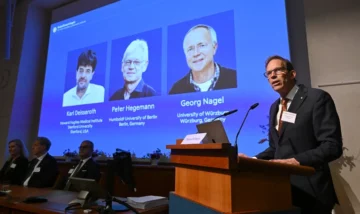 After being on many scientists’ shortlists for years, optogenetics — a technology that allows researchers to control the brain’s neurons with pulses of light — has been recognized by the 2026 Nobel Prize in Physiology or Medicine. The technique has transformed how neuroscientists study the brain, offering them a way to test cause and effect. The winners are Karl Deisseroth at Stanford University in California, Peter Hegemann at Humboldt University of Berlin, and Georg Nagel at the University of Würzburg in Germany. They share the prize of 12 million Swedish kronor (US$1.2 million).
“Optogenetics provides opportunities for mapping the brain in a way that we could once only dream of,” says Per Svenningsson, chair of the Nobel Committee for Physiology or Medicine, in its press release announcing the prize.
More here.
Enjoying the content on 3QD? Help keep us going by donating now.