
by Christopher Hall
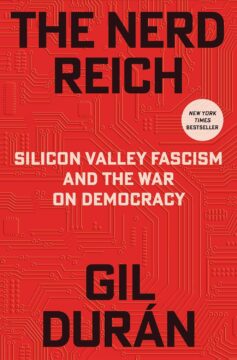
Reading Gil Duran’s The Nerd Reich: Silicon Valley Fascism and the War on Democracy is, as I’m sure it was meant to be, a concerning and surreal experience; the anti-democratic fantasias of Silicon Valley’s elite would be laughable if they weren’t having such a deep influence on the modus operandi of America’s kleptocracy. Duran traces the story from Peter Thiel’s encounter with Davidson and Rees-Mogg’s 1997 book The Sovereign Individual which predicts the total collapse of the welfare state, with crypto and other such decentralised mechanisms sustaining whatever emerges after the disaster. Participatory democracy will be replaced by system in which power is granted those cunning enough to win it, now that they have been freed of the fetters of government regulation and the damnable obligation to look after the lesser. The information age, say Davidson and Rees-Mogg, makes this inevitable, and it is thus not very surprising that the advocates of unlimited and unrestrained technological growth find this vision attractive; it naturally places them, as the “cognitive elite,” at the head of the table.
Duran then winds out the story to show how this vision has been articulated among both resplendent would-be John Galts, like Thiel, Elon Musk and Balaji Srinivasan (current CEO of Coinbase), and basement-dwellers who like to think of themselves as Underground Men, like Curtis Yarvin. This is the sort of power fantasy that reassures its votaries that the collapse will happen naturally and their victory is assured; nevertheless, it wouldn’t hurt to move the process along. The Nerd Reich shows how Thiel’s evangelism (literally, now that Thiel has added a version of apocalyptic Christian dominionism into the ideological mix) has snaked its way though a collection of political action groups and venture-capital firms, all culminating in the election of a Thiel acolyte in J.D. Vance, and the vigorous adoption of cryptocurrency by Trump as both ideological signal and as a means of personal enrichment, which is his primary, indeed only, agenda in his second term.
Srinivasan’s Network State – “states” which organise online initially before crowdfunding to build actual, physical cities in the real world – is a kind of culmination of this kind of thinking. So, presumably, one’s online knitting group – or, God help us all, 4chan – would suddenly burst out into the real world and declare itself a state. Because this is fantasy allied with obscene gobs of money, there have already been attempts to bring it into being: Srinivasan created a kind of libertarian college in Malaysia and called it the Network School. It soon collapsed due to, among other things, an infestation of mold, but Srinivasan has apparently simply picked up stakes and moved to Kazakhstan, where he relaunched the school this past August (Kazakhstan being, presumably, too dry for mold). Other such ventures are in the works: a company called Praxis is planning cities in Greenland (part of the reason, apparently, behind Trump’s interest there), Uruguay and in the middle of the Mediterranean. Malta, be forewarned.
These cities and schools and other such ventures represent, we must say at first, a very curious concept of a “network.” It is a network of entities which, being reified themselves, have a totally reified connection with one another, a connection which forbids any link which is not economic or mercenary; it is as if someone read Marx’s account of alienation and saw it as a blueprint. While, yes, it is funny to think of Ravelry setting up a city in Ghana, online communities are, after all, communal; buying and selling yarn and scarves is adjunctive to the hobby, not at its center. Network states and/cities are not networked communities who share a particular interest in some thing or activity, but only in the mere action of “networking” itself, with all the enervating connotations of that noun wrenched into new being as a verb. The connection, not the reason behind the connection, becomes key; this is a world in which total autonomy is unassailable, and so any deeper level of connection beyond the mere act itself would become a treasonable intrusion on one’s sovereign individuality. As with all extreme ideologies, this form of libertarianism demands that political goals can only be achieved through the most extreme expression of their opposites; we can only forge community if we understand ourselves to be the selfish and self-centered homo economicus that is this philosophy’s sole acceptable understanding of what human being is. “Network” becomes in this case a husk stood up at the doorway to represent what it used to be.
At any rate, what’s compelling about this collection of ideologies is that it seems to make absolutely no reference to the commonweal; it makes plain (which is, perversely, refreshing) that the political system it seeks to produce will exist primarily for the benefit of the elite and few others. There is no democracy in the network city; you may choose to be anything you want, as long as you don’t intrude on the power of the cognitive elite who justifiably rule you. The by-now somewhat tired sci-fi trope of the CEO-as-king, or king-as-CEO, and a social placement putting the corporation at the top and the worker/consumer at the bottom, is now made reality. This setup will allow the Great Men (and they are nearly all men) to do such great things as build Artificial General Intelligence and take us to Mars. Aside from what these men will clearly be able to accomplish, in Srinivasan’s conception, the system is “fair” for all since any individual who disagrees with the current conditions of their network state has the right to move to another; this is their sole means of “democratic” action, the ability to choose states much like one chooses a brand of strawberry jam at the grocery store. (This is a sort-of barely hifalutin version of “If you don’t like it here, just leave.”)
So, things will get a lot better for some and, ever so steadily, worse for everyone else, which is to say, not terribly different from right now, except the only possible redress to one’s progressive immiseration would be to absent oneself. The plumber would perform his necessary task – unless AI somehow takes over that job as well – and would ostensibly even make more money; there would be no such things as taxes, after all. There would also be nothing resembling free or low-cost health, regulations on labour safety or any other kind of safety, no public education and, strictly speaking, no public at all. The libertarian dream of a self-regulating society would finally get its chance to prove that it is the only rational system of economic and political organisation, a system of individuals colliding with and abrasing each other like so many rocks in a tumbler.
Even if we were to convince ourselves – and many have – that we are better off swinging through life without any obligation to others, the life of the plumber would, in fact, be much worse and would likely become so in a hurry. For one thing, it seems obvious to me that a world populated by network states would be one of near-constant war: think the Italian peninsula in the 16th century. Hiding behind Srinivasan’s conception of these free state actors peaceably in competition with one another stands the Hayekian notion that capitalism, once victorious over the cultural forces that inevitably produce conflict, is an inherently peaceful system; trade, allegedly, is difficult to do when the bombs are falling. Of course, we can point to literal centuries of evidence which demonstrate the opposite. War is profitable, at least for some, and if large states have had ample reason to avoid the near-total destruction that would ensue if they were to too vigorously pursue competitive advantage, they were and are more than happy to encourage and fund proxy conflicts elsewhere. International rules and the liberal international order, such as they were (and we should, following Mark Carney, be speaking of them in the past tense), succeeded in preventing most conflicts ballooning into something irreversible on a mass scale – even if the cost came at millions of lives irreversibly disposed of in shadow. If the state were to be whittled down to small, networked entities, and if the only international norm was the rule of constant and unrestrained competition, is anyone naïve enough to think that deadly conflict both subtle and overt wouldn’t become the norm? One imagines a set of cyber-condottieri being the most likely to benefit from such an arrangement. For everyone else, the option to move to another state would become a cruel mockery; citizenship being annihilated, the network state would be the surest way to make “refugee” the default status of nearly every human being.
But silly, stupid visions of the future, as ultra-libertarian visions surely are, exist primarily not because they are likely to come true but because they tell us stories about the present. One doesn’t imagine that the average Trump voter knows who Peter Thiel or Curtis Yarvin are, but the ethos of “success” without moral, political, or material restraint, cloaked in religious folderol and other assorted memes, has been central to a significant portion of American life and the Trumpian ethos especially. If only I were truly free is a cry that can unite high and low, the cognitive elite and the deplorables in their basket, the trodden-on and those who tread, “freedom” here representing nothing more than a baby’s babble, I want it.
Thus the network state is primarily a story about loneliness and alienation, our default conditions in liberal capitalist democracies, about atomised individuals who have forgotten how to molecularise, and who, having dismissed the most obvious solutions, turn to the most perverse. If, following Arendt, we find that loneliness is the quickest path towards totalitarianism, we must find ourselves at various stages of a circular path that runs between liberal autonomy, loneliness, collectivisation, and authoritarianism. Hyper-loneliness will be the default condition of the network state, and because this is so, any “soft” version of authoritarian it entails will rapidly evolve into the brutal kind – which is, in reality, the only kind there is. The answer to my title question is that the plumber plumbs, and dies just a little bit more, each and every day, until he can move to another city where he’ll die a little more slowly or quickly.
At heart I still consider myself a liberal, albeit of the left-wing sort, and I cringe a little whenever I heard somebody treat “liberal” as something on the level of “motherfucker” in the hierarchy of slurs. I always want to ask leftist anti-liberals just how far they’re willing to go with that; at what point does a just reduction of individual autonomy collide with unjust coercion. But the answer can’t be “everywhere and anywhere,” as the libertarians would have it. The leftist fantasy, at least, is trying to think seriously about community, and besides, it doesn’t have anywhere close to enough money behind it to be dangerous. The future can’t be trillionaires LARPing their political hallucinations and forcing all of us to participate. “Network” will, finally, have to mean something again.
Enjoying the content on 3QD? Help keep us going by donating now.