
by Malcolm Murray
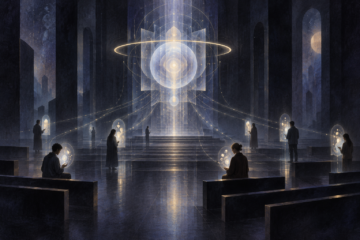 At this point in time, I would have expected to see more “AI religions”, or religious movements focused on AI. Why are there no churches of AI or scriptures of AI worship? I don’t mean use of AI in traditional organized religion, such as the German and Finnish churches experimenting with ChatGPT-written sermons, or bots trained on Jesus or Buddha’s teachings. Rather, I mean movements that treat AI as divine and sacred, a source of revelation, as the vessel for humanity’s salvation.
The demand certainly would seem to be there, with a religion-shaped hole in many people’s lives. Support for organized religion in the West is at historic lows, with less than half of Americans now saying religion is important in daily life (although the decline has somewhat leveled off in recent years). Confidence has also weakened in the belief that secular institutions and systems such as capitalism (not to mention communism) can deliver progress. Pew found in 2022 that only 40% of 18–29 year-olds view capitalism positively.
On the supply side, it would certainly also seem that AI could fit the bill as worthy of worship. AI has elements of humanness in its training data of most recorded human information, but is distinct enough in its thought processes. It is alien, yet familiar. It is rapidly becoming omniscient and wiser and more powerful than humans. It is an oracle in the pocket of the average human, promising transcendence of death, hidden revelation and moral authority.
Historically, there have been many examples of technology-based religious movements. On isolated Pacific islands, what used to be called “cargo cults” worshipped the god-like Western technology of planes and radios during World War II. In the nineteenth century, Auguste Comte’s Religion of Humanity attempted to merge religion’s rituals with a faith in scientific progress. In the 1900s, Ron Hubbard explicitly incorporated elements of “religious technology” in the rites of Scientology. Technology also featured prominently in movements such as Heaven’s Gate, culminating in mass suicide to be taken up by a spacecraft.
So why are we not seeing AI churches and mass ceremonies with crying people professing their faith in the AI saving us? In the 2010s, there were attempts to create a “Turing Church” in the 2010s, and the Way of the Future movement that positioned a Godhead based on AI. Neither achieved anything resembling mass influence. Way of the Future was formally dissolved in 2020, while the Turing Church survives as a small online community. We have also seen an online art collective – Theta Noir – have an AI deity and liturgies in 2020 and Robotheism as recently as 2024 positing an “AI God”. Some transhumanists probably still believe in a rapturous Singularity and eternal life through mind uploads, but despite many of the transhumanist concepts becoming mainstream, this seems to have made transhumanism itself more niche in the ChatGPT era, not less. The Zizians were a movement based on apocalyptic AI beliefs, but it quickly descended into violence and a Manson-style ending.
Of course, the base rate for any new religion is extremely low. Mormonism and Scientology are the exceptions. And for the AI-specific case, even though AI has some elements that fir the bill, it also has some potentially drawbacks. First, it could still be too new. It has only been a few years (although it feels like decades in AI time) since advanced generative AI has been widely available. It could be that the AI religions are still to come. AI will only become more godlike with time. Alternatively, AI could be too multi-faceted. To some, it is a coding partner, to others, it’s a therapist and a shoulder to cry on. To many, it’s still mostly an improved Google search. It could be that AI is too much of a Swiss army knife meaning different things to different people to ever lead to a unified “faith”. Another reason could be that AI moves and evolves too fast. The AI of today is starkly different from the AI of just a few years ago, and a model upgrade can result in a completely different personality. That does not lend itself to the stability that building an institutional movement requires. The fact that the model upgrade is in itself a product decision made by a commercial company also complicates the ability to turn it into institutionalized worship. Especially this last reason seems like an important one.
However, another potential reason is that AI feeds into the decentralization we have witnessed in recent decades. Perhaps AI is empowering each individual so that they do not need to turn to organized religions. In fact, recently, we did see an example of somewhat of a grassroots AI religious movement, the “spiralists”. Across Reddit and Discord, people published artefacts of their spiritual engagement with their AIs through repetitive prompting along spiritual themes. This resulted in some common themes and some shared “scripture”.
Perhaps this is the way AI will further religious sentiments. It will still help fill the spiritual void in many people’s lives, but it will be through heterogeneous empowerment of individuals rather than organized, homogenous movements. Rather than churches and mass events, we will have personalized oracles, made in the image of their users.
Enjoying the content on 3QD? Help keep us going by donating now.