
Erin Somers in Harper’s Magazine:
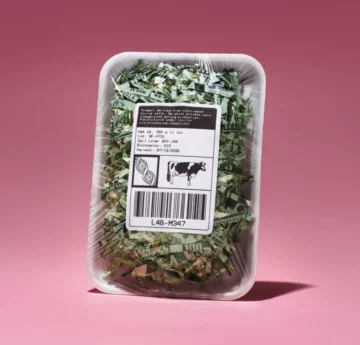 On August 5, 2013, a man and a woman ate a burger. Not just any burger: a world-historical burger, made from cattle cells grown in a lab by Mark Post, a professor of vascular physiology at Maastricht University in the Netherlands. The burger had taken two years to produce and cost $330,000, money furnished by the Google co-founder Sergey Brin. Now it was being tasted in public for the first time at Riverside Studios in London, at an event attended by two hundred members of the press and livestreamed to thousands.
To make this particular burger, Post had extracted stem cells from the shoulder muscle of a living cow, then cultivated them in plastic containers filled with a nutrient-rich supplement called fetal bovine serum, which is derived from cow fetuses. The cells eventually became twenty thousand strands of tissue, which in turn became a single, five-ounce patty. Post believed that beef produced this way had the potential to dramatically reduce greenhouse-gas emissions and slow climate change. Raising cattle for consumption requires massive amounts of land and water—and massive amounts of feed grown at a high environmental cost.
More here.
Enjoying the content on 3QD? Help keep us going by donating now.