
by Lei Wang
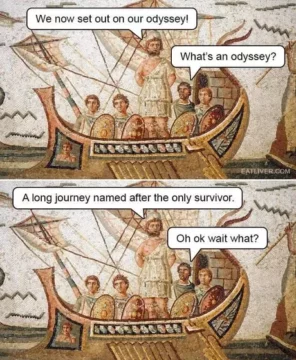 1. The Odyssey
I did not expect to enjoy this recent adaptation of The Odyssey, and indeed I did not. I watched for purposes of cultural touchstoning and schadenfreude, the way I enjoyed survivalist fiction as a child. Thank goodness I, unlike the main character in Hatchet and Brian’s Winter, get to be safe and warm and don’t have to plot to trap a bad-tempered moose just to survive, or use my own urine as a hot water bottle. Over the three hours in the theater, I was extremely grateful not to have to spend time on an undulating boat without sunscreen, kill, or be a man in any era. Which is perhaps not supposed to be the takeaway.
And yet I feel there must be something there to stories that have lasted, stories I don’t quite have the taste or patience for, which just means I don’t have enough understanding. The ex-journalist in me maintains that anything can be interesting; I am still waiting to love baseball, if only someone could explain to me the metaphysical implications. Film adaptations of great literary works often feel unsatisfactory because the parts that make literature great and literary—the interiority and insights—are lost. The odyssey is an internal story being told as an external adventure story, which is nonetheless a great marketing trick more philosophers could use.
When Dr. Athena Potari (yes, her name is actually Athena) explained the internal story of the epic on a recent Zoom meeting for a group of idealist philosophers and taggers-on like yours truly, she deployed so much etymology I felt as if I were listening to conspiracy theories, except coming from a Greek scholar who’s taught at Harvard and Oxford.
Consider the name Odysseus, which Homer himself translated as “he who gives or receives pain,” and which any quick Google search will tell you has been traditionally linked to the Greek verb odussomai—“to be angry at,” “to hate,” “to be grieved,”—in short, to suffer. Yet the name is up for debate; no one really knows. Dr. Athena broke it down on Zoom’s whiteboard as:
ODYSSEUS
O DYS EIS EUS
Here, “dys” means negativity—the “dys” of dysfunctional or discord, which comes from “dyo”—duality, separation. Meanwhile, “eu” refers to the ultimate good—the “eu” of euphoria and Eudaimonia, which comes from “en”—the one. So the meaning of his name could be:
O DYS EIS EUS
the dys towards eu
the dual into the nondual
In other words, the odyssey is a journey from separation to oneness. Of course this is the kind of story I am interested in. A story not of fighting with so many CGI arms and legs, but a struggle of the soul. A story of enlightenment. I’m told this is also what the Mahabharata is about.
Dr. Athena at one point had extensively studied Indian philosophy and made it all the way to the Himalayas when she had a spiritual encounter on a mountain near Dharamsala, the Indian home of the Dalai Lama. The voice she heard told her to go back to her own home, to Greece, that everything she was looking for in other traditions could be found there. She is now part of a movement in modern Greece that aims to revive pre-Christian Hellenic culture and spirituality, partly through correcting mistranslations and partly through making ancient philosophy a living practice, like Buddhism has done with meditation.
Dr. Athena has other controversial interpretations, but there are also the easier, more accepted symbols: the sea, we all know, is the mysterious unconscious, roiling with primal emotions. Odysseus returns to Ithaca (related not just to “ethics” but to “ethos,” habitual patterns of being) naked, a beggar—no men, no ships. Only the essential self can pass through the narrow gate. He does not even actively return; he simply wake up there, and after waking up—after enlightenment—is the real battle. There are 108 suitors, a spiritually significant number; Buddhism lists 108 human delusions, reflected in the 108 beads in a Buddhist mala (apparently, there are many books just about the math of The Odyssey, something else that sounds suspiciously like conspiracies).
The suitors are the unconscious patterns you have been feeding and which you must defeat, especially the primary antagonist, Antinous—a man named “anti-awareness.” Only then will you reach ever-patient Penelope, who is not just some loyal wife but your own true Self, waiting through your years of conquest and lotus addiction. (Dr. Athena: “You do not have to wait for awareness to come to you. Awareness is always waiting for you to come to it.”) Homer knew the human psyche well: of course Odysseus spent seven out of ten years with a nymph on Calypso, an eerily accurate depiction of the 70% of my time I spend on romance as distraction (whoops).
2. The Frictionless Years
I finally finished a draft of my first book a month ago. I started working on it officially in 2020, but had been trying to write it in some form since 2012. I also recently reconnected with a college boyfriend from that time period. We hadn’t really spoken in the intervening 14 years, and in the meantime he had become Very Impressive, in the fancy-philosopher-PhD-to-AI-thought-leader pipeline. We scheduled a call to catch up, and I was so afraid he would ask me to account for my time, as if he were my immigrant mother: what had I to show for these Odyssey years? Instead of building a real or at least simultaneous career, I wrote one draft of one book and actually, it’s still far from done?
I went into our call feeling less like Odysseus and more like the rat-exterminator-turned-poet Jack Gilbert (who got into college on a clerical error; they had admitted a different Jack Gilbert) when he wrote:
So I come on this birthday at last
here in the house of strangers.
With a broken pair of shoes,
no profession, and a few poems.
After all that promise.
Not by addiction or play, by choices.
By concern for whales and love,
for elephants and Alcibiades.
But to arrive at so little product…
My best friend’s favorite meme for the writing process is, “We didn’t do it because it was easy. We did it because we thought it would be easy.” Which apparently is also coder humor.
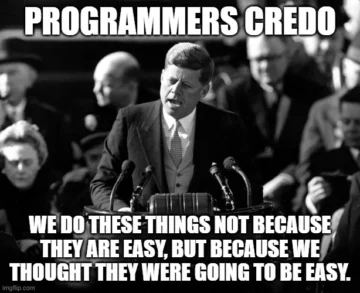
Like Jack Gilbert, we did it not by addiction or play, by choices. By concern for whales and love, for elephants and Alcibiades. By whales, Gilbert didn’t mean Moby Dick, not that external obsession (though I’m into the theory of Moby Dick as a tale of OCD). As he explained in a rare interview with Gordon Lish, whales were “the sudden sense of the alien nature of the universe not translatable into human terms… it’s out of scale, and not just physically. It threatens my life, the formulations on which I operate. I have to redo my mind.”
And what about Alcibiades? The poet was referring to the golden boy of fourth century Athens: “Pericles was his guardian, Plato his teacher. A fine athlete, a brilliant general, handsome, marvelously intelligent, popular, everything. A summation of the Golden Age. And what happened? He went bad. He was vain, treacherous, selfish, sacrilegious, debauched, dishonest, and a traitor twice over. His aid to the enemy during the Syracuse campaign destroyed Athens. Just about the finest product of the most notable civilization man has accomplished, and it turned out like that. This haunts me like the whales.”
Alcibiades had all the advantages, and yet he had not had his odyssey. He had not come home to himself. He may have had it too easy, which is why we needn’t be jealous of nepo babies.
As writing metaphors go, I have liked the story of the oyster, which is the story of sand: the grit of irritation, something that feels not right not right not right inside that you work with to transform, versus a totally frictionless life. Friction is a concept I keep hearing these days, from Byung-Chul Han’s concept of the great “smoothening” of civilization—an efficient, frictionless era of consumption, exemplified by glossy screens—to Esther Perel describing the lack of necessary friction in AI vs. messy human interactions.
Anna Lembke, who wrote Dopamine Nation: Finding Balance in the Age of Indulgence, has said, “Life is hard now in a really weird way, in that we don’t really have anything that we have to do. So we’re all forced to make stuff up, whether it’s being a scientist, or being a doctor, or being an Olympic athlete, or climbing Mount Everest. And people really vary in their need for friction. Some people need a lot more than others, and if they don’t have it, they are really, really unhappy. And I do think that a lot of the people I see with addiction… are people who need more friction. They are unhappy, not necessarily because there is something wrong with their brain, but because their brain is not suited to this world.”
I worry that I have not had enough friction in my life. Not that writing has been easy, but that, in Jungian terms, if the first half of life is about going out into the world and making an ego-identity, a home for yourself, while the second half of life is about finding the meaning of it all, I’m not sure if I’ve really had a first half of life. I had my mid-life crisis too early, at 22. I could not go on without meaning, and have spent the last 14 years agitating, yet only internally, and without knowing if I have produced any pearls. And what if it turns out I’m a clam, not an oyster?
I do feel I have found a sense of home now, but fear that I haven’t earned this homecoming. The most recent This Jungian Life podcast episode compares the first half of life to The Iliad, while the second half is The Odyssey. I had my Odyssey years before my Iliad years, like taking the in-breath without the out-breath, relaxing before any real fighting.
“The world’s your oyster” was not a sweet motivational saying in Shakespeare’s original context. Instead, it appeared in a conversation about money between two con men:
Falstaff: I will not lend thee a penny.
Pistol: Why then the world’s mine oyster, which I with sword will open.
How did we end up using oyster as the imagery for a world that is welcoming to us? The world may very well be our oyster, but to see if there’s a pearl, we still have to open it, which requires violence. Some people open their oysters by any means necessary.
3. The Pearl
What does Odysseus actually gain from his journey? He just goes back to the life he had before, older and weaker. Here is where one would quote the T.S. Eliot line about how “the end of all our exploring / will be to arrive where we started / and know the place for the first time.” Here is, “Before enlightenment, chop wood, carry water. After enlightenment…” Did you expect anything different?
The hobbits back in the shire are no longer the same. Can they even enjoy their multiple lunches the same way? After a few months of peace, will they be a little bored and hungry for adventure and a clear purpose to their days? Even at the beginning of Avengers: Endgame, Thor grew flabby and complacent, drinking without the possibility of a world to save. In a way, my book is about the third part of life: what do we do after the homecoming, in an increasingly frictionless world?
I really would like to think I will not have a midlife crisis anymore. For years, I was looking for something special: some special meaning or purpose, something extraordinary and outside of myself. But old suitors die hard.
A healer told me recently, “This is it. This is home.”
“But it feels so normal,” I said.
“Good,” she replied. “Home should feel normal.”
Life stages are blurred these days, with earlier self-awareness which also means more lostness. We’re supposed to actually like our jobs now? Are the warmongering Iliad years perhaps passé? Nowadays, we contend with questions of purpose earlier than we’ve ever asked them, questions my parents and most of our ancestors have never asked themselves because they were dead by the time they had solved the problem of survival. In a way, they are lucky.
Writing a book can be very safe. You get to decide, on your own, exactly what to put in it. You choose also when to reveal yourself. This is the perfectionist’s hiding place. Before I discovered the pleasures of the inner life, before college, I had been a young environmental activist. I had agitated in the world in a way I no longer agitate.
Maybe my aversion to action movies means something I still don’t want to admit. I have fought internal battles, but not yet rubbed up against the world, which means I am also missing other internal battles; as every writer knows, the character needs inciting incidents. The jobs I’ve quit, the relationships I’ve given up on at the first whiffs of incompatibility—I was overwhelmed and blame the jobs or the people themselves, but actually, they were creating fiction against something in me. Many potential pearls I did not make.
“So you’re just writing, thinking about the meaning of life, and hanging around Iowa?” my AI philosopher ex, symbol of worldly success from my Calypso years, asked on our catch-up call. I immediately felt ashamed.
And then he said, “You’re doing exactly what I thought you’d be doing in 14 years.”
I protested: wasn’t I much more ambitious back then, in college, with my idealist aspirations to save the world? But I have always found him impressive not just for his resume, but for his empathy.
“This is the most ambitious thing you could do,” he said. “It’s safer to do something where the success criteria are defined.” (I have this exact quote because I texted it to my artist friends immediately after.)
I’m still waiting for him to convince my mother.
I’m still wondering how to merge my life stages, to fight the good fight, but from a place of feeling at home in the world, no matter where I go.
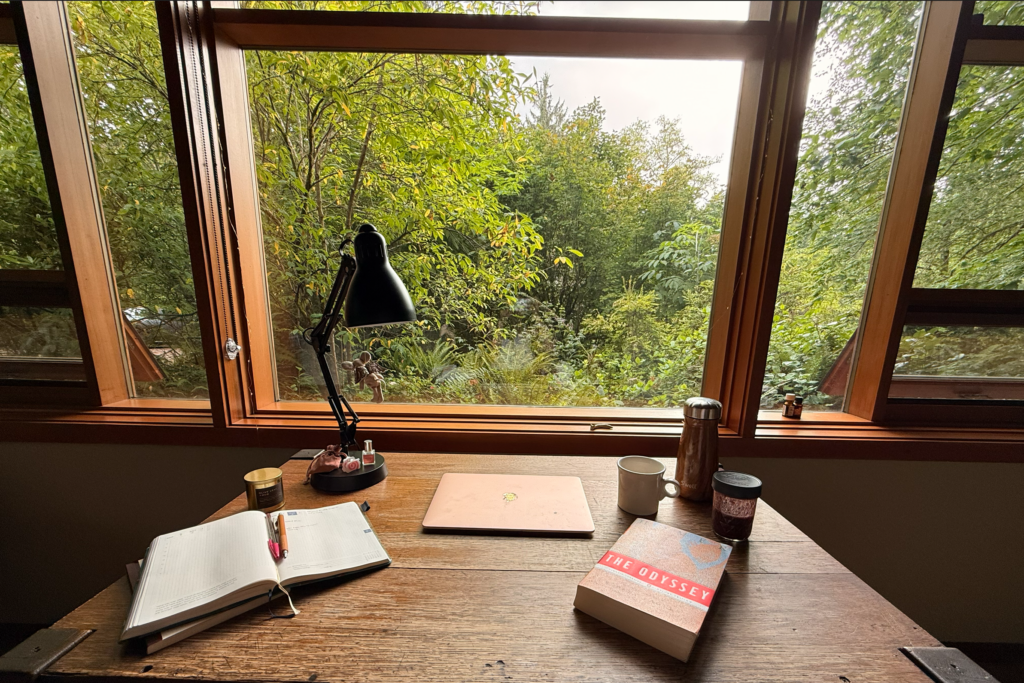
In the latest news of Life Imitating Art, I just arrived at a writing residency in Oysterville, Washington, whose home estuary contributes 10-25% of all U.S. oysters. I will be trying to wrestle 600 pages of my draft into 150. I would like to open to the world. If not now, when?
I learned just today that commercial edible oysters produce no pearls, but even in the wild, only 1 in 10,000 oysters have true natural pearls, and maybe only one in a million are the kind rich people would wear. Pearl-making is a rarely triggered defense mechanism; turns out that oysters are actually really great at expelling sand, and natural pearls are actually often formed by tiny parasites that manage to burrow in an oyster’s soft tissues. Pearl farms have to “seed” their oysters in all kinds of special ways—including grafting bits of the organ that produces mother-of-pearl from another oyster—but even in ideal conditions, the process can take two to three years with no guarantees.
Make of all that what metaphors you will.
The journalist Katherine Boo wrote an intimately reported book on a slum in Mumbai, Behind the Beautiful Forevers, but she had contemplated not going at all: wouldn’t it be dangerous? One night at home in Washington, D.C., as she was trying to decide whether or not to go, the phone rang, and as she went to pick it up, she tripped over an unabridged dictionary and ended up lying in a pool of Dr. Pepper on her living room floor with three broken ribs and a punctured lung. She went to Mumbai because she realized even her own apartment was not safe.
Nowhere is safe, so why not live?
*
PS—Alongside her spiritual and philosophical practices and teachings, Dr. Athena is agitating, too. The Greeks were proud to finally have their cultural epic depicted on the big screen, but in the very same time period, the Greek government passed a private bill overnight handing over control of all Greek monuments—including the Acropolis and Delphi—to an anonymous private company for 100 years. You can sign a petition, organized by her colleagues, here.
***
Enjoying the content on 3QD? Help keep us going by donating now.