
by Marie Snyder
 We want help to know the best approach to take to life. In lieu of church services or complex readings, many turn to influencers for their formulas for “winning” at life that often judge us based on challenging perceptions of beauty or endurance or wealth. The trend towards optimizing provokes people to track everything they do, from the number of steps, to hours of sleep, but for what? To prove they have a right to be here? To belong? To be loved? It definitely doesn’t appear to be making people happier. That may be the cost of simplification of complex advice that edits down more complex ideas into a more superficial draft. The profits come with the reality that it works. People will click on these videos, subscribe to podcasts, and buy all the books. At some point we stopped looking for how to be a good person and instead aimed to be impressive or even just base-line likeable.
There’s a capitalist benefit to convincing people they’re somehow defective by providing unattainable standards to work towards that, of course, involve products to buy. But it also feels like, culturally, we’re not growing up. Kant called it immature, lazy cowardice whenever people try to figure out how to live by blindly following advice instead of heeding their own reason:
“If I have a book to have my understanding in place of me, a spiritual adviser to have a conscience for me, a doctor to judge my diet for me, and so on, I need not make any efforts at all. I need not think, so long as I can pay; others will soon enough take the tiresome job over for me.”
In the 250 years since he wrote that, we’ve figured out some of the mechanisms that enable us to develop a conscience. We have mirror neurons that help us feel bad when we’ve exploited someone or made them suffer in any way, provided we direct any attention towards them. It’s only possible to be happy while knowingly harming others by not looking too closely at the effect of our actions. Luckily, we’re surrounded by distractions.
So, an advertiser or influencer (often both) convinces us that we’re not up to the standards necessary to be part of humanity or to mate or something, then we search for some quick fix from an easy lesson to implement that doesn’t require much work externally or internally, like taking a supplement instead of eating vegetables, and it feels a little better, but nothing really changes.
“If you ever happen to turn your attention to externals, so as to wish to please anyone, be assured that you have ruined your scheme of life.” ~ Epictetus, Enchiridion, 23
One example of an oversimplification that’s wildly popular is the work of Mel Robbins. She seems to exemplify the current reality that people will pay for a book built around a two-word slogan. The more digestible the idea, the easier it is for people to remember and follow. We want a fast fix with very little effort, and we’ll happily pay to get it. I wrote about her book a over a year ago, and then the hilarious podcast, If Books Could Kill, took her to task, and, more recently, Matt Bernstein posted a video on her “Griftpocalypse.” I don’t think she’s the worst example of grifting out there, but she’s the clearest example of that slow swing towards finding happiness through short-term individual benefits often at the expense of community or our own long-term development.
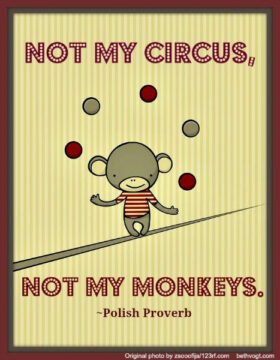
Robbin’s famous “let them” theory has the same idea as the old Polish saying, “not my circus, not my monkey,” which, apparently, is less than 40 years old. I’ve also heard “not my pig, not my barn,” and “not my bull, not my rodeo.” It’s an easy pattern to copy. Lots of people struggle with boundaries (and minding their own business), and it can be useful to have many little sayings like this to help people remember not to get so worked up about someone else’s decisions. It’s fine advice to let go of how people perceive you or whether or not they like you. We have a strong need for belonging, and we can sometimes be easily guilted into taking on the burdens of others just to get a little taste of perceived connection. So, sure, if it’s not your doing or responsibility, then it’s not your problem. As a saying it’s fine, as a theory, it leaves much to be desired.
There’s a “Let Them” poem (by Cassie Phillips) that may or may not have been the impetus for Robbins‘s theory and book deal. Robbins’ story is that her daughter used the phrase “let them” to talk her out of budding in to her son’s plans for prom. Potential plagiarism aside, despite that this is a great philosophy to shut down the busybodies in your life, I can’t imagine those two words flushed out into an entire book. You could get this, and so much more, from books on Buddhism or Stoicism, but those texts might have an unfamiliar writing style and require a dictionary at times and can’t just be skimmed for the gist of it, and that effort required puts up too great a barrier for many people.
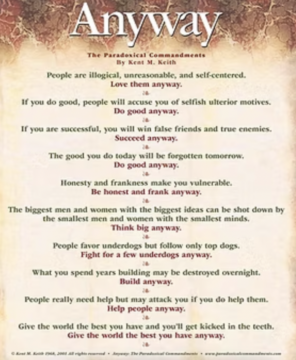
Phillips’ poem is a quick read, below. I followed it with the poem “Anyway,” aka the Paradoxical Commandments by Kent Keith, written in 1967. It was found in Mother Teresa’s room when she died, so it’s often mistakenly attributed to her. The two have a similar tone but a significantly different message. (Hit alt text if the images are blurry.)

Let’s compare and contrast:
The more recent piece encourages us to let others run their own lives how they see fit, staying out of their business, but it also suggests people have to “prove how worthy they are” and “earn your forgiveness.” People should take us out and love us and be grateful that our heart didn’t harden to them. It suggests it’s honourable if we let them be nice to us and don’t completely shut them out of our lives. It’s about taking from others. The 60-year-old piece also encourages us to succeed even if other people hate us for it, but, by contrast, it tells us to continue to love others despite how unreasonable or self-centred they are. Help them even as they attack you for it. It’s about giving our very best to the world even at some cost to ourselves.
Back to back, the “let them” advice might have the potential to become an excuse for some bad behaviour depending who the others are referring to. It may be good advice to provoke boundaries around abusive people, but it might also be read as permission to demand other people do things for us before we agree to let them into our little clique.
Our entire culture has shifted from any sense of universal duty or obligation to our neighbours, community, and world to “what’s in it for me” with a warped idea of creating and maintaining boundaries. You have to prove yourself to me before I’ll consider you worthy. Originally forming boundaries meant something like, “If you do something that is harmful to me, then I will leave the room,” but has become, “If someone does something I don’t like, they’re dead to me” mixed with, “I should be able to do or say anything without consequence because how I affect you isn’t my responsibility.”
I’ve heard this message for years, so it’s not entirely new, but I’ve always questioned it: “Our effect on others is their problem.” That needs some unpacking. Definitely it’s the case that sometimes an innocuous comment might yield strong feelings in someone else due to some skeletons in their closet, and that’s not on us. There’s no way we can predict that. But we can still apologize for the effect we have. If we hit someone who ran in front of our car, it might not be our fault, but it’s still our responsibility to help them. However, it is on us completely if we know something causes harm, we’re able to change, yet we continue down that road regardless (unless it’s to assert our very identity). If Aunt Peg is horrified that we’re in love with someone of the “wrong” gender, race, or whatever, that’s for her to deal with. If she can’t stand when we joke about people being killed on the streets by ICE, maybe don’t “joke around” with her like that. If she’s not laughing, was it really for fun or was it a bullying way to get her with cowardly plausible deniability because it was wrapped in alleged humour? The idea that it’s on other people to be strong enough to tolerate anything we say or do just enables bullying. It’s an attitude that grants tacit permission to people to spew vile insults without the guilt that’s typical of healthy socialization. It’s good that we feel bad when we’re intentionally hurtful.
We want to throw off the shackles of ever feeling guilty for anything, but it’s necessary for an optimally functioning society. It matters how we affect one another. It’s important that we develop the capacity to feel sorrow and joy for others, particularly at a time of divisiveness causing everything from mass deportations to deaths.
Robbins’ message waters Phillips’ poem down even further to, “who cares” or, colloquially, “whatevs”! The simplification doesn’t just make it easier to understand and implement, it makes it easier to narrow the focus of our concern to just ourselves.
No one can live happily who has regard to himself alone and transforms everything into a question of his own utility; you must live for your neighbour, if you would live for yourself.” ~ Seneca, Letter 48
Another piece that looks at the problem of simplification is in the Spring issue of The Philosopher. Matt Sharpe’s essay, “Reclaiming the ‘Porch’: Stoicism and its Manospheric Rise on the Far Right,” explores how the ancient philosophy has been popularized and simplified. He traces the path from Hadot’s 2002 The Inner Citadel, through the 2014 start of Stoicon (which I actually attended once) and into the “Broicism” grifter scene of people looking to cash in on dumbing-down and morphing ancient philosophies until it feeds a political agenda. Sharpe writes,
“Perhaps the principal reason behind today’s turn to Stoicism is the aching meaning gap that many people feel in our later capitalist societies, in which everything has become for sale and for profit. … Stoicism has had its moment as an ethical alternative to established forms of religiosity, lending meaning and order to many lives.”
I think it’s not just that we’re looking for meaning, but that we’re also hoping it’s not too much work. We’re too busy sucked into the achievement society that has us running from work to the gym and back for more work or some means to obliterate any thought of it, in order to try to live up to our potential. The OG Stoics aim for equanimity by focusing on what we can and can’t control and letting go of our frantic attempts to change things we can’t control, like reputation or illness. Unfortunately that’s at odds with the progress-orientation of our lives that hopes for infinite growth on a finite planet.
Sharpe focuses on the crisis of masculinity that has young men longing “for an imagined past in which they would have been privileged in ways they no longer are.” Influencers tell them to blame women and go it alone. This takes the listeners off the hook. It alleviates shame, but removing responsibility also removes agency. If all my problems are due to women, and women’s actions are out of my control, then there’s nothing to be done but accept this misery.
Of course only part of Stoicism is acknowledged by the tribe. Sharpe quotes Seneca to highlight some missing pieces: “Of all the ancient philosophies, none besides Stoicism are more full of love to man and more concerned for the common good.” Stoics recognize that “we are by nature adapted for companionship.” And here’s some generally ignored advice from Epictetus in Enchiridion, 5:
“When we are hindered, or disturbed, or grieved, let us never attribute it to others, but to ourselves; that is, to our own principles. An uninstructed person will lay the fault of his own bad condition upon others. Someone just starting instruction will lay the fault on himself. Someone who is perfectly instructed will place blame neither on others nor on himself.”
Sharpe points out that the Stoics’ relationship to money counters the messaging from influencers. It’s a fool’s game to accumulate more than we need, and Epictetus counsels, “Provide things relating to the body no further than absolute need requires.” For the ancients, the health of the soul matters more than the appearance of the body, but “in the devolution of ‘Broicism,’ these ideas simply disappear from the Stoicism that is being bought and sold.” Some of these gurus insist hierarchical rankings of people are natural, thereby justifying “the neoliberal transformations that have hollowed out the middle classes of capitalist nations since the 1970s, leading to levels of inequality not seen since the last Gilded Age, and thus to the resurgence of the far right internationally.” Sharpe warns that embracing this distorted version of stoicism makes people “scornful of democracy and longing for an authoritarian master,” and he calls for a return to ancient position that is,
“characterised by cosmopolitanism, egalitarianism, and an emphasis on reason over the passions, including outrage and resentment, and by a stress on human sociability and fellowship over status and material good … to resist the normalisation of inhumanity already underway, as authoritarian strongmen promise to make peoples ‘great again’ by setting them against others.”
We can easily see why these simple messages take root. They give us a landing spot for some uncomfortable emotions, like guilt and shame, and they ask nothing of us in return, no heavy reading or contemplation that has us interrogate our way of life. There’s not the emotional upheaval necessary for profound internal change. But we might hope it’s also easy to see why these new and improved versions are destined to be short-lived philosophies. Without care for others, humanity devolves.
Kant argues that the problem with moral contemplation in his day is that there was altogether too much civil freedom: “a lesser degree of civil freedom gives intellectual freedom enough room to expand to its fullest extent.” We’re at a point where exaltations of freedom often mean freedom from any restraints or limitations at all, including basic civility, and certainly freedom from having to be concerned with our effect on others. There’s no balancing with other people’s freedom to. Choosing the most convenient spin on older messages, and watering them down to the fewest possible words to remove nuance and complexity, provides a sense of learning without effort. We want to be free from effort as well and from education. Many of these old books are within reach online if we can shake off the shackles of the simplified distractions around us to contemplate: Are they right?
Your way is therefore to manage this minute in harmony with nature, and part with it cheerfully.” ~ Marcus Aurelius, Meditations, book 4
***
Enjoying the content on 3QD? Help keep us going by donating now.