
T.J. Clark at nonsite:
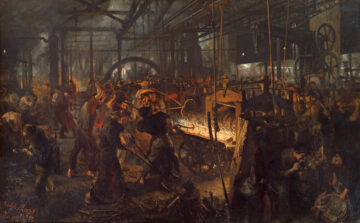 I begin from two images that have established themselves, one gradually and the other in short order, as classics. The first is Adolph Menzel’s Iron Rolling Mill, painted between 1872 and 1875, showing the interior of the Königshütte factory in Upper Silesia. The factory specialized in the production of rails for railway lines—a quintessential industrial activity, lying at the heart of capitalism’s high nineteenth-century dynamic. The painting, done for the banker Adolph von Liebermann, Menzel’s uncle, was meant partly as a celebration of German victory in the Franco-Prussian war: it gave concrete form to the “Eisen und Blut,” which Bismarck had predicted a decade earlier, in a phrase that became his signature, would “decide the great questions of the day.” Plenty of iron, obviously, in the Menzel. Blood is absent, though the red-hot line of a just-finished rail, cooling behind the group of men in the center, is a strong metaphorical substitute. Work and war are inseparable in Iron Rolling Mill, and in a sense, as we know to our cost, they have proved inseparable in the history of humanity in general, capitalist or otherwise. Marx’s “struggle with the realm of necessity,” which is certainly going on here in the light of the molten metal, has constantly tipped over into, or been propelled further by, the struggle with other nations and classes. Labor and capital, it follows (this would be my first thought on the subject as Menzel shows it), cannot be conceived of—or convincingly represented—apart from the matrix of human aggressiveness and our species’ deep love affair with death.
more here.
Enjoying the content on 3QD? Help keep us going by donating now.