
by Rachel Robison-Greene
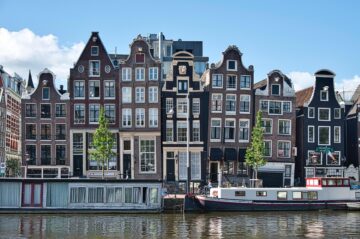
Last month I found myself navigating the alleyways of Amsterdam with a cluster of college students. We marked the canals as we passed. We took note of a house with an outdoor garden on one block and an unusual roof line on the next. As we emerged from one alleyway we saw in the distance something for which we were not looking but that we were thrilled to find—a statue of Spinoza standing like a sentinel guarding the city he once called home. We were not searching for Spinoza, but we found him.
In Plato’s dialogue, Meno, the titular character raises what is now referred to as The Paradox of Inquiry. He argues that inquiry is impossible because either we know what we are looking for or we don’t. If we know what we’re looking for, we don’t learn anything when we find it. If we don’t know what we’re looking for, we won’t recognize it when we see it.
When my husband and I decided to take our students on a study abroad to Paris and Amsterdam, we hoped to lead them down a particular path of inquiry. There were specific things we hoped they would find. We called our course “The Enduring Enlightenment” and we hoped the students would, in their travels with us, come to understand the intellectual origins of the emancipation of human thought. We wanted them to understand enlightenment as Kant understood it,
Enlightenment is the human being’s emergence from his self-incurred minority. Minority is inability to make use of one’s own understanding without direction from another. This minority is self-incurred when its cause lies not in lack of understanding but in lack of resolution and courage to use it without direction from another. Sapere aude! [dare to be wise] Have courage to make use of your own understanding! is thus the motto of enlightenment.
When we took the students to Versailles, the grand palace made ridiculous in its excess during the reign of Louis IIV of France, we wanted them to internalize the consequences of putting all one’s faith and trust in a single authority. I think most of them did leave with that impression. Some were more taken with the beauty found in symmetry. Others left with impressions about overtourism and at least one person learned to navigate the train from one foreign city to the next on his own.
In Amsterdam, we hoped the students would reflect on the explosion of creation and intellectual activity when cultures collide and a diverse range of views are permitted to be expressed. I’m sure students took that fact in, but they may have been more taken with the fact that they could walk a whole city and come to know it by landmarks. They could rediscover Spinoza and bring along new travel companions.
The students enjoyed hearing about the philosophers that worked in and influenced the cities that we visited. Their memories of standing in front of Rembrandt’s The Night Watch may be more profound than the impressions formed by the texts we assigned them to read in advance.
We had a very particular picture of what we hoped the students would learn. I think they did learn some of those things. To expect that to be the main focus may have been naïve, and that’s a good thing. They may not have learned much if we told them exactly what to find. It seemed they learned the most from the things they didn’t know they were looking for.
Ironically, that outcome lines up better with the spirit of the Enlightenment than the exact path we had planned. The students had the virtue Kant admired: the courage to make use of their own understanding without direction from another. Our role was to assist them in learning rather than to tell them precisely what they ought to find.
The United States would not exist without the Enlightenment project. Our system of government would not be possible. Despite that fact, in the name of our country, some people are calling for censorship of books and of course content in schools, often in an attempt to paint the picture for our children that this country has a more pleasant history than it actually does. If we really want our children to internalize the values that built this country, we should let them sort out, largely unrestricted, their own paths of inquiry. Let them find Spinoza when they weren’t looking for him.
Enjoying the content on 3QD? Help keep us going by donating now.