
by Christopher Hall
One thing the commotion over Jamir Nazir’s Commonwealth Prize-winning story “The Serpent in the Grove” – allegedly written by AI – has proven is that close reading is definitely not dead. I doubt if any recently published story, prize winning or not, has come under such scrutiny. Phrases denoting the presence of the machine are hunted out, scrutinised, parsed as certain shibboleths. There are the weird, incoherent metaphors and similes: “She had the kind of walking that made benches become men.” “The girl smiled like sunrise over a sink.” There’s some evidence of verbal cliches, like the pairing of a concrete noun with an abstract one in the same description: “…the air sweet with cane and forgetting.” But aren’t there some decent turns of phrase here as well? “She wore the island’s mixed bloodlines like a crown – African in the hips, Spanish in the cheekbone, East Indian in the hair when the rain kinked it, Carib in the way her gaze could bless and warn at once.” (Wait – is it that good? You can’t wear a crown on your hips or your cheekbones. Does that qualify as a hallucination?) The story is propulsive even amid the florid language. Are the characters a little on the undercooked side? Well, nothing’s perfect. How far exactly are we supposed to delve – what are we not accepting here that would pass by unremarked in a story that was unquestionably written by a human? We could say it’s not deserving of the prize it won – I’ll make no judgement here – but the questions this controversy poses go well beyond that.
I’m reasonably sure that I never would have thought the story was not written by a person if it hadn’t been suggested to me. That’s not surprising, though, as most people who don’t use AI a lot (while I’m bound to look out for AI use as a college teacher, I’ve found thus far I’m rather bad at it, and I don’t use it in my writing) are not good at identifying its hallmarks. Is it, in the end, a good story? It’s not quite my thing; as I’ve hinted, I don’t really like stories that seem allergic to basic exposition, and I think I would have blamed the excesses and mistakes here precisely on that desire to make every single phrase memorable rather than letting a few be merely functional. Over-figuration is a common compulsion, though, that I see cropping up in a lot of works that are untouched by AI – and I must admit that some of those works are very good. And we can never be sure if grammar errors or figurative lapses are genuine errors or mere anomalies as the writer tries to translate some idiom into “standard” English. Without claiming that I understand how benches can become men (empty benches in the bar suddenly filling up with men? I don’t know), catachresis, metaphors that are strained to the point of breaking, are hardly unknown in works of genuine quality. What T.S. Eliot called the “logic of imagery” must remain intact, but we aren’t logicians here, and can tolerate when the image travels a little further down the road from strict congruence – right?
Now, of course, that, I’ve read all the criticism of it, I see more of the story’s flaws; I do have a habit of being pretty charitable to everything on a first read-through. I am constrained to agree with what Malin Hay has to say about the “flatness” and “evenness” of the writing, both signals, apparently, of AI – along with the infamous m-dash and tricolons, both of which I’ve already used in this essay. (I’m also told the word “delve” is to be avoided.) Whether this particular story originated with from a human mind or not, one senses that the immediate future of reading and writing is going to be marked by unhealthy levels of paranoia and self-surveillance. I’d bet that AI writing isn’t going to remain entirely sloppy, and that the signs of its use aren’t going to be anything close to tell-tale in the future. Soon, you’ll need a label to distinguish authentic human writing from the other kinds. Some connoisseurs will insist they can tell the difference on sight, and maybe they can; close reading will constantly verge on becoming an act of indignation, internet detectives will abound, reputations will no doubt be ruined, some justly and, likely, some not. But once the quality issue of AI writing is eliminated (assuming that it can be), what grounds of complaint will we have?
The simplest one is that we want writing to be a communication between minds, not between one mind and a machine that knows which word to put in front of another word. Human minds are not like this, at least not entirely; we have a basis of sensoria and qualia behind the words we write, and we expect something like that basis in the minds of our readers. If a writer writes “Inside, air clung thick as porridge skin: damp earth, woodsmoke, and the sour tang of fermenting cocoa,” I’d like to think that some level of experience had contributed to this language, even if the author didn’t directly experience it. A writer’s imagination is not based on complete fabulism, after all, but rather the mixed and assorted fragments of reality and perception that are recombined into a story. A mind that constructs and a mind that receives are not optional elements which can be excised without consequence to the entire process.
And that’s the problem: for an AI, everything is complete fabulism. I’d venture that it can’t honestly write “Sasha felt hot” because it’s never felt hot, or cold, or nervous, or unsure about a neighbour’s romantic intentions, or anything. An AI that tells us that the sky is blue does not posses the qualia, the mental idea, of “blue.” They are worse than brains in a vat; nothing they say can be meaningful in any real sense because they have no ideas to make correspond with reality (I’m aware that not everyone will agree with a definition of truth or meaning exclusively based on such a correspondence). The point isn’t whether AI can put words together better than a given human, or even the best human writers. We can’t begin to talk about that special form of communication, the literary kind, when there simply aren’t the bases of actual minds involved in the first place.
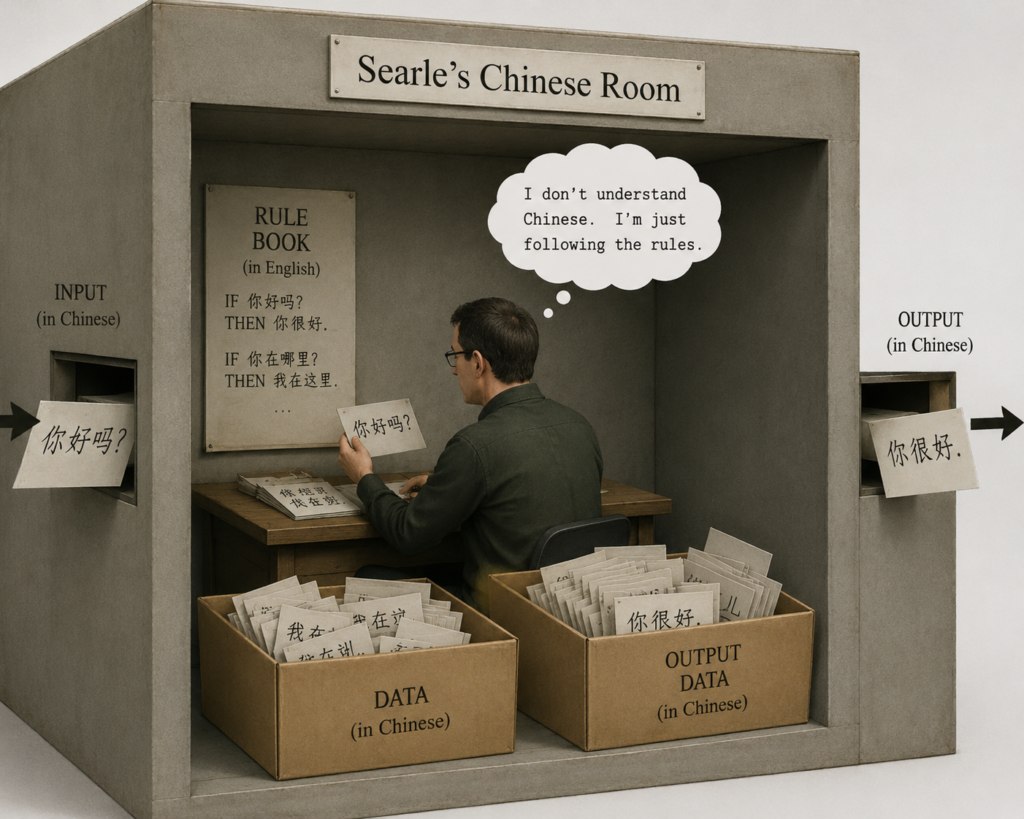
We can gain some more insight on why we might reasonably reject even high-quality AI writing, I think, from another philosophical thought experiment: John Searle’s “Chinese Room.” Searle asks us to imagine that he was placed within a room and given English instructions concerning how to output responses in Chinese to inputs he is given, also in Chinese. His argument is that, if he follows these algorithms in exactly the way a computer does, that would not mean that he understands Chinese, only that he is capable of following those instructions. Mere syntactics, the proper placing of the right word in front of another, does not equal semantic understanding. However skilled an AI may become in even literary syntactics, this skill does not have any origin in true understanding.
As much as I want to buy into this argument, there are possibly fatal objections to it. The most important consists not only in what one chooses to define as a “mind,” but also in what one defines as the functions of that mind: thinking, understanding, being conscious. If my ultimate argument is that, since AI does not have qualia, it can’t write literary fiction, I’ve merely made a retreat into very recondite territory – the hard problem of consciousness – and then left it there. That doesn’t seem exactly fair or thorough. Likewise, a problem lies in those functions of thinking and understanding. Critics of Searle’s idea point out that, while Searle doesn’t understand Chinese, the “system” he’s created does. Someone, after all, must construct both Chinese and English as “natural” languages. Someone then must construct meaningful sets of symbols in Chinese, and then create the instructions to produce a meaningful response in Chinese. And what is “semantic understanding” anyway? How do we know that the practice of one function – syntactics – doesn’t entail the semantic function as well? When an AI writes a story, it is basing what it writes on the structure of the language and in the many, many examples of writing it has that were, after all, generated by people with minds. Thus, it can know nothing about mental states but still, following a set of algorithms, create something that refers to and mirrors those states. One can, as I do, deny that AIs are conscious (I won’t speculate on whether they ever will be), and still think that there is something “mindlike” going on AI’s processes. Yes, AI writes from the Chinese Room, but the idea that there is some nonporous barrier between what it does and what the human writer does may only stand up to so much scrutiny.
I may not be capable of giving any intelligent answers to the questions raised here, but I want to advocate for their increasing legitimacy and importance as questions for those invested in the future of literature and criticism. We have, I’d suggest, gone too far in our rejection of intentionality as a foundation of literary meaning. Yes, the enterprise of generating and carefully reading literary works becomes largely pointless if we treat it all as a kind of treasure hunt where the author hides the meaning and then we go find it. But rejecting this crude notion of intentionality doesn’t mean we can banish consciousness entirely from our consideration. Literary form is a representation of consciousness, and understanding this does not entail restricting our discussion to “what was on the writer’s mind” but rather to the fact that language originates in consciousness. We don’t need any real solutions to the “hard problem” here to acknowledge that literary language is a product and representation not merely of intention but of all the other functions, some shadowy, of the human mind. A renewal of a kind phenomenological criticism interested in literary structure not merely as a self-standing linguistic artifact might give some needed oomph to any efforts to keep literary study as a distinctly human affair, assuming we think there is value in doing so. (And assuming literary study doesn’t just disappear entirely for reasons unrelated to AI.)
AI is going to challenge us to think deeply about what literature is “doing.” We may get to the point where the difference between choosing something AI produces and something a human does is an ideological, or, worse, a commercial, one. At any rate, I certify this essay as a 100% organic product of Christopher Hall. Whether that means it’s worth anything more than what an AI could produce…well, even though the answer is a mere prompt to ChatGPT away from finding out, I am too principled and scared to do so.
***
Enjoying the content on 3QD? Help keep us going by donating now.