
by Katalin Balog
The battles fought by our forbears
Our memory will dissolve into peace
To set our common house in order
This is our task – and it will not come with ease.
— Attila József, “By the Danube” (final stanza, trans. K.B.)
I have arrived in my hometown, Budapest, just before the election that delivered a decisive blow to Fidesz, Viktor Orbán’s party. Péter Magyar, the leader of the opposition party Tisza, is now the prime minister, and his party holds more than two-thirds of the seats in parliament, enough to restore the constitution and reverse Hungary’s autocratic backsliding. The night of the election, after the results were announced, entire subway cars burst out in spontaneous, triumphant chants of “two-thirds, two-thirds!”. Péter Magyar, in front of a huge, delirious crowd, with the Danube and Parliament in the background, promised a free, fair, and democratic Hungary. Street celebrations all over the country went on till dawn. Everything, it seemed, had changed that night.
Fidesz has dominated, subjugated, and run roughshod over the country for the last 16 years, reaching into virtually every aspect of life: the judiciary, the media, the economy, politics, government, education, science and culture, and everything in between. During this time, it has harassed and stigmatized politicians, business people, actors, teachers, students, and ordinary citizens, and became, according to political scientist Bálint Magyar (no relation to Péter Magyar), a “mafia state”. Ever since the election, a large part of the country has been living in what someone here called a “suspended moment of triumph”. According to the latest polls, among likely voters, today 23% would choose Fidesz, and 71% would vote for Tisza, Péter Magyar’s party. The emotions that took hold of the majority of the population, and certainly of everyone I know well in this city, can hardly be captured in ordinary language; something larger than life is taking place.
The fall of Fidesz has been spectacular; Orbán is somewhere in hiding, his all-powerful commissars acting like stuttering, cowed children in encounters with the new regime. People say even coffee tastes better in the morning. There are fewer lines on people’s faces, at least it appears so. While people thought, even a couple of months ago, that Fidesz would never give up power, now everyone is talking about whether they will end up behind bars.
Hungary is a small, landlocked, relatively poor country with a dismal history as a plaything of greater powers to the east and the west, from the Mongol invasions to Habsburg and Ottoman rule, its uprisings crushed by a rotating cast of intervening powers, most recently by the Soviet Union in 1956. The victory over Orbán is perhaps the first successful regime change in Hungary, brought about not by outside forces (as at the end of World War II or in 1948-49 by the Soviets) or by the elites, as in 1989.
This time, it was a unified push by the great majority of people in the country. It was the result of two years of tireless campaigning by Péter Magyar, who visited every town and village in the country in person, of the enthusiasm of fifty thousand volunteers, of the work of fearless investigative journalists, and of the surge of quality opposition podcasts. It was also, equally, the result of the determination of great masses of people fed up with the Orbán regime who finally glimpsed and then latched onto a hope of ending it. Hungary has a chance now to become a free country with a government accountable to the will of the people. Péter Magyar encourages the country to remain engaged and vigilant, lest the government stray from its remit to serve rather than dominate. Hungary, it seems, is undergoing a democratic revolution.
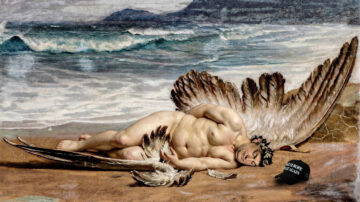
The crash landing of Icarus seems the right image for the end of Orbán’s career. Despite his country of 9 million people being of little significance to European politics, Orbán, ridiculously, had world-historical ambitions. A few years into his reign, having successfully overrun Hungarian society, it was no longer enough for Orbán to be the prime minister of Hungary. His theory was that by maneuvering cleverly between the US, the European Union, Turkey, Russia, and China, he would make his country a power player in Europe, and might even lead Europe into its post-liberal future of Christian nationalism. However, his concrete achievements on the world stage were mostly just obstructing and trolling the European Union. Hungary distinguished itself by its unique hostility toward Ukraine and its increasingly close cooperation with Russia.
Meanwhile, his attention turned away from Hungary, he let corruption fester, the economy falter, public services disintegrate, and inflation eat into people’s incomes. In the end, his campaign had nothing going for it beyond the usual fearmongering: he claimed that with Péter Magyar, Hungary would become a Ukrainian “colony”. He wagered that the preposterousness of this claim would not register as such, but it apparently did. And eventually, despite the pilgrimages to Hungary of illiberal politicians from Europe and the MAGA world over the years, despite JD Vance’s last minute Hail Mary visit during the campaign, despite Hungarian money funneled into CPAC conferences and right-wing think tanks, despite all the lobbyists and influencers, his prominence in the autocratic international cratered instantaneously, and his pals in high places shed no tears over his demise.
What is striking about the Orbán regime is how devoid of ideals it had been. He started out, like Péter Magyar, young, talented, and idealistic. He was one of the speakers at the ceremonial reburial of the martyrs of the 1956 revolution in 1989, unshaven, no tie – a young rebel talking to a crowd of 200,000 people. He said, “If we believe in our own strength, then we are capable of bringing an end to the communist dictatorship. And if we are determined enough, we can force the ruling party to subject itself to free elections.” Mutatis mutandis, the same program Magyar proclaimed when he set out to depose the Orbán regime. The ideals Orbán held as a young politician have devolved into a simple pursuit of power. After he lost, he did not literally crash like Icarus; instead, he disappeared into the ether. Nothing is left behind him, because all he had was power.

Over the last two years, Péter Magyar’s trajectory has been the inverse: from Fidesz insider to near-mythic hero of liberation. Many years ago, I saw an exhibition in Budapest by a German artist couple, LawickMüller, that made me understand how we imagine the ideal. They showed photographs they created by digitally merging images of ancient Greek gods and goddesses with photos of real people. The exhibition, especially this image of Athena Velletri, exploded in my mind. I felt a pure exaltation at the sight of the real made into the ideal.
At a less exalted scale, Péter Magyar seems to be reaching for something larger than himself. If Orbán is the son who flew too high, Magyar is like the youngest son who makes good in Hungarian fairy tales. He brings justice and truth to a land ravaged by lies, avarice, and theft. He embodies – only time will tell how faithfully – the ideals that Hungarians, against all odds, still seem to cherish: honesty, courage, justice, truth, democracy, and the rule of law.
He is like the táltos horse of Hungarian fairy tales, a scraggly, unprepossessing, often mistreated foal that reveals itself to be a supernatural creature of extraordinary power, loyal to the hero who recognizes and nurtures it. Two years ago, when his campaign just started, government media figures belittled and abused him, taunted him with jeers of “it’s over, shorty!” – a dig at his height. It became one of the slogans the triumphant crowd chanted on election day, now turned back at Orbán.
The Hungarian people waited for someone like Magyar. Someone who finally calls things by their real name, who speaks truth to power and dares assert the simple truth that theft, mistreatment of opponents, and mishandling the economy while profiting handsomely at the public’s expense are wrong. That flooding media with an ocean of hate and lies is wrong. That for a few families to own half the country is wrong. He reasserted values in a public square long dominated by raw force.
So far, he has been living up to his promises. His government initiated a constitutional amendment limiting the prime minister to two terms. He announced the establishment of the National Asset Recovery and Protection Office, whose mandate is to recover public assets stolen by the previous regime. The privatization of state universities and the Hungarian Academy of Sciences will be clawed back. Crimes committed by Fidesz will be investigated and prosecuted.
The coming years will tell whether the magic works and whether Hungary will successfully extricate itself from its past. But for now, we have a vision of a redeemed future. Beholding Athena in the form of a human is exhilarating because it shows the ideal made real. Watching Magyar, what we glimpse high in the sky is our country, as it could be.