
by Charles Siegel
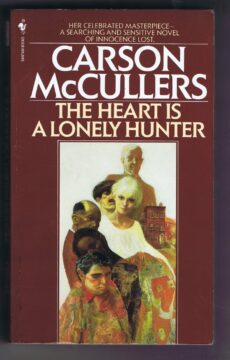
A couple of weeks ago I saw an item in Lit Hub Daily, about how June 4th would be the 86th anniversary of the publication of The Heart is a Lonely Hunter, Carson McCullers’ debut novel. This item brought back many wonderful memories — of the novel, of the time in my life when I read it, of the movie made of it, and of an uncanny coincidence.
It’s very hard to define the book. The Lit Hub story linked to a piece by Mary Dearborn, one of McCullers’ biographers: Literary Hub » Literature’s Lonely Hunter: On the “Sad, Happy Life” of Carson McCullers. She aptly described it as follows:
But the novel itself was an outlier. It did not fit any of the accepted and expected categories of mainstream fiction. It was neither a love story nor a bildungsroman, it did not have characters whom readers could recognize as like themselves, it did not have a happy ending, and it did not have a single strong narrative line. Instead, it followed a striking group of oddballs and misfits, the inhabitants of a small Southern city who individually take their hopes and fears to another oddball and misfit.
The other oddball and misfit to whom all hopes and fears are taken is named John Singer. Singer is a deaf-mute, who cares for, in both senses, another deaf-mute, a man with mental illness named Antonapoulos. Eventually Antonapoulos is committed to an asylum, and Singer must move to another small town in Georgia to be near him. He takes a room in the home of Mick Kelly, a teenage girl whose father has been injured in a work accident and is no longer employed; the family is poor and has to take in boarders. Mick is full of all the things teenagers are full of: hopes, dreams, longing, desires, anxieties, fears, and everything else.
Mick and Singer are the two main characters. But there are others too, who meet Singer, and then, like Mick, begin to tell their cares and woes to him as well. There’s Dr. Copeland, a Black doctor with very stern views about the struggle for equal rights, but equally rigid, unyielding attitudes toward his daughter Portia and her feelings about her own life, career and loves. There’s Jake Blount, a drifter who rages at economic injustice, but drinks himself into oblivion in his anguish. And there’s Biff Brannon, who runs the restaurant where Singer eats every meal. Brannon is an equable, imperturbable figure on the outside, but struggles internally with his sexuality and with unresolved feelings for Mick.
As best as I can recall now, I saw the movie, https://www.youtube.com/watch?v=S10UxqrKOrs, before I ever read the book. The movie came out in 1968, and I believe I watched it on TV at home with my parents and brothers. This would have been sometime in the early 1970s, and I imagine it was shown as a “movie of the week” on one of the three channels we got. Fifteen years ago or so, I made my own children watch it. Then last weekend, my wife and I watched it again as I was thinking about this column.
It really is a superb film. It brings the pathos of the story alive in a vivid way, but it has a slow and contemplative quality. Singer is played wonderfully by Alan Arkin. He was still relatively early into a long career, but he had already received a best-actor Oscar nomination for The Russians Are Coming, the Russians Are Coming. He received his second nomination for this movie. He never says a word in the film, of course, but his expressions — the director’s wise choice not to use subtitles for the sign language forces us to focus on them more — convey a world of different feelings.
Mick is played by Sondra Locke, in her first film role. She too received an Oscar nomination, for best supporting actress — which seems slightly off given the centrality of the role. She beat out several hundred other people who auditioned for the part, and lied about her age in the process. Strangely, another actor who went on to a long career also had his first film role in the movie — Stacy Keach, who plays the drifter Blount.
One last bit about the movie: the score is beautiful. In keeping with the relative youth of seemingly everyone involved, the film was scored by Dave Grusin. He wasn’t exactly a novice then; he was 34, having been born three months after Alan Arkin. Today he is an emeritus figure, spanning the worlds of jazz, soundtrack work, and much else. But back then, this was his seventh film score; nearly a hundred more were to follow, including the score for The Graduate. The Heart is a Lonely Hunter’s score is achingly moving. (I am still wondering — is that a harpsichord he uses at times?)
I eventually read the book in college. I worked it into a senior paper called “eduction of Jungian archetypes in Southern literature,” or something like that, which now sounds to me just about as ostentatiously presumptuous and silly as it must have sounded back then to my advisers. I wrote about McCullers, Flannery O’Connor, Eudora Welty and so on. (Somehow I mostly avoided Faulkner; either I was too intimidated or too lazy, or both.)
This was back in ancient times, at the University of Texas in the early 1980s. It was amazingly wonderful in retrospect: someone like me could get an absolutely first-class liberal arts education for basically nothing. In seven years at UT — four undergraduate years and then three at law school — my parents probably paid $2500 in tuition.
That era is long gone. Undergraduate tuition for Texas residents is now around $12,000 per year; for law school it’s over $35,000. And the university has knuckled under to Trump’s grotesque bullying, by “consolidating” several ethnic and women’s programs into a new “Department for Social and Cultural Analysis,” and banning discussion of “controversial topics” that are “not germane” to course subjects. Such abject cowardice, and concessions to political pressure, would have been unthinkable in the halls of the humanities departments I haunted back then.
The book was received well. Many critics were focused on the fact that McCullers was so young. And still today, this is almost impossible to believe. How could a 22-year- old girl from a small town in Georgia — or any 22-year-old anywhere — so skillfully create these characters, and how could she so compellingly depict the terrifying loneliness at the heart of their lives?
How could she so deftly show how the racism embedded in every aspect of the town’s life would inexorably poison all its citizens? Richard Wright wrote of her “astonishing humanity that enables a white writer, for the first time in Southern fiction, to handle Negro characters with as much ease and justice as those of her own race.” How could she so sensitively explore repressed sexuality? The relationship between Singer and Antonapoulos is ambiguous, as is Biff Brannon’s sexual identity.
The book would have been the crowning achievement of any writer’s career, but it was McCuller’s first novel. In the end, it would be her most acclaimed work as well. She published other novels, two of which — The Member of the Wedding and Reflections in a Golden Eye — were particularly well-received. Her novella The Ballad of the Sad Café was also a success. But her life was a difficult one: she suffered two strokes in her 20s, and at age 45 she was diagnosed with breast cancer and required a mastectomy. Depression stalked her as well, and at 31 she attempted suicide.
This would not be her last experience with suicide. In 1937, at 20, she married Reeves McCullers, about whom she later wrote that “it was a shock, the shock of pure beauty, when I first saw him; he was the best-looking man I had ever seen. I was 18 years old and this was my first love.” He was a writer too, or at least he aspired to be; he never published anything. But like her doomed characters’ relationships, the marriage soon curdled and they both drank heavily. Reeves tried to get Carson to commit suicide together, and eventually he killed himself anyway.
Reeves McCullers may have been her first love, but her most passionate relationships were with women. From a young age — perhaps even starting with her gender–ambiguous first name — McCullers’ queer identity was an essential part of her story. Her best friend as a teenager was a gay man in love, as Mick Kelly was, with music. Her most ardent, though apparently barely ever consummated, relationship was with a Swiss journalist, Annemarie Schwarzenbach, who was both an anti-fascist activist and the heiress of a wealthy Nazi businessman. Like McCullers, she had an androgynous appearance, although hers was much more severe than Carson’s, and like McCullers she was an alcoholic, with a morphine addiction and multiple suicide attempts thrown in as well. She died at 34 in a cycling accident in the Alps.
McCullers died at 50, in 1967. Her reputation today rests on just a few works. Regina Marler wrote that she “once loomed large in the mid-twentieth-century literature of the South, [but] now seems the smallest bird on the branch that holds William Faulkner, Flannery O’Connor, Eudora Welty, Tuman Capote, Richard Wright, and McCullers’ close friend Tennessee Williams.” I don’t know if I agree with every part of that statement, but such comparisons are ultimately beside the point. If you haven’t done so, by all means read The Heart is a Lonely Hunter and see the movie.
About that coincidence. At some point I learned that the title came from a poem. Wanting to read the poem, I looked it up, and found that it was written by a Scottish agent, critic and writer, William Sharp. But when it was published in 1896, it was said to have been written by Fiona McLeod, who was regarded at that time as one of the leading figures of the revival of Celtic literature. In a McCullers-esque gender and literary swerve, upon Sharp’s death, “McLeod” was revealed to be him.
So I went looking for this poem in the undergraduate library at UT. Eventually, I learned that it was in a collection. I found this collection in the stacks, and took the book down to the desk to check it out. This was back when the inside back cover of library books held a piece of lined paper, on which the return due date was written or stamped. When the librarian opened the book to stamp the new due date, I noticed that there was only one previous due date already listed: May 28, 1960. The book had only ever been checked out once, and it had been returned on or before the day I was born. And there it sat, for 22 years, waiting for me to check it out again.