
by Steve Szilagyi
Early motion-picture film and x-ray film were often made from cellulose nitrate, also called nitrocellulose — a highly flammable plastic created by chemically treating cellulose with nitric acid. Heat, pressure or friction can set it off. Under the wrong conditions, two sheets of nitrocellulose lying atop one another long enough can decompose and ignite. Poof.
Among its virtues, nitrocellulose produces exquisite images. On the other hand, it has been responsible for some of history’s most horrifying mass-casualty events.
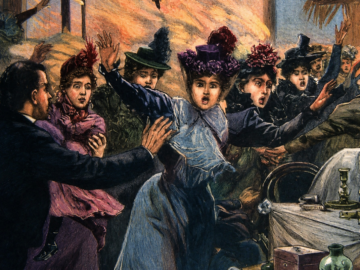
The most famous was the Bazar de la Charité fire, which took place in Paris in 1897.
The Bazar was one of the city’s largest annual charity fêtes, organized by society ladies and held at a novel location each year. In 1897, it was held in a large wooden warehouse whose interior had been decorated to resemble a medieval street. Among the attractions was a demonstration of projected motion pictures. A hot projector lamp ignited the nitrate film. The fire spread rapidly across the flammable decorations and through the wooden structure. Exits were poorly marked. A rough total of 126 people died.
Accounts of the disaster rarely fail to mention that many of the victims were upper-class women trapped in the voluminous fashions of the day. It was one of the first disasters in which dental records were used to identify the dead.
This movie-disaster has inspired at least four disaster movies, most recently the well-reviewed 2019 Netflix series Le Bazar de la Charité (Fire of Destiny). Today, a magnificent expiatory chapel, Notre-Dame-de-Consolation, stands on the site of the tragedy.
Less well known are the events that took place at the Cleveland Clinic, in Cleveland, Ohio, on the morning of May 15, 1929. There was fire and panic. But no dental records were required to identify the dead. Many of the corpses were unmarked; some were found seated in chairs with magazines open on their laps, seemingly dozing.
The Cleveland Clinic opened in 1921, a multispecialty group practice modeled after the Mayo Clinic. Its founders included Dr. George Crile, a pioneering surgeon famous for advances in shock treatment and blood transfusion.
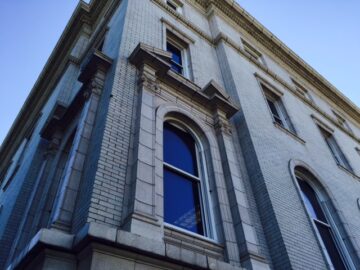
The Clinic occupied a handsome, state-of-the-art four-story building located at the eastern end of Cleveland’s “Millionaire’s Row” of industrialist mansions. Its striking interior featured a skylit atrium with imported terra-cotta tiles, ferns, and a soothing fountain.
Early patients and visitors included William Randolph Hearst and Charles Lindbergh. During its first eight years, the Clinic treated thousands of patients and became renowned for both surgical expertise and advanced radiological capabilities.
The Clinic’s founders were early adopters of Wilhelm Roentgen’s x-ray technology – one of them having attended a demonstration by Wilhelm Roentgen himself, in Paris, a year before the Bazar de la Charité fire.
By 1929, the Clinic had accumulated thousands of x-ray films. These were stored in metal filing cabinets in a cramped, poorly ventilated basement room. A hot steam pipe ran overhead. The films were stuffed into drawers or piled atop the cabinets. A bare light bulb hung above one stack.
At 11:30 in the morning, a steamfitter named Buffery Boggs was in the basement repairing a pipe. Did Boggs accidentally ignite the gases with a tossed match or cigarette? He denied it. Later investigators focused instead on the bare light bulb. According to the prevailing theory, the bulb heated the films, triggering a chemical reaction that spread rapidly through the cabinets.
If Boggs or anyone else had been listening, they might have heard a soft hissing or crackling sound. That would have been the nitrocellulose softening into a simmering ooze – all the while filling the room with toxic nitrogen oxides, nitric acid, carbon monoxide, and cyanide compounds.
The basement and upper floors of the Clinic were connected by an innovative system of ducts and shafts designed to circulate heat and fresh air through the building. Ironically, as a later inquest observed, the arrangement could scarcely have been better designed “to spread death throughout the building.”
It was a typical busy weekday at the medical center. The waiting room was full; patients sat undressed in examination rooms; laboratory technicians, medical artists, telephone operators, and other support personnel were hard at work.
The first sign of trouble was a rust-colored mist seeping from floor vents, electrical outlets, and cracks in the walls. According to some, the mist clung to the wall and crept slowly upward. Others remembered only a haze that gradually thickened into a fog or clouds.
The collective testimony of survivors has a kaleidoscopic, dreamlike quality. Unlike the Bazar de la Charité fire, where the menace was obvious — a raging inferno — the gas in Cleveland was transparent and insidious. It drifted into some rooms, bypassed others, gathered in pockets, and hung motionless in hallways. In some places it was only a scent: sharp, acrid, and bleach-like.
At first there was little alarm. A few nurses and attendants sniffed, and opened windows or stepped into hallways to investigate. Then came the blasts.
The first occurred in the basement room where the films were decomposing. Buffery Boggs was blown through a basement window onto the lawn. Two more explosions quickly followed — the last lifting the skylight off the roof and sending a cloud of orange gas over the surrounding neighborhood.
These were not fiery detonations like dynamite or propane explosions. They were pressure explosions — what fire investigators call deflagrations — caused by violently decomposing chemicals.
No one understood exactly what was happening, but within minutes they knew they had to escape — sometimes because the person beside them suddenly coughed, collapsed, and died.
Directly above the explosions, Mrs. Seth Nickens, wearing a blue patient gown, was thrown backward when the examination-room door blew open. The bodies of the doctor and nurse she had been waiting to see tumbled at her feet. In the hallway she saw a man crawling as though swimming across the floor. Some instinct told her to imitate and follow him, and both kept under the fumes and escaped.
Frantic individuals scrambled for exits, jammed stairwells, and suffocated. One group crowded into an elevator. In the basement, someone mistakenly believing the explosions were electrical shut off the power. The elevator stalled between floors as fumes rose through the shaft and killed everyone inside.
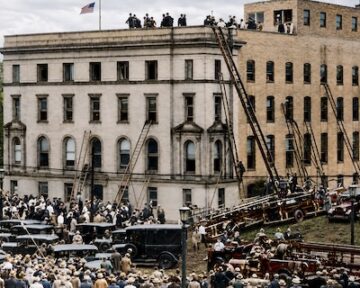
A miraculously unhurt Buffery Boggs ran to a nearby fire station for help. Firemen could smell the gas almost immediately upon leaving their garage. When they arrived, they saw terrified figures at every window, waving frantically.
The first rescuers entering the building took only a few breaths before collapsing.
Nearby sign painters dragged ladders to the structure. A doctor hung from a windowsill by his fingers. Jumpers narrowly missed landing on what the next morning’s Cleveland Plain Dealer described as “crowds of weeping and frenzied victims.”
The newspaper continued:
A fireman in a gas mask groped his way in. “Can’t make it. It’s killing, it’s killing,” he moaned when he could speak.
Figures on the roof were dimly seen through the rolling, orange-hued fog, an inarticulate wail came from the blackened windows on the upper floors, automobile horns wailed, spectators in quivering groups cried out in anguish …
A pair of firemen reached the roof and peered through the shattered skylight.
“I never hope to have to look at anything so horrifying again … Lord help me, as far down the stairway as you could see were bodies and bodies. Twisted arms and legs, screaming men and women. Bodies and screams.”
There were remarkable acts of heroism. Nurses, police officers, firemen, and bystanders repeatedly entered the building despite the danger. Wallace Trepczynski, janitor of a nearby theater, climbed to the third floor on a ladder and rescued six people. Mechanic Frank Salvini and others at the neighboring Hupmobile dealership initially thought the smoke came from a burning automobile. Then they saw victims staggering drunkenly from the building. Together they rescued twenty-five people.
Many of the Clinic’s doctors and nurses had served in the First World War and had treated victims of poison gas in the trenches. With sinking hearts, they realized that in most cases there was nothing … they … could … do. Even so, they administered oxygen, used pulmotors, and attempted blood transfusions, and offered what comfort they could.
Some victims died instantly. Others writhed in agony on the Clinic lawn. Still others made it out not realizing they’d inhaled a lethal dose. The chemicals quietly devoured their lung tissue over the course of hours. Much later, while celebrating their survival, they suddenly collapsed and died.
Weeks passed before the final death toll could be established.
It reached roughly the same number as the Bazar de la Charité fire: 126 dead, with nearly a hundred others injured or permanently disabled.
Almost immediately after the disaster, a committee of inquest was formed under Samuel Mather, one of the richest men in Cleveland. A few days later, Clinic founder George Crile wrote to a colleague that “We are sitting on a volcano” of potential liability.
But the Clinic’s founders were among the city’s most respected physicians and were deeply connected to banks, politicians, and civic leaders. Crile and his partners pledged their personal insurance policies to preserve the institution — which still possessed a functioning hospital annex even though the outpatient building had been devastated.
The Mather Commission and several additional inquiries ultimately did not come down hard on the Clinic or its founders. No one could determine with certainty what had triggered the nitrate decomposition, and the bare-light-bulb theory absorbed most of the blame.
Lawsuits were filed; the Clinic settled without admitting liability. In 1932, the Clinic’s $167,000 settlement was split among the injured and families of the dead.
Today, it’s hard to conclude that the Clinic was anything but grossly negligent and fully at fault. So many intelligent people worked in that building; so many people with so much chemistry study in their background; someone must surely have understood the danger of accumulating nitrocellulose – the chemical cousin of nitroglycerine and TNT – in a hot little room downstairs.
Perhaps William Brownlow could have warned them. Brownlow was the Clinic’s staff photographer and maintained a darkroom and office on an upper floor. Popular and genial, he had taken the day off on May 15, but stopped by briefly to pick something up and chat with coworkers. Suddenly the room filled with gas. Brownlow smashed a window with his fist and helped others onto a fire ladder before climbing down himself.
A nurse bandaged his badly gashed arm, and witnesses later recalled that he remained “dauntless” throughout the rescue effort.
But the gas had been silently eating away at his lungs since morning. By the end of his day off, he was dead.
(The most authoritative account of the Cleveland Clinic disaster is by Leonard H. Calabrese, DO, and appears in To Act as a Unit, The Story of Cleveland Clinic, Sixth Edition, edited by John Clough, MD, John Mangels, and myself; a richly detailed perspective is offered in Without Whose Aid, Nursing and the Cleveland Clinic by Diane Ewart Grabowski; particularly recommended is John Stark Bellamy’s vivid and gripping narrative of the tragedy in They Died Crawling: And Other Tales of Cleveland Woe.)
Enjoying the content on 3QD? Help keep us going by donating now.