
by David Hoyt
1.
I consider myself a farmer. Instead of food, I raise habitat. Another way of saying it would be that, instead of raising food for people, I raise food for everything else.
2.
It’s risky to define oneself, because others have their own perceptions, usually different, and sometimes more accurate. In the traditions of Amazonian peoples, you must imagine yourself through the eyes of your enemy to know who you really are. They may see me as a crank, a bad neighbor, a fool, an idealist, or a privileged urbanite who wouldn’t know how to earn a living off the land or fix a tractor. All of these perceptions are, to some degree, true. As are mine of them.
Still, we maintain relations.
3.
Few of us do or can live off the land these days (or can fix their tractor). Even farmers shop for groceries, and a good grocery store can be hard to find in farm country.
4.
There’s a preconception that if land exists, it exists so that it can be put to use. If it’s not in use, it’s up for grabs, and you can just take it. Look into this idea and you will run up against a fellow named John Locke, who gave the idea some legs as the English were expropriating land from the Irish and, seeing how well it worked there, shipped it over to New England.
5.
The problem is, land is already in use, everywhere. By people, often, as well as by animals and other living things, and by the air and water. It is already working, only in ways that have not always been apparent, or which have been forgotten. A piece of rangeland that supported herds of bison which was allied with groups of Plains Indians does not only begin working when all of them are replaced with cattle and ranchers. It was working already, and on many things at once, not just a few.
6.
We need more habitat farmers. The fact is that land can serve multiple purposes at the same time, which is what it has always done. It can support human needs and activity, while also accommodating and inviting the non-human into a relation of cohabitation. This requires forethought, consideration, and scientific knowledge of how to accommodate the flow of life, rather than cutting through it or eradicating it.
7.
No one built the train trestle so that a Whitetail deer could cross it high above traffic, but the deer do this and that is one less potential auto collision. No one thought that the Common Nighthawk might like the gravel on the library rooftop for its nest, but it does, and that it one more successful fledgling to wing it back to South America.
8.
It is easy to put up a hummingbird feeder in the backyard. It is harder for ranchers to live with wolves on the front range of the Northern Rockies. It is harder, but not impossible. In fact, it is necessary. To think like the wolf, to understand their behavior, and to maintain diplomatic relations. There has been enough genocide, enough eradication.
9.
The dogmas of the Neolithic, and their formalization in the thought of philosophers like Locke, militate against this. They argue for exclusive possession, for drastic simplification of landscapes and ecosystems, for the rearrangement of human societies in the service of commodity production, and the eradication of whatever does not contribute to this narrow range of activities. Like the wolf, or the grizzly, or the mountain lion, or at one time any raptor flying near a chicken coop, or even the varieties of Milkweed (Asclepias spp.) used by Monarch butterflies on their multi-generational, continental migration, which are considered a nuisance for the practice of intensive agriculture.
10.
The bison, America’s national mammal, has been evicted from federal grazing lands by the current administration. “There is no room for them anymore,” one rancher told the press. We have lost the art of cohabitation, if ever we had it, with regards to who and what was here before. Domination seems much simpler – at first.
11.
The landscapes we see most of the time are petroleum products. They are raised with petroleum products, and harvested with petroleum products, and to some degree (in the form of the nitrogen absorbed from synthetic fertilizers) are biologically composed of petroleum products. They are what the world looks like when it is shaped by choices made long ago, and then baked into a political economy which resists change. The spring green of the suburban lawn, the planting beds at the city park, in front of the dentist’s office or the shopping center, the glistening fields of soy or wheat that can charm with their orderliness and symmetry, most of what’s available at the big box garden store, is not designed for the land or with the land in mind.
12.
My back yard was once turf grass from fence to fence. The Northern cardinals flew across it. Now, I am watching two bright red males duel in the air above it, eager to claim it for their territory. A juvenile Magnolia warble is foraging among the stems of the Ninebark and Prairie Rose shrubs along the back. According to Merlin, half a dozen migrating warblers are hidden in the plants and trees nearby, most of which I would have no hope of seeing or hearing without assistance. About two thirds of the back yard has been converted to native flora. None of it was here five years ago.
13.
Farming for habitat is work. It’s not an exit ramp from yard duty. All land, everywhere, must be maintained by some combination of intentional, human, and non-human activity. It is not just letting things go and letting evolution take its course. Stems should be cut, but only when they have ceased providing cover and food over the winter. Leaves can be raked, but best to keep them on the property in areas where they can decompose, insulate the ground, and provide cover. In the country, exotic shrubs need to be pulled from the hedgerows. Water needs to pool where it should. And the prairie needs to burn.
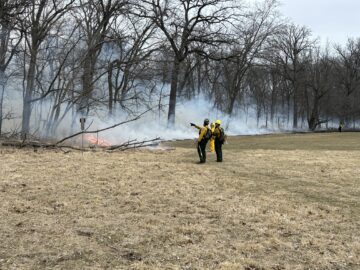
Burning into a field in the Forest Preserves, Cook County, Illinois
14.
It is easy to have a lawn that looks like everyone else’s. It is easy to hire a landscaping crew to ‘chop and drop’ the lawn, keep the exotic ornamentals happy over the summer and the evergreens green over the winter. It is harder to figure out how not to do all this, because the wisdom is scattered and the market not innovative. There is no private equity or venture capital working on this sector. It is conceivable that landscaping companies could handle organic lawns and native yards with appropriate training, education, and for the right price. Instead, our innovations and investments go elsewhere.
15.
Cohabitation: In central Wisconsin’s Portage County, about an hour and a half north of Aldo Leopold’s shack, lies a wildlife refuge that is one of the largest and last strongholds in Wisconsin and east of the Mississippi of the Greater Prairie Chicken. You probably have to be from the Midwest, and it helps to have a sense of history, to appreciate the iconic quality of this grouse species. It likes lots of land, and to be left alone. Like the passenger pigeon, it was once ubiquitous on the prairies.
A 7,000 acre, $2.5 billion, 1.2 gigawatt solar farm was proposed on lands abutting and overlapping those of the refuge. A new sort of conflict then materialized: climate change versus biodiversity loss. To which executioner should we beseech first, to global warming with the push for a green transition, or to systemic ecosystem collapse with the conservation of a threatened species of the greatly reduced northern prairie?
This is a sort of Sophie’s choice, one to be avoided at all costs, a self-devouring ouroboros which follows a well-paved express road to moral and environmental perdition.
The developer confronted local wildlife advocates and national conservation organizations, as well as scientific testimony from state wildlife officials. After a fair amount of warranted legal opposition, the developer agreed, among other things, to plant native prairie beneath the solar arrays, to purchase additional land for Prairie Chicken conservation, and move some of its arrays away from sensitive parts of the refuge.
Called it coerced cohabitation. Sometimes it calls for a fight. But it is cohabitation nonetheless. The idea is, it should be the default option, thought through in advance, cohabitation by design and not afterthought.
We are smart and wealthy enough to orbit the Moon. We can accommodate the Prairie Chicken.
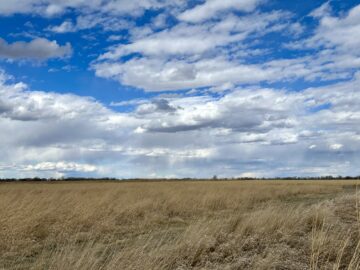
Greater Prairie Chicken country in Nebraska
16.
For many years we have been told that we live in a post-industrial society. It is true that many factories moved overseas, together with the jobs that supported local communities. But the industrial demand for land and its raw materials remains voracious, and the countryside is its arena: massive livestock confinements, carbon capture and storage pipelines, vast surface mines, logistics centers, solar farms, orbital launch sites, and most recently, more ravenous than any of them, data centers.
17.
Rural America is some of the most industrialized land in the nation. Wendell Berry described America’s relation to the countryside as a colonial one, structured around resource extraction in areas and among populations that are least capable of resisting it. His voice is needed now more than ever.
18.
Our land use needs to be permeable to wildlife, to life, to elemental earth cycles, through and through. We know how to do it. A 10 foot wide prairie strip along a corn field keeps 90% of applied nitrogen from running off into local streams, improving fish and invertebrate and bird habitat while supporting pollinators that care for most flowering plants. Well-designed tunnels in the right places help migrating frogs and turtles (Wisconsin) and even cougars (Florida) cross the road without getting hit.
19.
Habitat farming is especially rewarding during spring and fall migration, when birds from far away pass through a landscape. If I present migrating warblers with a patch of ground carrying more nutritional and shelter value than it had in its earlier incarnation as a suburban lawn, then I am helping to make their journey that much less taxing and more likely to be successful. It is one very small reciprocation for the “free gifts of nature”, freely given.
20.
I am amazed at how much native plant life has sprung from what was formerly Kentucky bluegrass. The force of its vitality is striking. The soil seems happy to have it. I work to keep the growth back, to keep it in. It’s as if it had all been waiting to express itself, held at bay for nearly a century by the blades of mowers.
21.
There is a French term that captures the agency of the living world in a way that really doesn’t have a match in English: le vivant. It has become common among French ecological thinkers and is made compelling use of in the writings of the philosopher of ecology, Baptiste Morizot. “Biota,” “the living world,” “living beings” fail to capture the association of life and living things in all their diversity in a single, poetic word.
22.
Morizot writes of an ecological principle (attributed, I believe, to E.O. Wilson), that the absence of a species from a given suitable habitat is often due to active barriers, like a sort of force field, preventing that species from establishing itself. The implication is that the species is there, in potential. Morizot writes, in particular, on the return of wolves in the early 1990’s to their ancestral lands in rural France. They were kept at bay for half a century by poison and guns and government eradication programs. When these barriers are removed, the wolves begin to return.
23.
Sometimes we set the stage, and provide an assist. If all goes well, reintroduction occurs. There are now river otters living wild within an hour of Chicago.
24.
On the front walkway, beside a bed of woodland sedges, violets, and Virginia Iris, a small brown bird hops up and down, pecking newly fruited seeds from gracefully arching Philadelphia sedge. One quickly notices a bird that is different or unusual, even if one can’t immediately identify it. The bird forages for a few moments, allowing me to note its size and markings, and then darts in angular, low, sparrow fashion to a larger prairie bed, where it disappears into the greenery and its future.
In that time, I was able to identify it as a Lincoln’s sparrow, a grassland bird I had only seen once before, and far from the city. I don’t know how far those seeds got that sparrow on its journey.
I am happy to set the table. The guests will come when they choose.
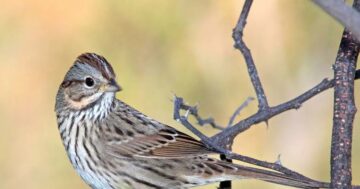
Lincoln’s Sparrow. Image source: US Fish and Wildlife Service [https://www.fws.gov/species/lincolns-sparrow-melospiza-lincolnii]