
by Anton Cebalo
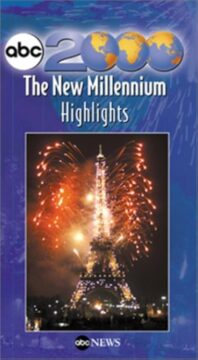
The film The Matrix famously froze its simulation in the year 1999. It was chosen as the alleged peak of human civilization. What unknowns might the new millennium bring? Many were understandably anxious. It was a psychologically-heavy turning point.
But celebrations abounded. ABC News ran a special program that covered the new millennium festivities around the world. A global consortium was formed to commemorate the occasion. 2000 Today was made up of a diverse set of national channels from Venezuela to Egypt to Poland. It even had its own soundtrack titled “A World Symphony for the New Millennium.” There had never been before such a successful effort to create a globalized world through media, with the exception of maybe the song “We Are the World” in 1985.
Three world powers—the United States, Russia, and China—each took a very different tone in addressing the momentous occasion.
For the United States, the new year was spoken of as if sitting atop the highest peak and gratitude from Americans was expected. At his 2000 State of the Union Address, President Bill Clinton tried to keep this optimism going with little room for acknowledging past tragedy. His opening statement was blunt in stating: “We are fortunate to be alive at this moment in history.” Never before had America enjoyed “so much prosperity and social progress with so little internal crisis and so few external threats.”
Russia, however, had an altogether different experience of the new millennium, one of shocking dysfunction.
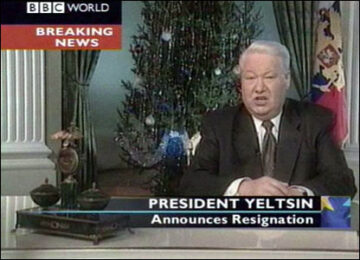
In a surprise announcement, President Yeltsin gave an appearance on state television on New Year’s Eve and announced he was resigning. He apologized to the country for having completely failed. As if speaking from personal sorrow, he told Russians that “the pain of every one of you was my pain, the pain of my heart.”
I want to ask your forgiveness – for the dreams that have not come true, and for the things that seemed easy but turned out to be so excruciatingly difficult. I am asking your forgiveness for failing to justify the hopes of those who believed me when I said that we would leap from the grey, stagnating totalitarian past into a bright, prosperous and civilized future. I believed in that dream, I believed that we would cover the distance in one leap.
We didn’t. I was too naive in some things, and the problems turned out to be bigger than expected in other things. We ploughed ahead through mistakes and failures. Many people were traumatized by that time of upheavals.
The Russian new millennium would be welcomed the following day by Yeltsin’s replacement, Vladimir Putin.
The Chinese response to the year 2000 took a middle road. President Jiang Zemin told the United Nations that the world had undergone “calamities and holocausts” but also achieved “splendid material and spiritual accomplishments.” The message was pluralistic. The Cold War was over, but global hegemony by any one power should be prevented. President Zemin argued that the new millennium would not be ruled by any single civilization, development model, or set of values. China, too, wanted its place in the sun.
The tone was set by each of the world powers. In one, a triumph of unipolar Americanism; in the second, a paternalistic new order that was marred in elite mystery; and the third, a soft skepticism from a rising power that viewed its future as a peer competitor of the United States. We’re still living in the emotional clash of all three visions of the future.
Enjoying the content on 3QD? Help keep us going by donating now.